
The idea that program directors are “moving away” from Step 2 CK is wrong. They’re moving toward it—with both hands—because Step 1 went pass/fail and someone has to be the sorting hat.
Let me translate the polite language you see in official reports and webinars: “holistic review,” “deemphasizing scores,” “valuing the whole applicant.” Sounds nice. But when I talk to program directors off the record, what I hear is this:
“We still need a number to cut the list from 1,200 applicants to 200. Step 2 is that number now.”
You wanted myth-busting. Here’s what the data and real behavior actually show.
Step 1 Went Pass/Fail – Step 2 CK Got Promoted
When Step 1 went pass/fail, people fantasized that applications would suddenly become more “human.” Less numerical, more nuanced. That fantasy lasted about five minutes into the first application cycle.
Program directors didn’t suddenly get more time or more faculty. They didn’t magically stop getting 800–1200 applications per spot in derm, plastics, and ortho, or 2,500–3,000+ apps to big-name IM programs. They just lost their most convenient numerical filter.
So what happened?
The NRMP’s Program Director Survey is blunt:
- Before Step 1 P/F, Step 1 was the dominant numerical screen.
- After Step 1 P/F, Step 2 CK became the main standardized score metric.
Programs didn’t move away from test scores. They shifted which test score they lean on. That’s very different.
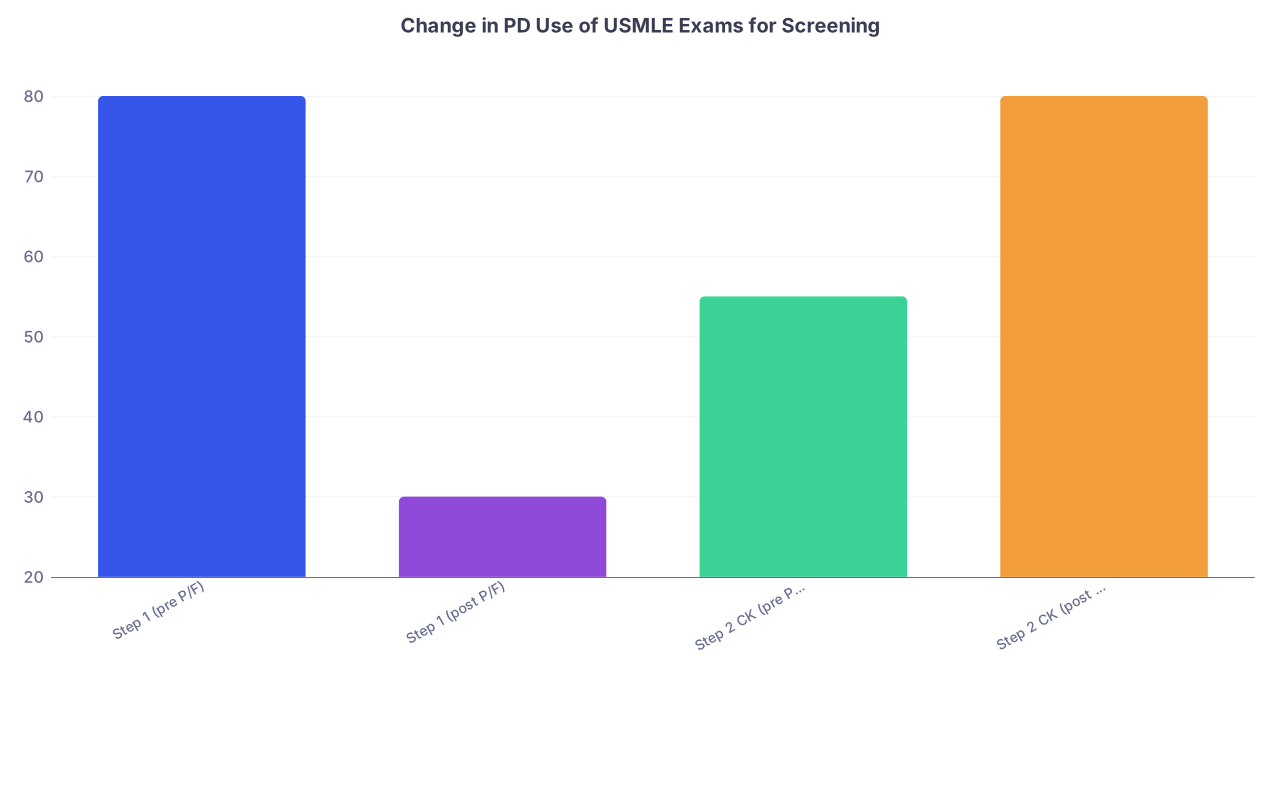
| Category | Value |
|---|---|
| Step 1 (pre P/F) | 80 |
| Step 1 (post P/F) | 30 |
| Step 2 CK (pre P/F) | 55 |
| Step 2 CK (post P/F) | 80 |
Those numbers are illustrative, but the pattern is real: Step 1 importance down, Step 2 CK importance up. Not a retreat. A substitution.
What Program Directors Actually Do vs What They Say
Here’s a pattern I’ve seen play out repeatedly:
A PD on a webinar says:
- “We value clinical performance.”
- “We do not have a hard Step 2 cutoff.”
- “We review applications holistically.”
Then, one floor up, the chief resident helping with screening says:
- “Below 230 we almost never look, unless they’re from our home school or have insane research.”
- “We flagged anyone under 220 as low priority and only reviewed if we had time.”
Both statements are “true.” One is PR. One is actual workflow.
The reality is:
- A lot of programs do not officially publish cutoffs.
- Many of them still use practical cutoffs behind the scenes.
- Low Step 2 CK makes it very hard to get past the first screen, especially in competitive specialties or big-name programs.
Are there exceptions? Yes. Home students. URiM applicants some programs are trying to support. People with elite research or connections. But for the average applicant, Step 2 is the only standardized academic number left, and programs lean on it.
The Data: Step 2 CK and Match Outcomes
No, Step 2 CK doesn’t guarantee a match. But pretending it’s “less important now” is fiction.
Look at trends you can actually observe in recent cycles:
- Competitive specialties (derm, ortho, neurosurgery, plastics, ENT) increasingly emphasize Step 2 CK since Step 1 lost resolution.
- Internal medicine, EM, anesthesia, and radiology programs that used to talk nonstop about Step 1 now specifically ask for Step 2 CK to be in before interview season.
- PDs and selection committees report using Step 2 CK to:
- screen for interview offers,
- break ties between similar applicants,
- justify “riskier” applicants if they do well.
When you analyze match outcomes over the last couple of cycles, here’s the real pattern people miss:
| Step 2 CK Range | Competitiveness Signal (General) | Reality Check |
|---|---|---|
| 270+ | Top 1–2% | Opens most doors; still need research/letters in top specialties |
| 255–269 | Very strong | Highly competitive for most fields; still not enough *alone* for derm/ortho/plastics |
| 240–254 | Solid | Competitive for IM, EM, anesthesia, peds, psych, OB; mid-risk for top-tier surgical subspecialties |
| 225–239 | Below average for competitive fields | Need strengths elsewhere and strategic list; some high-demand programs unlikely |
| <225 | Risk band | Match possible, but you’re fighting uphill—school reputation, letters, home advantage matter a lot |
Are these rigid cutoffs? No. But they reflect how PDs talk when they’re not on-record. Nobody is saying, “Oh yeah, since Step 1 is P/F, we ignore Step 2 too.”
The New Hierarchy: What Actually Replaced Step 1
Here’s the myth: “Holistic review means Step 2 is just one small part of a big picture.”
Here’s the actual pecking order for many programs now, especially for initial screening:
- Step 2 CK score – main quantitative academic filter.
- Clerkship grades & narrative comments – especially core rotations related to the specialty.
- Letters of recommendation – particularly from people the PD knows or respects.
- Home institution / geographic ties – easier to trust known schools.
- Research and niche strengths – more important in academic and competitive fields.
Step 2 CK is not some minor supporting actor. It’s the lead numerical role now.
And no, clerkship grades did not fully replace Step 1 either. Why?
Because they’re:
- hugely inflated (half the class is “honors” in some schools),
- inconsistent across med schools,
- often vague in narrative comments (“hard-working,” “pleasant,” “great team player”—nothing you can rank with).
So when a PD has 600 PDFs to parse in three days, they do what anyone would:
They sort by the one number they understand: Step 2 CK.
Are Any Programs Actually Moving Away from Step 2 CK?
Some are. But not in the fantasy way applicants want to believe.
Here’s where I do see reduced Step 2 obsession:
- Family medicine, psych, peds at community or mid-tier programs:
- More willing to look at lower Step 2 scores if you fit their mission, geography, or have strong letters.
- Some explicitly say: “We don’t screen out based on a single score.” And they actually mean it.
- Home programs:
- They know your clinical performance.
- They’ve watched you on rounds.
- They’ll sometimes back a 220 Step 2 with stellar in-person performance over a 250 from a stranger’s PDF.
- Strongly mission-driven programs:
- Underserved care, rural focus, safety-net hospitals.
- They may tolerate lower scores if you clearly match their mission and show consistent commitment.
But notice something. These programs are stepping away from rigid screening, not from caring about scores at all. A weak Step 2 will still trigger concern. They’re just more willing to contextualize it.
There’s a huge difference between:
- “We don’t only use Step 2 to choose people,” and
- “We don’t care about Step 2.”
The former is common. The latter is fantasy.
Timing: Another Way Step 2 CK Became More Important
Here’s a detail a lot of students miss: the timing of Step 2 CK now matters more than it used to.
Before Step 1 went P/F:
- People could apply on a strong Step 1 and take Step 2 later.
- A mediocre Step 2 could be explained away if Step 1 was stellar.
Now:
- Many programs explicitly want Step 2 CK scores in hand before offering interviews.
- Some even state on their websites or in webinars: “We prefer applicants with Step 2 completed by September 1” or similar.
So what happens if you delay Step 2 until October or November?
- You don’t show up in early filters.
- Your application looks incomplete.
- Programs that get 2,000+ apps by mid-September may not circle back when your score finally posts.
That’s not “moving away” from Step 2. That’s making it a requirement earlier in the cycle.
But Aren’t Some PDs Saying They Want to Deemphasize Exams?
Yes. And I believe many of them genuinely want to.
The problem is structural, not moral.
- They still have too many applications.
- They still have too little time.
- They still need a defensible way to reduce a pile of 2,000 down to 200 interviews.
Absent structural reform—application caps, centralized screening, more interview slots, better shared evaluation tools—Step 2 CK remains the cleanest, laziest, and unfortunately, most defensible sorting mechanism.
A lot of PDs hate that. But they still do it. Because the alternative is chaos.
What This Means for You (Not the Fantasy Version)
If you’re pre-clinical or early third year, here’s the non-sugar-coated reality:
Step 2 CK is your only standardized shot to prove you can handle medical knowledge at speed.
That makes it more—not less—strategic than Step 1 ever was for this generation.A strong Step 2 CK can rescue an otherwise average-looking transcript.
I’ve seen mid-pack students with mediocre pre-clinical performance jump into contention because they dropped a 255+ on Step 2, then matched at strong IM or EM programs.A weak Step 2 CK puts pressure on everything else.
Suddenly you’re dependent on:- home program favoritism,
- extra research,
- away rotations with flawless performance,
- and a painfully strategic rank list.
You can’t hide your Step 2 CK like you could sometimes “hide” a mediocre Step 1 in a big file.
Now it’s front-and-center. Often the first number someone sees.
The Real Trend: More Weight Per Exam, Not Less
Here’s the twist people keep missing.
By eliminating Step 1 as a three-digit score, the system:
- did not reduce test pressure,
- did not decentralize evaluation,
- did not meaningfully slow arms-race behavior.
Instead, it concentrated the pressure and importance on Step 2 CK:
- Fewer exam attempts to show you can excel.
- One major number instead of two.
- Fewer second chances.
That is not “moving away” from Step 2 CK. That’s treating it as the single high-resolution academic filter.
If the USMLE ever made Step 2 CK pass/fail too, then you’d see true fragmentation—programs pulling harder on school reputation, letters, research, and subjective clinical narratives. But for now, Step 2 CK is the last standardized quantitative pillar left.
Bottom Line: What the Data Actually Shows
Cut through the marketing language and the wishful thinking, and the picture is clear:
- Program directors are not moving away from Step 2 CK. They shifted reliance from Step 1 to Step 2, and in many places Step 2 CK is now the primary numerical screening tool.
- “Holistic review” has limits under volume. When you’re facing thousands of applications, Step 2 CK is still the fastest way to triage. Many programs use de facto cutoffs even if they deny having “hard” ones.
- For your strategy, Step 2 CK matters more than most rumors suggest. A strong score opens doors. A weak one doesn’t end your chances, but it forces you into a far narrower and more tactical path.
Believe the behavior, not the branding.