
The idea that “taking Step 2 CK early always helps your application” is wrong. Sometimes it helps. Sometimes it is neutral. And sometimes it quietly torpedoes your chances at the programs you care about most.
Let me be direct: early Step 2 CK is a tool, not a virtue signal. Programs do not hand out bonus points because you took it in June instead of September. They care about what you scored, how it fits your trajectory, and whether they actually needed it when you sent your ERAS.
If you treat “take Step 2 CK as early as possible” like a rule instead of a strategy, you can hurt yourself. Badly.
Why Everyone Thinks “Earlier Is Better” – And Why That’s Oversimplified
The mythology usually comes from a mashup of half-true statements:
- “Programs want Step 2 CK before interviews.”
- “After Step 1 went Pass/Fail, Step 2 CK is king.”
- “Top programs filter based on CK now.”
- “If you take Step 2 CK late, you’ll be screened out.”
Parts of this are true. But the nuance matters. A lot.
Here’s what the data and real-world behavior actually show:
Most programs do not strictly require a Step 2 CK score at the time you apply.
You can verify this on FREIDA or program websites. Many say “Step 2 CK required for ranking” or “preferred before matriculation,” not “must be in ERAS by Sept 15.”Step 2 CK is a stronger predictor of board passage and in‑training exam performance than Step 1.
Studies in IM, surgery, EM, etc., consistently show this. So yes, PDs care about it. But that does not mean they need it early for everyone.Programs use CK differently depending on your Step 1 history.
- Strong Step 1? CK is often confirmatory.
- Marginal/failed Step 1? CK becomes damage control / redemption.
- No red flags? They may not care if CK shows up in September vs November.
Score timing only matters when it changes what pile you land in.
If your application is already clearly strong or clearly weak, Step 2 CK timing is a rounding error. For borderline candidates, timing + direction of change can matter.
The blanket “earlier is always better” advice ignores the ugly side of early testing: you cannot hide a mediocre or disappointing score once you’ve released it, and ERAS updates are fast. You also cannot re-time it after you see your practice tests.
When Early Step 2 CK Genuinely Helps
Before I tear into when it hurts, let’s be fair. There are scenarios where early Step 2 CK is strategic.
1. You Have a Weak or Failed Step 1
If your Step 1 is:
- A fail on first attempt
- A low pass relative to your specialty (e.g., below class average, or clearly below matched cohorts from NRMP data)
Then a strong Step 2 CK taken early can reframe your narrative:
- Step 1 marginal, Step 2 CK solidly above national mean = “late bloomer, better with clinical material”
- For some PDs, a good Step 2 CK is the difference between “auto-reject” and “maybe.”
But notice the caveat: strong score. If you’re not testing in a range that clearly beats your Step 1 story, early is pointless or harmful.
2. You’re Targeting Fields That Publicly Emphasize Step 2 CK
Certain specialties have become more CK‑centric post P/F Step 1:
Think internal medicine at academic programs, EM, anesthesiology, neurology, some pediatrics programs. They’ll say things like “Step 2 CK is used for interview offers” on their websites.
If:
- Your practice tests are consistently where you want to land, and
- You can get an official score in ERAS by early October,
then early CK can push you into a higher pile. But again, score quality > exam date.
3. Your School Forces You to Take It Early and You’re Ready Anyway
Some schools push Step 2 CK right after M3 year, often June–July. If:
- You had a solid clinical foundation
- Your NBME/UWSA scores are stable
- You’re not gunning for a hyper-competitive specialty with razor-thin margins
then testing early is harmless or mildly helpful. Not game-changing, just clean and done.
Now let’s talk about the part no one wants to mention on Reddit: early Step 2 CK can absolutely hurt you.
When Early Step 2 CK Hurts Your Application
1. You Turn a “Maybe” Into a “No” Before They Even Look Deeper
Here’s the most common landmine.
Scenario I’ve watched play out repeatedly:
- You have:
- Pass Step 1, nothing fancy
- Decent clinical evals
- A mix of high passes and passes on clerkships
- Decent but not amazing letters
You rush Step 2 CK in July “to show programs I’m proactive.” Your practice tests were borderline: UWSA1 233, UWSA2 236, NBME 9 at 228. You convince yourself you’ll “turn it on” on test day. You score a 229.
On paper for a moderately competitive specialty (let’s say IM at academic programs or mid-tier anesthesia):
- Now you look modest on Step 1 and Step 2.
- You’ve removed any ambiguity. PDs who might’ve wondered “maybe they’re stronger clinically” now see a firm ceiling.
If that score had arrived in November, some programs would’ve already filtered and invited you based on Step 1 + holistic review. Early CK locked in a mediocre impression right when they were building interview lists.
Programs are risk-averse. When they have 3 applicants per spot with similar applications but one with a noticeably lower CK, that person drops to the bottom fast. You just volunteered to be that person earlier than necessary.
2. You Compress Studying and Sacrifice Score Potential
Here is an unsexy, reality-based trade-off: your test date is a score determinant. You’re not a machine; your brain needs time with UWorld, NBMEs, and real clinical exposure.
Students who force Step 2 CK into a narrow 3–4 week window “to be early” often:
- Rush through UWorld without deep review
- Skip weaker rotations (psych, peds, OB) because they think “IM and surgery are enough”
- Ignore fatigue and burnout from back-to-back clerkships and exams
The data: large analyses and school-level reports show Step 2 CK correlates with time-on-task and clinical exposure. Internal reports I’ve seen at schools: students who test later in the summer/early fall, once they’ve had a full year of core rotations and 6–8 weeks of focused studying, often score higher than early testers who cram immediately after M3.
If you could score 10–15 points higher by testing in September instead of July, the slight delay is more than worth it. A 245 in October is more valuable than a 232 in August for almost every specialty.
3. Strong Step 1, Mediocre Early CK = Downward Trend
Another pattern PDs absolutely notice: direction of scores.
- Step 1 (pass only now, but schools often provide percentiles or internal notes) + narrative: strong basic science performance, honors, etc.
- Step 2 CK: suddenly low 230s or 240s for a student clearly performing at a higher level before.
This looks like:
- “Peaked early, struggles with clinical complexity” or
- “Unmotivated once they got past Step 1”
Is that always fair? Of course not. But it’s how they think when they have 500 apps and 50 interview slots.
If you had the option to:
- Spend 4–6 more weeks dialing in UWorld and NBMEs
- Fix weaknesses in OB/GYN, peds, psych, neuro
- And raise that score into line with your previous performance
then taking it “early” was not just neutral. It actively created a negative trend line in your file.
Early is only good if it accurately showcases your best work. Otherwise you’re publishing your draft instead of your final version.
Programs That Don’t Care About Early CK As Much As You Think
Here’s where people get misled. They overgeneralize from a small set of hyper-competitive programs.
| Program Type | CK Required at Application? | CK Required Before Ranking? | Timing Priority Level |
|---|---|---|---|
| Top 10 academic IM | Often Preferred | Usually Yes | High |
| Mid-tier community IM | Usually No | Often Yes | Moderate |
| Competitive surgical subspecialty | Sometimes Yes | Yes | High |
| Primary care / FM most programs | Usually No | Often Yes | Low–Moderate |
| Psychiatry / Neurology mid-tier | Usually No | Often Yes | Moderate |
Read that carefully: “required before ranking” ≠ “must be early.”
I’ve seen plenty of applicants match strong programs with CK taken in:
- Late September
- October
- Even November, provided scores posted by ranking time
The big determinant wasn’t “Did you take it in July?” It was:
- Did your final CK score align with the level of programs you were targeting?
- Did your file have enough other strengths (letters, clerkship grades, research, fit) to carry you into the interview phase?
How to Decide If Early Step 2 CK Helps You – Not the Mythical Average Student
You need a decision framework, not vibes.
Step 1: Look at Your Practice Scores, Not Your Aspirations
Your last 2–3 practice exams (UWSAs, NBMEs) tell you more than any forum thread.
Rough guide:
- Consistently scoring at or above the level you’d be happy to report?
Early exam can be reasonable. - Scores volatile or below target?
Early exam is gambling with your future.
Step 2: Match Score to Specialty Competitiveness
You already know this, but let’s spell it out:
- A 235 CK means very different things for:
- Family med vs ENT
- Midwest community IM vs UCSF IM
Rushing to get a “decent” score on the books early might be fine for less competitive fields, but it can close doors in highly competitive ones.
Step 3: Check What Your Target Programs Actually Say
Not what someone on Reddit claims they say. What they actually say.
- FREIDA: “USMLE Step 2 not required before interview invitation” vs “strongly preferred” vs “required for application.”
- Program websites: many explicitly state “Step 2 CK must be available prior to ranking applicants.”
If your dream programs don’t need CK by September 15, then why are you rushing July 10 just to say you did it early?
Step 4: Consider Your Trajectory
Ask three honest questions:
- Did I underperform on Step 1 relative to my potential?
- Are my clerkship grades trending up or plateauing?
- Do I learn clinical material better with time and repeated exposure?
If:
- Yes, you’re clearly improving clinically → waiting often helps, not hurts.
- You’re burned out and sliding downward → do not force an early, half-prepped CK.
The Quietest Risk: Early CK Removes Strategic Flexibility
Once that score is out, it’s out. You can’t:
- Hold it back on ERAS
- selectively send it to programs
- test again and pretend the first didn’t happen (multiple attempts are obvious and almost always worse)
By testing early, you’re committing before you know:
- How competitive your peers are this year
- How PDs are reacting to the new Step 1 P/F landscape
- Whether you might pivot specialties based on M4 experiences
Delaying CK within reason buys you data and flexibility. You can:
- See where your Step 1 cohort is matching
- Talk to advisors who’ve just watched a cycle play out
- Adjust your study plan based on early UWSA/NBME performance
That flexibility is underrated. Early CK burns it for a badge that programs mostly do not care about.
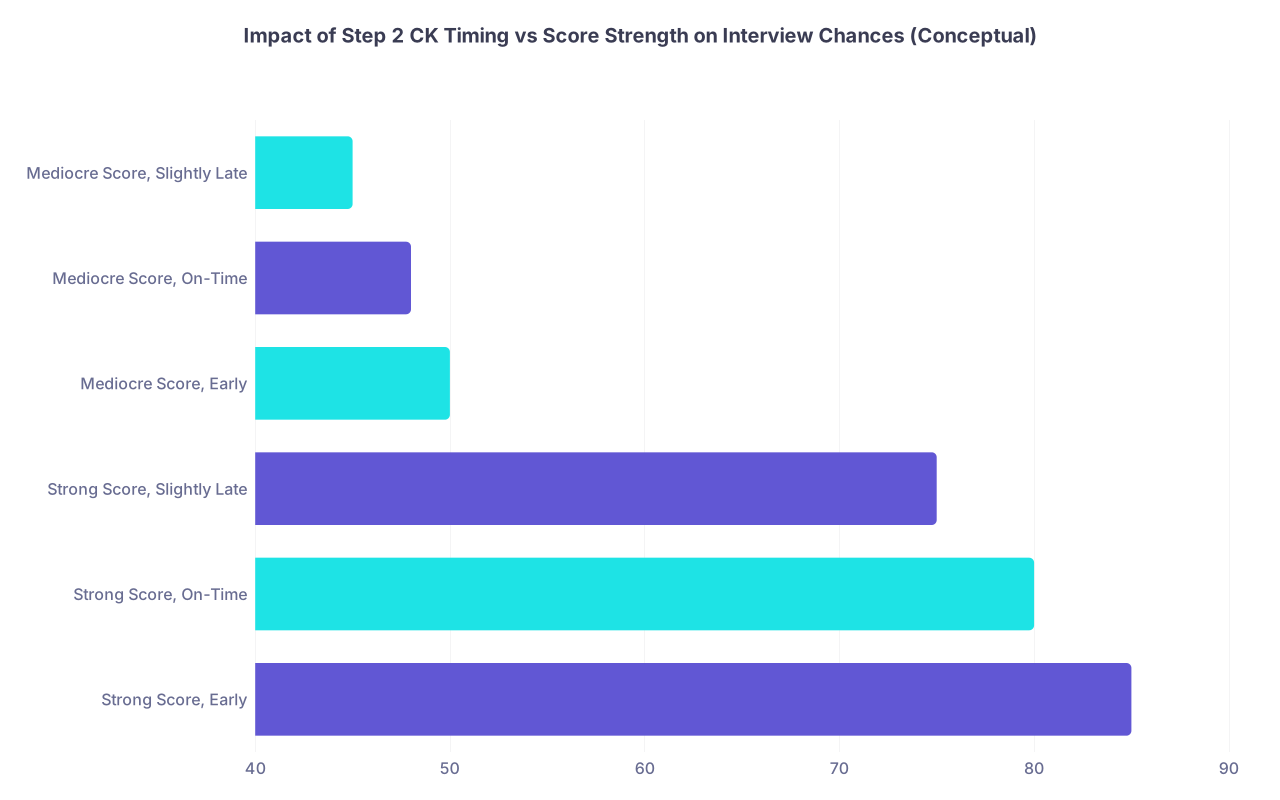
| Category | Value |
|---|---|
| Strong Score, Early | 85 |
| Strong Score, On-Time | 80 |
| Strong Score, Slightly Late | 75 |
| Mediocre Score, Early | 50 |
| Mediocre Score, On-Time | 48 |
| Mediocre Score, Slightly Late | 45 |
Conceptual point from the chart: score strength moves the needle far more than timing, within a typical June–November window. Early + mediocre is not better than later + strong.
A More Honest Rule of Thumb
Let me give you a replacement for the dumb “early is always better” mantra.
Use this instead:
Take Step 2 CK as early as you can while still realistically maximizing your score. Not earlier.
Concrete translation:
- If you could gain ~10+ points with 4–6 more weeks? Wait.
- If your practice tests already match or exceed your goal? Fine, go early.
- If your Step 1 is weak and your CK practice tests are strong? Early CK can help clean up your narrative.
- If your Step 1 is fine and CK is shaky? Early CK is a liability, not an asset.
And one more sanity check: ask yourself, If this exact score showed up on ERAS tomorrow, would I be happy to send it to my dream programs? If the answer is “uh, maybe not,” then you’re not ready. No matter what your school or classmates say about being “on time.”

Key Takeaways
- Early Step 2 CK is not inherently good. It helps only when the score itself strengthens your story and your target programs actually care about having it early.
- A mediocre early CK can hurt you by confirming a low ceiling, creating a negative trend, and burning your chance to improve with more studying and clinical exposure.
- Optimize for maximal score within the application window, not for bragging rights about how early you tested. Score quality beats timing almost every time.