
The new dogma that “Step 2 CK is all that matters now” is lazy, wrong, and dangerous.
Step 2 CK is more important than it used to be. That much is true. But programs didn’t wake up the day Step 1 became pass/fail, collectively erase every other filter, and decide your entire career rests on one 9‑hour exam. That’s fantasy — usually pushed by people selling question banks or “score booster” courses.
Let’s pull this apart using what we actually know: NRMP data, program director surveys, and real‑world behavior from competitive specialties.
What Actually Changed When Step 1 Went Pass/Fail
Before Step 1 went pass/fail, the game was obvious: Step 1 was the first and biggest sieve. Programs used hard cutoffs because they had to sort thousands of applications in a few clicks. Step 2 CK was important, but secondary for many fields.
Then Step 1 lost its score.
Here’s what happened in reality — not on Reddit:
- Programs lost their favorite numerical filter.
- They didn’t get fewer applications. They got more.
- They needed a new fast, sortable metric.
- Step 2 CK filled part of that vacuum. Part. Not all.
You can see this in how program directors answered the NRMP Program Director Survey.
- Historically, Step 1 score sat at or near the top of “factors for interview offers.”
- As Step 1 went pass/fail, Step 2 CK jumped upward — especially in competitive fields like derm, ortho, ENT, plastics, and some IM subspecialty feeder programs.
But here’s the key: it jumped into a cluster of other high‑value filters: clerkship grades, class ranking, letters of recommendation, and school reputation. It did not become the only thing that matters, and it’s not even #1 for every specialty.
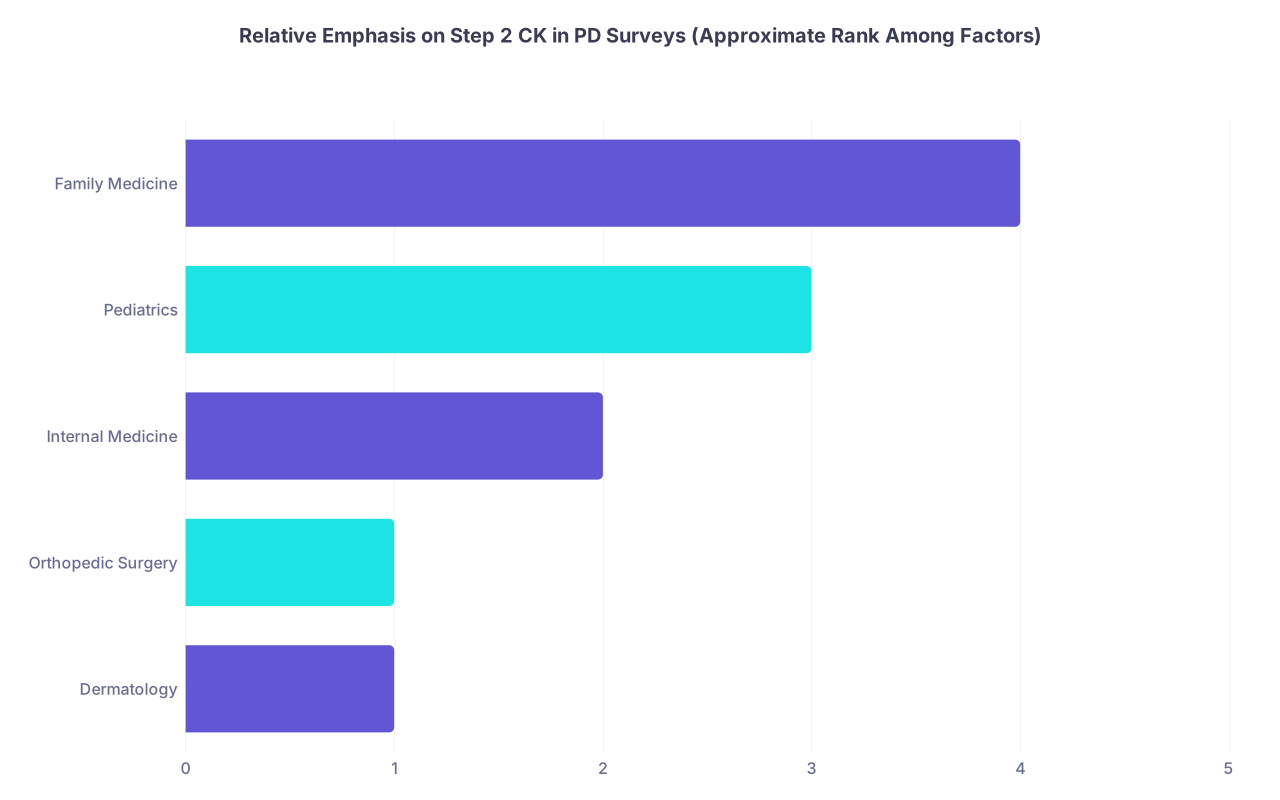
| Category | Value |
|---|---|
| Dermatology | 1 |
| Orthopedic Surgery | 1 |
| Internal Medicine | 2 |
| Pediatrics | 3 |
| Family Medicine | 4 |
That chart isn’t exact to the decimal (specialty and year differences matter), but it reflects the pattern: Step 2 CK is a major factor, especially where competition is brutal. But it’s one of several major factors.
Myth: “If I Just Crush Step 2 CK, Everything Else Won’t Matter”
I’ve heard this too many times from third‑years:
“If I get a 260+ on Step 2, it’ll erase my mediocre clerkship evals and lack of research, right?”
No. That’s not how this works.
Programs read your entire application in context. The shift post–Step 1 P/F is toward more holistic review (forced by necessity), not less. They’re not thrilled about that — it’s harder and takes time — but they’re doing it.
Here’s how a competitive academic program actually thinks when they see a high Step 2 CK:
- Strong Step 2 CK + strong clerkship grades + solid letters
→ Confirms you’re the real deal. You get serious consideration. - Strong Step 2 CK + average/bad clerkships + lukewarm letters
→ Raises an eyebrow: “Good test taker, but what are they like on the wards?” You may get screened in, but you’re not “saved.” - Strong Step 2 CK + little or no research in a research‑heavy specialty
→ You’re still behind the MD/PhD with 245 but 5 pubs and a letter from a known PI.
Where a big Step 2 score does meaningfully help:
- You had a mediocre Step 1 (pre P/F) and you need to prove upward trajectory.
- You’re from a lower‑tier or lesser‑known school and need to show you can compete nationally.
- You’re targeting a competitive specialty without a “home” department and want a clean, objective way to stand out.
But a high Step 2 isn’t a magic eraser. It’s a strong signal in a noisy application, not a get‑out‑of‑jail‑free card.
What the Data Actually Shows Programs Care About
Let’s get concrete with the recurring top factors in NRMP Program Director Surveys (aggregating patterns across years/specialties):
- Step 2 CK score
- Clerkship grades (especially core rotations)
- Class rank/AOA
- Specialty‑specific letters of recommendation
- Perceived “fit” from the personal statement and interview
- Research and scholarly activity (heavier in academic/competitive fields)
- Whether you rotated with them (away/sub‑I performance)
- Fails/attempts on any USMLE/COMLEX exam
Notice what’s missing? Anything suggesting Step 2 CK sits alone on an island controlling your fate.
| Filter Type | Pre Step 1 P/F Role | Post Step 1 P/F Role |
|---|---|---|
| Step 1 Score | Primary numeric screen | Pass only, used for red flags |
| Step 2 CK Score | Secondary academic marker | Primary numeric screen (for many) |
| Clerkship Grades | Important but variable | Increased relative importance |
| Research | Crucial in competitive fields | Still crucial, unchanged |
| Letters of Rec | Major tie‑breaker | Even more central |
| School Reputation | Moderate to high influence | Still matters, sometimes more |
So yes, Step 2 CK moved up the ladder. But clerkship performance, letters, and track record did not move down. They’re still there, and for some programs they matter more, because they reflect how you work with real patients and teams — not hypothetical vignettes on a screen.
How Different Programs Actually Use Step 2 CK
Programs don’t all treat Step 2 CK the same way. The “Step 2 is all that matters” myth usually comes from people extrapolating from one specialty, one school, or one attending’s pet theory.
Let’s break it into broad program types.
1. Highly competitive, academic, “name brand” programs
Think: MGH IM, UCSF, HSS Ortho, big 4 derm programs, top ENT/plastics.
What Step 2 CK does here:
- Serves as a hard or soft screen for interview offers (e.g., under ~235–240? You’d better have something exceptional elsewhere).
- Differentiates among applicants who all look strong on paper.
- Provides reassurance when Step 1 is pass, and clerkship grading is noisy across schools.
What also matters just as much (sometimes more):
- Research output (especially in‑specialty)
- Strong, detailed letters from recognizable names
- Honors in key clerkships and sub‑Is
- Evidence you can function on a busy academic service without imploding
If you believe Step 2 alone gets you into these programs, talk to the student with a 260+ Step 2 who didn’t match ortho because they lacked research, home support, and strong advocacy. I’ve seen that exact scenario.
2. Solid university‑affiliated and large community programs
Here Step 2:
- Often acts as an initial filter (cutoff somewhere in the 220s–230s depending on specialty).
- Helps contextualize your school and grading system.
But once you clear that bar:
- Your interview, letters, and perceived fit dominate.
- Consistent performance (no failures, no professionalism issues) matters more than a few extra points on a test.
For many IM, peds, EM, and FM programs in this tier, a 245 vs 260 on Step 2 isn’t changing your rank position as much as a killer letter or outstanding sub‑I performance.
3. Less competitive / community‑heavy specialties and programs
Think: many FM, psych, smaller community IM programs.
Here, Step 2 CK is:
- Mostly a competence check and a screen for obvious risk (very low score, failures, huge discrepancy with Step 1 if you have one).
- Not the central obsession. They care a lot about whether you’ll show up, take decent care of patients, and not cause chaos.
If you’ve convinced yourself that a 260+ in this setting will erase a garbage dean’s letter or chronic professionalism problems, you’re kidding yourself. These programs talk to your school. They read between the lines of your MSPE.
Where Step 2 CK Really Does Matter… A Lot
Now let’s be fair. There are scenarios where Step 2 CK is absolutely critical — sometimes make‑or‑break.
No numerical Step 1 + competitive specialty target
If you’re the first “all P/F Step 1” class applying into derm or ortho, yes, Step 2 is your only three‑digit standardized measure. Programs will lean on it hard.Prior academic concerns
A weak pre‑clinical record, low MCAT, or marginal Step 1 (if you had a score) can be partially “rescued” by a strong Step 2. Programs like improvement.IMGs and DOs aiming for competitive ACGME programs
Sad but real: many PDs still anchor first on USMLE scores when looking at IMGs/DOs. Step 2 is often the clearest apples‑to‑apples number they trust. A strong Step 2 doesn’t guarantee anything, but a weak one almost certainly closes doors.Late test timing
If you take Step 2 CK late (after apps submit) and don’t have a Step 1 score, some programs will hold or ignore your file until they see that number. That timing can make Step 2 feel like the central bottleneck.
So yes, in these contexts, Step 2 is a big deal. But “big deal in key scenarios” is not the same as “all that matters for everyone.”
The Real Risk of Believing the Step 2 Myth
This myth isn’t just inaccurate. It’s harmful, because it distorts how you spend your limited time and energy in third year.
Bad consequences I’ve watched play out:
- Students blow up clinical performance because they’re constantly doing UWorld on their phones instead of being present on rounds. Result? Mediocre evals, bland letters.
- People skip meaningful research or departmental involvement because “I’ll fix everything with Step 2.” Then they hit a good but not elite score and have nothing else that differentiates them.
- Others panic‑delay Step 2 endlessly chasing a perfect practice score, then end up with late or missing Step 2 on ERAS — which is far worse than just having a solid-but-not-spectacular score early.
If you over‑weight Step 2 in your mental model, you under‑invest in the things that PDs repeatedly say they care about: consistent performance, reliability, teamwork, and evidence you actually like their specialty.
How You Should Actually Think About Step 2 CK
Here’s the more accurate — and less click‑baity — way to frame Step 2 CK in the post–Step 1 P/F era:
Step 2 CK is:
- The main standardized academic metric for many specialties now.
- A powerful signal that can open doors, especially if other parts of your academic record are ambiguous.
- A screening tool, not a complete application.
It is not:
- A substitute for strong clinical performance.
- A replacement for letters, research, or evidence of commitment to a specialty.
- A guarantee of an interview, let alone a match, at competitive programs.
So your strategy should look something like this:
- Aim for a strong but realistic Step 2 CK score based on your baseline, not someone else’s flex on social media.
- Schedule it early enough that your score is back by the time programs start really reviewing applications.
- Study efficiently, but never at the expense of sabotaging your clerkship evaluations.
- If you’re targeting a competitive specialty, build a portfolio: research, home department relationships, away rotations, and at least one letter from someone who will go to bat for you.

| Step | Description |
|---|---|
| Step 1 | Start Clinical Year |
| Step 2 | Perform well on clerkships |
| Step 3 | Begin Step 2 prep light |
| Step 4 | Earn strong letters |
| Step 5 | Increase Step 2 prep after cores |
| Step 6 | Identify target specialties |
| Step 7 | Take Step 2 CK on time |
| Step 8 | Do sub I or away rotation |
| Step 9 | Submit ERAS with score |
Notice in that flow, Step 2 is integrated with everything else. Not sitting on a throne by itself.
Bottom Line: What Actually Matters Now
If you strip away the noise, here’s the reality.
- Step 2 CK is now the primary numerical filter for many programs, but it’s one of several high‑impact factors — not the only one.
- A strong Step 2 score can open doors or partially mitigate weaker areas, but it does not erase bad clinical performance, weak letters, or a nonexistent track record in a competitive specialty.
- The students who do best are not the ones who worship Step 2. They’re the ones who treat it as one important piece of a coherent, well‑planned application story.