
The myth of the “perfect” Step 2 CK timeline is fake. Programs are not sitting there with a stopwatch waiting to punish you for taking it in July instead of June.
They care about two things far more than the exact date:
- how strong the score looks in the context of your application, and
- whether it’s available in time for them to use it.
Everything else—“must test by June,” “late July is death,” “no one will look at you if your score posts after ERAS opens”—is exaggerated, half-true, or flat-out wrong.
Let me walk you through what the data and real-world behavior of program directors actually show.
The Big Myth: There’s One “Correct” Time for Step 2 CK
Here’s the standard dogma you hear on the wards:
- “You have to take Step 2 CK by June or you’re behind.”
- “If your score isn’t back when ERAS opens, kiss interviews goodbye.”
- “Late test date = red flag. Programs assume you bombed.”
I’ve watched students panic-schedule Step 2 just to hit an arbitrary month, then walk out with a score 10–20 points below their practice range. That “perfect” timing? It cost them.
The reality is much less dramatic and much more flexible. For most specialties, you’re dealing with a window, not a razor’s edge.
What Programs Actually Use Step 2 CK For
Step 2 CK is not one monolithic thing in the eyes of residency programs. It serves different roles depending on your profile.
Score recovery / reassurance after Step 1
- Post–Step 1 pass/fail, PDs still look at Step 2 as the objective metric.
- If your preclinical performance or COMLEX-only status raises questions, a strong Step 2 reassures them.
- If you have a weak prior board (COMLEX or old Step 1), Step 2 can prove the trend is up.
Tiebreaker among similar applicants
Once you’re in the “interview possible” pile, Step 2 is one more way to sort:- 250 vs 220? Sometimes it matters.
- 245 vs 248? Almost never the decisive factor.
Filter in ultra-competitive fields or programs
Certain specialties and top programs still use hard-ish cutoffs, even if they pretend they do not. They may not publish them, but they’re there in the spreadsheet.
So timing only matters insofar as it affects whether:
- The score exists when the program builds its interview list.
- The score is strong enough to help you rather than hurt you.
Notice what’s missing: “Did the student take it in June vs August?” There’s no checkbox for that.
Data Reality Check: When Scores Are Available vs When Programs Decide
Let’s line up the actual calendar instead of the folklore version.
| Event | Usual Timing (Approx) |
|---|---|
| Core clerkships end | April–July |
| Most students take Step 2 CK | June–September |
| ERAS opens for applicants | Early September |
| Programs see apps (release) | Mid–Late September |
| Heavy interview invite period | October–November |
| Rank list due | Late February–March |
Now combine that with the score release lag—about 2–3 weeks for most Step 2 CK tests.
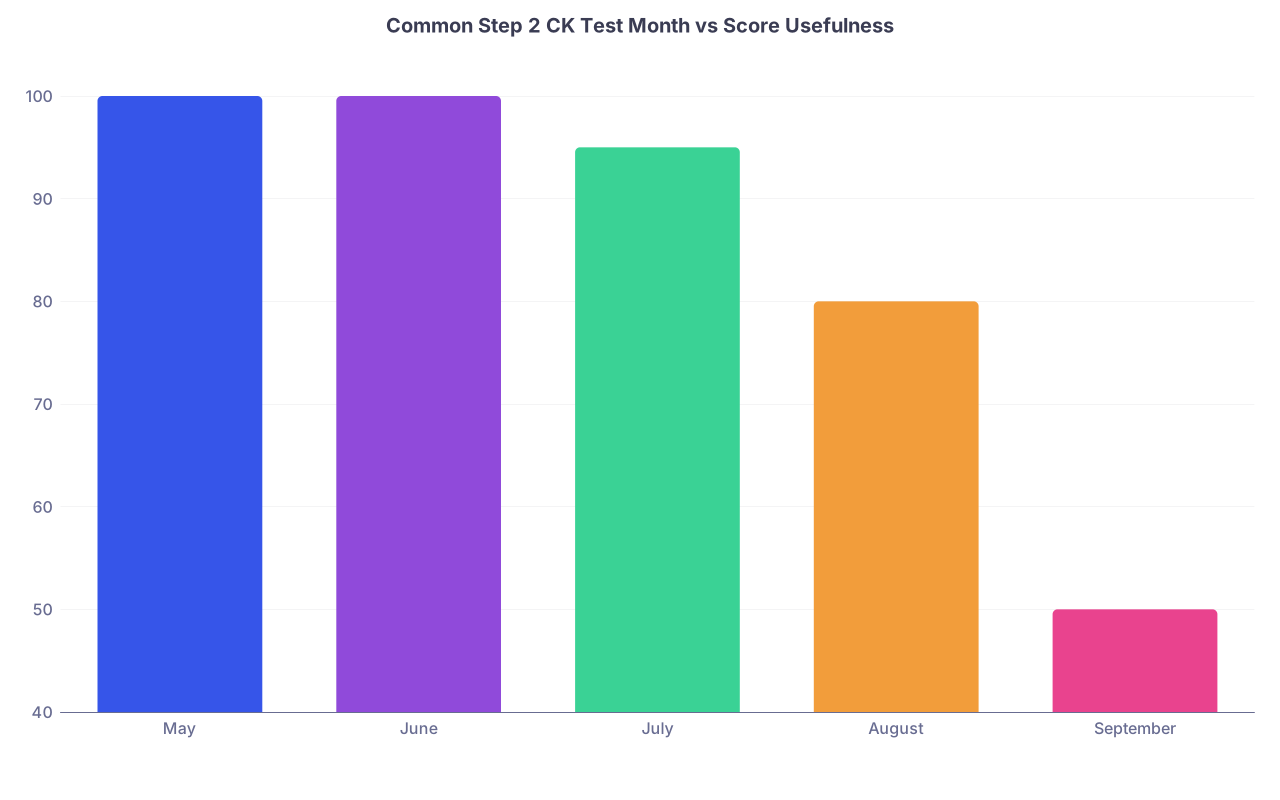
| Category | Value |
|---|---|
| May | 100 |
| June | 100 |
| July | 95 |
| August | 80 |
| September | 50 |
Interpretation, not mythology:
- Test in May or June → Score is back comfortably before ERAS opens. Every program sees it from day one.
- Test in July → Score usually back by late July or August. Still visible for nearly all programs when they start clicking “filter by Step 2.”
- Test in August → Score hits right around or just after ERAS release. Many programs still incorporate it before sending all interview invites.
- Test in early September → Score may arrive mid–late September. Not all programs will use it for interview decisions, but it still matters for rank lists, especially if they interviewed you with “pending score.”
The catastrophic framing you hear—“If it’s not there on day one, you’re unrankable”—doesn’t align with this timeline. Programs don’t finalize their interview lists on September 10th and then go on vacation.
They screen. They revise. They add interviews in November and December, especially in less saturated specialties.
Myth vs Reality by Specialty Competitiveness
Not all fields treat timing the same. But again, it’s not black-and-white.
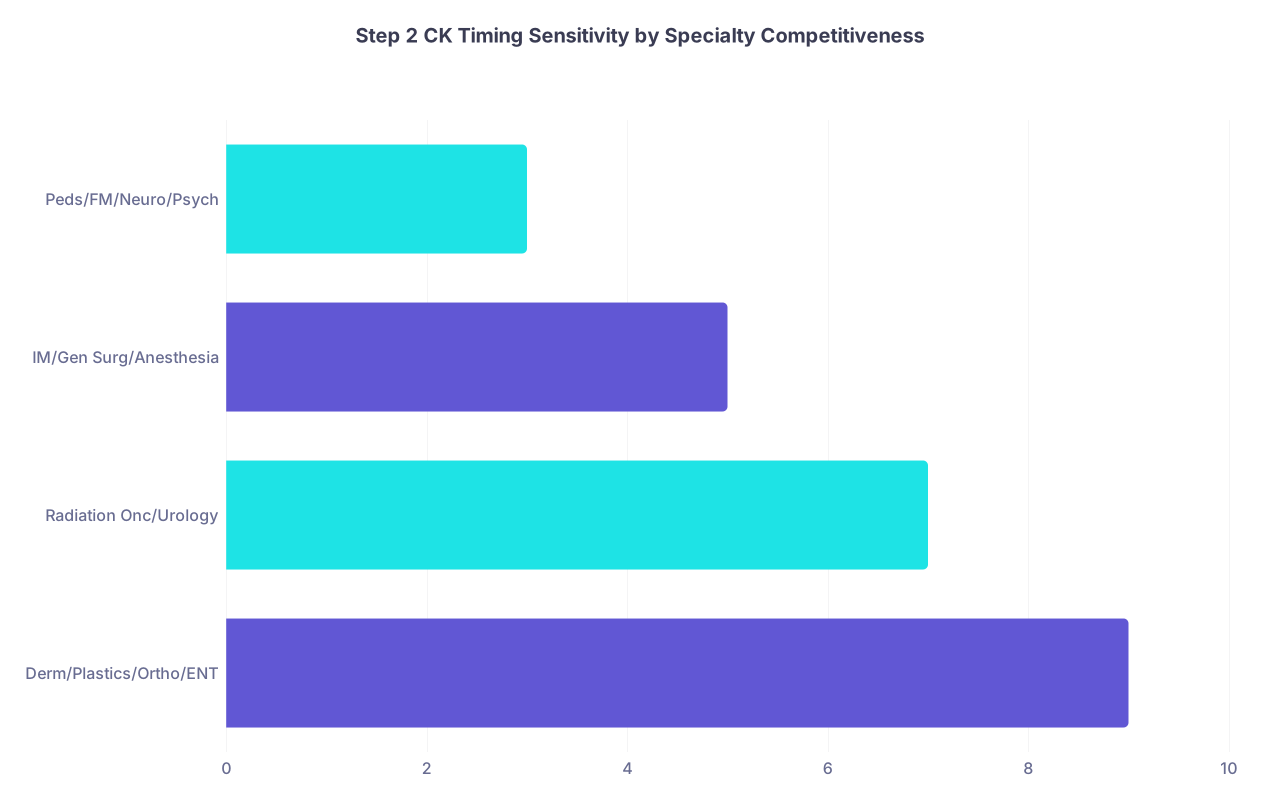
| Category | Value |
|---|---|
| Derm/Plastics/Ortho/ENT | 9 |
| Radiation Onc/Urology | 7 |
| IM/Gen Surg/Anesthesia | 5 |
| Peds/FM/Neuro/Psych | 3 |
Scale 1–10: Higher = more sensitive to early Step 2 timing.
Hyper-competitive fields (Derm, Ortho, Plastics, ENT, some Radiology)
Here the dogma has a grain of truth:
- These programs are flooded with applications.
- Many still use numerical filters behind the scenes.
- They build interview lists earlier and lean heavily on objective metrics.
If you’re going for these:
- Having your Step 2 CK score in by ERAS opening is a big advantage.
- A late “pending” score can hurt, because they’ll just move on to the dozens of other applicants with complete data.
But even then, a mediocre early score is not automatically better than a strong later one. I’ve watched more than one ortho-bound student tank their odds by rushing Step 2 to “hit June.”
Middle-competitive majors (IM, General Surgery, Anesthesia, EM)
Most applicants are here. This is where the flexibility is vastly underappreciated.
- Many programs are fine seeing “Step 2 pending” in September, especially if the rest of your file is strong.
- If you’re at or above average for your target programs, a score coming in October can still boost you for later waves of invites and absolutely for ranking.
The key difference: these specialties rarely say “no score by September 15 = no interview.” They just don’t need to be that rigid.
Less-competitive / broader-access fields (FM, Peds, Psych, Neuro at many places)
You have even more leeway.
- Taking Step 2 in August or September is often perfectly acceptable.
- Many program directors here will tell you directly: they care more about trends, narrative, and fit than whether you took CK on July 10 vs August 5.
Does that mean wait until December? No. But it means the “perfect” June test date is absolutely not mandatory.
When Earlier Is Actually Worse
Here’s the part students hate hearing: rushing Step 2 CK to hit an arbitrary early date is one of the most common unforced errors I see.
You trade score quality for the illusion of “perfect timing.”
I’ve seen this sequence so many times it feels scripted:
- Student finishes clerkships in late May, utterly fried.
- School whispers: “You should take Step 2 by late June to be safe for residency.”
- Student crams 3–4 weeks of half-baked prep, juggling sub-I or research.
- NBME practice exams plateau 10–15 points below where they want to be.
- They sit anyway. “I can’t push it back—I’ll be late!”
- They underperform their potential. Then spend the fall explaining a mediocre score instead of showcasing a strong one.
The truth: Program directors would rather see a 250 in August than a 235 in June. No contest.
Strategic Timing by Applicant Type
Stop looking for a universal rule. Look at your starting point.
1. Strong student, solid clerkship performance, aiming for competitive but not hyper-elite programs
You’re consistently scoring well on practice tests, clinical evals are strong, and you’re not banking on a “miracle” Step 2.
- Reasonable target: late June–July.
- If you’re not ready by then, postpone. A slightly later but stronger score still helps.
2. Step 1 / preclinical underperformance; you need Step 2 to show growth
Here timing matters—but the score matters more.
- Take Step 2 early enough that programs actually see the recovery.
- For most: July–early August is a solid compromise.
- But if your practice scores are not near where they need to be, forcing June just so it’s “early” is self-sabotage.
3. Applying to Derm, Ortho, Plastics, ENT, or aiming for top-10 academic IM
You’re in the minority who really benefits from early completeness.
- Goal: score visible by ERAS release if possible. That usually means testing by mid-July.
- Still, don’t ignore practice data. If you’re clearly underperforming, taking an extra 3–4 weeks and testing in early August might still be the smarter trade-off.
4. Non-traditional, dual-degree, or heavy-research applicant
Sometimes your research, pubs, or unique background do more for you than a marginal 5–10 point improvement in Step 2.
- In that case, you can treat Step 2 timing with more flexibility—especially for IM, Neuro, Peds, Psych, FM.
- Just avoid so late that programs never see a score (we’ll get to that).
The Only Timing That Truly Hurts
There is a zone where timing becomes a real problem: when your score never enters the decision process.
Two main pitfalls:
Taking Step 2 so late that the score isn’t back before programs finalize rank lists.
- Think: testing in January of your 4th year with no prior score.
- Many programs will rank based on incomplete data or push you down because of uncertainty.
Having a poor early score and then trying to “hide” it with a very late retake or incomplete plan.
- They already saw it. The damage is done.
- Timing tricks don’t erase a number burned into ERAS.
The flexible zone is May–September. The dangerous edge is November–January if you’re relying on Step 2 to do heavy lifting for your application.
How Programs Actually Think About a “Pending” Step 2
Let’s separate fantasy from what program directors actually say on record and off.
Common PD sentiments I’ve heard directly:
- “If they look great otherwise and Step 2 is pending, we assume it’ll be roughly in line with their performance so far.”
- “We don’t reject strong applicants just because CK isn’t back in September.”
- “For borderline files, a good Step 2 can tip them up. A pending one keeps them in limbo until we see it or run out of spots.”
Translation:
- If your application is strong, pending doesn’t kill you.
- If your application is marginal and you need Step 2 to rescue it, then yes—timing becomes more critical.
But that’s a function of your profile, not some magical universal deadline.
Practical Rule Set (Without the Myths)
You want simple? Here’s the unpretty, reality-based version.

| Step | Description |
|---|---|
| Step 1 | Check practice scores |
| Step 2 | Delay a few weeks and keep studying |
| Step 3 | Target test by mid July |
| Step 4 | Target test by late July or August |
| Step 5 | Test when practice scores stabilize |
| Step 6 | Avoid pushing into winter unless required |
| Step 7 | At or near goal? |
| Step 8 | Competitive specialty or top program? |
| Step 9 | Still before October? |
And a comparison of extremes:
| Scenario | Pros | Cons |
|---|---|---|
| Early but underprepared (June) | Score visible early | Lower score than potential |
| Slightly later but well-prepared | Higher score potential | Some programs see it later |
| Very late (Nov–Jan) first attempt | Max prep time | May be ignored for invites |
You can see the pattern: good score slightly later > mediocre score early, except in very narrow ultra-competitive contexts—and even there, it’s not as simple as Reddit makes it.
The Bottom Line: Flexibility, Not Fragility
Strip away the noise and here’s what Step 2 CK timing really boils down to:
There is no single “perfect” month. There is only the intersection of your readiness, your specialty competitiveness, and when programs actually make decisions.
For the majority of specialties and applicants, testing anywhere from late June through August is entirely reasonable—and often strategically better than rushing for an earlier date that tanks your score.
The only truly bad timing is so late that the score never factors into programs’ decisions, or so rushed that you blow your chance at the strong performance you’re actually capable of.
Stop chasing the myth of the perfect timeline. Chase the best score you can get within a sane, roughly May–September window, with a clear eye on how your specific specialty and profile use that number.
That’s how you use Step 2 CK timing like a grown-up, not like someone letting rumors run their entire application strategy.