
43% of students with below-average internal medicine shelf scores still end up scoring above the national mean on Step 2 CK.
So much for “your shelves are your Step 2 CK destiny.”
People talk about shelf scores and Step 2 CK like one is just a scaled version of the other. If you crush your shelves, you will obviously crush Step 2 CK. If you’re average or below, you’re “in trouble.” Attendings say it on rounds. Residents repeat it in workrooms. Students internalize it and spiral.
The reality is messier—and a lot more hopeful.
Yes, there’s a correlation. High-performing students tend to do well on both. But the assumption that you can perfectly “predict” your Step 2 CK score from your NBME subject exams? That is flat-out wrong.
Let’s walk through what the data and real-world behavior actually show—where shelves do matter, where they mislead you, and how to stop using them as some kind of prophetic judgment on your Step 2 future.
The Correlation Myth: “Good Shelves = Good Step 2”
Most schools that track data will tell you something like this: “Shelf averages are moderately correlated with Step 2 CK performance.” That part is true. Correlated. Not identical. Not perfectly predictive.
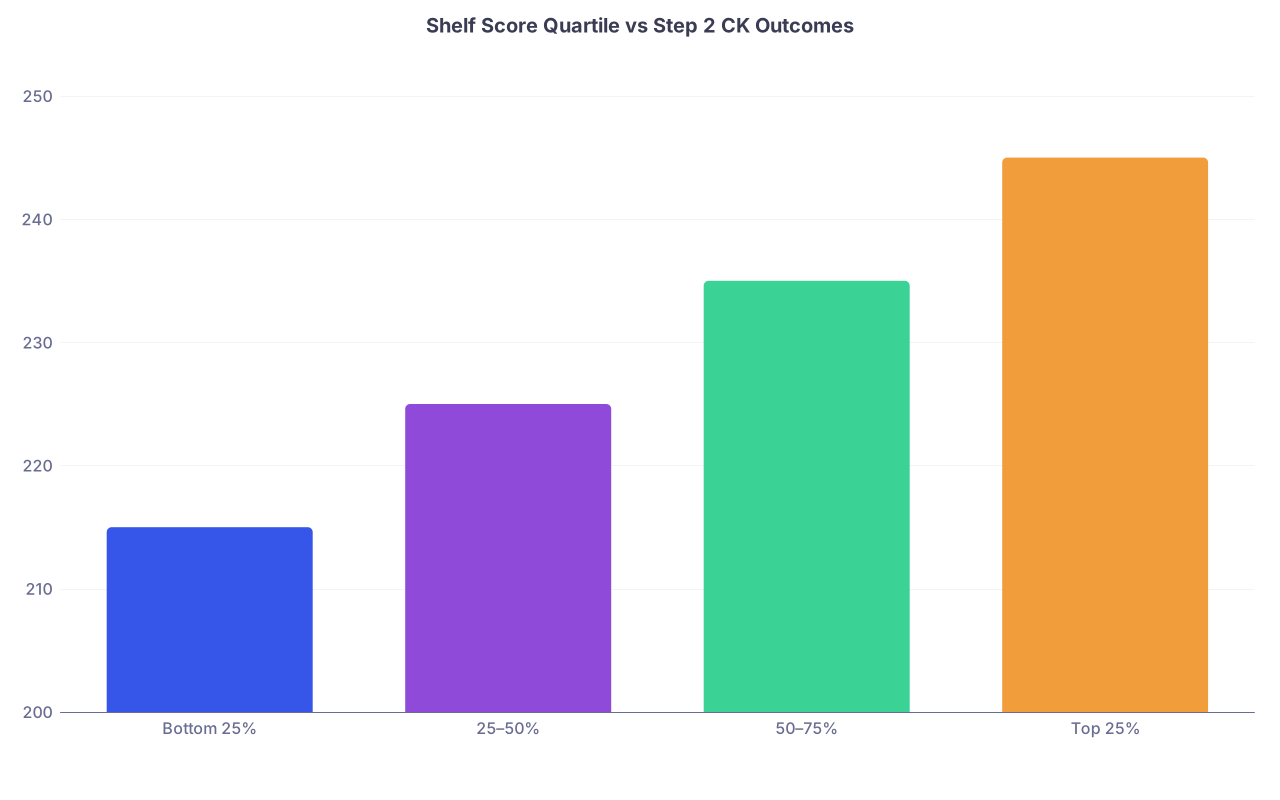
| Category | Value |
|---|---|
| Bottom 25% | 215 |
| 25–50% | 225 |
| 50–75% | 235 |
| Top 25% | 245 |
That bar chart is the kind of thing schools like to show: as shelf quartile goes up, average Step 2 CK score goes up. You’ve probably seen something similar in a dean’s “State of the Class” presentation.
Here’s the part nobody emphasizes: within each quartile, the spread is huge. I’ve seen students with mid-220s-worth of shelf performance jump to a 255+ Step 2 CK. I’ve also seen people who lived in the top shelf decile coast, under-prepare, and land right around average.
Shelves and Step 2 share some DNA:
- Multiple-choice clinical questions
- NBME style wording
- Overlap in topics like pneumonia, chest pain, prenatal care, psych emergencies
So yes, if your brain is good at decoding NBME clinical vignettes, that tendency carries over. But that’s like saying someone who runs a decent 5K will “obviously” run a great marathon. Related skills, totally different demands.
The dangerous leap is this: “My bad pediatrics shelf means I’m doomed on Step 2.” No. It means you had a weak point at a specific moment in third year, under totally different conditions than a dedicated Step exam.
These Are Not the Same Test (And They Don’t Measure the Same Thing)
Turn off the noise for a second and compare what you’re actually being asked to do.
| Feature | Shelf Exams | Step 2 CK |
|---|---|---|
| Scope | Single specialty | All core specialties |
| Timing | End of each clerkship | Usually after all clerkships |
| Preparation style | Rotation-focused, fragmented | Dedicated period plus review |
| Stakes | Clerkship grade | Residency screening, Step 1 proxy |
| Question style mix | Depth within one domain | Breadth, cross-discipline |
Shelves are narrow and deep. You’re in OB/Gyn, living and breathing pre-eclampsia, fetal heart tones, and postpartum hemorrhage. Your brain is tuned to one domain. You’re often tired, adjusting to clinical life, sometimes actively getting pimped on variants of the same shelf questions.
Step 2 CK, by contrast, is “everything at once.” You’re jumping from nephrotic syndrome to schizophrenia to preterm labor to trauma protocols. It’s a cognitive switching test as much as a knowledge test.
So a few things break the “perfect prediction” fantasy:
Timing of learning.
That psych shelf you took 9 months before Step 2 doesn’t mean much by itself. You might have bombed it early in the year before you understood how NBME questions work, before you had Anki decks dialed in, before you did a single UWorld block in tutor mode.Direction of improvement.
Plenty of students actually learn how to study during clerkships. They stop passively re-reading and start grinding questions. Their shelves rise rotation by rotation. Step 2, taken at the end of that evolution, reflects the endpoint—not the starting point.Span of responsibility.
On shelves, you can sometimes survive by being hyper-good at the “big 5” topics for that specialty. Step 2 punishes that approach. You cannot ignore outpatient psych, preventive care, ethics, or zebra presentations and expect the same score.
Treating them as equivalent tests is lazy thinking. They’re cousins, not clones.
What the Data Actually Suggests (And What It Doesn’t)
When schools dig through their numbers, they usually find:
- Shelf composite (or average) has a moderate correlation with Step 2 CK (think correlations in the 0.5–0.7 range, not 0.95).
- Failing multiple shelves increases the risk of failing Step 2 CK. Not guarantees—risk.
- High shelf performers tend to be high Step 2 performers, but with non-trivial exceptions.
The big statistical trap here is this: group trends are real, but they are terrible fortune-tellers for individuals.
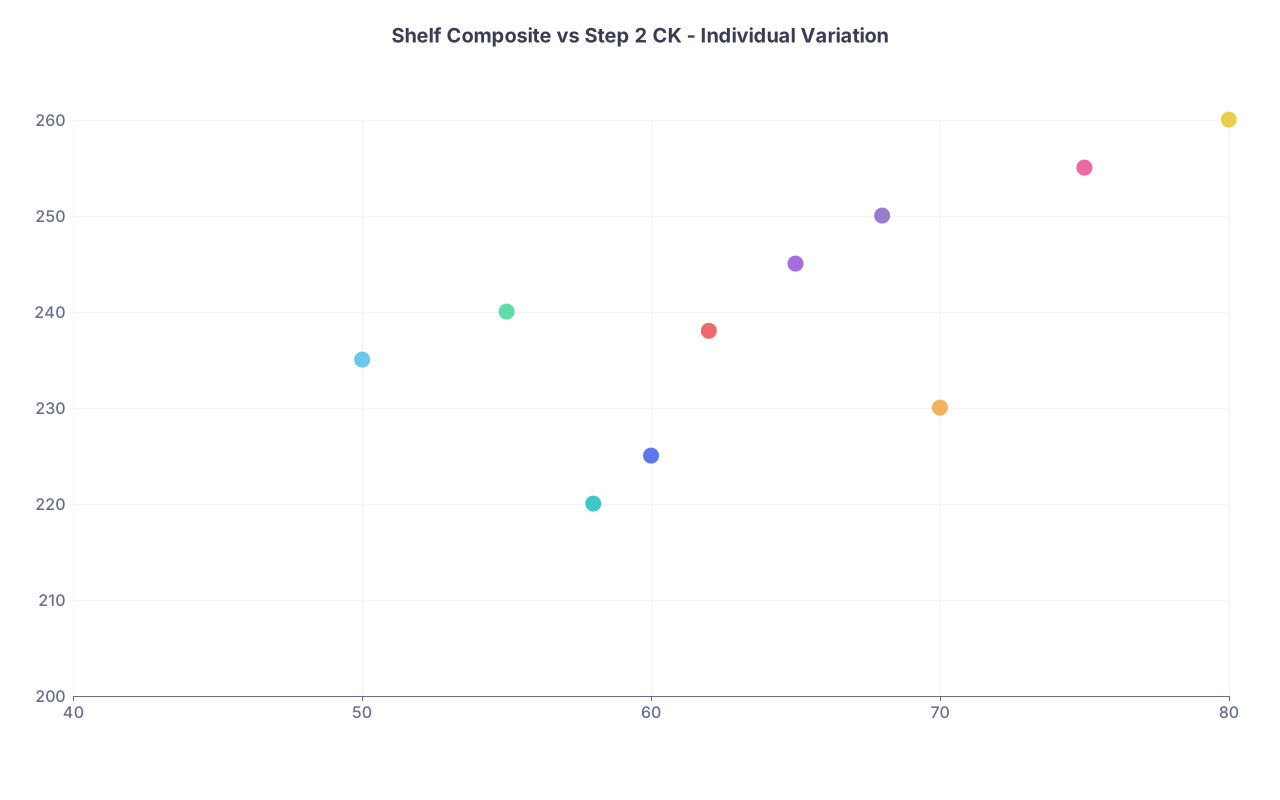
| Category | Value |
|---|---|
| Student 1 | 60,225 |
| Student 2 | 65,245 |
| Student 3 | 55,240 |
| Student 4 | 70,230 |
| Student 5 | 75,255 |
| Student 6 | 50,235 |
| Student 7 | 80,260 |
| Student 8 | 58,220 |
| Student 9 | 68,250 |
| Student 10 | 62,238 |
That fake-but-realistic scatterplot tells the story: you can have a student with a mediocre-looking 60th percentile shelf composite but an excellent 240–245 Step 2 CK. You can also have someone with great shelves who never consolidates, overestimates their readiness, and underperforms.
Programs that understand stats know this. They do not sit there with your shelf history spreadsheet doing regression models. They care mainly about the final Step 2 CK number and the pattern: did you pass shelves, did you crash and burn, or did you improve?
The “my shelves sucked, so my Step 2 future is sealed” narrative is psychological, not statistical.
Why Smart Students Underperform on Shelves but Do Fine (or Great) on Step 2
This is the part I’ve watched repeatedly:
- Student A barely survives surgery and OB/Gyn shelves. Low 60s percentiles, maybe even a near-fail at the start of the year.
- By the end of clinical year, they finally figure out question-based learning, review their weak systems, and focus for 4–6 weeks on dedicated Step 2 prep.
- Step 2 score? 240–250+. Sometimes higher.
Were they “lying dormant” geniuses? No. They were misaligned with what shelves measured at the moment those exams were given.
You can underperform shelves for several reasons that don’t persist:
You were drowning in clinical adjustment.
The first one or two clerkships are often a mess. You’re figuring out how to write notes, pre-round, present, stay awake, not annoy the team. Studying comes last. By the time you’re on your fourth or fifth rotation, you’ve stopped spending 2 hours editing your SOAP notes and started sneaking UWorld during the lull.You studied like it was Step 1.
Way too many students cling to “content first, questions later.” They read 300 pages of an OB shelf book, then sprint through 10 questions at 1 a.m. That’s a great way to feel busy and stay mediocre. For Step 2, most people finally accept reality: question banks drive learning.You were rotation-lottery unlucky.
Sometimes your shelf aligns with a service that underexposes you to testable material. Two weeks of pure surgical oncology is not going to cover the bread-and-butter trauma and acute abdomen patterns that fill the exam. Same issue with outpatient-heavy psych rotations that ignore inpatient emergencies.
Once you:
- Have all the clerkships under your belt
- Switch fully to question-based prep
- Plug your systematic content holes
…your “test-taking self” is simply not the same person who took that early shelf.
So no, those numbers are not destiny. They’re a fossil record of earlier, less-optimized versions of you.
Why Step 2 CK Can Absolutely Be Higher (or Lower) Than Your Shelf Trajectory
Let’s be blunt. Step 2 CK is the exam where a lot of people redeem themselves, and a smaller but real group quietly blows it.
The redemptions usually look like this:
- Shelf history: mostly 50–70th percentile, maybe one <30th percentile embarrassment.
- Behavior shift: 2–6 weeks of structured questions, UWorld reset or thorough second pass, NBME practice tests used honestly.
- Result: Step 2 CK 15–25+ points above what they “feel like they deserve” from their shelf history.
The quiet blowups look like this:
- Shelf history: high percentiles on IM, surgery, neuro. Classmates think they’re a lock for 260+.
- Behavior: Coasting. Lots of “I’ll be fine, I’ve always tested well.” Half-hearted question review, no real error logging, NBMEs taken but not dissected.
- Result: Step 2 right around the mean, maybe slightly above. Strong, but nowhere near the myth their shelves predicted.
Shelves don’t account for maturity, intensity, or burnout. Step 2 CK does.
If you peaked in January of third year and mentally checked out by June, your shelves will flatter you and Step 2 will expose you. If you started slow and built methodically, your shelf story will undersell you and Step 2 will finally show your real ceiling.
What Residency Programs Actually Care About Here
Let’s connect this to the residency application game, since that’s why you’re obsessing about all this.
Programs are not naïve. They’ve watched enough classes move through the pipeline to know:
- Shelf exams are not standardized across schools. Some curve generously. Some use different forms. Some weight them weirdly into grades.
- Step 2 CK, love it or hate it, is standardized and easy to compare.
So what do they actually look at?
They care about three things:
The Step 2 CK number.
This is the post–Step 1–P/F filter. A strong Step 2 gives PDs confidence you can pass in-training exams and the boards. A weak Step 2 raises concern, shelves regardless.The pattern of performance, not single shelves.
One bad shelf? No one cares. A cluster of repeated failures, remediation, or a narrative of “always barely passing”? That matters.Narrative coherence.
If you had rough shelves early, improved over time, and then posted a strong Step 2, that’s a happy story: “Early adjustment, then clear growth.” If your MSPE or transcript shows improvement and your Step 2 backs it up, most competitive specialties will not obsess over your rough start.
A mediocre shelf in OB is not killing your IM or psych application. A below-average peds shelf is not why you did or did not match into EM. Programs are too busy triaging applicants to micromanage that sort of granularity.
What will hurt is using “my shelves were bad” as an excuse to downshift effort for Step 2. Residency directors won’t know or care about the pity party; they’ll see a flat 220 on the score report and move on.
How to Use Shelves Without Letting Them Own You
Shelves are feedback. Not prophecies.
Treat them like this:
- Rough IM shelf? That’s your signal to target internal medicine and multi-system issues heavily in Step 2 prep.
- Chronically low peds scores? You probably ignore outpatient and growth/development questions. Fix that systematically.
- Strong in surgery but mediocre in psych and neuro? Great—maintain your surgical strengths, but spend more Step 2 time on brain and behavior.
The point is simple: shelves are diagnostic, not deterministic. They identify weak systems, broken study habits, or test-taking issues. Step 2 CK is your chance to show that you did something about it.
Bottom line
Two or three things to remember when you start talking like shelves and Step 2 are the same exam wearing different hats:
- Shelf scores and Step 2 CK are related, but the relationship is noisy. They’re cousins, not clones.
- Your shelf history is a snapshot of earlier versions of you; Step 2 CK reflects the final form—after you’ve seen all the rotations and fixed your approach.
- Residency programs care far more about your actual Step 2 CK score and trajectory than about a scattered pattern of mid-tier or even bad shelves.
Use shelves as data points, not a verdict. The test that really counts is still ahead of you—and it does not care how much you let those earlier numbers mess with your head.