
The common advice to “just hit the cutoff” for Step 2 CK is lazy, outdated, and in many cases flat‑out harmful.
Residents and fourth‑years repeat it like gospel: “Programs just want to see you passed.” “As long as you’re above 230 you’re fine.” “Once you’re past the filter, scores don’t matter.” None of that is generally true in the actual residency selection ecosystem you’re about to walk into.
You’re applying in an era where Step 1 is pass/fail, applications are bloated, and programs are overwhelmed. Step 2 CK is not just a hurdle. It’s one of the few remaining hard numbers programs can use to sort a ridiculous pile of applicants quickly and ruthlessly.
Let’s dismantle the “cutoff myth” properly.
Myth: “Programs only care that you’re above their cutoff”
Here’s what the data and real‑world behavior actually show: most competitive programs do not treat Step 2 CK as binary. They treat it as a distribution — and your position on that distribution changes your outcome odds.
We have three realities colliding:
- Step 1 is now pass/fail.
- Applications per applicant keep going up.
- Programs don’t have more time; they have less.
So what do they do? They lean harder on the next available numeric signal. That’s Step 2 CK.
The NRMP and program director surveys (even pre–Step 1 pass/fail) already showed:
- Step 2 CK score was consistently ranked among the top factors for granting interviews.
- Many programs reported score ranges, not single “cutoffs”, for typical matched residents.
- For competitive specialties, average Step 2 CK scores of matched applicants skewed far above any stated “minimum.”
Now with Step 1 pass/fail, several PDs (especially in IM, EM, surgery, anesthesiology) have been blunt at conferences and in webinars: they are raising their attention on Step 2 CK, not relaxing it.
“Just hit the cutoff” ignores that reality. It imagines a world where a 231 and a 261 are treated the same. That world doesn’t exist.
How programs really use Step 2 CK
Programs don’t publish their full decision tree, but we’ve seen enough patterns to reconstruct the logic.
Roughly speaking, Step 2 CK is used in three major ways:
Automatic or semi‑automatic screens
- Hard lower limits (e.g., 220 or 230) for auto‑rejections or “low priority” bins.
- Slightly higher internal targets for interview consideration (e.g., 240+).
Relative strength signal within your cohort
- Comparing your Step 2 CK against:
- Other applicants at your school
- Other applicants to that program
- The program’s current residents
- This isn’t “pass/fail”; it’s “are you above, at, or below our norm?”
- Comparing your Step 2 CK against:
Tie‑breaker and risk assessment
- Between similar applications, higher Step 2 CK often wins.
- Lower scores push committees to look for red flags or reasons to doubt clinical readiness.
The fact that some programs state a minimum (e.g., “We require Step 2 CK ≥ 230”) doesn’t mean that 231 is functionally the same as 260 in their process. It just means 229 is dead on arrival.
To make this concrete:
| Specialty Level | Typical 'Cutoff' Used | Typical Matched Range | How Programs Actually React |
|---|---|---|---|
| Highly Competitive | 235–240 | 250–265+ | Score stratifies you sharply |
| Moderately Competitive | 220–230 | 240–255 | Higher score = more interviews |
| Less Competitive | 210–220 | 225–240 | Lower floor, but still tiered |
Nobody is publishing it this honestly on their website. But you see the pattern when you look at match data and resident rosters over time.
“But my advisor said being above 240 is enough…”
Advising culture is often stuck 5–10 years behind the market.
I’ve heard all the lines:
- “Aim for a 240, that’s a strong score.” (2012 logic.)
- “Programs just use it as a screen.” (Technically true, but incomplete.)
- “After 240, it’s just diminishing returns.” (Tell that to the applicant with 22 interviews vs 8.)
The pursuit of some mythical “threshold” is misguided for two reasons:
Programs are comparing you to others this year, not to an arbitrary fixed bar.
If average Step 2 CK for matched applicants in a specialty climbs from 245 to 252 over a few cycles, that “240 is strong” narrative quietly becomes nonsense.You don’t control where the “cut” really falls.
A program might:- List 230 as a minimum publicly.
- Soft‑screen at 240 internally for busy reviewers.
- End up with a de facto interview pool where almost everybody is 245+ because they’re drowning in applications.
The ceiling keeps creeping up, especially as more applicants treat Step 2 CK as the new “big exam” to flex on.
Let me visualize what’s actually happening.
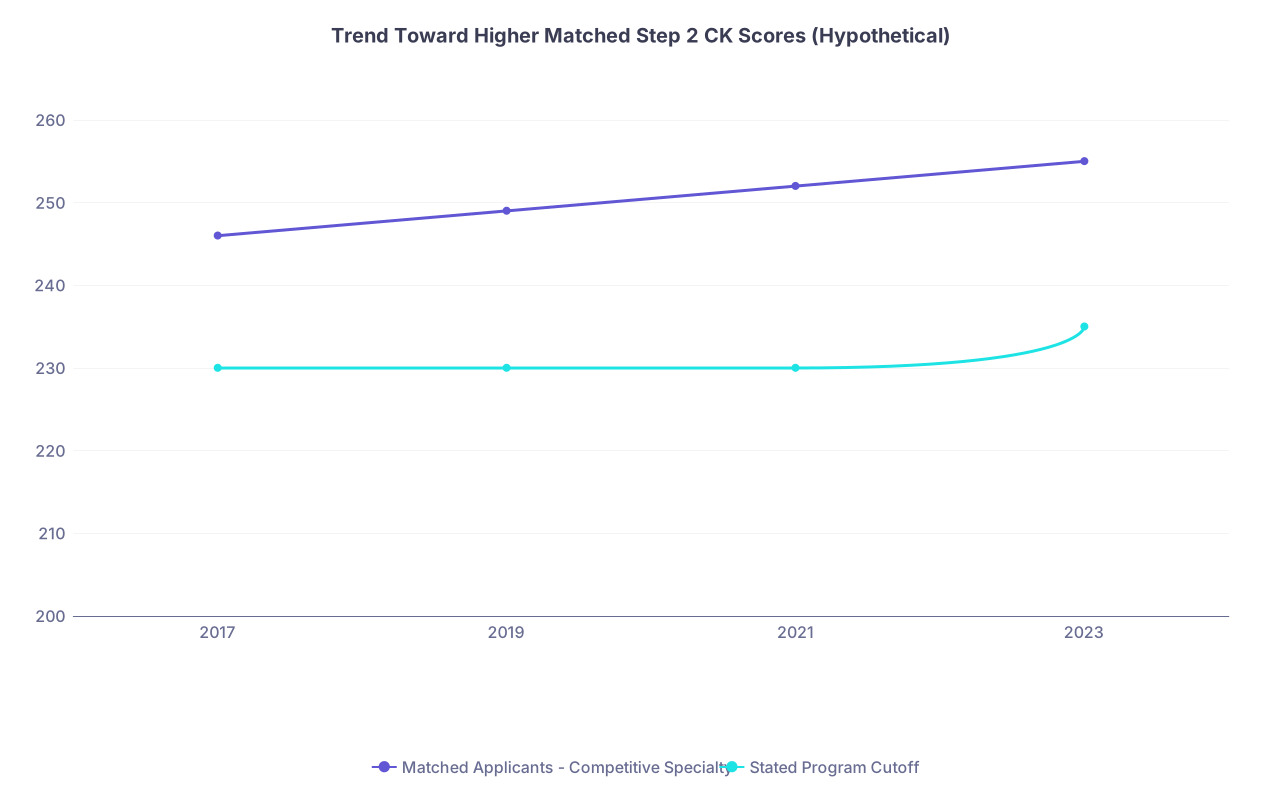
| Category | Matched Applicants - Competitive Specialty | Stated Program Cutoff |
|---|---|---|
| 2017 | 246 | 230 |
| 2019 | 249 | 230 |
| 2021 | 252 | 230 |
| 2023 | 255 | 235 |
Notice the gap: stated cutoffs barely move, real matched averages creep higher. If you stop the moment you “hit the cutoff,” you’re essentially choosing to live near the bottom of the viable range.
Why “just enough” is a terrible strategy in a crowded market
There are three big problems with “just hit the cutoff” as a planning strategy.
1. It ignores specialty realities
A 235 Step 2 CK in family medicine? Reasonable, maybe even strong at many programs.
A 235 in dermatology or plastics? That’s effectively a non‑competitive score no matter what the technical “minimum” is.
Yet people throw out one‑size‑fits‑all targets like “Just get above 240.”
You need to think like this instead:
- What are the recent matched averages for my target specialty?
- Where do students from my school who matched that specialty typically land?
- What’s the implied “safe zone” vs “fragile zone” for Step 2 CK?
For a ballpark mental model:
| Specialty Category | Rough Competitive Target Range | “Barely Above Likely Cutoff” Range |
|---|---|---|
| Ultra-Competitive (Derm, PRS, Ortho at top places) | 255–265+ | 240–248 |
| Competitive (EM, Anes, ENT, Rads, Gen Surg at solid programs) | 245–255 | 230–240 |
| Moderate (IM, Peds, OB/Gyn, Neuro) | 235–248 | 220–230 |
| Less Competitive (FM, Psych, Path) | 225–238 | 210–220 |
“Just hitting the cutoff” lands you largely in the right‑hand column. That’s not where you want to live unless the rest of your app is bulletproof and aligned with that specialty.
2. It assumes your other metrics are perfect
The “cutoff” mentality quietly assumes:
- Strong clinical evaluations
- Solid letters from known attendings
- No red flags
- Decent research (for fields that care)
- No Step 1 struggle
But a lot of people lean on Step 2 CK precisely because something else isn’t ideal. Maybe Step 1 was marginal. Maybe preclinical grades were mediocre. Maybe you switched specialties late and your research doesn’t match.
In that case, Step 2 CK is not just a box to check. It’s your best shot at a “loud” compensatory signal. Settling for “barely above the line” is like bargaining for a C when you desperately need something on your transcript that screams turnaround.
3. It kills optionality
The worst part of the cutoff mindset is this: you’re making irreversible future decisions based on a minimal present goal.
I’ve watched this play out in real time:
- MS3 is sure they want IM, told they just need 230–235.
- They get a 238, feel “safe,” and back off.
- Then they rotate in anesthesiology or EM, fall in love, realize those fields are more score‑sensitive.
- Too late. Step 2 CK is done, no retake. Optionality gone.
A stronger Step 2 CK keeps doors open you have not even considered yet. Especially if you have not done all of your away rotations or specialty‑specific experiences by the time you sit for the exam.
What the score actually signals to programs
Program directors aren’t just using Step 2 CK to see “smart vs not smart.” They’re looking for evidence across a few dimensions:
- Can you handle high‑volume clinical information and apply it quickly?
- Are you likely to pass your boards on the first attempt? (This matters directly to accreditation.)
- Are you going to be a constant remediation project, or can we trust your baseline knowledge?
They won’t say it this bluntly on their websites, but the internal calculus often looks like:
- 260+: “Board score risk almost zero. Strong cognitive horsepower. Probably near top of the stack.”
- 245–259: “Solid. Fits or exceeds our resident average. No concerns.”
- 230–244: “Fine, but let’s check the rest of the file. Are there red flags? Is this school known to grade hard?”
- <230 in a competitive field: “Why would we pick this person over the many 245+ applicants we have?”
Here’s the risk perception visually:
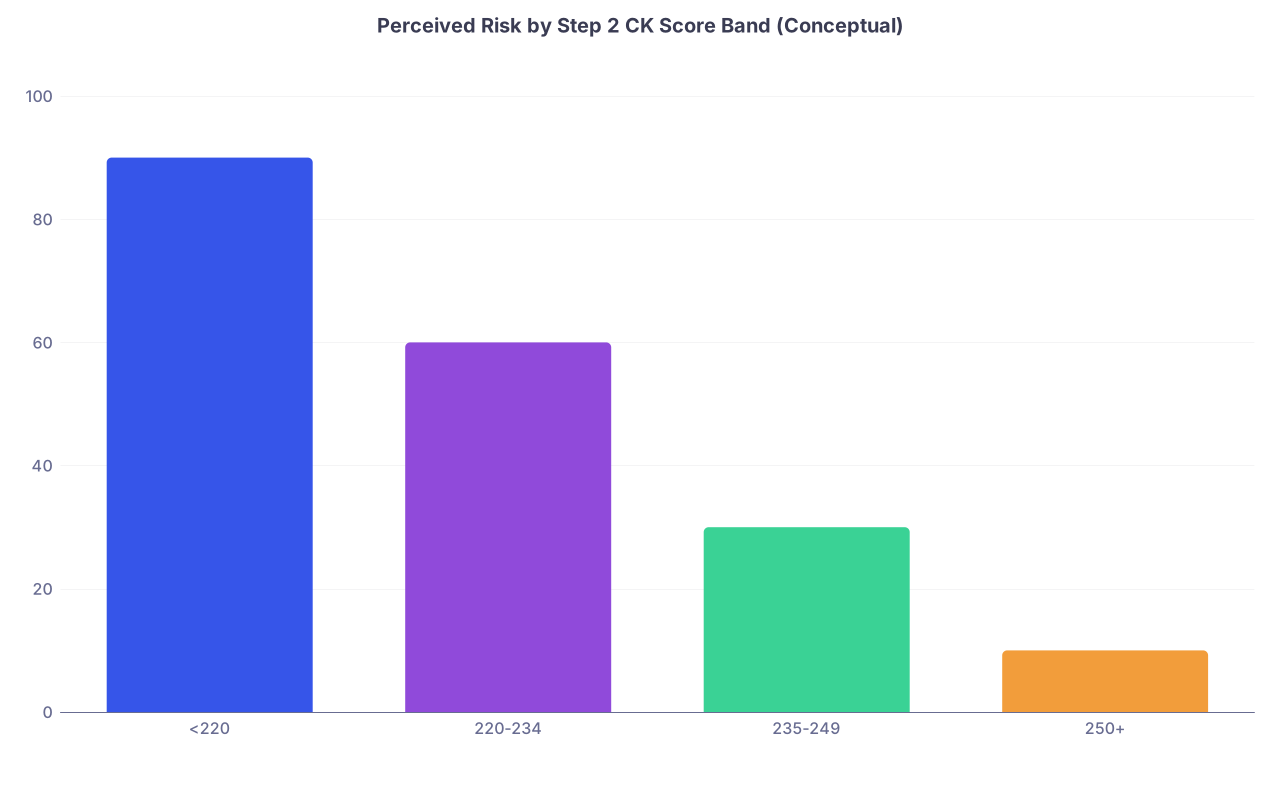
| Category | Value |
|---|---|
| <220 | 90 |
| 220-234 | 60 |
| 235-249 | 30 |
| 250+ | 10 |
Think of the “values” as rough risk scores in a PD’s mind. Higher bar = more perceived risk that you’ll struggle with boards or clinical workload. Obviously oversimplified, but you get the point.
Where the “aim higher” message does not mean “burn out”
Here’s where people twist this advice.
No, I’m not saying:
- You need a 260+ for everything.
- You should study until you break.
- Your worth as a human is tied to three digits.
The contrarian point is narrower and more uncomfortable:
If you’re going to put in months of work anyway, why would you optimize to be minimally acceptable rather than clearly strong, especially when the exam is one of the very few levers you fully control?
More useful framing than “just hit the cutoff”:
- “Hit the range that matches or slightly exceeds your specialty’s recent matched averages.”
- “If you’re below that range in other metrics, treat Step 2 CK as a chance to over‑perform.”
- “Do enough UWorld + NBME work that your practice trend lives in the score band you actually want, not the band your classmates tell you is ‘good enough.’”
If your practice NBMEs are clustering around 250 and you say, “I’m fine with 235,” that’s not “being balanced.” That’s self‑sabotage disguised as humility.
Strategic Step 2 CK prep in the new era
Let me be extremely practical. A Step 2 CK strategy that respects reality looks more like this:
Choose your test date around your peak, not your earliest possible pass.
You want:- Enough core clerkships completed (IM, surgery, peds, OB, psych at minimum).
- 6–8 weeks of focused review if your baseline is average.
But you don’t rush to sit just to “get it out of the way” if your NBMEs are still shaky.
Track your trajectory, not a single practice score that “hits your target.”
Someone with NBME scores of 225 → 230 → 235 is fundamentally different from 245 → 240 → 235.
The first is rising and might hit 240+ with more work. The second is drifting down.Benchmark against your actual competitive set, not a generic number.
That means understanding your:- School’s historical performance for your specialty
- Your Step 1 story
- Your research/letters/clinical evals
Optimize your ceiling before dialing back.
Push until your practice tests stabilize in a range you’d be happy to see on your real score report. Then you can shift into maintenance and protection mode for the remaining 1–2 weeks.
This doesn’t mean no breaks or no boundaries. It means your mental model isn’t “I just need a 230 to be safe,” it’s “I want to sit for this exam when my practice scores put me in the outcome range I want.”
If you’re curious about how this fits into the bigger application cycle:
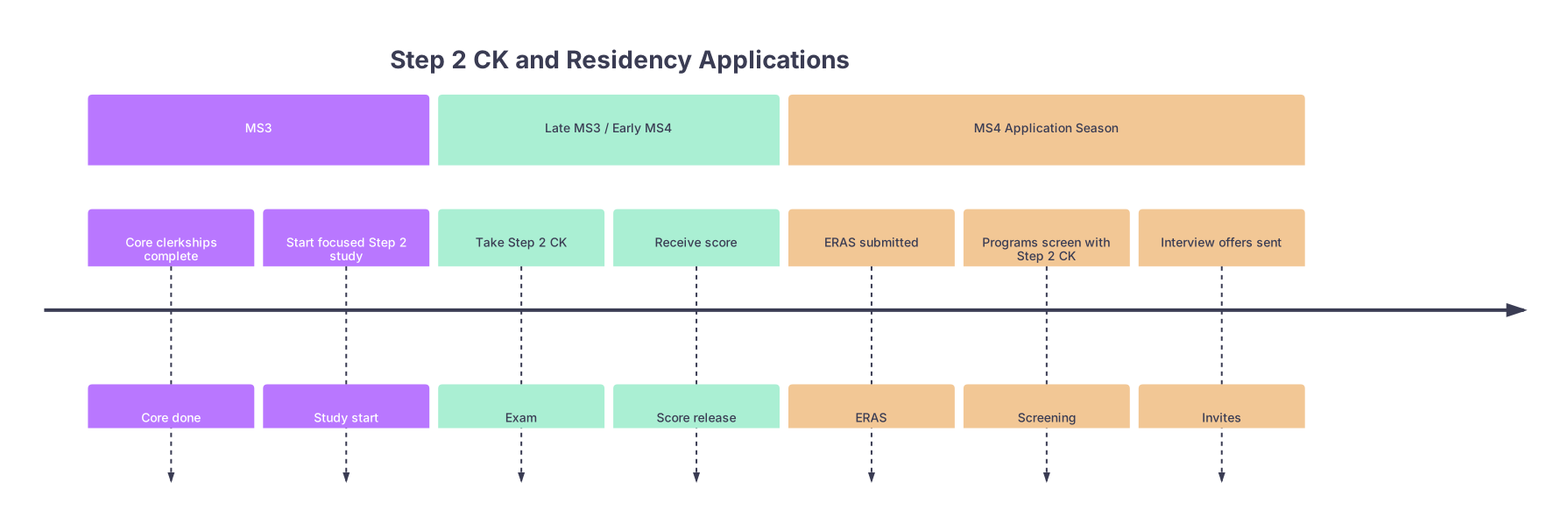
| Period | Event |
|---|---|
| MS3 - Core clerkships complete | Core done |
| MS3 - Start focused Step 2 study | Study start |
| Late MS3 / Early MS4 - Take Step 2 CK | Exam |
| Late MS3 / Early MS4 - Receive score | Score release |
| MS4 Application Season - ERAS submitted | ERAS |
| MS4 Application Season - Programs screen with Step 2 CK | Screening |
| MS4 Application Season - Interview offers sent | Invites |
Notice where “Programs screen with Step 2 CK” sits. That’s why the score is not just a pass/fail gate.
When “just hit the cutoff” is closer to reasonable
There are narrow cases where the minimalist attitude is less harmful:
- You’re applying to a clearly less competitive specialty.
- Your Step 2 CK practice scores are fragile and additional study time is wrecking your mental health.
- You already have strong Step 1, honors, research, and letters backing you up.
- Your career goals are not program‑pedigree sensitive (e.g., you’ll be happy at a wide range of community programs).
Even then, what you should be saying to yourself is not “cutoff.” It’s “I’m at a point on my practice tests where the marginal benefit of more score is lower than the marginal cost to my sanity and life.” That’s a grown‑up tradeoff.
Not: “Someone told me 230 is enough so I’m going to stop pushing even though I’m trending toward 245.”
The bottom line
Three points to walk away with:
- Step 2 CK is no longer “just a hurdle.” With Step 1 pass/fail and bloated application volumes, it’s one of the primary signals programs use to sort and rank you.
- “Just hit the cutoff” is a dangerous oversimplification. Real programs operate with ranges, averages, and implicit tiers; being barely above the line usually means you’re at the bottom of the viable pool, not sitting pretty.
- If you’re going to spend months preparing anyway, aim for the score band that matches your actual goals and keeps options open, not the minimum someone casually tossed out in a hallway conversation.