
Community programs do not care less about Step 2 CK. They care differently. And in some ways, they care more.
The “chill community program” myth is one of the most persistent and most dangerous ideas circulating among applicants right now—especially IMGs and lower‑stat US grads. I keep hearing the same line in advising sessions and on Reddit:
“I do not need a 250. It’s just a community program. They do not care as much about scores.”
That assumption gets people unmatched.
Let’s tear this apart with what actually happens in community programs, how they screen, what the algorithms look like, and where Step 2 CK really sits in their priorities.
Myth: “Academic programs are Step-obsessed, community programs are holistic”
Reality: Both use Step 2 CK as a blunt screening tool. Academic centers just tend to push the cutoffs higher.
Community PDs are not sitting with candles, reading your personal statement while ignoring your 219. They’re staring at a spreadsheet like everyone else, sifting through 3,000+ apps with maybe 30 interview spots, often with less administrative support than the big-name university next door.
If anything, community programs are more dependent on quick filters because they do not have:
- Residents or fellows pre-screening as much
- Large faculty committees
- Fancy custom software and analytics
I’ve sat with community PDs and watched them work. The process often looks like this:
- Pull ERAS data into some sort of sorting system (sometimes literally Excel).
- Apply a hard Step 2 CK cutoff. Everything below disappears from practical consideration.
- Among the survivors: filter by visa status, graduation year, and red flags.
- Only then look at experiences, letters, personal statement… for a subset.
That “Step 2 CK cutoff” is not soft. If the filter is 225 or 230, your beautifully crafted application at 219 never gets opened.
Do some programs read holistically? Yes. But the idea that “community = holistic, academic = score-obsessed” is fantasy. Both care about performance. Community programs often just calibrate the number lower. Not the importance.
What the data and trends actually show about Step 2 CK
Let me ground this in something more than anecdotes.
With Step 1 being pass/fail, NRMP surveys and specialty organizations have made one thing painfully clear: Step 2 CK moved from “nice secondary metric” to primary standardized comparator.
From recent NRMP Program Director Surveys (pre–Step 1 P/F but directionally accurate, and every PD I know says it’s even truer now):
- Step 2 CK score is consistently ranked among the top 3–5 factors for granting interviews across broad specialties.
- In many fields, it’s used as a hard screen just like Step 1 used to be.
- PDs overwhelmingly report using minimum score thresholds.
Here’s the key twist that people miss:
Community programs saw the same tidal wave of applications as academic programs—sometimes worse, because they’re viewed as “safer targets,” especially for IMGs. When you’re a mid-sized community internal medicine program getting 4,000+ applications, you cannot “holistically” review everyone. You need a machete, not a scalpel.
That machete is Step 2 CK.
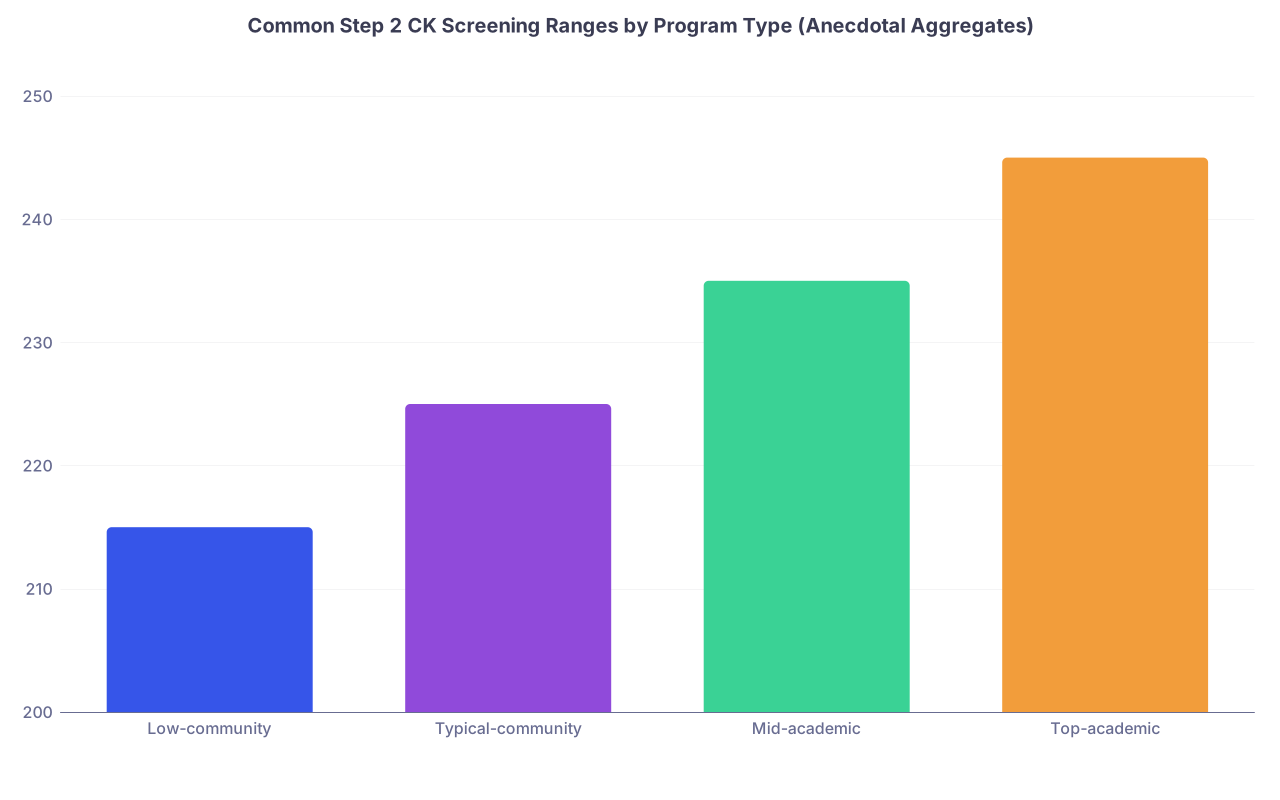
| Category | Value |
|---|---|
| Low-community | 215 |
| Typical-community | 225 |
| Mid-academic | 235 |
| Top-academic | 245 |
These numbers aren’t official; they’re the ranges I keep hearing over and over from real PDs and coordinators:
- Less competitive community programs: often screening around ~215–220.
- Solid community programs: ~225–230.
- Mid-tier academics: ~235.
- Top-tier academic: 240+ just to avoid auto-trash.
The takeaway isn’t the exact number. It’s that everyone is screening. Community programs included.
Why community programs may quietly care more about Step 2 CK
This is the part almost nobody talks about.
Academic departments can “hide” a weak resident behind layers of fellows, advanced practice providers, and subspecialty attendings. Community programs can’t. When you’re the PGY-2 on nights at a 200-bed hospital without an in-house cardiology fellow, your knowledge base is the safety net.
So PDs in community settings often tell me some version of:
"I do not need 260s. I need people who can pass boards and not drown on night float."
Translation: they’re not obsessed with elite scores, but they’re very sensitive to scores that suggest risk of failing boards or struggling on the floor.
For many community PDs, Step 2 CK is:
- A surrogate for test-taking ability and board pass likelihood.
- A proxy for clinical knowledge since it’s more clinically focused than Step 1.
- A way to avoid remediation nightmares when they have fewer resources.
If a community PD’s board pass rate drops, they feel it quickly: ACGME scrutiny, reputation hits, and major stress on a small team. They cannot gamble on someone whose score screams “borderline.”
So no, they do not need your 260. But if you think a 205 is “fine because it’s just a community program,” that’s wishful thinking.
The IMG and “safety program” fantasy
This myth does the most damage to international grads.
I keep seeing the same strategy:
- Step 2 CK: 218
- No US clinical experience or one short observership
- Applied to “easier” community programs only
- Expectation: “They need bodies, I’m fine.”
Here’s the cold reality: for many community IM or FM programs that are IMG-friendly, you’re competing against:
- IMGs with 235–245 Step 2 CK
- Multiple US clinical experiences
- Strong letters from US attendings
- Recent YOG (year of graduation)
Community ≠ desperate. Many of these places get thousands of highly motivated, well-prepared IMGs who specifically target them.
| Profile Type | Step 2 CK | USCE Months | YOG Gap | Interview Likelihood* |
|---|---|---|---|---|
| Strong IMG | 240 | 3–6 | ≤2 yrs | High |
| Solid IMG | 230 | 2–3 | ≤4 yrs | Moderate–High |
| Borderline IMG | 220 | 1–2 | 3–5 yrs | Low–Moderate |
| Weak IMG | <215 | 0–1 | >5 yrs | Very Low |
*Not actual percentages, but the pattern is real.
So when someone tells you, “Do not stress, community programs don’t care about Step 2 CK,” what they’re really saying is “I haven’t actually looked at who you’re competing against.”
How community programs really use Step 2 in the screening funnel
This is the typical flow I see, across multiple states and specialties like IM, FM, psych, and prelim surgery.

| Step | Description |
|---|---|
| Step 1 | All Applications |
| Step 2 | Meets Basic Rules |
| Step 3 | Screened Out |
| Step 4 | Filter by Visa, YOG |
| Step 5 | Remove Big Red Flags |
| Step 6 | Review Experiences and Letters |
| Step 7 | Invite for Interview |
| Step 8 | Step 2 CK above cutoff |
“Meets Basic Rules” = not too old of a grad, proper documentation, etc. But look at step C. That’s where half the applicant pool dies in some programs.
And no—most programs don’t shift the cutoff lower for “just a community spot.” They might keep it a bit lower than shiny university hospitals, but within their ecosystem, it’s still a binary gate.
Once you’re above the threshold, Step 2 CK loses some marginal power. They’re not debating 238 vs 241. They’re deciding 228 and above = eligible, 227 and below = gone. Crude, but fast. That’s the point.
When community programs actually are more forgiving
There are cases where Step 2 CK matters a little less, or can be offset.
Community programs may be more flexible when:
- You’re a US MD/DO with strong home-school support, even with a borderline Step 2.
- You’re a graduate of their affiliated med school or have rotated there and impressed them.
- You bring unique value (bilingual in a needed language, strong local ties, known to faculty).
- The specialty is truly less competitive in that region (e.g., some FM or psych programs in less popular locations).
In those scenarios, the “cutoff” for interviewing can drop a bit. I’ve seen PDs say, “We usually use 225, but we interviewed this 217 because the chair knows them and they killed it on our sub-I.”
But notice the pattern: the exception is almost always built on relationships, performance in person, or institutional familiarity, not just vibes. And it’s rarely for a 190. It’s for someone just under the usual line.
So the more accurate statement is:
Community programs are sometimes slightly more forgiving around the margins if they know you, like you, and trust you.
That is very different from “they don’t care about Step 2 CK.”
The Step 1 pass/fail effect: community programs did not become nicer
Once Step 1 went pass/fail, there was some magical thinking going around: “Programs will care less about scores and more about the whole applicant.”
What actually happened in many places:
- Step 2 CK became the primary objective academic benchmark.
- Programs started expecting Step 2 earlier in application season.
- A late or missing Step 2 became a red flag, especially for IMGs and non-traditional applicants.
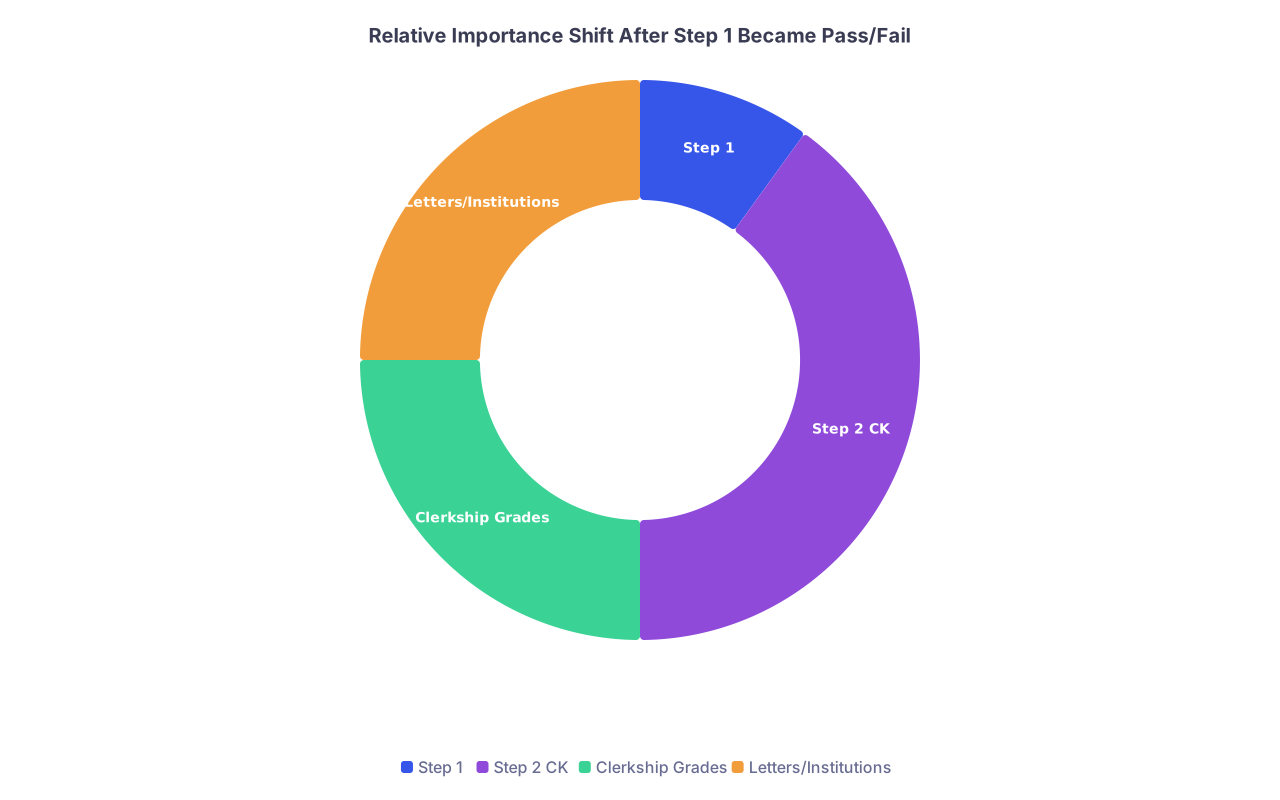
| Category | Value |
|---|---|
| Step 1 | 10 |
| Step 2 CK | 40 |
| Clerkship Grades | 25 |
| Letters/Institutions | 25 |
Again, not an official NRMP chart—this is the rough consensus from a lot of PD conversations. The absolute importance of Step 2 CK went up. And community programs rode the same wave as everyone else.
They still care about:
- Clinical grades
- Letters (especially from US clinicians)
- Interview performance
- Professionalism, communication, etc.
But Step 2 CK is now the front door for many of them. Shut that door with a low score or a missing score, and nothing else gets seen.
The dangerous comfort of “I only need to be good enough for community”
Let me be blunt: the mindset “I’m not aiming high, I just need community” is how people end up under-studying for Step 2 CK.
You don’t need to chase a 260 unless you’re aiming for derm, rad onc, plastics, etc. But you absolutely should act like every point above the cutoff gives you more oxygen.
Because it does.
Applicants forget something simple: you’re not competing against the program’s minimum. You’re competing against the other humans applying there this year. If the average among the people they actually invite is 235, your 221 is not “fine” just because they technically screen at 220.
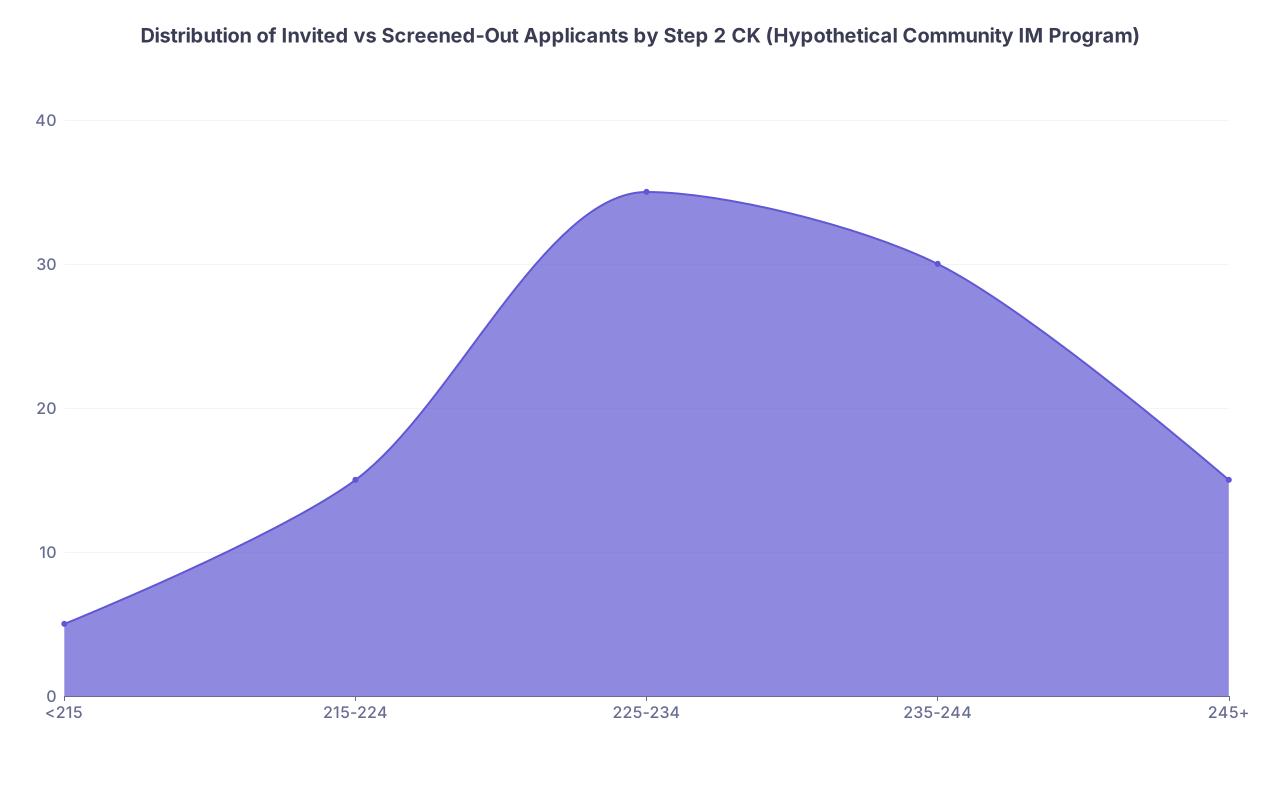
| Category | Value |
|---|---|
| <215 | 5 |
| 215-224 | 15 |
| 225-234 | 35 |
| 235-244 | 30 |
| 245+ | 15 |
In a situation like this, “just barely above the cutoff” lives in the least-invited segment. That’s where people cling to the myth that community programs are relaxed about scores. Then wonder why interview invites never arrive.
So what do you actually do with this?
I’m not saying you should collapse under test anxiety. I’m saying stop using “community program” as a justification for mediocrity on the one standardized metric almost every PD agrees on.
A more honest framework:
- Step 2 CK is non-negotiable for both academic and community programs.
- Community programs may accept lower but not low scores.
- Once above their threshold, other factors can push you up or down.
- Below their threshold, you basically do not exist to them.
If you’re already sitting on a low Step 2 score, the solution is not denial, it’s strategy: target more IMG-friendly programs, apply broadly, maximize USCE, lock down strong US letters, consider prelim/TY routes or a re-take where possible and appropriate. Hard work, not magical thinking.
If you haven’t taken Step 2 yet, drop the fantasy that you’re “only” aiming for community. Aim to make yourself an easy yes for them, not a mercy interview.
Years from now, you won’t be thinking about whether a program was technically “community” or “academic.” You’ll remember how seriously you took your one real shot to control the narrative: how prepared you were when the score that everyone said “did not matter as much” turned out to be the thing that decided who even got in the door.