
The mythology around Step 2 CK thresholds is lazy. Programs are not using one magic number. They are stratifying applicants into tiers, and the data shows clear score bands by competitiveness tier.
You are not trying to “do well” on Step 2 CK in some vague sense. You are trying to land in the right percentile band for the tier of specialties and programs you care about.
Below I am going to lay out those bands using recent NRMP, NBME, and program-reported data trends, organized by:
- Specialty competitiveness tier
- Program type (community vs university vs top-20 academic)
- How Step 2 CK functions as a screen vs a differentiator in each tier
No fluff. Just numbers and what they actually mean for your odds.
1. Step 2 CK in the post-Step 1-pass era
Once Step 1 went pass/fail, Step 2 CK became the quantitative weapon of choice. Program directors did not become less score-driven. They just shifted the weight.
Three data points frame the landscape:
NRMP Program Director Survey (latest editions):
- Step 2 CK is cited by >80% of PDs across most major specialties as “important” or “very important.”
- In competitive specialties, >60–70% of PDs admit to using “minimum score cutoffs.”
Score distribution (approximate, based on NBME-reported means and SDs):
- Mean Step 2 CK: ~245
- Standard deviation: ~15
- So:
- 230 ≈ ~25th percentile
- 245 ≈ ~50th percentile
- 255 ≈ ~75th percentile
- 265+ ≈ ~90th+ percentile
The pattern that actually matters:
- Community and lower-tier academic programs tend to have hard cutoffs in the 225–235 range.
- Mid-tier academic programs cluster their “comfortable” zone around 240–250.
- Top academic and hyper-competitive fields start expecting 255+ to offset anything less-than-perfect elsewhere.
To visualize how program types separate by Step 2 CK expectations:
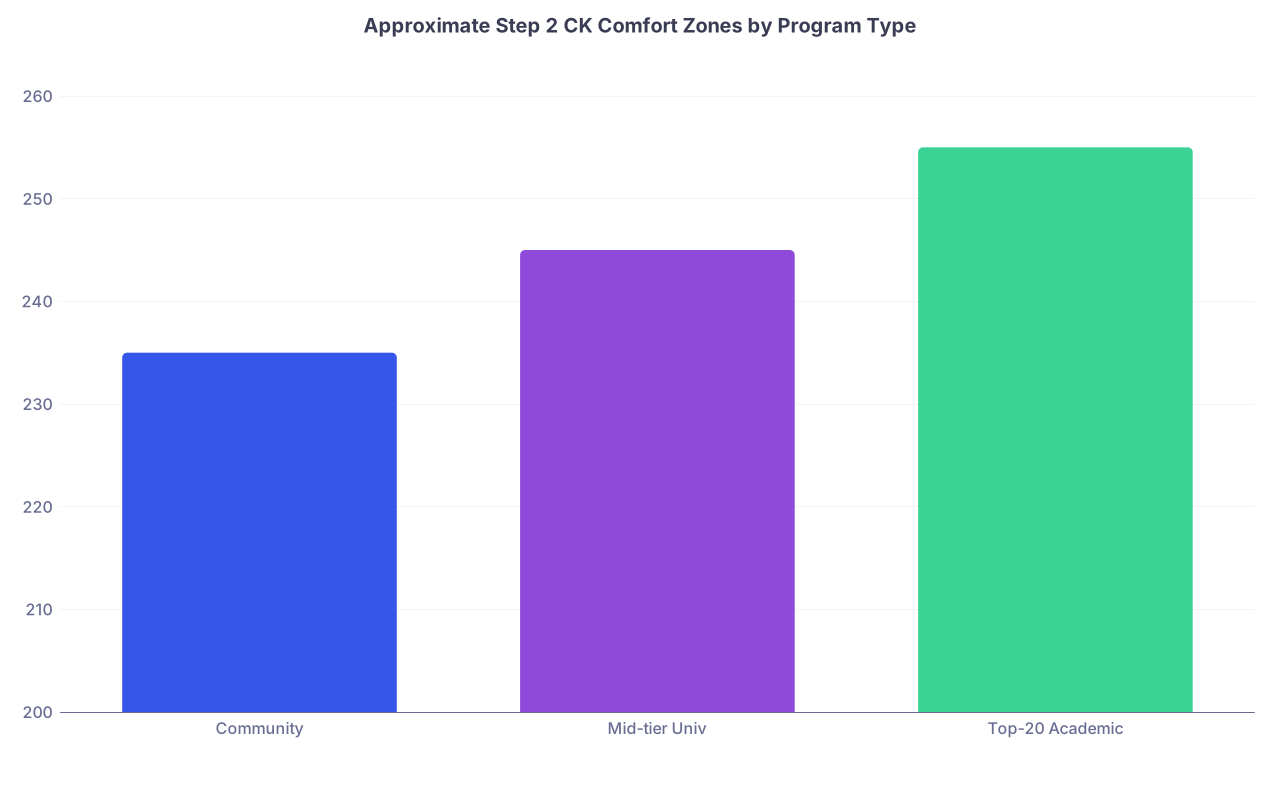
| Category | Value |
|---|---|
| Community | 235 |
| Mid-tier Univ | 245 |
| Top-20 Academic | 255 |
Those numbers are not hard rules, but they are accurate enough to set strategy.
2. Defining competitiveness tiers
You cannot talk about thresholds without segmenting the market. Different specialties live in entirely different scoring ecosystems.
For practicality, group specialties like this:
Tier 1 – Ultra-competitive
Dermatology, Plastic Surgery, Orthopedic Surgery, Neurosurgery, ENT, Integrated Vascular, Integrated Cardiothoracic, some Integrated IRTier 2 – Competitive
Diagnostic Radiology, Anesthesiology, Emergency Medicine (rebounding), OB/GYN, General Surgery, some Pathology, early trend upwards in PM&RTier 3 – Moderate / broad
Internal Medicine, Pediatrics, Neurology, Psychiatry, Family Medicine, most prelim-only medicine/surgery spots
Now combine that with program “prestige tier” within each specialty: community, regular university, top-20.
Here is the simplified matrix of realistic Step 2 CK expectations.
| Specialty Tier | Community / Lower-Tier Univ | Standard Univ / Mid-Tier | Top-20 / Elite Programs |
|---|---|---|---|
| Tier 1 (Ultra) | 240–250 | 250–260 | 260–270+ |
| Tier 2 (Comp.) | 235–245 | 245–255 | 255–265 |
| Tier 3 (Moderate) | 225–235 | 235–245 | 245–255 |
If you want one summary sentence: the data shows that “competitive” usually means aiming 10–15 points above the national mean for your target specialty, and “elite” means 20+ points above.
3. Tier 1: Ultra-competitive specialties
These specialties use Step 2 CK as both a hard screen and a ranking amplifier. They are flooded with applicants who all look strong on paper.
Score distribution reality
In ultra-competitive fields, a disproportionate share of matched applicants fall above the national mean. Think something like this profile:
- Mean of matched applicants: ≈ 255–260
- Interquartile range: ~250–265
- A not-trivial chunk at 265–275
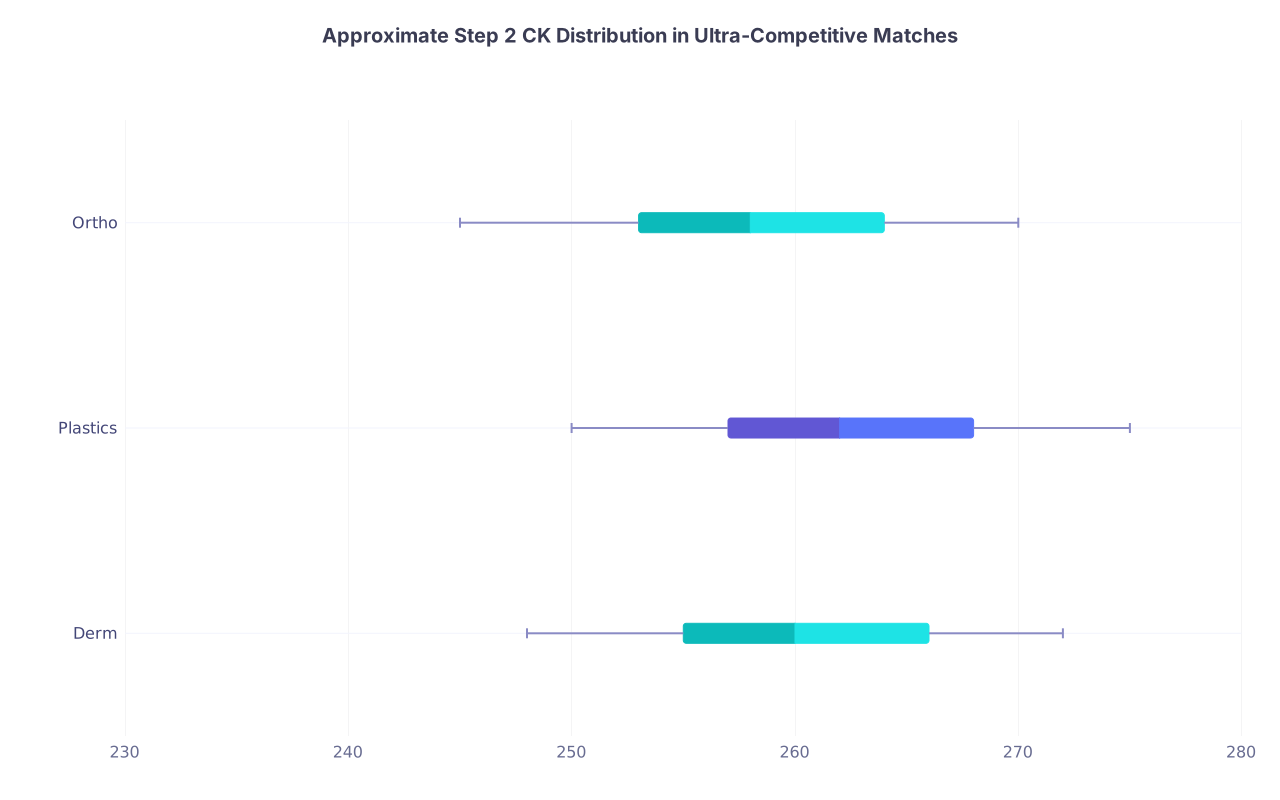
| Category | Min | Q1 | Median | Q3 | Max |
|---|---|---|---|---|---|
| Derm | 248 | 255 | 260 | 266 | 272 |
| Plastics | 250 | 257 | 262 | 268 | 275 |
| Ortho | 245 | 253 | 258 | 264 | 270 |
Do not overinterpret exact values. Focus on the pattern: median around 260, with many applicants clustered tightly near that mark.
Practical thresholds by target
If your Step 2 CK is:
≥265:
Quantitatively competitive at almost any program, provided the rest of your application is not a disaster. You still need research and letters, but you are through nearly all score filters.255–264:
Strong in this tier. You clear most cutoffs at many academic and some top programs. Research depth and home institution now determine how high you can realistically aim.245–254:
You are at the lower edge for ultra-competitive fields. You must overperform on:- Specialty-specific research
- Honors in key clinical rotations
- Letters from known names in the field
<245:
For dermatology, plastics, neurosurgery, and similar: the data suggests your probability of matching without a major “hook” (home program connection, heavy research output, second degree, etc.) falls sharply. People still match from here, but they are the exception with unusually strong non-score assets.
Use case: Strategic decisions
I have seen the same pattern across multiple cycles:
- Student A: Step 2 CK 268, 2 derm pubs, solid letters from mid-tier school → ends up with 8+ derm interviews including some top-20s.
- Student B: Step 2 CK 247, 10 derm pubs, strong mentor but from non-derm-heavy school → struggled into 3–4 derm interviews, ended up SOAPing into prelim medicine.
Harsh lesson: in ultra-competitive specialties, Step 2 CK is not everything, but it is a hard ceiling if it is low.
4. Tier 2: Competitive but not insane
These specialties are selective but give more leeway to balance a slightly lower Step 2 CK with strong clinical performance, SLOEs/letters, and fit.
We are talking about radiology, anesthesia, OB/GYN, EM, some surgery tracks, etc.
Score bands in practice
Typical matched applicant profile in these specialties:
- Mean Step 2 CK ~250–255
- Wide usable range: 240–265
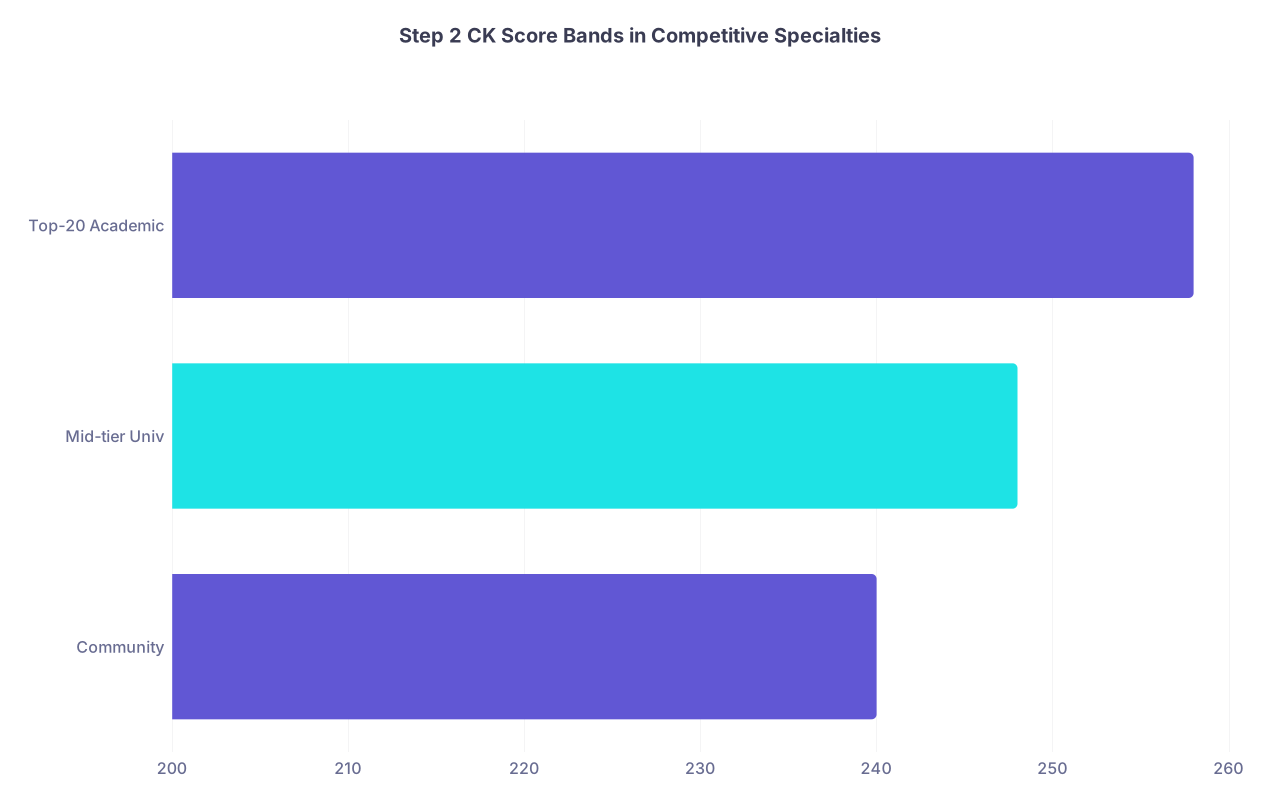
| Category | Value |
|---|---|
| Community | 240 |
| Mid-tier Univ | 248 |
| Top-20 Academic | 258 |
Interpretation:
- Community / smaller programs: comfortable around 235–245
- Mid-tier university: 245–255 often viewed as “ideal”
- Top-tier academic: 255+ becomes a strong positive signal
Practical thresholds
If your Step 2 CK is:
≥255:
You are numerically strong for almost all programs in this tier. At this point, the bottlenecks shift to:- SLOEs and narrative comments
- Class rank / honors
- Institutional reputation
245–254:
The “workhorse” competitive range. Most matched applicants in these fields are here. Your outcome will be driven primarily by:- How your core clerkships read (especially OB for OB/GYN, ED for EM, surgery for anesthesia/surg)
- Networking, away rotations, and letters
235–244:
Borderline but clearly workable.
Interpretation:- You will likely be filtered out at some of the very top academic programs that quietly like 250+.
- You remain very viable for community and standard university programs if the rest of your file is strong.
<235:
You are now below the typical mean of matched applicants in competitive fields.
It is not a death sentence, but you need:- Strong home support
- Possibly a wide application net (40–60+ programs)
- And you might want a realistic backup tier-3 specialty or prelim year plan.
Example patterns I keep seeing
- EM applicant with 238, strong SLOEs, good EM rotations, applied broadly → 10+ interviews, matched solid academic EM.
- Radiology applicant with 231, average letters, no research, narrow list → 2–3 interviews, matched but only because of strong home program connection.
- OB/GYN applicant with 256, mid-tier letters, applied broadly → many interviews, ended at a top-20 program despite “just okay” narrative pieces.
For these specialties, Step 2 CK is a strong signal, but not the sole gatekeeper like in derm or plastics.
5. Tier 3: Broad-access specialties
Internal medicine, pediatrics, family medicine, psychiatry, and most neurology programs occupy this space. The market is deep, and programs care more about reliability and fit than a Step 2 CK arms race.
Score patterns
Matched applicants in these specialties show much broader distributions:
- Mean Step 2 CK of matched ≈ national mean (240–247)
- Huge spread from low 220s to 260s
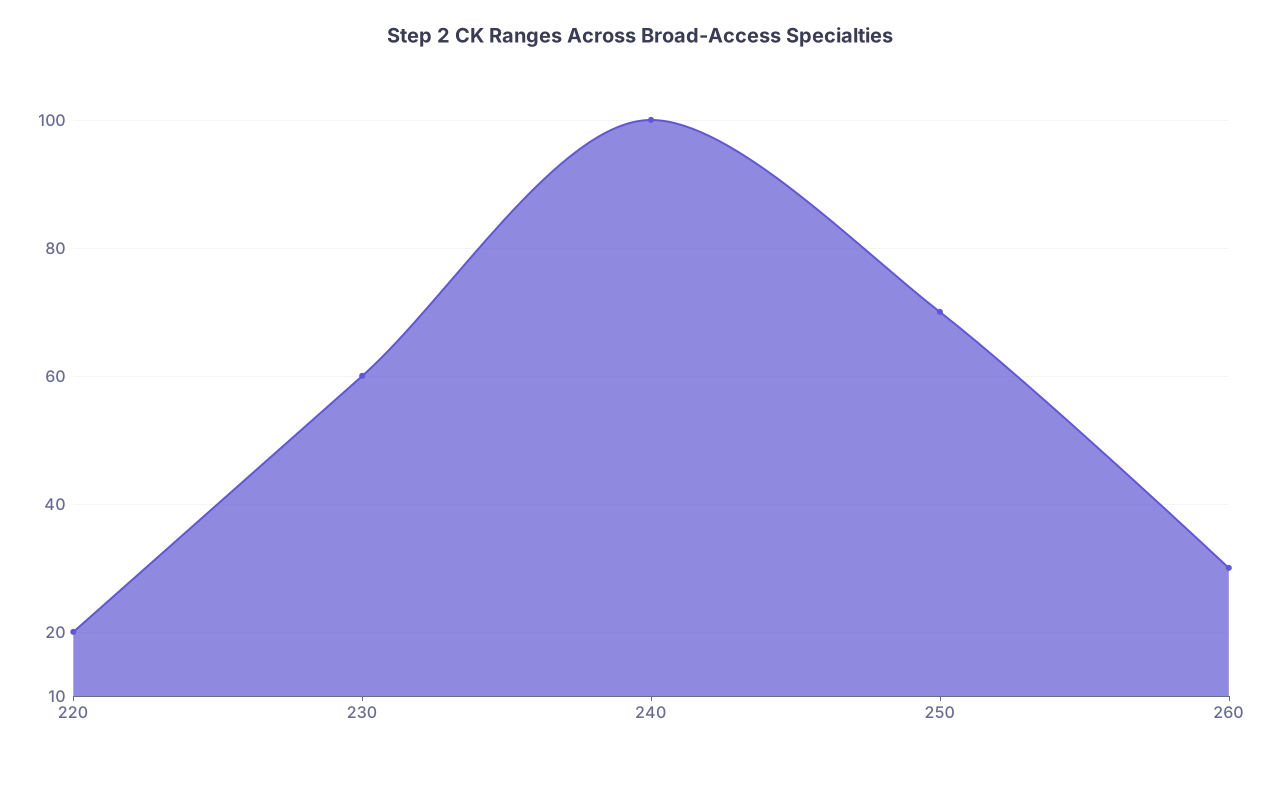
| Category | Value |
|---|---|
| 220 | 20 |
| 230 | 60 |
| 240 | 100 |
| 250 | 70 |
| 260 | 30 |
This shape (peaking around 240–245, with long tails on both sides) is exactly what you expect when a score is one piece of the picture, not the main filter.
Practical thresholds
If your Step 2 CK is:
≥250:
Overkill for many community programs. You will not be rejected for being “too strong,” but you may raise skepticism about whether you actually want to be there. Top academic IM, peds, and neuro like these numbers (especially if you are eyeing subspecialty fellowships later).240–249:
Solid and unremarkable in the best way. You clear nearly all filters. Fit, letters, and clinical performance will now drive match outcomes.230–239:
Very workable for almost all community and a large share of university programs. You might get auto-screened at some of the highest-prestige IM programs that see 260s all day, but you can still land at very good places.220–229:
Now you sit around the 15th–25th percentile. Many FM, psych, and a subset of IM/peds programs will still view you as viable, especially if:- You have no red flags
- Your clerkship narrative is strong
- Your letters argue that your low score is not representative of your actual clinical ability
<220:
You are now significantly below mean. This is where program behavior diverges:- Some FM and psych programs are explicitly open to remediation stories and holistic reviews.
- Some IM and peds programs quietly cut off below 220–225.
This is the score range where I tell people: your application strategy and story matter more than another 10 points of Step 2 CK hypotheticals. You have the score you have. You need letters and a personal statement that address it coherently.
6. How programs actually use Step 2 CK
The idea that programs treat scores as a single “minimum” is naïve. In practice, most decent-sized programs use two or three tiers of score logic:
Hard auto-screen cutoffs
Below this number, your file is never opened except in rare cases with a direct advocate. For many programs this sits around:- 220–230 (broad specialties)
- 230–240 (competitive)
- 240–250 (ultra-competitive)
Comfort zone band
This is where most of their rank list will fall. Applicants in this band get a full, serious look.“Flagged high” band
Very high scores sometimes trigger two behaviors:- Positive bias (“let’s look closely, this applicant seems strong”)
- Or skepticism at community sites (“why here?”), especially if the rest of the application does not explain it.
I have watched selection committees go through ERAS spreadsheets:
- A column with Step 2 CK.
- A filter applied: “show ≥235.”
- Another quick sort by school, then by home program status, then by research.
Scores are not subtle in the early pass.
7. Using your Step 2 CK to shape your match strategy
Enough theory. Here is how to actually use this information.
1. Benchmark yourself correctly
Stop comparing your score to your classmates in isolation. Compare it to the tier you care about.
- 245 in derm: below average for matched applicants; you are starting from behind.
- 245 in radiology: strongly competitive.
- 245 in internal medicine: above mean, opens doors at strong academic programs.
Decide your target tier, then read your score in that context only.
2. Adjust your program list size and spread
The lower your Step 2 CK relative to your target specialty’s norm, the more you must compensate with:
- Larger application volume
- More geographic flexibility
- More community-heavy mix in your list
As a crude rule for a US MD student with one attempt:
At/above typical match mean for specialty:
20–30 programs in IM/peds/psych/FM; 30–40 in anesthesia/EM/rads/OB; 60+ for derm/ortho/neurosurg/plastics.10–15 points below typical match mean:
Add 10–20 programs to those baselines, especially community and mid-tier academic.
US DO and IMG applicants usually need to scale those numbers up further. Not because of fairness, but because program behavior says so.
3. Decide when not to chase a tier
Data-backed blunt statement:
If you are 20+ points below the typical median for matched applicants in an ultra-competitive specialty, you are functionally betting on being a statistical outlier.
Sometimes that is rational:
- You have 15+ first-author papers in that field
- You are at a powerhouse institution with heavy advocacy
- You already did a research year and mentors are all-in
Most of the time, it is just denial. The match statistics tell the story: each year dozens of people in that situation go unmatched and scramble into prelims.
8. Quick specialty-by-specialty reference bands
These are approximate “comfortable” Step 2 CK ranges for a strong shot at interview consideration (not guarantees), assuming no major red flags:
| Specialty | Community / Broad | Academic / Strong | Top-Tier / Elite |
|---|---|---|---|
| Dermatology | 245–255 | 255–262 | 262–270+ |
| Orthopedic Surgery | 240–250 | 250–260 | 260–270 |
| Neurosurgery | 245–255 | 255–262 | 262–270+ |
| Plastic Surgery | 245–255 | 255–262 | 262–270+ |
| Radiology | 235–245 | 245–255 | 255–265 |
| Anesthesiology | 235–245 | 245–255 | 255–262 |
| EM | 235–245 | 243–252 | 252–260 |
| OB/GYN | 235–245 | 245–255 | 255–262 |
| Internal Medicine | 225–238 | 238–250 | 250–260 |
| Pediatrics | 225–235 | 235–245 | 245–255 |
| Family Medicine | 220–230 | 230–240 | 240–250 |
| Psychiatry | 220–230 | 230–240 | 240–250 |
Again: these are bands, not guarantees. But they line up well with what PDs report and what recent match cycles have shown.
9. Timelines, retakes, and Step 2 CK timing games
One last piece the data makes painfully clear: late scores shrink opportunity.
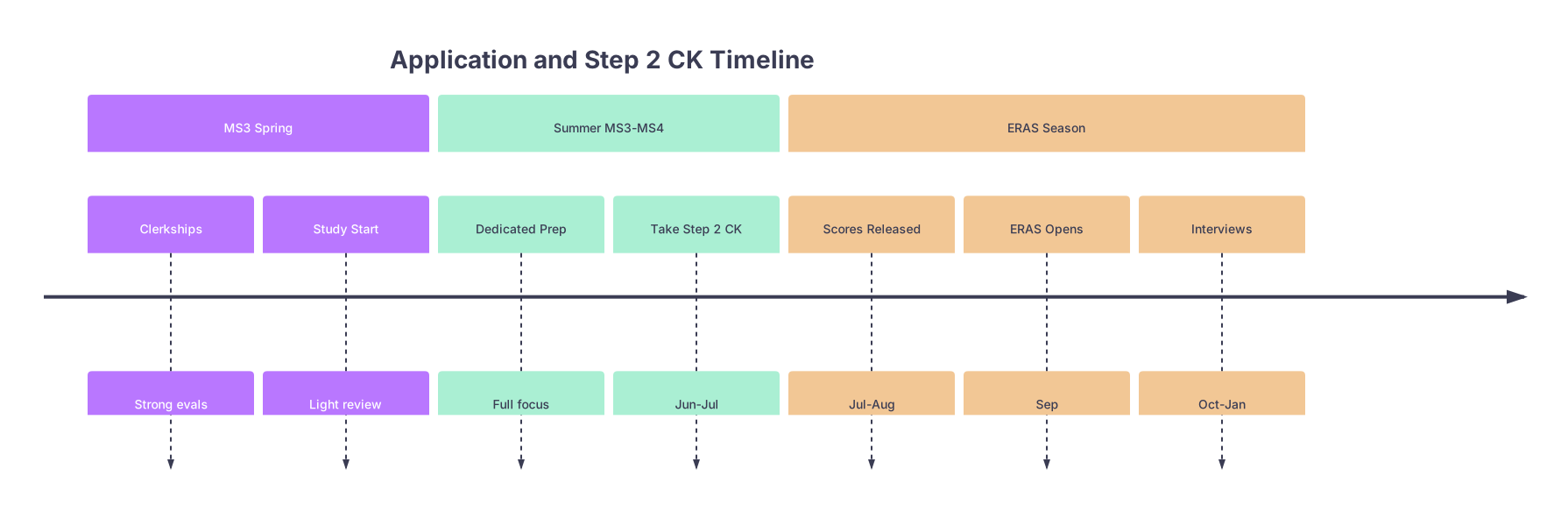
| Period | Event |
|---|---|
| MS3 Spring - Clerkships | Strong evals |
| MS3 Spring - Study Start | Light review |
| Summer MS3-MS4 - Dedicated Prep | Full focus |
| Summer MS3-MS4 - Take Step 2 CK | Jun-Jul |
| ERAS Season - Scores Released | Jul-Aug |
| ERAS Season - ERAS Opens | Sep |
| ERAS Season - Interviews | Oct-Jan |
If your score posts:
By July–August:
Most programs will see it before deciding interviews. You get full benefit (or penalty).After October:
A chunk of programs will have already sent most interview invites. A strong Step 2 CK will help less; a weak one might quietly limit late offers or push you down rank lists.
Retaking Step 2 CK after a low attempt is rarely viable. Programs see all attempts, and Step 2 CK is not designed for easy retakes in the application window. For nearly everyone, you get one swing that matters.
10. The bottom line
Here is the condensed version, without the sugar-coating:
Step 2 CK is now the main quantitative filter.
Programs use it aggressively for auto-screening, especially after Step 1 went pass/fail.Thresholds vary systematically by specialty tier and program prestige.
Ultra-competitive fields like derm, plastics, and neurosurgery effectively start at 255+ for comfort at strong programs. Broad specialties have viable paths even in the 220s.Your score should dictate strategy, not your ego.
Once you know where you land relative to your target tier, you adjust your program list, backup plans, and expectations accordingly.
If you treat Step 2 CK as a blunt “good/bad” metric, you will make sloppy decisions. If you treat it as a percentile band aligned with your specialty tier and program level, you can play the match like an analyst instead of a gambler.