
You have your Step scores. Your clerkship grades are solid. You have research, leadership, nice letters (you think).
ERAS opens, you fire off your applications, and then… silence. Programs you “should” be competitive for never email. Interview season ends and your calendar looks painfully empty.
This is where people usually say, “Residency is random.”
Sometimes that is true. More often, it is not. More often, there are quiet red flags in your ERAS that program directors and coordinators see in two seconds, but no one ever pointed out to you.
I am going to walk you through those landmines.
1. The “Generic Overachiever” Personal Statement
You think: “I will be safe. I will tell them how I always wanted to help people, how much I love teamwork, and how my sub-I showed me dedication and resilience.”
Programs think: “I have read this exact statement 400 times this week.”
The mistake is not being average. The mistake is being interchangeable. A generic personal statement does three damaging things:
- Signals you did not think deeply about the specialty.
- Suggests poor insight and weak self-awareness.
- Makes you easy to forget during the rank meeting.
Red flags here:
- No specific clinical anecdotes anchored in reality (real patients, real dilemmas, real reactions).
- No clear “why this specialty, and not others” beyond clichés like “I like procedures and continuity of care.”
- The “trauma dump” personal story that never ties back to how you function as a trainee.
Fix it:
- Anchor your statement to 1–2 specific, detailed moments from clinical training.
- Make it specialty-specific enough that it could not be copy-pasted for another field without sounding absurd.
- Have at least one attending in that specialty read it and tell you honestly if it sounds like everyone else they read.
If three different people tell you, “It’s nice,” that is usually a bad sign. “Nice” is code for “forgettable.”
2. Lopsided Application: Great Scores, Weak Clinical Story
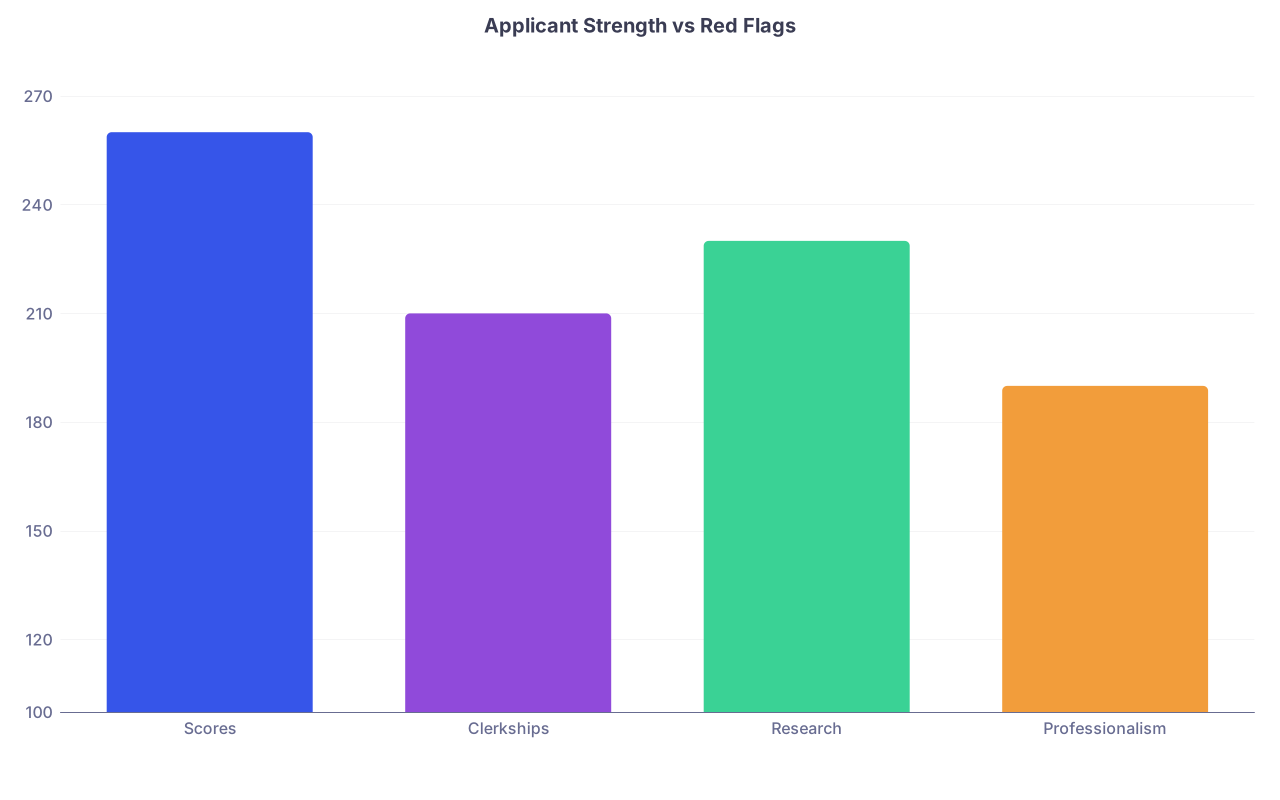
| Category | Value |
|---|---|
| Scores | 260 |
| Clerkships | 210 |
| Research | 230 |
| Professionalism | 190 |
You know USMLE carries weight, so you lean on it. Your ERAS literally screams:
“Look at my 260. Ignore everything else.”
Programs do not ignore everything else.
Common pattern:
- Step 2: 250+
- Clinical comments: “quiet,” “needs prompting,” “limited ownership”
- Sparse explanation of what you actually did on rotations
- No strong narrative of being a reliable, teachable team member
Program directors have been burned by high-score-or-bust residents who crash on the wards. So they are wary. They look for congruence: do your scores, letters, comments, and experiences tell a consistent story?
- Honors in only 1–2 core clerkships with no explanation.
- No sub-I description that shows increasing responsibility.
- A CV stacked with pre-clinical research but thin on real patient care involvement.
Fix it:
- Use your experiences section to highlight clinical behaviors: follow-up, ownership, communication, not just “assisted with admissions.”
- Ask letter writers who saw you actually function on busy services, not just in quiet elective clinics where you could hide.
- If your clerkship record is uneven, address it briefly and professionally in your personal statement or a meaningful experiences description. Not excuses—context.
Programs do not want walking textbooks. They want residents who will not crumble on night float.
3. Letters of Recommendation That Sound… Lukewarm
The worst letters are not obviously bad. They are bland. That is why students miss the red flag.
You assume: “They agreed to write, so it must be good.”
Wrong. Some attendings feel obligated. They write safe letters that quietly sink you.
Common silent killers:
- “Did well for his level of training.”
- “Pleasant to work with.”
- “She will be a competent resident.”
- Overly descriptive and not comparative: lots of “what you did,” not “how you ranked compared to peers.”
That last one is key. Program directors scan for comparative language: top 10%, top few students in years, one of the best sub-interns this cycle.
Red flags (if someone leaks the content to you or you see a draft):
- No explicit comparison to peers.
- Language heavy on “reliable, punctual, respectful” but light on “clinical reasoning, efficiency, ownership.”
- Generic wording that could be anyone: “He is a hard worker and team player.”
Fix it:
- Ask directly: “Would you be able to write a strong and enthusiastic letter of support for my application to [specialty]?” If they hesitate, thank them and find someone else.
- Give your letter writers concrete examples of your work: sick patients you managed, QI data, specific projects. Make it easy for them.
- Prioritize letters from faculty who evaluated you intensely on demanding rotations. A quiet 2-week elective letter is seldom better than a 4-week inpatient block from someone honest and supportive.
Do not be afraid to pivot if an attending seems lukewarm about supporting you. Better no letter from them than a weak one.
4. Sloppy, Misaligned Experiences Section
This is the stealth disaster zone of ERAS. People treat it like a list; programs read it like an x-ray.
I see the same mistakes over and over:
- Overstuffed: 25 scattered entries, each with shallow descriptions.
- Under-explained: “Research assistant” with no outcomes, no role clarity.
- Misaligned: experiences that scream “I wanted derm” applying in psychiatry, with zero psychiatric thread.
Programs are hunting for coherence and maturity.
Red flags:
- Descriptions that are obviously copy-pasted or written in the same stiff template voice.
- Overemphasis on pre-med activities and underemphasis on medical school roles.
- Vague impact statements: “Improved patient satisfaction” with no numbers, no method, no result.
Fix it:
- Curate. More is not better. Choose experiences that build a clear, believable arc toward your specialty.
- Be specific in your role: number of patients, size of team, your exact responsibilities.
- Show progression: medical school organizations where you moved from member to leader, projects that grew over time.
If an experience does not enhance your story for this specialty, strongly consider cutting it or shortening it ruthlessly.
5. Inconsistent Timeline: Unexplained Gaps and Odd Transitions
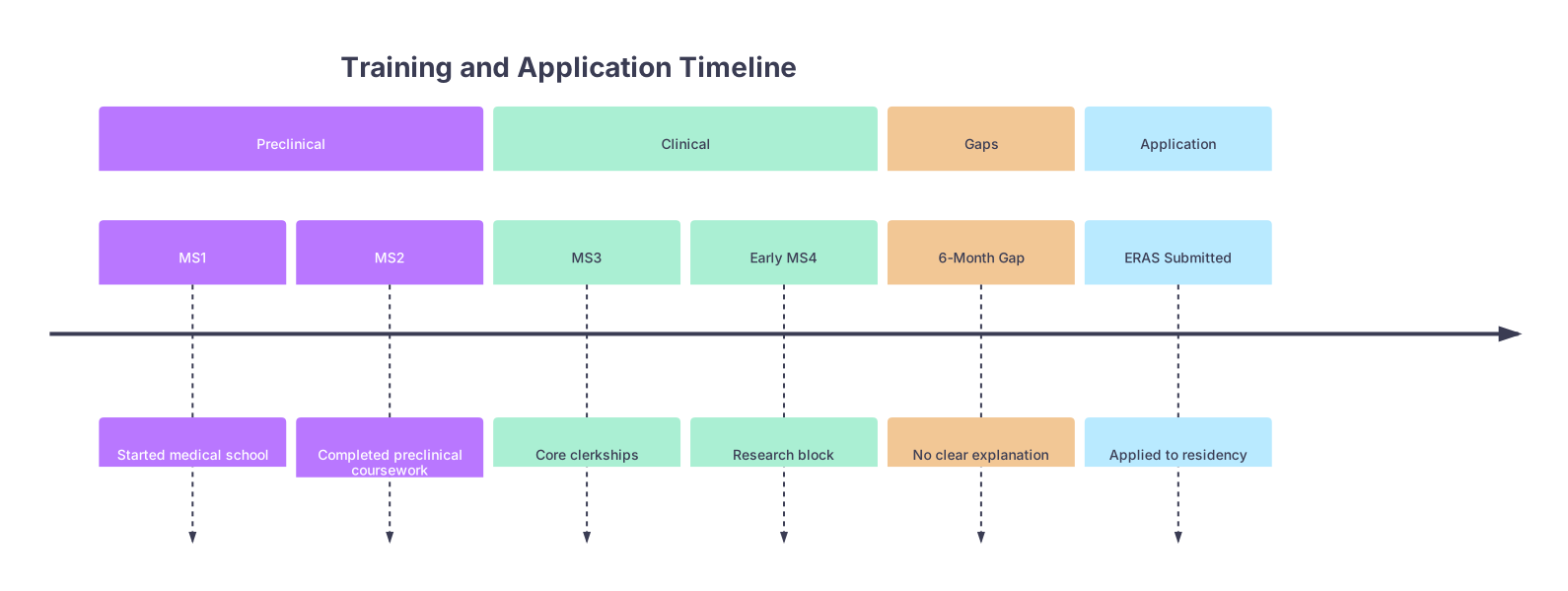
| Period | Event |
|---|---|
| Preclinical - MS1 | Started medical school |
| Preclinical - MS2 | Completed preclinical coursework |
| Clinical - MS3 | Core clerkships |
| Clinical - Early MS4 | Research block |
| Gaps - 6-Month Gap | No clear explanation |
| Application - ERAS Submitted | Applied to residency |
Program coordinators are experts at reading timelines. They do it all day.
Anything that looks “off” without explanation is a red flag, even if the real story is completely understandable.
Common triggers:
- Long leaves without any mention anywhere.
- Delayed graduation not referenced in MSPE or personal statement.
- Switching specialties late without explaining the shift.
Programs will not spend 20 minutes guessing what happened to you. They will just move on to a file that makes sense.
Fix it:
- Briefly explain any significant gap or delay (more than a couple of months) in a professional way: health, family, research year, personal reasons. No drama. Just facts and growth.
- Use the additional information section or personal statement, not a cryptic half-sentence buried in one experience.
- If you changed specialties late, at least acknowledge the transition and why you are now certain of this field.
Silence is interpreted as hiding something. A concise, adult explanation reassures more than you think.
6. Research That Looks Impressive but Smells Inflated
You know “research” is a checkbox. So you stuff your ERAS with every poster and abstract, every “manuscript in preparation,” every case report that never left your hard drive.
Program directors are used to this. They read past the volume to the structure.
Red flags:
- Ten “submitted” or “in preparation” manuscripts with zero accepted publications, especially if all clustered in the last 3–4 months before ERAS.
- Inflated author positions or vague roles: every project lists you as “co-first author” or you “assisted with data analysis” on everything.
- Obvious padding: repeated listing of the same project under different titles, or stretching one poster across multiple entries.
Here is what quietly happens: they stop trusting your self-report. Once that trust erodes, they devalue everything else you say.
Fix it:
- Be brutally honest. If it was never submitted, it is “in preparation” at best—and you should be ready to explain what that means concretely.
- Group smaller works or minor posters rather than giving each one its own grand entry.
- Clarify your actual role: designed survey, did chart review, wrote introduction, did statistical analysis. Specifics show legitimacy.
If you would feel uncomfortable being quizzed in detail on a project at an interview, think twice about how you list it.
7. A Sloppy CV: Typos, Inconsistent Formatting, Weird Capitalization
This one annoys people more than they admit.
Program leadership will often say they do not care about fonts and small typos. Then in rank meetings, I have watched them say, “Her application was kind of sloppy,” as a shorthand for “something felt off.”
What they are actually reacting to: attention to detail.
Red flags:
- Inconsistent date formats, random capitalization (“President of MEDICAL STUDENT ASSOCIATION”), bullet styles changing halfway down.
- Obvious copy-paste errors: wrong institution names, duplicated months, mismatched program titles.
- Multiple spelling or grammar mistakes in your three most important sections (personal statement, experiences, leadership).
This does not prove you will be a bad resident. But you are competing with candidates who look polished. Guess who gets the tie-break.
Fix it:
- Print your ERAS PDF and read it on paper. You will catch mistakes your brain auto-corrects on screen.
- Have at least two people who are good with language read it. Not just content experts—people who actually notice detail.
- Do a final line-by-line pass once everything is uploaded. Every field. Every date.
Sloppiness in your application suggests sloppiness in notes, orders, prescriptions. That is not a mental leap; that is how people actually think.
8. Mis-targeted Program List: Either Unrealistic or Random
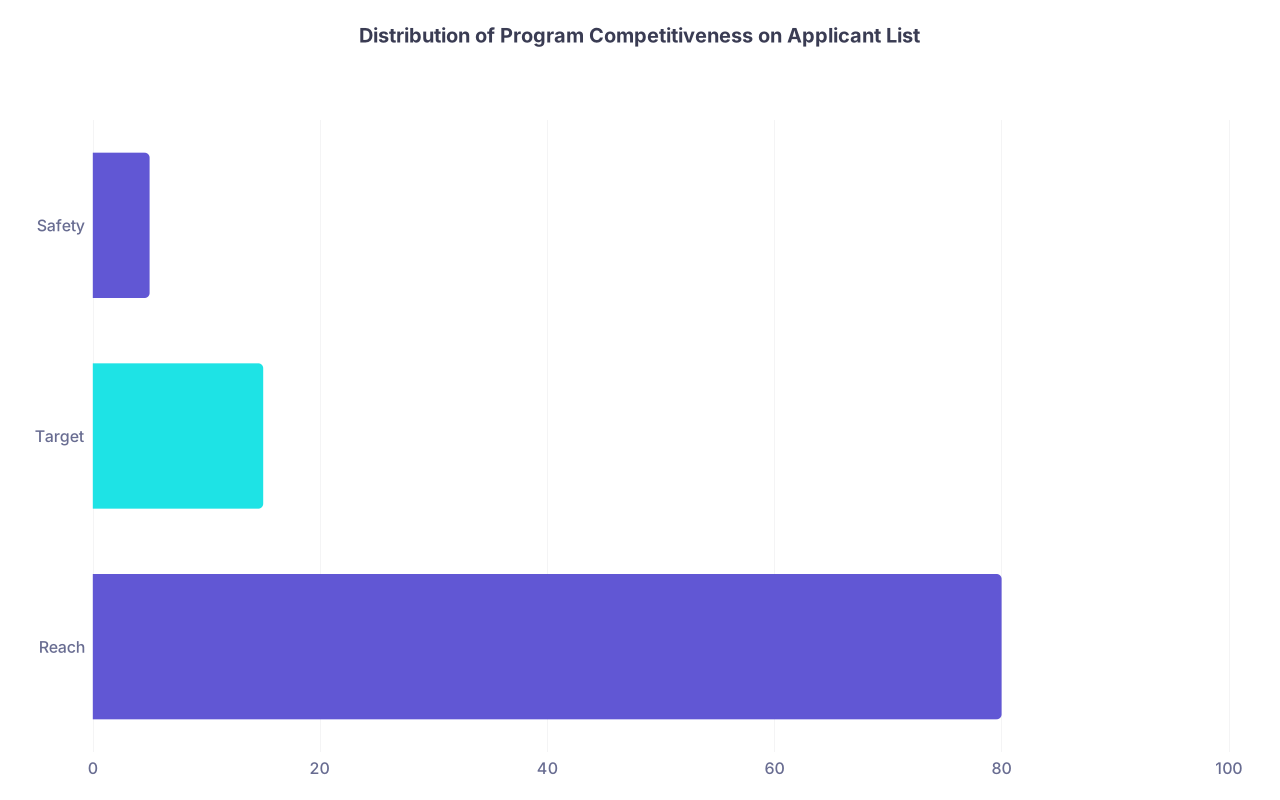
| Category | Value |
|---|---|
| Reach | 80 |
| Target | 15 |
| Safety | 5 |
Your program list itself can be a red flag.
Two common, quiet errors:
- All reach, almost no realistic or safety programs.
- Scattergun list that ignores geographic, mission, or competitiveness fit.
Programs look at this more than you think. Some coordinators will literally glance at your other applications (yes, they can) and infer how serious or grounded you are.
Red flags:
- Applying to every hyper-competitive academic program in all the biggest cities with no prior ties and mid-range metrics.
- Zero community or mid-tier university programs on your list despite a very average application.
- Applying to one program in a region with no other anchors there; it looks like a whim, not a serious plan.
Fix it:
- Use your school’s match data and advisors to build a stratified list: realistic mix of reach, target, and match-preserving “floor” programs.
- Anchor your story geographically or mission-wise and then apply in aligned clusters, not one-offs.
- If you are applying broadly due to personal flexibility, explicitly say in your personal statement or secondary communications why multiple regions make sense for you.
Programs do not want to be your “just in case” backup if everything else fails. They want to feel chosen, at least somewhat.
9. Red-Flag Comments Buried in the MSPE (Dean’s Letter)
This is the section most students weirdly ignore. That is a mistake.
MSPE comments matter. A lot. And programs know exactly where to look for quiet bad news.
Classic hidden bombs:
- “Sometimes required additional prompting to complete tasks.”
- “Benefited from close supervision.”
- “Has grown in her ability to receive feedback.” (Translation: struggled with it.)
- Pattern of “met expectations” with very little positive commentary, especially compared to peers.
One isolated mildly negative comment usually is not fatal. A pattern is.
Fix it:
- Read your MSPE draft carefully as soon as your school allows it. Compare your language to known strong applicants if you can.
- If there is openly incorrect or misleading content, ask (politely but firmly) whether any clarifications can be added. Some schools will adjust phrasing; some will not.
- If there is a legitimate issue (professionalism event, remediation), have a consistent, brief explanation prepared that emphasizes what changed since then.
Do not pretend programs will not notice these lines. They were written for programs. They know exactly where they are.
10. Weak or Confusing Specialty Commitment
You think showing yourself as “open-minded” is positive. Residency programs do not agree.
They want people who actually want their field and will not bail in a year.
Red flags:
- You have 3–4 specialty-specific experiences for a different field, then suddenly apply into something else with no explanation.
- Your personal statement reads like it could be for internal medicine, pediatrics, or family medicine equally.
- Your experiences, research, and leadership all scream “ortho” and you apply anesthesia with zero bridging story.
What this signals: you are using this specialty as a backup or last-minute switch. And yes, they can tell.
Fix it:
- Show at least a minimal consistent thread: elective time, shadowing, research, clinic work in the specialty you are applying to.
- If you changed late, acknowledge that in one or two sentences and explain what you learned that confirmed your current choice.
- Have at least one letter from someone in the specialty you are applying to. “No letter from specialty” is a huge unspoken red flag.
You do not have to pretend you never considered anything else. But you cannot look like you applied here last Tuesday at 11:59 PM.
11. Unprofessional Digital Footprint and Photo Problems
Your ERAS photo and your online presence send signals in 0.2 seconds.
Photograph red flags:
- Poor quality, odd lighting, distracting background (cars, kitchen, “glamour shot” vibes).
- Non-professional attire: wrinkled clothing, casual tops, visible logos.
- Odd expressions—overly playful, disinterested, or clearly a cropped social photo.
Online presence red flags:
- Public Instagram or TikTok with unprofessional posts that are easily tied to your name or school.
- Aggressive or insulting commentary on Twitter/X about patients, attendings, other specialties, or medicine in general.
- Bio lines that clash with your application persona (“Future plastic surgeon” while you are applying internal medicine).
Fix it:
- Get a straightforward, neutral professional headshot: plain background, business or professional attire, normal expression. No artistic experiments.
- Search your own name and clean up public profiles. If necessary, lock things down. Assume some programs or residents will look. Many do.
- Align your visible online identity with the maturity you are trying to project in ERAS.
A sloppy photo or reckless social profile will not help you. At best, it adds doubt. Why risk that?
12. Poor Communication After Submission: Emails, Signals, and Updates

Too many applicants sabotage themselves after ERAS goes in.
Programs watch how you communicate. Every email is part of your file whether you like it or not.
Red flags:
- Sloppy, casual emails: no greeting, no capitalization, text-message tone.
- Overly aggressive follow-up: “I just wanted to check for the third time whether my application has been reviewed.”
- Sending mixed signals: telling multiple programs they are your “top choice” in obviously copy-pasted messages.
Remember: coordinators talk. Chiefs talk. People share screenshots.
Fix it:
- Write concise, formal, polite emails: greeting, one paragraph of content, clear closing with your full name and AAMC ID.
- Use interest signals (letters of intent, updates) sparingly and honestly. Do not tell five programs they are all “number one.” It gets around.
- Respond to any program communication promptly and professionally. If they sense disorganization or disrespect now, they assume it will be worse at 3 a.m. on night float.
Bad communication will not redeem a mediocre file. But good communication can rescue borderline impressions. Do not throw away that leverage.

| Red Flag Area | Primary Fix Focus |
|---|---|
| Personal Statement | Specific, specialty-tied stories |
| Letters of Recommendation | Honest, comparative supporters |
| Experiences Section | Coherent, impact-focused entries |
| Timeline & Gaps | Brief, professional explanations |
| Program List | Realistic, mission-aligned mix |
FAQs
1. If I already submitted ERAS, can I fix any of these red flags?
You cannot rewrite what is locked, but you can still influence perception. You can:
- Strengthen communication: professional emails, thoughtful responses, clear interest.
- Use interviews to clarify gaps, specialty switch, or past issues in a calm, mature way.
- Submit genuine updates (new publication, award, improved Step 2, additional letter) when programs allow them.
You are not powerless after submission, but you are limited. Next cycle, these fixes start months earlier.
2. How many “manuscripts in preparation” is too many before it looks suspicious?
More than 3–4 starts to raise eyebrows, especially if you have zero accepted publications and weak details. A single truly substantial project in preparation is fine. Ten vague “in prep” items looks like padding. If you cannot explain status, collaborators, and your role in under a minute, it is probably not strong enough to list prominently.
3. My MSPE has a negative comment. Should I address it in my personal statement?
If it is mild and isolated, you can let it sit without drawing more attention. If it is significant (professionalism concern, remediation, repeated struggles), you should briefly and directly acknowledge it: what happened, what you learned, what changed. Keep it to a few sentences. Owning it calmly looks far better than pretending no one will notice.
4. Is it a red flag if I do not have research for non-competitive specialties?
Usually not. For many IM, FM, psych, peds, and similar programs, lack of research is not a problem if you have strong clinical comments, decent scores, and good fit. The red flag appears when your application looks empty—no research, minimal leadership, vague experiences—and nothing else stands out. You do not need research; you need something that shows depth and follow-through.
5. How can I tell if my personal statement is “generic” without a program director to read it?
Show it to three different people who know your story: one advisor, one resident in your chosen specialty, and one friend who will be blunt. Ask them one question: “Could this statement be copy-pasted for another person with minimal changes?” If the answer is yes, or if they say “It’s nice” and nothing else, that is your sign to rewrite with concrete scenes, specific details, and a clearer specialty anchor.
Key points:
- Strong metrics do not protect you from subtle red flags; they just make the contrast more glaring.
- Your ERAS must tell a coherent, honest, specialty-specific story with no obvious gaps or padding.
- Details—tone of letters, phrasing in MSPE, formatting, emails—quietly shape whether a program trusts you enough to invest an interview slot.