
You are post-call, sitting at a computer in the resident workroom. ERAS is open. You are on the “Experiences” page, staring at a list that reads like every other applicant’s: “SNMA Vice President, QI Project Lead, Anatomy TA, Clinic Coordinator.”
You know program directors say they value “leadership.” You also know half the class has some kind of title on their CV. You are trying to answer one question:
Does any of this actually look like leadership? Or does it just look like you collected positions?
Let me break this down specifically: leadership in medicine that actually moves the needle on a residency application is not about how many titles you stack. It is about translating roles into measurable impact, and then communicating that clearly enough that a program director can see you functioning as a senior resident or chief.
This is where strong applications separate from the noise.
What Program Directors Really Mean by “Leadership”
You have probably heard vague phrases like “demonstrated leadership” during info sessions. Behind closed doors, program directors are more blunt.
I have heard versions of the same thing from multiple PDs:
- “I want people who make other people better.”
- “If I leave the floor and everything falls apart, that is not my future chief.”
- “Do they own projects to completion, or just add their name and disappear?”
They are not looking for “president of 7 clubs.” They are scanning for three things:
- Can you coordinate humans in a clinical environment?
- Can you move a project from idea to completed change?
- Can you handle responsibility without hand-holding?
Those three questions map almost perfectly onto what you already do as a senior resident:
- Running a team on rounds
- Driving QI initiatives and protocol changes
- Managing cross-coverage, triage decisions, patient flow
Your job in the application is to make that translation obvious. You need to turn:
“Student Interest Group President”
into something like:
“Led a 15-person team to create a new weekend pre-op education class that reduced same-day surgery cancellations by 23% over 6 months.”
One line shows a title. The other line shows leadership.
Types of Leadership That Actually Matter (Clinically and On Paper)
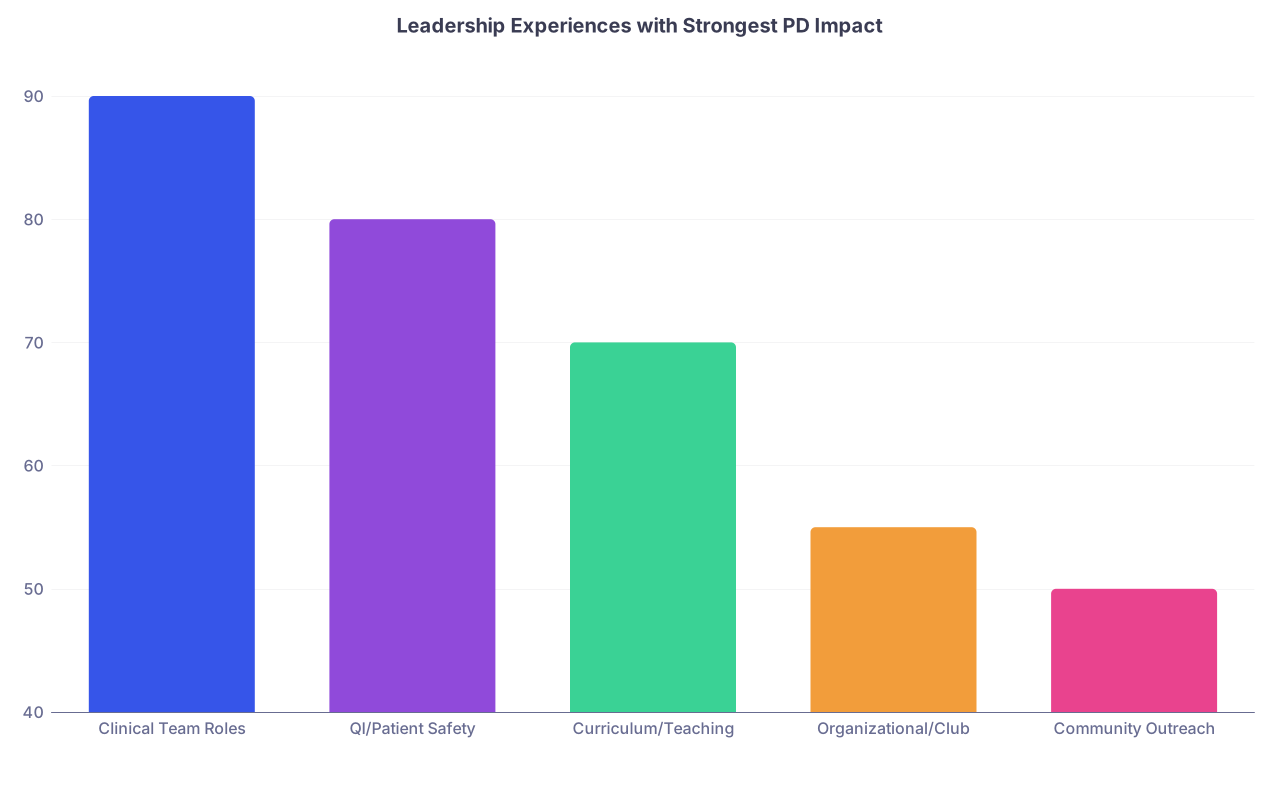
Most students drastically underestimate how much genuine leadership they already have, and drastically overestimate the value of certain “high-prestige” titles that had zero real responsibility.
Let’s sort this out.
| Category | Value |
|---|---|
| Clinical Team Roles | 90 |
| QI/Patient Safety | 80 |
| Curriculum/Teaching | 70 |
| Organizational/Club | 55 |
| Community Outreach | 50 |
1. Clinical Leadership: The Closest Proxy to Residency
If you are trying to convince a program to hire you as a physician, leadership that already lives in clinical space is your strongest currency.
Examples:
- Student team leader on inpatient services (formal roles many schools have for sub-I’s or acting interns)
- Code team coordinator / organizer of mock codes
- Clinic workflow redesign lead
- Telehealth implementation or triage redesign
Weak version on ERAS:
“Served as student leader on inpatient internal medicine service; coordinated student activities and helped with rounding.”
Stronger version:
“Selected as student team leader for 8-week inpatient medicine rotation. Assigned tasks to 4 third-year students daily, pre-rounded on up to 8 patients, led daily student presentations on rounds, and coordinated admission workups with residents, improving on-time note completion from 60% to 95%.”
That second version screams: “I already behave like a junior resident, and I made the team more efficient.”
You are drawing a straight line from:
student → acting intern → resident.
2. Quality Improvement and Patient Safety Leadership
Many programs will outright say: “We need residents who can lead QI.” This is not decorative. Accreditation demands it.
So QI leadership that goes beyond “I joined a project” is high-yield.
Examples that matter:
- Designing and leading a QI initiative (not just collecting data)
- Chair or co-chair of a patient safety committee at the student level
- Leading a morbidity and mortality (M&M) review process as a student
- Implementing checklists, order sets, or bundles that persisted after you
Compare these two:
Version 1:
“Participated in QI project to reduce Foley catheter infections. Collected data and presented a poster at regional conference.”
Version 2:
“Co-led a multidisciplinary QI project on Foley catheter utilization on a 32-bed medicine unit. Developed a daily nurse-driven removal checklist, trained 25 nurses and 12 residents, and helped cut catheter-days by 18% over 4 months. Protocol adopted unit-wide.”
One is “student on a project.”
The other is “junior resident-level leadership on a system change.”
That second version gives a PD confidence that you will not just “be in the room” during their QI meetings—you will drive something.
3. Educational and Curriculum Leadership
Residency is teaching-heavy. Program directors need residents who can organize curricula, mentor juniors, and not crumble when asked to run a didactic on 30 minutes’ notice because the attending is stuck in the OR.
Teaching roles become leadership when they involve:
- Designing or restructuring a course, workshop, or clerkship component
- Coordinating a teaching program (tutor corps, peer teaching)
- Leading a regular teaching conference, bootcamp, or orientation
- Building educational materials that other learners actually use
Weak:
“Medical anatomy teaching assistant for first-year course.”
Strong:
“One of 6 senior anatomy TAs overseeing 120 first-year students. Coordinated weekly lab schedules, trained 18 peer TAs, and introduced a structured pre-lab briefing that was associated with a 12% average score increase on the practical exam compared with the prior year’s cohort.”
Again—coordination, project ownership, measurable outcome. Leadership, not just “I taught people.”
4. Organizational and Student Group Leadership
This is where most students over-collect titles and under-deliver substance.
Holding positions like “President, Internal Medicine Interest Group” or “Vice President, SNMA” can matter a lot—or almost not at all. It depends what you actually did.
Ask yourself two blunt questions:
- Did I change the trajectory of the group, or just maintain the calendar?
- Could someone else have done exactly the same thing without noticing my absence?
If your honest answer to both is “yes, someone else could have done this without noticing I was gone,” then it is not leadership that will stand out.
Impactful examples:
- You took a dormant or small group and ramped it up to a large, active organization.
- You created a new program: mentorship, pipeline, skills, conference, service.
- You managed a budget, fundraising, or significant logistical complexity.
Weak:
“President, Emergency Medicine Interest Group. Organized monthly lunch talks and skills sessions.”
Stronger:
“As President of the EM Interest Group, grew active membership from 15 to 60 students by restructuring events into 3 themed tracks (clinical skills, career, community). Secured $4,000 in departmental funding to launch a suturing and US bootcamp now embedded into the second-year curriculum.”
One describes duties. The other shows initiative, scale, and legacy.
5. Community and Advocacy Leadership that Feels Clinically Relevent
Community work matters when it is not just “I volunteered once a month.” Program directors increasingly care about health equity, advocacy, and longitudinal commitments.
But the bar for leadership is the same:
- Did you build something that persisted after you?
- Did you coordinate people and resources?
- Did it touch actual patients or at-risk populations in a sustained way?
Examples:
- Co-founding a free clinic or expanding its services/hours
- Running a longitudinal health education or screening program
- Leading an advocacy initiative that changed institutional or local policy
Weak:
“Volunteer coordinator at student-run free clinic.”
Stronger:
“As volunteer coordinator for a student-run free clinic serving 1,200+ visits/year, reorganized the scheduling system for 80+ volunteers across medicine, nursing, and pharmacy. Reduced last-minute shift cancellations by 40% and expanded evening coverage, enabling the clinic to add a third weekly session.”
Again: numbers, scale, coordination, outcome.
Turning Vague Titles into Sharp, Impact-Oriented Descriptions
You already see the pattern. Most students describe roles. Strong applicants describe impact.
Here is the basic translation framework I have medical students use when we rewrite ERAS entries:
- Scope – Who and what were you responsible for?
- Actions – What did you actually do that changed something?
- Outcome – What became different? Ideally with numbers.
- Transfer – How does this mirror resident-level responsibility?
Let’s make it concrete.
| Role | Weak Description | Strong Description (Impact-Focused) |
|---|---|---|
| QI Lead | Led QI project on discharge summaries. | Led 6-person QI team to redesign discharge summary template for general medicine service; reduced average completion time from 23 to 14 minutes and increased inclusion of follow-up plans from 72% to 96%. |
| Clinic Coordinator | Coordinated student volunteers in clinic. | Managed 40-student volunteer pool for weekly primary care clinic; implemented new shift sign-up and reminder system that cut no-shows in half and enabled clinic to add 10 additional patient slots per week. |
| Interest Group President | Organized meetings and events. | As Psychiatry Interest Group President, created a 4-session “Psych on the Wards” practical series attended by 80+ students, which was later adopted by the clerkship as required pre-rotation prep. |
The content of your leadership does not need to be earth-shattering. You are not expected to cure sepsis as an MS3. But it does need to demonstrate that you:
- Noticed a problem.
- Thought through a solution.
- Got other people on board.
- Saw it through to measurable change.
That is residency.
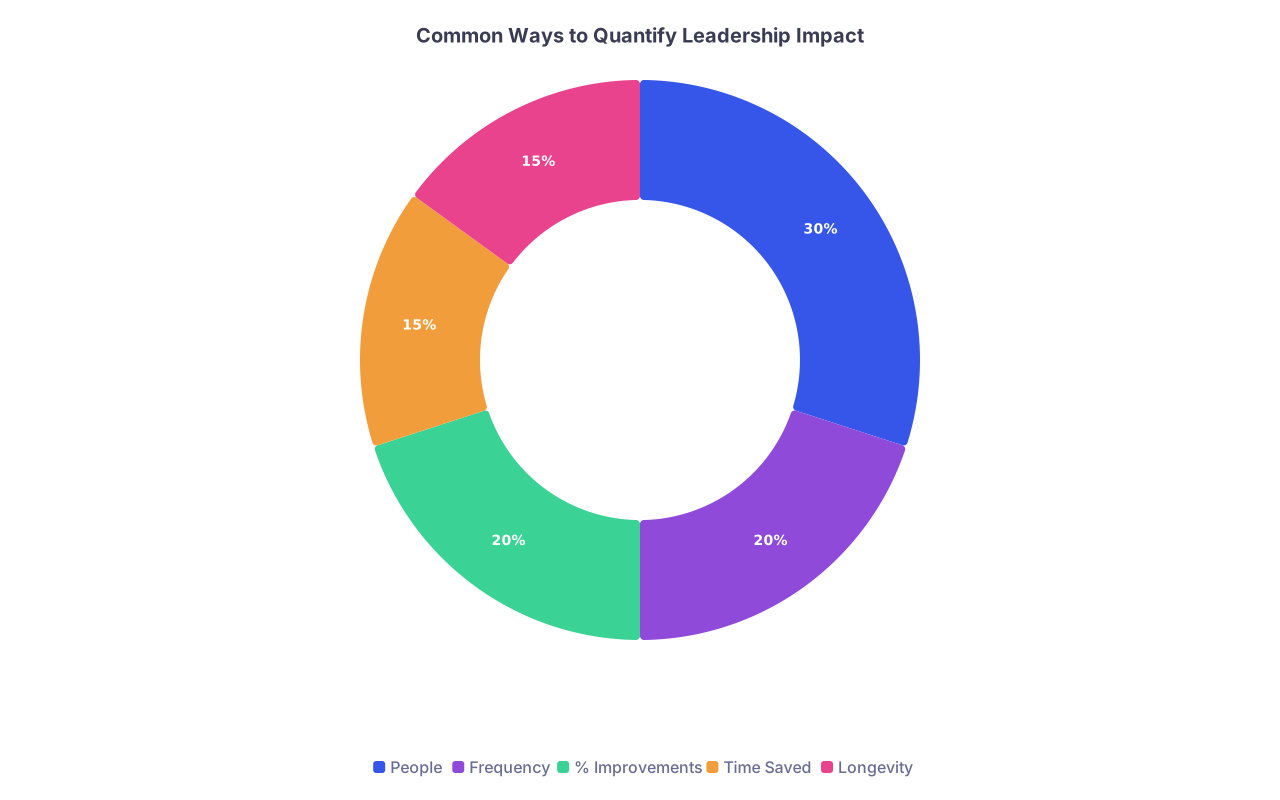
Quantifying Impact Without Making Up Numbers
Students often tell me, “I do not have numbers for my impact.” Usually that is not true. They just have not thought carefully enough.
Reasonable, non-fabricated numbers you can typically estimate:
- Number of people: members, volunteers, students, patients served.
- Frequency: weekly clinic, monthly event, annual conference.
- Percentage changes: attendance increased by ~X%, no-shows dropped by ~Y%.
- Time changes: reduced waiting time by Z minutes, shortened report by A minutes.
- Longevity: “still in use 2 years later,” “integrated into curriculum,” etc.
| Category | Value |
|---|---|
| People | 30 |
| Frequency | 20 |
| % Improvements | 20 |
| Time Saved | 15 |
| Longevity | 15 |
Example transformations:
“Organized lectures for interest group” →
“Organized a 6-lecture career and skills series attended by an average of 45 students per session over one academic year.”
“Improved pre-clinic workflow” →
“Created a pre-visit chart prep checklist that decreased average rooming time from 14 to 9 minutes across 3 clinic sessions per week.”
If you truly have no numbers, use structured qualitative outcomes:
- “Requested by the clerkship director to continue annually.”
- “Adopted by the residency program as a standard orientation session.”
- “Served as the template for similar initiatives in two other clinics.”
It is not about perfection. It is about giving PDs enough specificity that they believe you did more than hold a title.
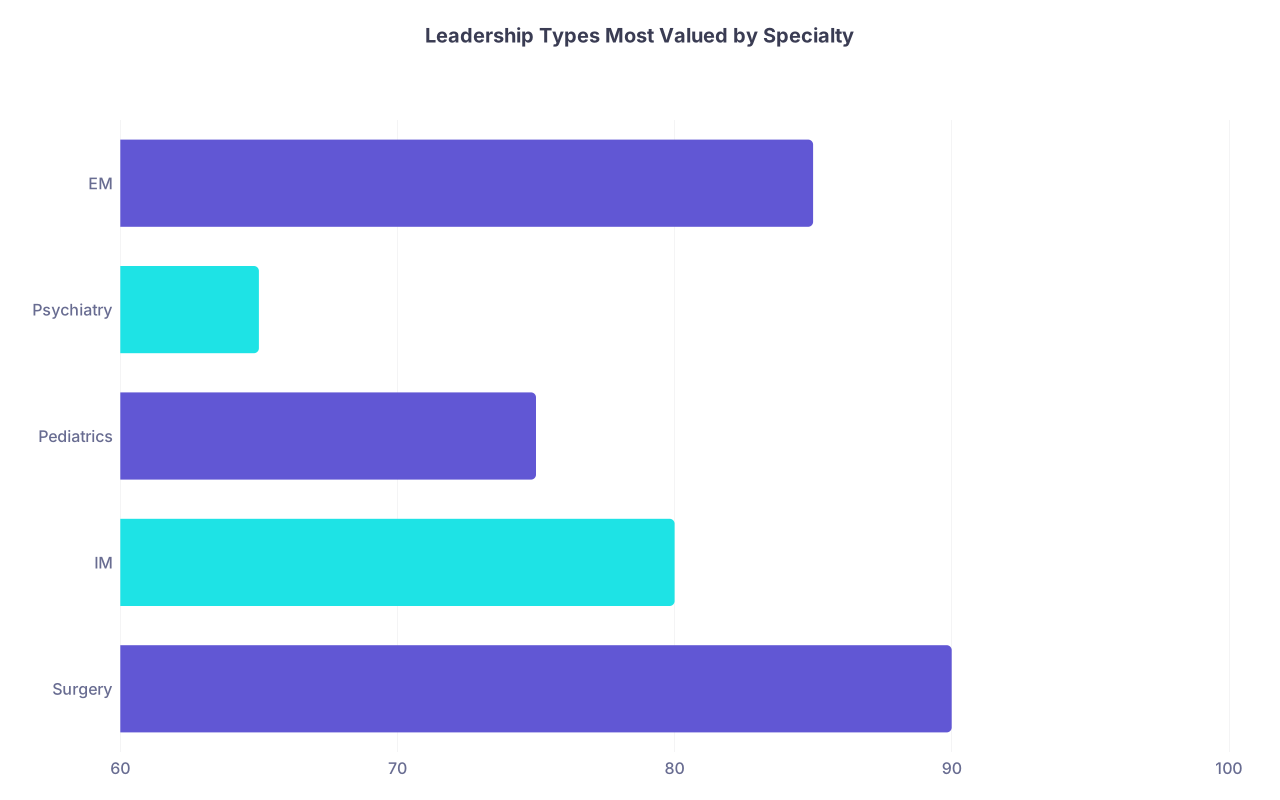
Aligning Leadership With Your Target Specialty
Here is where many otherwise excellent applicants miss the mark. They have good leadership, but they never connect the dots to their specialty.
Program directors are pattern-matching: “Can this person function in our specific environment?”
| Category | Value |
|---|---|
| Surgery | 90 |
| IM | 80 |
| Pediatrics | 75 |
| Psychiatry | 65 |
| EM | 85 |
Surgical Specialties (General, Ortho, ENT, etc.)
What plays well:
- OR workflow / turnover improvement projects
- Simulation-based leadership: bootcamps, skills labs
- Clinical team leadership on acute, procedure-heavy services
- Anatomy / procedural teaching coordination
Example framing:
“Co-led a simulation-based central line insertion curriculum for 30 third-year clerkship students, coordinating schedule, supervising practice sessions, and working with nursing educators to standardize sterile technique checklists currently used on the vascular access team.”
You are telegraphing: I can handle high-acuity, procedure-centered systems and teach others.
Internal Medicine and Subspecialties
What plays well:
- Inpatient medicine team coordination
- QI projects tied to chronic disease management, readmissions, throughput
- Interdisciplinary leadership—particularly with nursing, pharmacy
- EBM/journal club leadership with structured approaches
Example:
“Served as student co-leader for a 12-month heart failure transitions-of-care project; coordinated data collection across medicine, cardiology, and case management teams and helped implement a standardized follow-up call script, associated with a 10% relative reduction in 30-day readmissions on the pilot unit.”
That shows you understand systems, complexity, and team-based care.
Pediatrics
What plays well:
- Longitudinal community and school-based programs
- Vaccine outreach, literacy, developmental screening initiatives
- Family-centered or communications-focused projects
- Advocacy or school-health collaborations
Example:
“Founded a monthly ‘Asthma Action Night’ at a local middle school for children with poorly controlled asthma and their caregivers. Coordinated a team of 10 students and 2 pediatric residents, providing education, inhaler technique checks, and follow-up calls; school nurse-reported ED visits for asthma dropped from 18 to 9 in the following semester.”
Psychiatry
What plays well:
- Longitudinal mental health initiative or peer support leadership
- Curriculum work around communication, interviewing, or stigma reduction
- Interdisciplinary work with social work, psychology, community orgs
Example:
“Developed and co-facilitated a 4-session ‘Managing Distress on the Wards’ small-group curriculum for third-year students. Collaborated with psychiatry faculty and wellness office; 92% of participants rated sessions as ‘very helpful’ for coping with emotionally challenging clinical situations.”
Emergency Medicine
What plays well:
- Triage, disaster response, EMS, or ED workflow projects
- Mock codes, simulation, resuscitation teaching
- High-acuity environments requiring rapid coordination
Example:
“Coordinated 6 interprofessional mock mass-casualty simulations with EM residents, EMS, and nursing; managed roles for 50+ participants per event, debriefed learners, and helped revise the ED triage algorithm based on identified bottlenecks.”
You are essentially saying: “I already operate like a junior EM resident leading parts of a chaotic shift.”
How to Weave Leadership into the Entire Application (Not Just One Box)
Strong residency applications do not isolate leadership in one ERAS section. They let it leak into everything:
- Personal statement
- Letters of recommendation
- Interview answers
- Supplemental/secondary essays (where applicable)
1. Personal Statement: One Leadership Story, Told Well
Do not list your leadership roles in your personal statement. That is what ERAS is for. Pick one story.
The best leadership story for a personal statement has:
- Real stakes (patients, team morale, something could fail)
- Real conflict (resistance, time pressure, limited resources)
- A pivot moment where you made a specific decision
- A change in outcome
Bad:
“I served as president of our interest group and learned a lot about leadership.”
Better:
“Midway through my year as free clinic coordinator, we were short-staffed, behind on charts, and at risk of cutting our Saturday session that served undocumented patients. I had 48 hours to decide whether to cancel or find another path…”
Then you walk through what you did, why, and what changed.
And somewhere, cleanly but directly, you link it to residency:
“That experience is the closest I have come as a student to the pager going off on a busy call night, when the easy option is to triage for survival and the harder option is to ask: What system can we change so this does not keep happening?”
Now your leadership reads as preparation, not a side hobby.
2. Letters of Recommendation: Set Your Attending Up to Notice
Most attendings will default to generic praise unless you give them concrete material.
When you ask for a letter, send a 1-page summary of:
- Your 2–3 main leadership roles
- 2–3 specific examples that your letter writer could reference
- A line connecting that leadership to the specialty
For instance:
“During my sub-I, I helped restructure the student sign-out process; I would be grateful if you could comment on that and my role in coordinating the team on our busiest days if that fits with your experience of me.”
Not everyone will use it. But when they do, you get letters that say:
“On our service, Alex essentially functioned at the level of a beginning intern when it came to coordinating the student team, particularly after they developed a new standardized student sign-out template that our clerkship has now adopted.”
That is far more powerful than “Alex is a natural leader.”
Common Leadership Pitfalls That Weaken Applications
Let me be blunt about a few things that quietly hurt otherwise strong candidates.
1. Title Inflation Without Substance
If you have seven “president” or “founder” titles, PDs assume:
- You are exaggerating.
- None of them were actually that serious.
If one or two roles were substantial, expand those. The rest can be listed without fanfare or even omitted if marginal.
2. Vague Buzzword Soup
“I developed leadership, communication, and teamwork skills” means nothing. Everyone writes that.
Specify:
- What decision did you have to make that was uncomfortable?
- Where did you have to tell someone “no” or “this needs to change”?
- When did something almost fail, and what did you do?
Specificity is the antidote to buzzwords.
3. Overplaying Non-Translatable Leadership
If your biggest leadership is in a completely non-medical context (tech startup, sports team, business), it can still help, but you must translate.
Bad:
“As captain of the varsity soccer team, I learned leadership.”
Better:
“As captain of the varsity soccer team, I coordinated 25 athletes with conflicting academic schedules, mediated interpersonal conflicts, and created a peer-led film review system. It is the same skill set I used later to coordinate residents and nurses on a chaotic call night during my medicine sub-I.”
You must do the translation work. Do not leave it to the reader.
A Simple Framework to Audit Your Leadership Before You Submit
Before you hit “certify” on ERAS, take 20 minutes and run every leadership entry through this filter:

| Step | Description |
|---|---|
| Step 1 | Leadership Role |
| Step 2 | De-emphasize or cut |
| Step 3 | Clarify scope and outcome |
| Step 4 | Add 1 line mapping to residency-level skill |
| Step 5 | Keep and highlight |
| Step 6 | Did something change because of you? |
| Step 7 | Can you describe the change clearly? |
| Step 8 | Is it relevant to residency/specialty? |
You should end up with:
- 1–3 leadership experiences that clearly show ownership, impact, and relevance.
- Several smaller roles that are still solid but not oversold.
- A personal statement and at least one letter that reinforce the same narrative.
How This Actually Lands in a Selection Meeting
Let me give you the reality of how this plays out.
Selection committee, 7 p.m., conference room. A stack of applications. Everyone is tired.
Applicant A:
- “President of 4 interest groups”
- “Involved in QI project”
- “Volunteer at free clinic”
Applicant B:
- “Co-led QI project decreasing catheter-days by 18% across a 32-bed unit; protocol adopted.”
- “Student team leader on inpatient service; improved note timeliness from 60% to 95%.”
- “Coordinated 40 volunteers for free clinic, reducing shift no-shows by 40% and enabling 10 more patient visits per week.”
Same raw ingredients. Different outcome.
Applicant B gets labeled as: “Clearly can run a team; potential chief.”
Applicant A gets labeled as: “Standard good med student.”
Residency programs are not selecting résumés. They are selecting future colleagues who will be left alone on nights and weekends and expected to keep things running.
Your leadership narrative’s job is to convince them you can already do a student-level version of that.
Looking Ahead: From “Leadership Experience” to “Leadership Identity”
Right now you are trying to get interviews and match well. That is the immediate goal. But the way you conceptualize leadership in this phase does something else: it sets up how you will show up as a resident.
You have two options:
- Treat leadership as a line item you needed to check off for ERAS.
- Treat it as the early version of the physician you are becoming.
If you take the second route, something shifts. You start asking, on every rotation:
- What is broken here, and what can I actually fix?
- How do I make the people around me more effective?
- How do I take responsibility for outcomes, not just tasks?
Those are the people who become go-to residents, chiefs, fellows, and faculty. The ones PDs talk about later as “we knew from their application they were going to be a leader here.”
For now, your job is simpler: translate your roles into clear, concrete impact, and make it impossible for a program director to miss the through-line between what you have already done and the resident you are about to become.
Once your application is out, the next step is learning how to talk about all of this out loud, in real time, across 10–15 interviews without sounding rehearsed. That is the next phase in the journey.