
Last November, I watched a program director close the door, drop into his chair, and say, “Alright. Let’s talk about who we’re actually willing to work with at 3 a.m.”
On the table: a stack of printed ERAS files, a projected spreadsheet with color‑coded names, and the careers of a couple hundred nervous applicants who had no idea how their fate was being decided.
Let me tell you how those conversations really go. And where people like you win, lose, or quietly get erased from the rank list.
What the Room Actually Looks Like on “Rank Night”
You’re picturing some formal, orderly academic proceeding. It’s not.
By the time rank meetings happen, everyone is tired. It’s after clinic. Someone’s still in scrubs. Someone’s on call and will be in and out. Half the room has a pager that will go off at the worst possible moment. There’s pizza or cold sandwiches. Coffee that’s been reheated twice.
The core players usually look like this:
- Program Director (PD) – runs the show, voice carries the most weight
- Associate PD(s) – often the organized brains of the operation
- A handful of faculty – some engaged, some barely know any names
- Chief residents – surprisingly influential in good programs
- Sometimes a coordinator in the back – quietly tracking everything
And then there’s The Spreadsheet. Every program has a version:
| Category | Weight in Score | Notes |
|---|---|---|
| Academics/Board | 20–30% | Step scores, class ranking |
| Clinical Performance | 20–30% | MS3/MS4 evals, grades |
| Letters of Rec | 15–25% | Especially from known faculty |
| Interview Score | 20–30% | Faculty & resident ratings |
| Fit/Professionalism | 10–20% | Vibes, red flags, gut check |
The exact percentages vary, but the underlying truth doesn’t: by “rank night,” your file is no longer a neat packet. You are a composite score, a color on a spreadsheet, and—if you’re lucky—a strong opinion in someone’s mind.
And the first thing they do? They redraw the list from scratch based on those opinions.
Step One: Who Even Makes It to the Debate?
Most applicants will never be debated. That’s the first unpleasant secret.
The real arguments are about a thin band in the middle–top of the list. Everything above that band is “obviously in,” everything below is “only if we don't fill.”
Before any meeting, leadership has already done a quiet pre‑cut. Usually something like:
Auto‑drops:
– Clear professionalism red flags (documented issues, bad dean’s letter language)
– Very low board/COMLEX scores with no strong offset
– Terrible or generic letters from core rotationsAuto‑keeps at the top:
– Home students we like
– Rotators who crushed it
– Applicants with powerhouse letters from people the PD actually knows
Here’s the part nobody tells you: a lot of programs weight interview scores less than they claim, and letters more than they admit. Especially letters from friends. You won’t see that on the website.
By the time the full committee walks in, the discussion is really about a narrower subset: “people we’re interested in but not sure about” and “people someone in this room is willing to fight for.”
How They Actually Talk About You
Let’s walk through what happens when your name comes up.
The PD (or associate) pulls up your name and says something like, “Alright, next let’s talk about Patel, Priya.”
Then a predictable pattern:
A quick scan of the summary slide:
Step scores, school, AOA or not, research count, interview score, any red/yellow flags.The “Who met this applicant?” question.
Faculty glance at their notes. Chiefs look at their ranking sheets. Someone will say, “I interviewed her,” or “She was on my service in October.”Then comes the part you never see: the unfiltered impressions.
You get comments like:
- “Strong clinically, great stories, I’d absolutely trust her on nights.”
- “He was fine, but I couldn’t get a sense of his personality.”
- “The letter from Dr. X was glowing, and I trust her judgment.”
- “Research is all fluff—poster after poster, nothing substantial.”
- “Came late to interview day. Blamed traffic. That bothered me.”
- “Residents loved him. That matters.”
Understand this clearly: most of the room does not know your full file. They’re not re‑reading your personal statement. They’re working off a summary, their own memory, and the emotional residue of your interview day.
That’s why certain parts of your application matter way more than others behind closed doors:
- The letter from a known, respected faculty member = gold
- Specific behaviors on interview day, good or bad = remembered
- Your away rotation performance = decisive, especially in competitive fields
- Any whiff of ego, laziness, or drama = poison
What Actually Counts the Most (Not the Brochure Version)
Let me break the mythology for you.
Programs publicly say: “We take a holistic approach. We value well‑rounded applicants.”
Behind closed doors, it’s more “Who will do the work, not cause problems, and make us look good?”
If you really want to understand what makes an application “strong” in that room, it’s this mix:
1. Dependability Signal
They’re looking for evidence you’ll show up, work hard, and not implode.
That signal comes from:
- Consistent, strong clerkship comments (“hard‑working,” “takes ownership,” “reliable”)
- Letters that say versions of: “I would be thrilled to have them as a resident”
- No professionalism blemishes. And I mean none. One vague sentence in the MSPE can sink you.
If your file suggests “high‑maintenance,” that’s nearly impossible to overcome. I’ve heard PDs say, “Brilliant, but I don’t want the headache.” And that’s it. You’re done.
2. Resident Endorsement
Far stronger than applicants realize.
Residents will often:
- Run a separate “resident rank list” after meeting/interviewing you
- Give feedback like, “Cool but odd vibe,” or “Instantly felt like one of us”
- Flag concerns: weird comments, lack of respect to staff, arrogance
In many programs, if residents strongly dislike an applicant, the PD simply won’t rank them high. Some won’t rank them at all.
If you were warm, curious, and respectful to residents on interview day, that carries more weight than the tenth research abstract on your CV.
3. Known Quantity Effect
Familiarity is a huge advantage.
Who gets that?
- Home students
- Away rotators
- Applicants with trusted letters from close colleagues
When a faculty member says, “I’ve worked with her, she’s excellent,” everyone relaxes. You rise, sometimes several positions instantly. Conversely, a lukewarm “He’s fine” from a trusted faculty is the kiss of death in a competitive pool.
The Real Debates: Where Files Live or Die
Let’s get to the fun part: the actual arguments.
Scenario 1: The Numbers Outlier
Applicant A: mediocre board scores, strong letters, residents loved them.
Applicant B: stellar boards, okay interview, generic letters.
This is the classic tension. The PD will ask: “Who do we actually want beside us in the trenches?”
You’d be surprised how often Applicant A wins—if the program trusts their clinical ability. Boards open the door, but they don’t guarantee a top rank. Once you’re in the interview pile, performance and trust signals matter more.
But if you have below‑average scores and nothing special in letters or narrative, no one has a reason to fight for you. That’s when you slide down the list quietly.
Scenario 2: The Risky Superstar
This is the “could be amazing, could be a disaster” applicant.
Think: prestigious school, eye‑popping research, almost cocky in the interview, a faint professionalism concern in the MSPE like “occasionally had difficulty accepting feedback.”
The room will literally say things like:
- “If they’re good, they’d be our best resident.”
- “If they’re bad, they’ll be a constant headache. Do we want to take that chance?”
If a PD has recently burned themselves on a high‑risk applicant, they’re far less likely to roll the dice again. They remember the pain of remediation, grievances, team dysfunction. You don’t see those scars, but they drive decisions.
Scenario 3: The Quiet Gem
Honestly? These are my favorite.
Applicant from a mid‑tier school, solid but not perfect scores, limited research, but:
- Glowing narrative from a rotation: “One of the best students I’ve worked with in 10 years.”
- Chiefs say, “We all liked him. Very down‑to‑earth, teachable.”
- Interview wasn’t flashy, but no weirdness, no red flags.
In the room, someone will say, “I know he doesn’t pop on paper, but I really liked him,” and if that person has any clout, you move up. One advocate in that room can change your trajectory dramatically.
This is where your personal statement, your story, and your behavior on interview day matter more than you think. They create that “I liked them” memory.
How Much Your Personal Statement and Research Really Matter
Let me be blunt.
Nobody is sitting in that room re‑reading your personal statement sentence by sentence. They skim it before the interview for:
- Any major red flags
- Coherence of your story
- Alignment with the specialty
- Evidence you actually understand what you’re applying to
If your personal statement gets discussed at rank time, it’s usually either:
- Because it was really good and memorable (“She talked about caring for rural patients and then backed it up with free clinic experience.”)
- Or because it was bizarre, generic to the point of useless, or tone‑deaf
Research is similar. Past a certain threshold, volume doesn’t move the needle. Committees care about:
- Substance over quantity (a legit project you can speak intelligently about > 15 poster footnotes)
- Fit with the program’s strengths
- Whether you were actually involved or just a name at the bottom
Programs with strong academic identities will care more. Community programs may barely glance at it, unless it’s totally absent for a very competitive specialty.
So if you’re banking on your research volume to carry a weak clinical narrative or sketchy professionalism history, you’re misreading the game.
The Unspoken Tiebreakers
When two applicants look similar on paper and interview, the committee moves to softer, barely documented factors. This is where it can feel unfair, but it’s also where smart applicants can stand out.
Here’s what sways borderline calls more than anyone admits:
The “Will They Be Happy Here?” Question
Programs dread early attrition and chronically unhappy residents. So they look for:
- Applicants who seem to understand the city and actually want to live there
- People who expressed specific interest in that program’s features (not copy‑paste lines)
- Life circumstances that realistically match the program environment
I’ve heard: “He kept telling us he hates cold weather. We’re in Minnesota. Why rank him high?”
The “Do They Want Us or Just Anyone?” Vibe
Programs can smell shotgun applicants.
If you sent a weak or generic “why us” signal, you get treated as interchangeable. Strong, program‑specific interest—shown in your interview answers, questions you asked, sometimes even a thoughtful post‑interview communication—pushes you up a few spots.
Not 20 spots. But in the crucial middle band of the list, three spots is the difference between matching and not.
The “Will They Fit Our Culture?” Gut Check
That word “fit” can be abused, but it usually means:
- Do they communicate clearly and respectfully?
- Are they teachable or already know everything?
- Do they seem like someone our residents will enjoy working with at 4 a.m.?
If your humor, tone, or interactions on interview day felt off, that sticks. People remember how you made them feel more than what you said.
The Politics You Don’t See
There are power dynamics in that room. Pretending otherwise is naïve.
A letter from a big‑name faculty at another institution who’s close friends with your PD? That’s not “just another letter.” That’s, “I promised I’d take a good look at this one.”
Examples of quiet influence:
- “He’s coming from our med school. We know their training; I trust their clinical skills.”
- “She rotated with Dr. X, who called me personally about her.”
- “She’s done serious work in the subspecialty we’re trying to build.”
Also: internal politics. Departments sometimes nudge the PD about research needs, call schedules, or service coverage. It shouldn’t be the primary driver, but it does color borderline decisions.
None of that is on the website. But it absolutely shapes how hard someone’s willing to push for you.
How to Build a File That Wins in the Room
You want the practical takeaway, not just the voyeuristic view. Fair.
If your goal is a “strong residency application” in the actual committee room, focus on three priorities:
Be the person residents and faculty like working with.
Rotations, sub‑Is, away rotations—those evaluations are not just numbers. They become the stories people tell in that room. Don’t just be competent. Be prepared, respectful, and low‑drama.Get at least one letter from someone whose opinion carries real weight.
That means: a respected clinician in your specialty who knows you well enough to write specifics. Ideally someone your target programs might know by reputation. Specific, detailed praise gets remembered and quoted.Eliminate avoidable red flags like your life depends on it.
Because in this process, it kind of does. No unexplained gaps. No weird behavior on interview day. No unprofessional emails. No showing up late and casual about it. Committees will forgive an average score before they forgive a pattern of poor judgment.
Your job isn’t to impress a computer algorithm. It’s to put enough trust signals into your file that, in that windowless conference room, one or two people feel comfortable saying, “I’ll go to bat for them.”
If you manage that, you stop being just a line in a spreadsheet. You become a name people actually want to see on their call schedule.
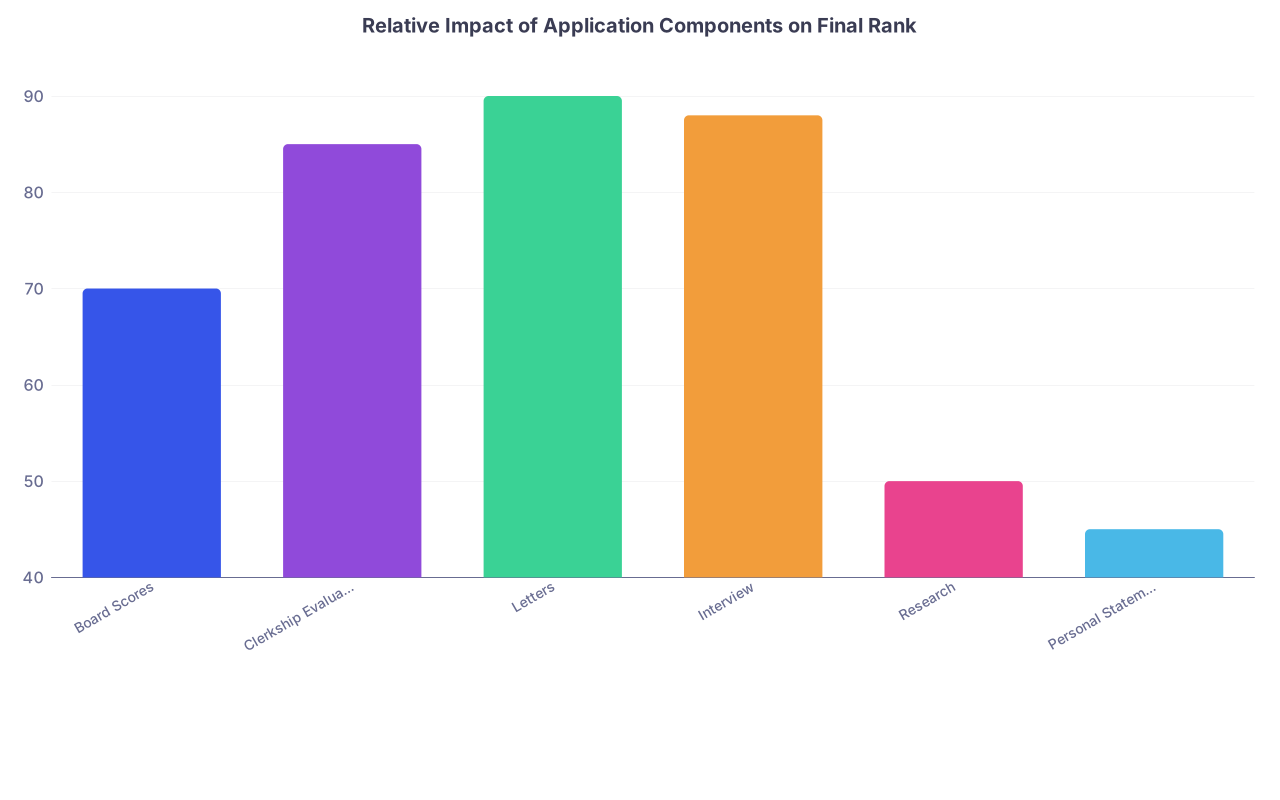
| Category | Value |
|---|---|
| Board Scores | 70 |
| Clerkship Evaluations | 85 |
| Letters | 90 |
| Interview | 88 |
| Research | 50 |
| Personal Statement | 45 |

| Step | Description |
|---|---|
| Step 1 | Application Submitted |
| Step 2 | Screened by PD/Coordinator |
| Step 3 | Removed from List |
| Step 4 | Interview Day |
| Step 5 | Faculty & Resident Scores |
| Step 6 | Preliminary Rank Spreadsheet |
| Step 7 | Selection Committee Meeting |
| Step 8 | Moved Up List |
| Step 9 | Stay or Move Down |
| Step 10 | Final Rank List |
| Step 11 | Advocate in Room? |


FAQ: Behind Closed Doors Residency Selection
1. Does one bad interview sink my entire application?
Not automatically, but a clearly poor interview absolutely damages you. If every interviewer scores you low or flags concerns about communication, maturity, or professionalism, you’ll drop sharply. If just one person “didn’t connect” but others liked you, the committee usually treats that as noise unless the criticism matches something in your file (e.g., similar concerns from a letter or MSPE).
2. How much do away rotations really matter in competitive specialties?
A lot. For fields like ortho, derm, ENT, neurosurg, EM, an away where you’re seen as “one of our own” can move you from anonymous to top‑tier at that program. But the reverse is also true: a mediocre or bad away is often worse than no away. If you rotate, you are auditioning. Every day. Every note. Every interaction with nurses.
3. Do post‑interview thank‑you emails or letters impact ranking?
Most of the time they don’t move you more than a tiny bit, if at all. But they can serve as tiebreakers in the “who really wants to be here?” sense. A short, specific, genuine note that references something unique about the program is noticed more than you think. Overly effusive, copy‑paste, or obviously strategic messages are rolled eyes and deleted.
4. If my Step 1/COMLEX 1 is low but everything else is strong, can I still be ranked high?
Yes, if your later performance proves that low score was an outlier. Strong Step 2, excellent clerkship comments, and convincing letters from respected clinicians can more than compensate. Committees are much more forgiving of older academic “dings” when your more recent story is: capable, growing, reliable. What does not work is low scores plus vague or average evaluations.
5. Should I try to get faculty who are friends with the PD to write my letters?
Only if they genuinely know you well enough to write something specific and true. A weak letter from a “big name” is worse than a strong letter from a mid‑tier but highly engaged mentor. When PDs read, they’re looking for credibility plus detail, not just a famous header. If your mentor happens to be connected, that’s a bonus. But forced networking letters with no substance are instantly obvious—and quietly discounted in that room.
Key things to walk away with: committees rank people they trust, not just files that look impressive; one genuine advocate in that room is worth more than three generic “strong” letters; and your day‑to‑day behavior on rotations and interview days isn’t background—it’s the main story they tell when the doors close.