
You are here
You are staring at your MSPR / dean’s letter draft and that stack of rotation evaluations your school finally released.
You see: “Pleasure to work with.” “Solid knowledge base.” “Will do well in residency.”
Sounds fine. But your advisor looks at them, pauses, and says, “We need stronger language if you’re aiming for that program list.”
Now you are wondering:
What does “stronger language” actually mean?
Which phrases make PDs sit up, and which are faint praise?
And what does a top student’s evaluation really look like in words, not fantasies?
Let me break this down specifically. Rotation evaluations are coded documents. Attendings reuse the same 40 phrases, but they are not equal. Some are basically, “Did not scare me.” Others are, “I would hire this person tomorrow.”
You need to know the difference.
How program directors actually read rotation comments
Program directors are not reading your evaluations like a novel. They are skimming for pattern and signal.
Three things they care about:
- Is this student safe and reliable?
- Are they above-average for my specialty?
- Did anyone stick their neck out with truly strong praise?
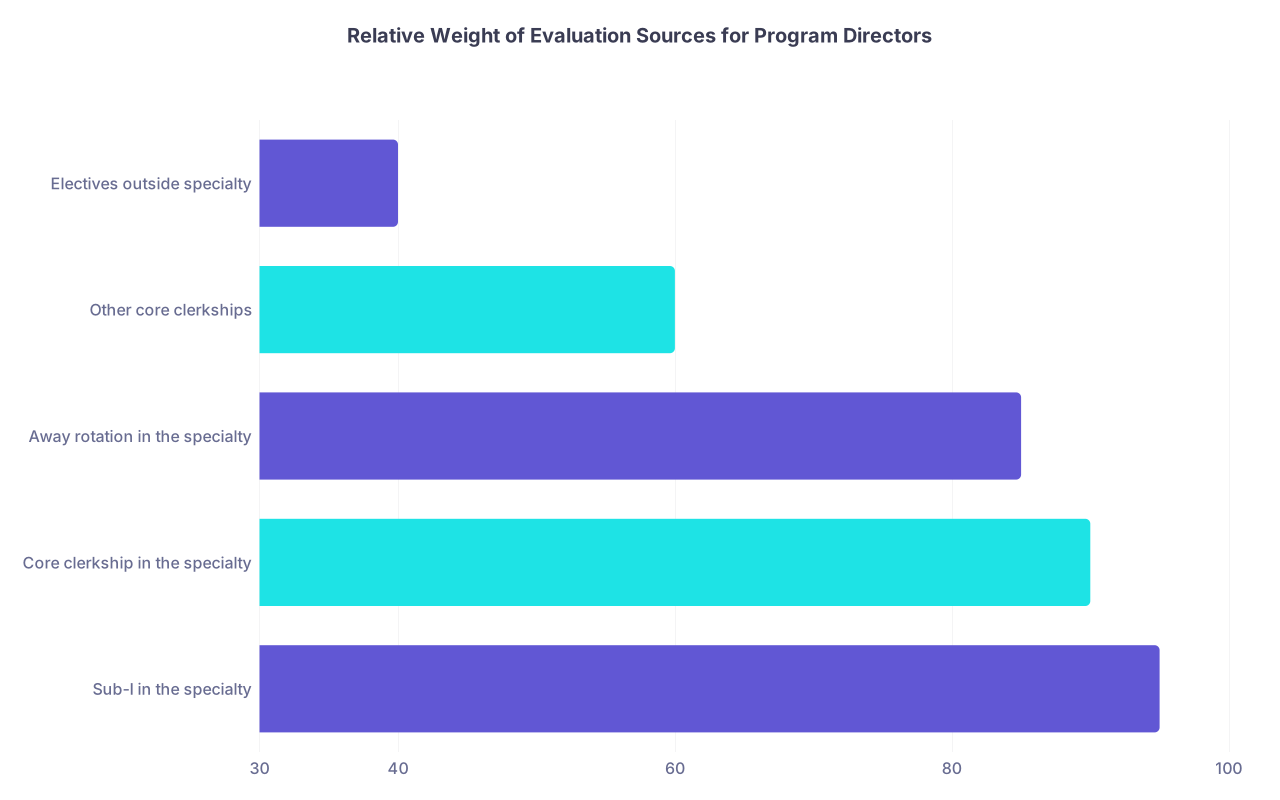
And they look for that across who wrote the comment (weight) and how they wrote it (language strength).
| Category | Value |
|---|---|
| Sub-I in the specialty | 95 |
| Core clerkship in the specialty | 90 |
| Away rotation in the specialty | 85 |
| Other core clerkships | 60 |
| Electives outside specialty | 40 |
Numbers are rough, but the pattern is real. Let’s translate that into practical tiers.
Tier 1: High‑stakes evaluations
These carry disproportionate weight:
- Your sub‑I in the specialty you are applying to
- An away/audition rotation in that same specialty
- Core clerkship in that specialty at your home program
A lukewarm comment here hurts more than a glowing comment in an unrelated field helps. PDs know attendings in their specialty calibrate students more harshly and more precisely.
Tier 2: Core clerkships outside your chosen specialty
Internal medicine for surgery applicants. Surgery for EM applicants. Pediatrics for IM applicants, and so on.
These answer the question: “Is this student consistently good, or just good when they care?”
Programs like to see that you were at least “above average” almost everywhere, with one or two rotations that are clearly exceptional.
Tier 3: Electives and fluff rotations
Derm elective for an anesthesia applicant. Radiology for a psychiatry applicant. These are nice, but no one bases a rank decision on “Superb performance on culinary medicine elective.”
Bottom line: The same phrase means different things in a sub‑I in your chosen field vs a random elective. A “top 10 percent” in your sub‑I is heavy currency. “Top 10 percent” in an easy outpatient elective is mildly interesting at best.
The evaluation phrase dictionary: what actually signals “top applicant”
Let’s get concrete. I will group common phrases into four categories:
- True top‑tier / “write the letter now” language
- Strong but not elite
- Lukewarm or coded concerns
- Red flags
We will stay mainly on categories 1–2, but you need to know the landmines as well.
1. True top‑tier language: the “I would hire this resident” bucket
These are the phrases that make PDs slow down and reread.
You see any of these on a sub‑I or core in your target specialty? That is what separates you from the pile.
a. Explicit ranking language
These are gold. Attendings know exactly what they are saying here.
Phrases that mean: This student is in my top handful, across years:
- “One of the best students I have worked with in several years.”
- “Top 5% of students I have supervised.”
- “Among the top students I have worked with in my career.”
- “Truly exceptional; in the very top tier of students at this institution.”
- “Ranks in the top 1–2 students I have worked with this year.”
On a key rotation, even one of those sentences is enough to reframe an entire application.
Be careful with watered‑down versions though. “Above average” or “strong” are not the same as “top 5%.” PDs know the difference.
b. “I would gladly work with / hire this person” language
These phrases speak directly to the residency question: would this attending want you on their team as a resident.
Look for:
- “I would be delighted to have this student as a resident in our program.”
- “I would recruit this student to our residency without hesitation.”
- “I strongly recommend this student for residency training in [specialty].”
- “I hope she matches into our program.” (Yes, that matters.)
- “We would be fortunate to have him as a colleague.”
These are powerful because they cross a line from generic praise to clear endorsement. The attending is staking a little bit of reputation.
c. Advanced autonomy and near intern‑level functioning
True top students get language that sounds like: “This person is basically an intern already.”
Key phrases:
- “Functioned at or near the level of an intern.”
- “Worked with a high degree of independence appropriate for a sub‑intern.”
- “Required minimal supervision for tasks typically done by interns.”
- “Managed the team’s patients with an intern‑level understanding of diagnosis and management.”
- “I trusted her to independently follow up on plans and communicate with the care team.”
This language is especially potent on internal medicine, surgery, EM, and OB/GYN sub‑Is. PDs are scanning for whether they can put you on call July 1st without disaster.
d. Strong comparative professionalism and teamwork comments
Residency is a team sport with high risk. The top applicants get singled out as safe, mature, and pleasant at baseline.
Look for statements that include both comparative and qualitative language:
- “An outstanding team member and a stabilizing presence on the ward team.”
- “Mature beyond her level of training.”
- “Colleagues consistently sought him out for help and collaboration.”
- “Exemplary professionalism, even in stressful or chaotic situations.”
- “Sets the standard for professionalism among medical students.”
PDs see hundreds of “pleasant to work with” comments. They do not see “sets the standard” very often. That is top‑tier.
e. Rapid growth / steep learning curve
Top performers do not just “show up strong.” They get noticeably better, fast. Attendings comment on that.
Top language here:
- “Showed remarkable growth over the course of the rotation.”
- “Incorporated feedback immediately and did not repeat mistakes.”
- “Progressed from novice to near intern‑level over 4 weeks.”
- “Demonstrated an unusually steep learning curve.”
This buys you forgiveness for early clumsiness and reassures PDs that 3 years of training will turn you into something excellent.
2. Strong but not elite: still very good, very useful
If top‑tier phrases are the bolded, underlined lines PDs quote at rank meetings, this second category is the backbone. Many excellent residents had mostly “strong but not hyperbolic” language.
These phrases are good signs, especially when consistent across multiple rotations.
a. Clear “above average” comparative language
Comparison matters. “Good student” is weak. “Above average” with specifics is solid.
Examples:
- “Clearly above average for level of training.”
- “Performed better than most students at this stage.”
- “Stood out among the rotation cohort for work ethic and preparation.”
- “Consistently exceeded expectations for a third‑year student.”
On a key rotation, a couple of these, stacked with decent grades and test scores, is completely adequate for most programs.
b. Strong clinical reasoning and knowledge, but not billed as “the best”
Phrases that signal good but not legendary:
- “Demonstrated strong fund of knowledge and applied it well clinically.”
- “Formulated appropriate, prioritized differential diagnoses.”
- “Integrated evidence and guidelines into patient plans.”
- “Solid understanding of pathophysiology and disease processes.”
You want these in combination, not as isolated comments. A single “good knowledge base” without anything else is generic. Three or four different attendings writing about your reasoning? That is pattern.
c. Reliable workhorse language
Programs need people who show up, finish the work, and do not create drama. Strong but not flashy students get reliably positive comments like:
- “Extremely dependable; followed through on all assigned tasks.”
- “Always prepared and on time; could be counted on.”
- “Required minimal prompting to complete responsibilities.”
- “Took ownership of patient care responsibilities appropriate to level.”
This language does not wow anyone, but it calms them. And believe me, PDs like calm.
d. Good communication and rapport
Again, not the top 1% glossy comments, but very good:
- “Communicated clearly with patients and families.”
- “Established strong rapport with patients across a wide range of backgrounds.”
- “Delivered difficult news with empathy and professionalism.”
- “Worked effectively with nursing and ancillary staff.”
For psychiatry, pediatrics, family medicine, EM, these carry more weight. A psych applicant with multiple “exceptional empathy” comments is doing well.
The code words of trouble: what lukewarm actually looks like
You want to know when you are being quietly dinged. Many students miss it because nothing looks obviously negative.
Let me translate.
3. Lukewarm: damning with faint praise
On your transcript, it looks fine. On PD eyes, it is “meh.”
Common phrases that sound OK but actually signal “middle of the pack” or “a bit underwhelming”:
- “Pleasant to work with.”
- “Got along well with the team.”
- “Will do fine as a resident.”
- “Solid performance.”
- “Met expectations for level of training.”
- “Demonstrates a good foundation” (with no specific strengths listed after).
One of these, buried in a pile of glowing ones, is noise. But if your best comments are “pleasant” and “solid,” that is a problem if you are targeting competitive programs or specialties.
Worse are the “compliment sandwiches” where the middle is the real message:
- “Despite initially struggling with organization, she ultimately met expectations by the end of the clerkship.”
- “With further development, he will be an effective intern.”
Translation: borderline now, maybe safe later.
4. Red‑flag language: words that make PDs nervous
A single sentence can override a lot of neutral comments. These are the phrases that trigger concern:
- “Required more supervision than typical for level of training.”
- “Struggled to integrate feedback.”
- “At times, appeared disorganized or overwhelmed by routine clinical tasks.”
- “Professionalism concerns were addressed during the rotation.”
- “Needs to improve reliability and follow‑through.”
- “Had difficulty accepting feedback.”
- “Knowledge base is below expected for level.”
Most schools soft‑pedal this language, but program directors read between the lines. If a comment like this shows up in your chosen specialty, then the rest of your application has to work harder.
How phrases vary by specialty: the subtext shifts
Same words, different impact, depending on where they appear.

Surgery and surgical subspecialties
What excites surgical PDs:
- “Exceptional technical aptitude”
- “Fine motor skills and spatial awareness beyond level”
- “Calm and effective in the OR even under pressure”
- “Quick hands, excellent tissue respect”
- “Actively sought opportunities to improve technical skills”
Also valued:
- “Took initiative in pre‑op planning and post‑op management”
- “Strong workhorse; first in, last out, without complaint”
A surgery evaluation that only says “good presentations, pleasant to work with” without any mention of technical ability or OR demeanor? That is mediocre for someone applying to surgery.
Internal medicine and IM subspecialties
They care most about thinking and ownership.
Power phrases:
- “Outstanding clinical reasoning and synthesis.”
- “Owned her patients; anticipated problems and addressed them.”
- “Generated thoughtful, evidence‑based plans.”
- “Exceptional written and oral presentations; guided team discussions.”
Weakness on “ownership” or “clinical reasoning” is a much bigger problem here than “not very fast with procedures.”
Emergency medicine
EM is big on teamwork, calm under pressure, and multitasking.
Look for:
- “Thrived in a fast‑paced environment.”
- “Stayed composed during multiple simultaneous critical patients.”
- “Outstanding team communication in resuscitations.”
- “Quick to recognize sick vs not sick appropriately.”
Generic “good student” language on an EM rotation, with no comments on speed, triage, or communication in chaos, will not help you much for EM.
Pediatrics, family medicine, psychiatry
Relational skills move the needle here.
Phrases that matter:
- “Exceptional empathy; quickly established rapport with patients and families.”
- “Highly attuned to patient concerns and psychosocial context.”
- “Worked seamlessly with nursing and interdisciplinary team.”
- “Sensitive and respectful when discussing difficult topics.”
If your peds evaluation sounds like a medicine evaluation—with zero mention of communication or rapport—that is a missed opportunity.
The structure behind the comments: numbers, anchors, and dean’s letters
Most schools now have some combination of:
- Numerical/anchor ratings (e.g., “below expectations / meets / exceeds / outstanding”)
- Free‑text comments
- A dean’s letter (MSPE) that summarizes or excerpts these
Understanding the interplay matters.
| Anchor Term | What Attendings Usually Mean | How PDs Read It |
|---|---|---|
| Outstanding | Top ~10% or better | Strong positive signal |
| Exceeds | Above average | Good but not elite |
| Meets | Average | Neutral at best |
| Below | Below average | Problem unless isolated |
When PDs see “outstanding” boxes checked with weak comments, they discount both. When they see “exceeds” with very strong comparative language (“one of the best students”), they assume the checkbox scale was stingy.
How MSPEs distort or amplify phrases
Some schools sanitize comments so hard that everything sounds the same. Others preserve direct language.
Patterns I have seen:
- Schools that remove explicit comparative text (“top 5%”) and replace it with vague summary lines. This blunts your standout comments.
- Schools that only include negative comments or “areas for improvement” in the MSPE. This can make your record look worse than it is if you do not understand the policy.
- Schools that rank you by quartile for each clerkship. Then “above average” comments plus a “3rd quartile” rank is a contradiction that raises questions.
You cannot change your school’s format, but you should know it cold. Ask exactly how comments and checkboxes map to the MSPE and what gets left out.
Reading your own evaluations: how to audit your signals
You need to stop reading your evaluations like a person looking for validation and start reading them like a PD deciding whether to hire you.

| Step | Description |
|---|---|
| Step 1 | Collect all evaluations |
| Step 2 | Sort by specialty relevance |
| Step 3 | Highlight comparative phrases |
| Step 4 | Identify strongest rotations |
| Step 5 | Look for consistent above average |
| Step 6 | Align these with target specialty |
| Step 7 | Identify weak or concerning comments |
| Step 8 | Plan future rotations & letters strategically |
| Step 9 | Any top-tier language? |
Step 1: Sort by importance
Group:
- Core and sub‑I in your target specialty
- Away/audition rotations
- Other major cores
- Electives
Then, within each, sort by how strong the language is.
Step 2: Extract and categorize the key phrases
Literally make a document and copy‑paste the strongest and weakest sentences from each evaluation.
Mark them as:
- Top‑tier language (one of the best, intern‑level, would recruit, etc.)
- Strong but not elite (above average, strong reasoning, dependable)
- Lukewarm (pleasant, solid, met expectations)
- Concerning (needed extra supervision, professionalism concerns)
You will see patterns quickly.
Step 3: Compare pattern vs your target specialty
If you are applying to surgery and your best language is on psych and peds, but your surgery comments are “pleasant and hardworking,” that is a misalignment you need to handle in your personal statement and letters.
If you are applying to IM and three separate attendings say some version of “exceptional clinical reasoning, above average for level,” you are in a very good position even without dramatic flowery phrases.
How to generate stronger phrases on future rotations
You cannot rewrite your old comments. You can absolutely influence the next ones.

I am not talking about lobbying attendings to “please write that I am top 5%.” That is annoying. I am talking about deliberately doing the behaviors that produce those comments.
1. Engineer “intern‑level” comments on sub‑Is
Attendings use “intern‑level” when you:
- Anticipate daily needs without constant prompting (labs, imaging, consults, discharge planning).
- Know your patients cold and can answer questions without fishing.
- Write notes and orders that residents barely have to edit.
- Communicate with nurses and ancillary staff proactively.
If you want that phrase, you need to explicitly ask for that level of responsibility: “I would like to work toward functioning as close to an intern as is safe. I would appreciate feedback on what I need to do to get there.”
Then actually implement the feedback within 24 hours. This is where the “steep learning curve” comments come from.
2. Get comparative language by prompting comparison indirectly
Attending: “You are doing really well.”
You: “Thank you. I am aiming to be at least above average for my level. Are there specific things that distinguish your top students that I can work on during the rest of this rotation?”
Now you have:
- Signaled that you care about being top, not just safe.
- Given them a vocabulary: “top students,” “above average.”
When they see the eval form later, those exact phrases are on the menu. You are not asking them to lie; you are priming them to think in comparative terms.
3. Generate “ownership” language in cognitive specialties
On medicine, neurology, psych, etc., you get “ownership” comments when you:
- Show up knowing every lab, every imaging result, every overnight event for your patients.
- Propose plans before being asked, with rationale.
- Follow through on tasks and circle back with updates without prompting.
Residents notice, then attendings echo:
“Owned her patients,” “Took responsibility for follow‑up,” “Acted as an integral member of the team.”
4. Build “communication/rapport” phrases in people‑heavy fields
If you are angling for psych, peds, FM, EM and your evals never mention communication, you are losing easy points.
Be explicit:
- Volunteer for family meetings.
- Offer to lead patient education conversations.
- Ask attendings for feedback specifically on your patient interactions.
Then, when they fill out your eval:
“Exceptional rapport,” “Communicated complex information clearly,” “Patients consistently praised him” start to appear.
When your evaluations are weaker than you want
This is where the cynicism pays off. You might discover that your target‑specialty evaluations are merely “fine.”

What then?
1. Identify if the problem is localized or global
If:
- One bad eval on a notoriously harsh rotation director.
- All other comments are strong.
Then you contextualize it in your advisor meetings and move on. PDs are not stupid; they know local reputations.
If:
- Multiple rotations say “met expectations,” “pleasant,” with no comparative or standout phrases.
Then you have a global “too generic” problem, and you need:
- A couple of late, very strong rotations (ideally in your specialty).
- A personal statement and LORs that emphasize your growth and current level.
2. Use letters of recommendation as the “override”
Letters can carry stronger, more explicit language than standardized eval forms. You want your letter writers to put in, essentially, the phrases your evaluations lack:
- “One of the strongest students I have worked with recently.”
- “I would rank her at the top of any applicant list.”
You do not script their letter, but you can tell them frankly:
“I am very interested in [specialty] and [your program]. I am hoping to be described, if you feel it is accurate, in comparative terms. For example, how I compare to other students and whether you would want me as a resident.”
The good letter writers know exactly what that means.
3. Align your school list with your evaluation profile
If your evals never approach top‑tier language, but are consistently “above average,” you should not build a list made entirely of hyper‑competitive programs that mostly interview “top 5% at their school” applicants.
That is not self‑doubt. That is pattern recognition.
Use your evaluation language as a reality check against your Step scores, research, and school prestige.
One example: side‑by‑side comments
Here is what I mean in practice. Imagine two IM sub‑I eval snippets.
| Student | Key Phrases in Evaluation |
|---|---|
| A | "Pleasant to work with. Solid fund of knowledge. Met expectations for level of training." |
| B | "One of the strongest sub-interns I have worked with this year. Functioned at near intern level, consistently owning patient care tasks. I would be delighted to have her as a resident in our program." |
Same grade: “Honors.”
Same shelf: 85th percentile.
Who gets flagged for interview at a strong IM program? Student B, every time. The delta is entirely in the language.
Visual: how comments accumulate into a signal
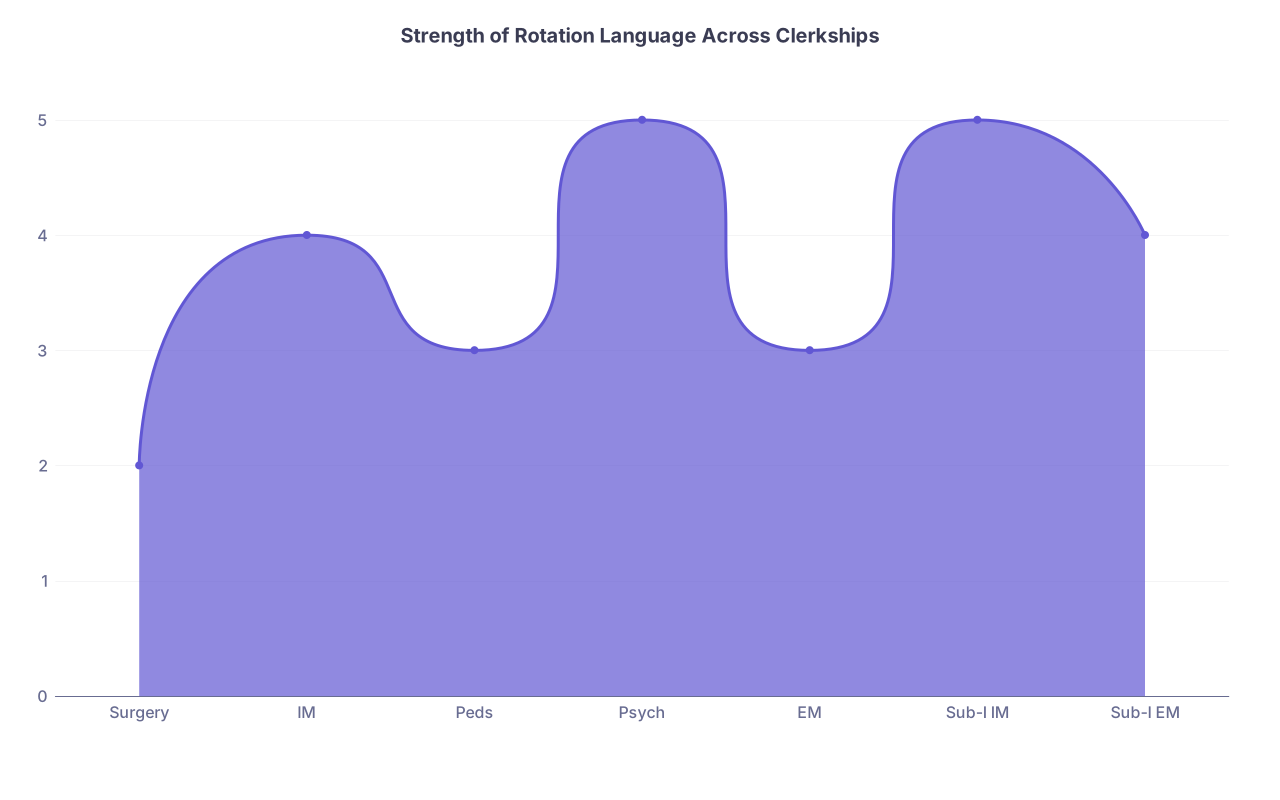
To make this concrete, think of your rotations as data points.
| Category | Value |
|---|---|
| Surgery | 2 |
| IM | 4 |
| Peds | 3 |
| Psych | 5 |
| EM | 3 |
| Sub-I IM | 5 |
| Sub-I EM | 4 |
Scale:
1 = concerning, 2 = lukewarm, 3 = solid / above average, 4 = very strong, 5 = top‑tier language.
PDs are essentially tracing that line in their heads.
A peak in your target specialty (4–5) with no 1s? Very workable.
Flat 2–3s with no spikes? That is a “good but generic” story. You need the rest of your application to add distinctiveness.
If you’re still early: pre‑emptive moves
If you are MS2 or early MS3 reading this, good. You have time.

A few targeted moves:
- Before each rotation, ask your advisor what strong evaluations from that department look like. Ask for anonymized examples if possible.
- On day 1–2, ask your attending or senior: “What do your top students do on this rotation? I’m aiming to be in that group.”
- Mid‑rotation, explicitly ask: “How am I doing compared to other students at this stage? What concrete things can I do over the next two weeks to be in your top tier?”
Most students never ask these questions. The ones who do tend to end up with, “Steep learning curve, clearly above average, among the best students this year.”
Key takeaways
- Strong rotation evaluations use comparative and specific language: “top 5%,” “one of the best,” “intern‑level,” “would recruit as resident.” Generic “pleasant, solid, met expectations” is background noise.
- Program directors weigh comments from your sub‑I and core rotations in your target specialty far more than others. The same phrase on an away EM rotation vs a radiology elective carries very different weight.
- You can still influence future evaluations by deliberately behaving in ways that produce the phrases you want—owning patient care, asking for comparative feedback, demonstrating rapid growth, and aiming explicitly for intern‑level performance on sub‑Is.