
Your CV is not “too weak.” It is just unfinished—and you still have time to fix it.
If you are mid–third year, staring at classmates with 12 publications and 5 leadership titles while your ERAS spreadsheet looks like a ghost town, you are not doomed. But you do need a plan. Wishful thinking and “I’ll just write a great personal statement” will not salvage a thin application.
This is the playbook for turning a sparse MS3 CV into a credible, competitive profile in 6–12 months.
Step 1: Get Ruthlessly Clear on Your Target and Your Gap
You cannot fix “weak” in the abstract. You fix specific deficits for a specific target.
1. Pick a realistic target band, not a fantasy
You do not need to know your exact specialty, but you must know the competitiveness band:
- Tier 1: Derm, ortho, plastics, ENT, neurosurg, urology, IR, some programs in rad onc
- Tier 2: EM (still variable), anesthesia, general surgery, OB/GYN, some IM programs
- Tier 3: IM, peds, psych, FM, neuro, pathology (again: ranges exist, but you get the idea)
Look at:
- Your Step 1 (P/F but still matters for screening in some fields)
- Your Step 2 practice scores/trajectory
- Your class rank / clinical evaluations
Then be blunt with yourself. If you are sitting around 230–240 Step 2 practice range and mid-class, a derm / neurosurg hail mary is reckless unless a mentor specifically tells you otherwise.
2. Compare your CV to what actually matters
Most programs care about:
- Clinical performance
- Honors in core clerkships
- Strong narrative comments
- SLOEs (for EM) or rotation-specific letters
- Standardized exams
- Step 2 CK, shelf scores
- Letters of recommendation
- From people known in the specialty
- From rotations at target institutions
- Evidence of commitment to the field
- Specialty-related research
- Specialty-specific electives / sub-Is
- Specialty interest group involvement
- Professionalism and “no red flags”
- No major professionalism issues
- Reliable, good team member
- Extras that help but are not mandatory
- Leadership
- Teaching
- Community service
Now, write out your current state in a simple grid.
| Domain | Current Status | Target for Competitiveness |
|---|---|---|
| Core clerkship honors | ? / 6 rotated so far | 3–4 honors (for Tier 1–2) |
| Step 2 trajectory | NBME practice range | ≥ 245 for very competitive |
| Research | 0 / X | 1–3 specialty-linked items |
| Leadership | 0–1 roles | 1 meaningful role |
| Specialty exposure | 0–1 rotations | 2–3 rotations + sub-I |
If most of your boxes are “0,” fine. That just defines the work.
Step 2: Stop the Bleeding – Fix What You Are Still Doing Now
Before you chase new shiny activities, protect the two biggest levers still in front of you: clerkships and Step 2.
1. Maximize the remaining clerkships
If you are MS3, you probably have several rotations left. Turning “Pass” into “Honors” on even 2–3 more rotations materially changes your application.
Action protocol for every new rotation:
- Day 1: Explicit expectations
- Ask your senior: “What does an honors student look like on this service?”
- Ask about:
- Note style and length
- How many patients they expect you to carry
- Preferred presentation structure
- First 3 days: Overshoot on effort
- Be early. Pre-round. Read on your patients the night before.
- Volunteer: “I can admit the next patient,” “I can call the family,” “I will update the med rec.”
- Week 1–2: Mid-rotation feedback
- Ask the attending: “What one thing should I change to be functioning at an honors level?”
- Then actually change it, and tell them a few days later: “I tried what you suggested about X—any better?”
- Last week: Subtle signal for evals
- Short, direct: “I have really enjoyed working with you. I am working hard to achieve honors on this rotation. Any last feedback for things I should improve this week?”
This sounds basic. I have seen it change “solid, quiet student” to “strong, honors” more times than I can count.
2. Treat Step 2 as a repair tool, not just an exam
Step 2 is your last hard metric. A strong Step 2 can partially compensate for a thin CV.
If your exam is 2–6 months away:
- Minimum 4–6 weeks of true dedicated time
- Non-negotiables:
- UWorld (or Amboss) as primary Qbank
- NBME practice tests to track trajectory
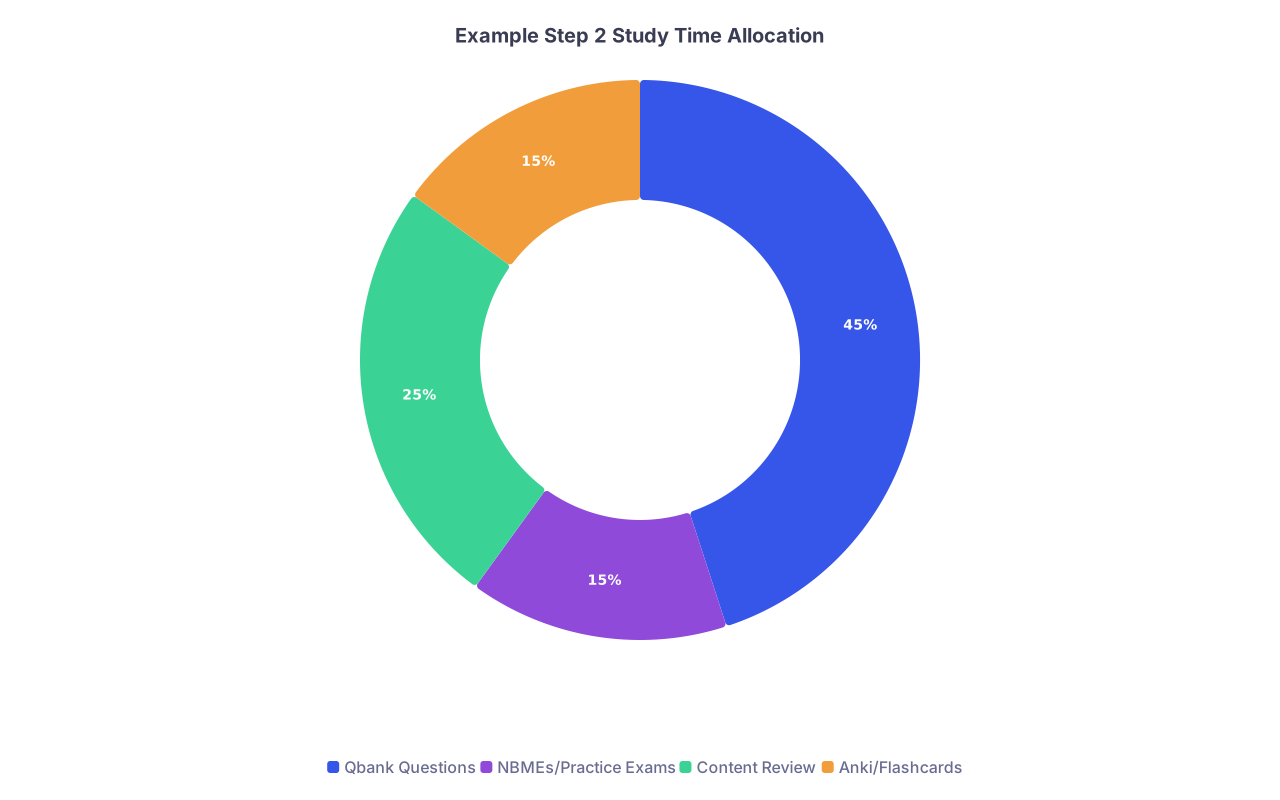
| Category | Value |
|---|---|
| Qbank Questions | 45 |
| NBMEs/Practice Exams | 15 |
| Content Review | 25 |
| Anki/Flashcards | 15 |
Do not waste time building the “perfect” Anki deck from scratch in MS3 if your CV is sparse. Your Step 2 plan should be:
- One main Qbank, 2 blocks per day minimum on weekdays, 1–2 on weekends
- Every block: timed, random, mixed
- Review all questions the same day; make very short notes or limited cards only for repeat-miss concepts
- Take an NBME every 1–2 weeks; adjust volume based on scores
Your short-term priority stack is:
- Do not tank a core clerkship you are still on
- Get Step 2 into a competitive range for your tier
Everything else comes after.
Step 3: Rapid-Fire Research – How to Go From 0 to “Enough”
You do not need 10 publications. You need 1–3 credible, specialty-aligned scholarly items that show you can finish something.
The mistake most MS3s make: they chase some big, slow, “cool” basic science project that will not produce anything before ERAS.
You need velocity and completion.
1. What kinds of projects are fast enough?
Ranked from fastest to slowest (on average):
- Case reports / case series
- Chart review / retrospective study with existing data
- Quality improvement (QI) projects
- Educational projects (curriculum, workshops)
- Prospective research (almost always too slow to help MS3/MS4 timeline unless already in motion)
You are looking for projects where:
- IRB is already done OR not required (case reports often exempt)
- Data already exist or are easy to extract
- A fellow or resident is already pushing it and needs a workhorse
2. How to actually get those projects quickly
Do this in a single week. Yes, really.
Step A: Pick 3–5 attendings/fellows in your target specialty.
Sources:
- People you worked with clinically
- Department website – look for “Director of Research,” “Education Director,” “Program Director”
- Residents you know who can point you to “the person who always has projects”
Step B: Send a tight, specific email.
You are not “interested in research.” Everyone is. You are available and want to finish something.
Example:
Subject: MS3 interested in [specialty] – available for concrete projects
Dear Dr. Smith,
I am a third-year medical student at [School], currently leaning toward [specialty]. I am looking for 1–2 discrete research or quality improvement projects where I can be immediately useful and help push something to completion before the upcoming ERAS cycle.
I am comfortable with [data tasks you actually can do: chart review, REDCap, basic stats in R/SPSS/Excel, manuscript editing]. I can commit [X hours per week] consistently through [month].
If you have any active projects that need an extra set of hands, I would appreciate the opportunity to help. I am happy to meet briefly in person or via Zoom to discuss what would be most useful to you.
Best regards,
[Name, MS3, contact info]
Send 10 of those. Not 2. Ten.
Half will ignore you. Two will respond with something vague. One or two will say, “Actually, I do have a chart review that needs help.”
That is where you say yes.
Step C: Negotiate scope and timeline on day one.
In the first meeting, ask:
- “What does completion look like for this project—abstract, poster, manuscript?”
- “What is the realistic timeline?”
- “What specific parts will I own?”
You want something that can reasonably yield:
- An abstract for a conference, or
- A submitted or near-submitted manuscript
within 3–9 months.
3. Execution rules so you actually get output
This is where many students disappear. Do not.
Set your weekly commitment:
- 5–8 hours per week is enough for a focused, well-scoped project
- Block that on your calendar just like a shift
Your rules:
- Every week: send a brief update email if you did anything significant
- If you hit a roadblock (IRB, stats, access), ping your mentor within 48 hours; do not let it stall for weeks
- Ask early about conference targets: “Is there an upcoming [Specialty] regional or national meeting we can aim for?”
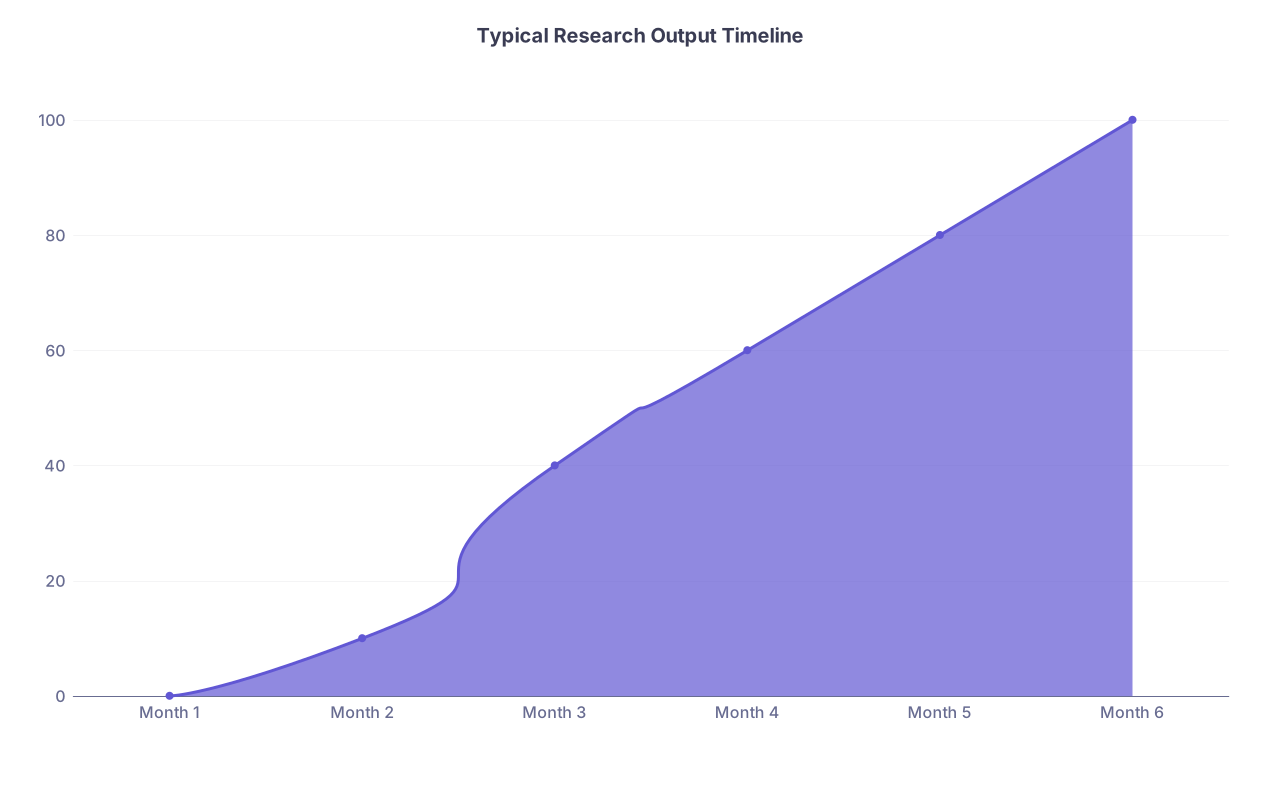
| Category | Value |
|---|---|
| Month 1 | 0 |
| Month 2 | 10 |
| Month 3 | 40 |
| Month 4 | 60 |
| Month 5 | 80 |
| Month 6 | 100 |
(0–100 here is “percent of projects that actually yield an abstract/manuscript” with consistent effort. The big drop-off happens when people stall in the middle.)
You are not trying to become a research star. You are trying to transform “No research” into “Has done research in our field and finished things.”
Step 4: Build Real Specialty Commitment without Wasting Time
Programs want evidence that you did not pick their specialty last Tuesday. You can build that narrative in under a year.
1. Lock in rotations that matter
For most specialties, you want:
- 1 home sub-internship (sub-I) or acting internship in that field
- 1–2 away rotations if the specialty values them (EM, Ortho, Derm, some IM programs, etc.)
If you are late to the game:
- Talk to your dean or clerkship director now about:
- Switching some remaining elective time to your target specialty
- Getting on a sub-I earlier rather than later
- For away rotations:
- Use VSLO/VSAS
- Consider mid-tier programs, not only big-name ones; they are more likely to say yes
2. Plug into the specialty’s local ecosystem
You are not joining 10 clubs. You are doing 2–3 things that actually touch faculty and residents.
Fast, high-yield options:
- Join the specialty interest group and ask to help with:
- Organizing a panel
- Running skills workshops
- Coordinating a mentorship night
- Volunteer to coordinate student involvement in:
- M&M conference attendance
- Journal clubs
- Grand rounds
Your pitch is simple: “I will do the logistics so faculty just have to show up and teach.”
That gets you face time with the people writing your letters later.
Step 5: Create Leadership and Teaching Experience That Is Not Embarrassing
You do not need to be president of everything. You do need to show you can take responsibility and move a project.
1. Leadership: pick one thing and actually lead
Look for roles where you can point to concrete outcomes:
- Coordinator or director of a free clinic shift
- Organizer of a recurring workshop series (e.g., “MS2 Skills Night in [specialty]”)
- Lead organizer for a community health initiative or screening event
Poor leadership line on CV:
- “Member, [Interest Group], 2023–2024”
Good, specific, leadership line:
- “Coordinator, Student-Run Free Clinic – led 8-person team staffing weekly IM clinic, implemented new triage protocol that reduced patient wait times by 30%.”
That second one gets attention.
You can build a role like that in 6–12 months if you start now and actually change something.
2. Teaching: low-barrier, high-yield
Programs like applicants who teach. You do not need a formal title for it to count.
Options you can start in MS3:
- Peer tutoring for MS1/2 (anatomy, physiology, Step 1, OSCE skills)
- Small-group leader for clinical skills sessions
- Board review sessions you organize and run with a friend
Document it:
- “Tutor, MS1 Anatomy – delivered weekly small-group review sessions for 6 students; created 5 session guides now used by the course.”
- “Peer Instructor, Clinical Skills – taught basic physical exam to pre-clinical students during 4-session workshop.”
The point is not prestige. It is evidence you care about passing knowledge on and can communicate clearly.
Step 6: Fix Your CV Structure and Story
A sparse CV often looks worse than it is because it is disorganized and undersells what you have.
1. Structure your CV like a resident’s, not a college kid’s
Core sections, in this order:
- Education
- Exam scores (if your school allows it on CV; ERAS will have it regardless)
- Clinical experience and clerkships (honors indicated)
- Research and publications
- Presentations and posters
- Leadership and service
- Teaching and mentoring
- Awards and honors
- Skills (language, technical, software)
Do not bury your best items at the bottom.
2. Rewrite weak bullets into strong ones
Common mistake: describing positions, not actions.
Weak:
- “Volunteer, student-run clinic.”
Strong:
- “Student Physician, student-run clinic – evaluated 2–4 patients per shift under supervision, presented assessments and plans, and followed up lab results and imaging.”
Weak:
- “Research assistant in cardiology lab.”
Strong:
- “Research assistant, cardiology outcomes study – extracted and coded data on 350 patients with heart failure, performed basic statistical analysis (chi-square, t-test) using SPSS, and drafted Results section for abstract submitted to [Conference].”
Your test: every bullet should have action + scope + outcome where possible.
Step 7: Build Relationships That Turn into Strong Letters
Letters can carry a thin CV across the line. But not generic ones.
1. Choose your letter writers strategically
Ideal mix (for most specialties):
- 1–2 letters from attendings in your target specialty, preferably:
- On sub-I or away rotation
- Known to the program world if possible
- 1 letter from a core clinical rotation where you crushed it (IM, surgery, peds, etc.)
- 1 research mentor letter if you had substantial involvement
Fast path if you are behind:
- On your next rotation, pick one attending you click with.
- Be consistently excellent around them.
- Ask for a letter near the end with this phrasing:
“Dr. X, I am applying in [specialty] this cycle and have greatly valued working with you. Would you feel comfortable writing me a strong letter of recommendation?”
If they hesitate or say “letter” without “strong,” thank them and pick someone else.
2. Make it absurdly easy for them to write well
When someone agrees:
- Send:
- Your CV
- A short paragraph on why you are choosing that specialty
- Bullet points of specific cases or interactions they saw you handle well
- Any forms / submission links they need
You are not writing your own letter. You are jogging their memory with concrete examples.
Step 8: Time-Box Your Turnaround – 6–12 Month Roadmap
Let us translate all this into a simple, time-based plan. Assume you are mid–MS3 with ~12 months to ERAS.
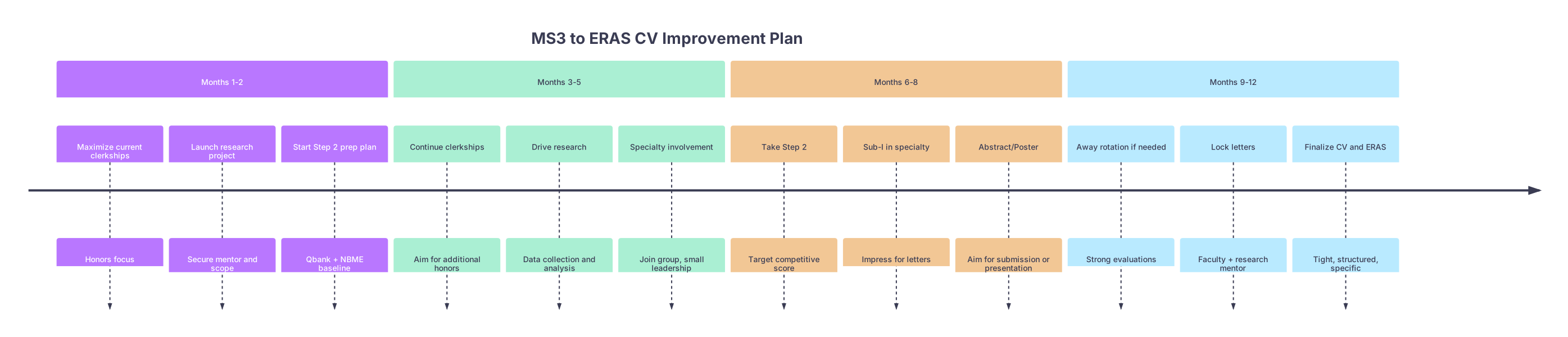
| Period | Event |
|---|---|
| Months 1-2 - Maximize current clerkships | Honors focus |
| Months 1-2 - Launch research project | Secure mentor and scope |
| Months 1-2 - Start Step 2 prep plan | Qbank + NBME baseline |
| Months 3-5 - Continue clerkships | Aim for additional honors |
| Months 3-5 - Drive research | Data collection and analysis |
| Months 3-5 - Specialty involvement | Join group, small leadership |
| Months 6-8 - Take Step 2 | Target competitive score |
| Months 6-8 - Sub-I in specialty | Impress for letters |
| Months 6-8 - Abstract/Poster | Aim for submission or presentation |
| Months 9-12 - Away rotation if needed | Strong evaluations |
| Months 9-12 - Lock letters | Faculty + research mentor |
| Months 9-12 - Finalize CV and ERAS | Tight, structured, specific |
You will not hit every box perfectly. You do not need to. If, by ERAS submission, you have:
- Step 2 in a respectable range for your specialty tier
- 2–4 honors in important clerkships
- 1–3 specialty-related research items (even as abstracts/submissions)
- 1 actual leadership role with measurable impact
- Some credible teaching experience
- 3–4 strong letters
You have moved from “sparse and vague” to “solid, competitive candidate.”
Quick Reality Check: What Actually Moves the Needle Most?
If you feel overwhelmed, prioritize. Not all “improvements” are equal.
| Action | Impact on Competitiveness | Time/Effort Cost |
|---|---|---|
| Improving Step 2 score by 10–15 points | Very High | High |
| Earning honors on a core rotation | Very High | High |
| Completing 1–2 specialty-related projects | High | Moderate |
| Sub-I performance + strong letter | Very High | Moderate–High |
| Minor committee membership | Low | Low |
If you have to choose between:
- Another random volunteer activity, or
- Serious Step 2 prep
- Extra work on a high-yield research project
- Extra effort to secure honors / strong evals on current clerkship
Choose the second, third, or fourth every time.
Common Pitfalls That Keep CVs Thin
Let me be blunt about what will sabotage you.
Waiting for the “perfect” project or mentor
- Take the good-enough opportunity now. Perfection is why you still have zero output.
Overcommitting across 6 organizations and doing nothing well
- One substantial leadership role beats 5 lines of fluff.
Ignoring Step 2 because “I am a good test taker”
- Programs do not care about your self-perception. They care about your score.
Being a ghost on rotations
- Quiet, nice, invisible students get “solid, pleasant” evals, not “outstanding, top 10%” comments.
Thinking one home-run away rotation will fix everything
- Away rotations help, but they are not a magic wand. If your base is weak, an away cannot fully compensate.
Two Things You Can Do This Week
If you remember nothing else, do these immediately:
On your current or next rotation
- Ask for concrete feedback by the end of the first week. Adjust.
- Signal that you are aiming for honors and back it up with visible work.
For research and specialty commitment
- Send 10 targeted emails asking for discrete projects.
- Join the specialty interest group and volunteer for one operational role.
Those two moves alone will start changing your trajectory.


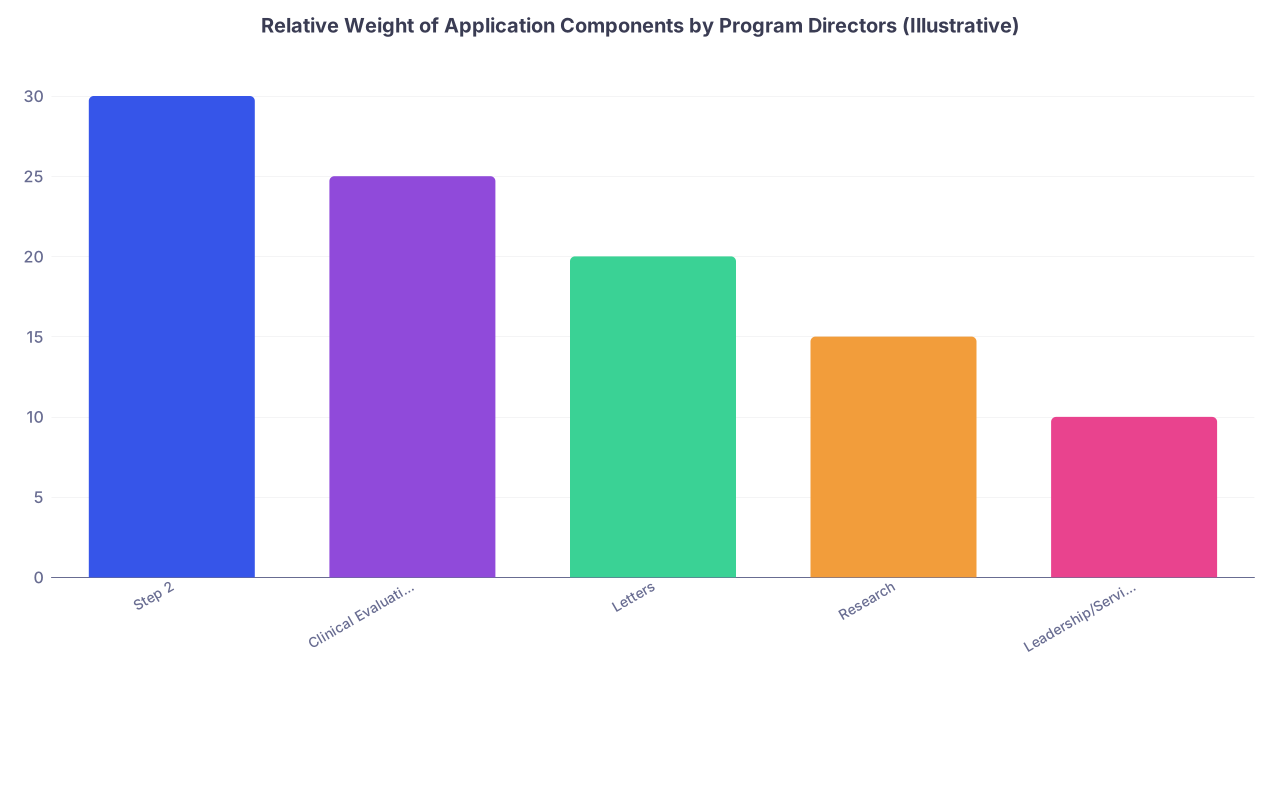
| Category | Value |
|---|---|
| Step 2 | 30 |
| Clinical Evaluations | 25 |
| Letters | 20 |
| Research | 15 |
| Leadership/Service | 10 |

| Step | Description |
|---|---|
| Step 1 | MS3 with Sparse CV |
| Step 2 | Prioritize Dedicated Step 2 Prep |
| Step 3 | Increase Effort and Feedback on Current Rotations |
| Step 4 | Email 10 Faculty for Fast Projects |
| Step 5 | Target Sub-I and Away Rotations for Letters |
| Step 6 | Polish CV and ERAS, Focus on Fit |
| Step 7 | Step 2 Competitive? |
| Step 8 | Honors in Key Rotations? |
| Step 9 | Any Specialty Research? |
| Step 10 | Strong Letters Lined Up? |