
It is late PGY-0 season. You are sitting in a call room or your apartment, clicking through your school’s evaluation portal. You open your third-year Internal Medicine clerkship. Overall grade: High Pass. Then you scroll to the narrative comments that will feed into your MSPE.
“Pleasant to work with. Attentive to patient needs. Will do well with continued growth.”
Your stomach drops. That is deadly vague. No concrete skills. No “hard worker,” no “clinical reasoning,” no “among the top.” You know those words matter. And you also know: once the MSPE is finalized, you are stuck.
Here is the good news: you are not at the mercy of the system. There is a window—months long—where you can influence what gets written about you and how it ends up in your MSPE. But you have to be deliberate. Early. And a little bit pushy in the right way.
Let me walk through exactly how to do that.
Step 1: Understand What “Weak” Comments Actually Look Like
Before you fix a problem, you need to see it clearly. Most students do not recognize weak comments until it is too late.
Weak clerkship comments usually fall into a few buckets:
Generic fluff
- “Pleasant to work with.”
- “Good team member.”
- “Well liked by patients.”
- Translation: The evaluator either did not know you well or did not care to be specific.
Vague growth statements
- “Will benefit from more experience.”
- “With continued development, will be a strong physician.”
- Translation: You are average. Nothing special to highlight.
Damning faint praise
- “Arrives on time and completes tasks when asked.”
- “Accepts feedback.”
- Translation: Bare minimum. No initiative, no leadership, no standout skill.
Comments focused only on personality
- “Very nice and polite.”
- “Friendly and easy to get along with.”
- Translation: They could not comment strongly on your clinical work.
Strong comments, on the other hand, have specific, measurable anchors. They talk about:
- Clinical reasoning
- Work ethic / reliability
- Independence and ownership
- Communication with patients and team
- Growth over the rotation
- Comparison to peers or residents
You want phrases like:
- “Among the top students I have worked with”
- “Functions at the level of an intern”
- “Outstanding clinical reasoning and thorough presentations”
- “Takes ownership of patient care”
- “Sought out and integrated feedback rapidly”
If your current or past comments do not sound like that, you are at risk of a weak MSPE narrative.
Step 2: Learn How MSPE Narratives Get Built at Your School
This is one of the most underutilized moves: understand the pipeline from clerkship evaluation → dean’s office → MSPE.
Different schools have very different processes. You cannot game a system you do not know.
Within the first half of third year, do this:
Check the official policy
- Look on your school’s website for “MSPE,” “Dean’s letter,” or “Medical Student Performance Evaluation.”
- Many schools outline:
- Who writes the MSPE
- Whether students can review drafts
- What sources are used (narrative comments, grade distributions, etc.)
Ask upperclassmen who matched well
- Ask specific questions:
- “Does our MSPE quote comments verbatim?”
- “Do they edit or summarize?”
- “Do they include negative comments or only positive ones?”
- “Did you get to see your MSPE before it went out?”
- Ask specific questions:
Meet with the dean’s office early
- By late third year, schedule a 20–30 minute meeting with whoever coordinates MSPEs.
- Your goal:
- Clarify timelines (when they start drafting, when they finalize).
- Clarify what they pull (all evals, only core clerkships, weighted comments, etc.).
- Ask directly: “If an attending misremembers me or writes something inaccurate, is there any process for clarification or context?”
Here is why this matters: if your school basically copy-pastes attending comments, then the battle is at the clerkship level. If they synthesize and edit, you have a second chance to shape context with the dean’s office.
Step 3: Set Up Attending Feedback So It Writes Your Comments For You
Weak clerkship comments usually come from one of two things:
- The attending does not remember you.
- The attending cannot point to specific behaviors you demonstrated.
You fix that by giving them memories and language.
A. Make yourself easy to remember
You do not need to be the loudest person on the team. You do need a clear profile.
You want attendings to think something like:
- “She is the one who always had detailed overnight updates.”
- “He is the student who called all his own consults.”
- “They are the one who made that killer antibiotic table.”
The simplest way:
Pick 1–2 “signature” behaviors each rotation Examples:
- Always have a one-liner and plan ready for every patient.
- Volunteer to write the discharge summary for every patient you follow.
- Pre-chart thoroughly and flag abnormal labs before rounds.
- Offer to lead a brief 5-minute teaching moment once per week (topic emailed ahead).
Let your attending see those behaviors
- Do not just work hard in the background.
- Name what you are doing during check-ins:
- “I went through all our patient labs this morning; for Mr. X, I am concerned about his creatinine.”
- “I can call the endocrine consult and present our question if that is helpful.”
Memorable behaviors create memorable comments.
B. Engineer mid-rotation feedback conversations
If you wait until the final day to ask, “How did I do?”, it is too late.
Mid-rotation check-in protocol:
Ask for a 5–10 minute meeting around the midpoint
- Script:
- “Dr. Patel, could we set aside 5 minutes sometime this week for brief feedback? I want to make sure I am working on the right things before evaluations are due.”
- Script:
Use targeted questions that force specifics Try these:
- “If you had to describe my strengths in 1–2 phrases right now, what would they be?”
- “What is one behavior I could change this week that would make me function more like an intern?”
- “On a spectrum from passive to taking ownership, where do you see me right now?”
Listen, then restate a “theme” back to them
- Example:
- Attending: “You are reliable and your notes are solid, but your differential is a bit narrow.”
- You: “So my strengths are reliability and thorough documentation, and my main growth area is broadening my differential and articulating my reasoning more clearly. That is what I will work on this week.”
- Example:
Why that last step matters: you just gave them language they can reuse in the written evaluation—“reliable,” “thorough,” “works to broaden differential,” “improves articulation of reasoning.”
C. Close the loop before they write the eval
Near the end of the rotation, you have one more chance.
Two to three days before evaluations typically go out:
- Ask for one more very short feedback check-in:
- “Can I quickly check in on how I did with the things we discussed earlier—reliability, thorough notes, and expanding my differential?”
Then say, concisely:
- “I focused on broadening my differential and making my reasoning explicit on rounds. For example, with Ms. X’s abdominal pain, I listed 4–5 causes and talked through why I prioritized biliary colic over pancreatitis. I also tried to take more ownership by calling the GI consult myself after confirming with the resident.”
You are not fishing for compliments. You are handing them concrete behaviors that they can now convert directly into comments.
Step 4: Use Goal-Setting Emails to Seed Strong Language
A lot of attendings write evaluations in 60 seconds on a busy clinic day. The form pops up, they vaguely remember you were fine, and you get “pleasant, will do well.”
You can pre-load their memory.
The “First-Day Goals Email”
Within 24 hours of meeting your attending:
Send a short email:
Subject: Clerkship Goals – [Your Name]
Dr. [Name],
Thank you for the opportunity to work with you on [Rotation/Service]. My goals for the next [X] weeks are:
- Improve my efficiency and organization on rounds so I can function more like an intern.
- Strengthen my clinical reasoning by consistently presenting a prioritized differential and plan.
- Take greater ownership of my patients by anticipating next steps (tests, consults, discharge needs).
If there are other areas you think I should focus on, I would appreciate your guidance.
Best,
[Your Name]
What you just did:
- Gave them three structured themes.
- Supplied language: “efficiency,” “organization,” “clinical reasoning,” “ownership,” “anticipating next steps.”
When they write your evaluation, guess what their brain reaches for? Those exact words.
The “End-of-Rotation Summary Email”
After your last day on service, send another brief note:
Subject: Thank you – [Your Name], [Clerkship]
Dr. [Name],
Thank you again for the chance to work with you on [Rotation]. I learned a great deal, especially about [1 specific clinical or professional lesson].
As we discussed, I focused on:
– Becoming more organized and efficient on rounds.
– Making my reasoning explicit with a prioritized differential and plan.
– Taking greater ownership of my patients (calling consults, following up tests, initiating discharge planning).I will continue working on these skills in my upcoming rotations.
Best,
[Your Name]
You have now:
- Reminded them who you are.
- Reminded them what you worked on.
- Fed them “MSPE-ready” phrases.
Is this manipulative? No. It is making their job easier and making your evaluation more accurate.
Step 5: Fix Problems While You Are Still On Service
Occasionally, you will feel an attending is not thrilled with you. Or a resident tells you, “Dr. X is hard on students.” This is where most people freeze and hope for the best.
That is the wrong move.
You handle this on the rotation, not six months later.
A. If you sense negative impressions
Use a direct but non-defensive script:
- “Dr. [Name], I get the sense there may be areas where I am not meeting your expectations. I want to improve before the rotation ends. Could you share 1–2 specific things I should change this week?”
Then:
- Do those things.
- Make the changes visible:
- “Yesterday you mentioned I should be more concise in presentations. Today I tried to keep my one-liners tighter and focus on assessment and plan. I will keep working on that—let me know if that is closer to what you are looking for.”
People are much more generous in evaluations when they see clear, responsive improvement.
B. If you actually make a mistake
Everyone does. What matters is the recovery.
Own it immediately:
- Acknowledge:
- “I missed following up the potassium this afternoon. That was my responsibility.”
- State the fix:
- “I have checked it now and it is 3.1; I ordered oral replacement and updated the resident.”
- State the prevention:
- “I have added critical lab checks to my checkout list so this does not happen again.”
Attendings remember professionalism and growth more than one discrete error. That “matures with feedback” line can become a strong positive comment instead of a buried criticism.
Step 6: Choose and Cultivate Champions Strategically
Not every evaluation carries the same weight. A generic comment from a community preceptor who had you twice in clinic is not the same as a detailed narrative from the core inpatient medicine attending who saw you daily.
You need champions—attendings who:
- Actually saw you work.
- Respect you.
- Are willing to write detailed, specific comments.
A. Identify potential champions early
During each rotation, ask yourself:
- Who has watched me on rounds, in notes, with patients?
- Who has explicitly praised my work or growth?
- Who seems to enjoy teaching and mentoring?
Those are your targets.
B. Ask explicitly for detailed evaluations
You do not say, “Please write me a great eval.” You say:
- “Dr. [Name], I have really appreciated working with you and the feedback you have given me. Your evaluation will likely be part of my MSPE. If you are able, I would really appreciate any specific comments about my strengths and growth areas, especially around clinical reasoning and ownership, so residency programs can get an accurate picture of how I work.”
Most good attendings respond well to this. You have told them what matters and where to focus.
C. Consider targeted letters that reinforce your MSPE
Beyond clerkship evals, some programs still care about individualized letters. Strong letters do not replace a weak MSPE, but they can counterbalance mediocre clerkship comments.
If an attending:
- Knows you well.
- Thinks highly of you.
- Has seen you over more than one setting (e.g., on rotation and in research or clinic).
Ask them for a letter that explicitly comments on clinical performance and work ethic, not just research.
Step 7: Deal With Existing Weak Comments Before MSPE Drafting
Let’s say the damage is partly done. You have:
- 1–2 rotations with very bland comments.
- Maybe a single slightly negative line (“needs to speak up more on rounds”).
You cannot erase history, but you can shape how it is interpreted.
A. Know which comments are likely to be used
The dean’s office will not use every random line from every evaluation. They usually pull:
- Core clerkships.
- Required sub-I’s.
- Maybe key electives.
Ask the MSPE coordinator:
- “Do you primarily quote comments from core clerkships, or do you also use sub-internship and elective feedback?”
- “Are there particular evaluations that are weighed more heavily?”
B. Proactively supply context and contrast
When you meet with the dean’s office (ideally late third year or very early fourth):
Bring:
- A list of rotations with weaker comments.
- A list of rotations where you clearly improved.
Use a factual, non-whiny approach:
- “On my early surgery rotation, I was still learning how to speak up and present confidently, and that is reflected in the comments. By my medicine sub-I, my attendings commented on my independence, ownership, and ability to manage patients at an intern level. I wanted to highlight that growth in case you are selecting which comments to emphasize.”
Explicit ask:
- “When you choose comments to highlight in my MSPE, would you be willing to include language that reflects that trajectory of growth?”
You are not asking them to hide negatives. You are asking them to frame your story accurately: early learning curve, then clear progression.
C. If a comment is factually wrong or inappropriate
This is rare but it happens. Examples:
- “Habitually late to rounds” when your arrival times are documented and on time.
- Personal remarks about appearance, accent, or unrelated characteristics.
- Confidential medical info mentioned.
You cannot “edit” the evaluation itself most of the time, but you can:
Document your side:
- Write down the issues, dates, and any objective evidence (emails, schedules).
Meet with the clerkship director:
- Calm tone, no outrage.
- “I want to bring a specific evaluation comment to your attention because I believe it is inaccurate / inappropriate and could unfairly affect my MSPE.”
Ask for one of the following:
- An addendum from the clerkship director.
- A note in your file clarifying context.
- A commitment that this particular line will not be quoted in the MSPE.
Deans do not like legally problematic or obviously biased comments. They are often willing to omit or contextualize them if you raise the issue professionally.
Step 8: Use Your Sub-I and Late Rotations as MSPE Repair Tools
If your early clerkships were mediocre—generic comments, few strong phrases—your sub-internship is your chance to rewrite the narrative.
You treat your sub-I like a controlled experiment in “creating stellar comments.”
A. Behave at an intern level
- Own 3–4 patients fully.
- Pre-round thoroughly.
- Know every lab, image, and plan before rounds.
- Write notes without being chased.
- Call your own consults (with resident approval).
- Anticipate discharges and follow-up.
Make it impossible for the attending to see you as “pleasant med student.” You are a proto-intern.
B. Tell the attending you want intern-level feedback
On day 1:
- “Dr. [Name], I am using this sub-I to prepare for internship. I want you to evaluate me as you would a new intern. Could you give me frank feedback on where I am at that level and what I need to close the gap?”
You just signaled seriousness. You also planted the idea: “functions at the level of an intern.”
C. Loop that into the MSPE
When the dean’s office asks for your highlights or meets with you:
- Emphasize this rotation:
- “On my medicine sub-I, my attending commented that I functioned at an intern level with strong ownership and clinical reasoning. That rotation best represents how I will perform as a resident.”
They now have a clear, positive evaluation to anchor your narrative.
Step 9: Quick Reality Check – What PDs Actually Read
Program directors skim. They look for patterns and red flags, not single adjectives.
Most PDs focus on:
- Overall grades / class ranking pattern.
- Any explicit concerns: unprofessional, unreliable, significant remediation.
- Highlights: “top X%,” “among the best,” “functions at intern level,” “strong work ethic,” “excellent team member.”
What weak comments do:
- They fail to help you stand out.
- They create a “generic” impression.
What you are trying to do:
- Insert a few high-yield phrases into the written record.
- Show trajectory: early learner → strong, independent, reliable near graduation.
If you have:
- A few strong, specific comments in key rotations.
- A clear “growth” story.
- No glaring professionalism or behavior flags.
You are in decent shape. Even if some clerkships say “pleasant to work with.”
Step 10: Non-negotiable Behaviors That Improve Comments Everywhere
Everything above is strategy. None of it works if your baseline behavior is sloppy.
Here are the fundamentals that nearly always generate good comments when done consistently:
Be early. Every day.
- Not “on time.” Early.
- Gives you space to pre-chart, think, and not look chaotic.
Know your patients cold.
- Vitals, labs, last imaging, meds, overnight events.
- If an attending asks, you already know.
Own your follow-through.
- If you say you will do something, you do it.
- “Closes the loop” is one of the best phrases that ends up in comments.
Speak up with a plan, not just facts.
- “I think this is CHF exacerbation. My plan is diuresis, daily weights, trend BMP, and consider echo if no improvement.”
Ask for feedback weekly.
- And then visibly act on it.
That combination, plus the structural strategies above, is what moves you from generic fluff to the kind of comments that strengthen your MSPE instead of weakening it.
One Practical Snapshot: What You Are Aiming For
Here’s how this plays out in real life when done well.
| Area | Weak Phrase | Strong Phrase |
|---|---|---|
| Work Ethic | Pleasant and cooperative | Exceptionally reliable; consistently goes above basic expectations |
| Clinical Reason | Developing clinical reasoning | Demonstrates strong, organized clinical reasoning with prioritized differentials |
| Ownership | Helps with patient care tasks | Takes ownership of patient care, anticipates next steps independently |
| Growth | Will benefit from more experience | Responds rapidly to feedback and shows clear day-to-day improvement |
| Comparison | Good student | Among the strongest students I have worked with this year |
That is the language you are trying to seed in your attendings’ heads and in your dean’s office.
To visualize how this effort stacks up across your year:
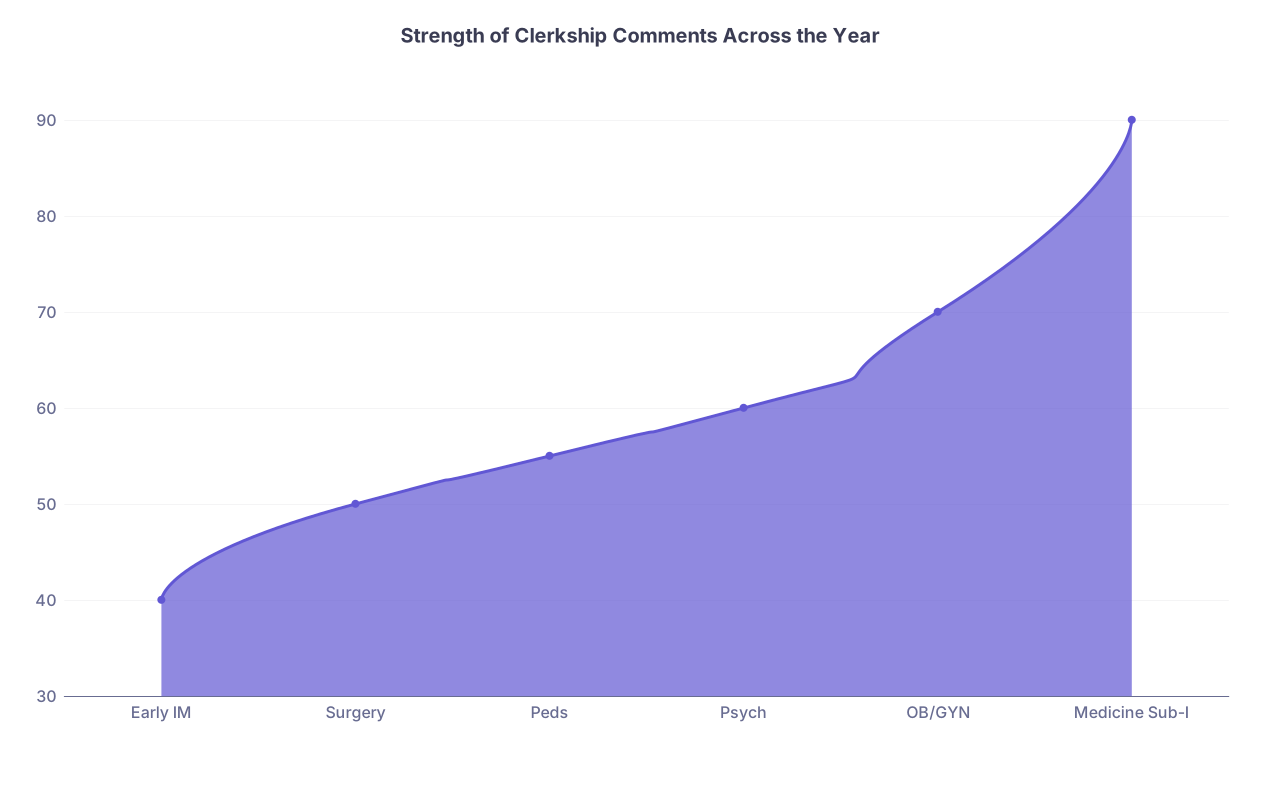
| Category | Value |
|---|---|
| Early IM | 40 |
| Surgery | 50 |
| Peds | 55 |
| Psych | 60 |
| OB/GYN | 70 |
| Medicine Sub-I | 90 |
Think of that line as your “narrative arc.” Early rotations may be average. Your job is to make the later ones unambiguously strong.
And to keep the moving pieces straight, a quick rotation-to-MSPE flow:

| Step | Description |
|---|---|
| Step 1 | On-Service Performance |
| Step 2 | Attending Observations |
| Step 3 | Written Clerkship Evaluation |
| Step 4 | Deans Office Review |
| Step 5 | MSPE Narrative Draft |
| Step 6 | Student Review/Meeting |
| Step 7 | Final MSPE Sent to Programs |
You can intervene at A, B, C, and F. Most students only realize F exists. That is too late.
Key Takeaways
Strong MSPE comments do not happen by accident. You have to seed specific, high-yield language in your attendings’ minds through visible behaviors, goal-setting emails, and structured feedback conversations.
You can repair early weak comments by dominating your sub-I and later rotations, then working with the dean’s office to highlight growth and emphasize your strongest evaluations.
The non-negotiables—being early, knowing your patients cold, owning your tasks, and asking for feedback you actually act on—are the foundation. The strategy layered on top of that is what turns “pleasant med student” into “functions at the level of an intern” on your MSPE.