
Last September, I watched a visiting student walk out of an attending’s office after a “great” evaluation meeting. She was glowing. The attending had called her “a pleasure to work with” and “very enthusiastic.” She thought she’d just locked in an interview and probably a high rank. I knew, the second I saw the wording in the eval form, that she was dead in the water for that program.
Let me walk you through what those comments actually meant—and what your attendings are really signaling when they submit those away rotation evaluations that you never get to see.
The Truth About Away Rotation Evaluations
On away rotations, the written evaluation is not a formality. For competitive fields—ortho, derm, ENT, plastics, neurosurgery, EM at top programs—those comments can be the difference between an automatic interview invite and your application going straight into the “no” pile.
Here’s the part students rarely understand: faculty and program directors read these comments in a completely different “language” than you do. They’re not just looking at what is written. They’re looking at what isn’t written. What’s conspicuously missing. What’s being avoided.
And many attendings, especially at big-name places, are very deliberate about the way they phrase these things. They know exactly what their words will signal to the PD.
So when you see:
- “Pleasure to work with”
- “Hard-working”
- “Well-liked by peers”
- “Will make a fine resident somewhere”
you read “positive.” A program director reads: “Safe to reject. Not one of ours.”
How Program Directors Actually Read Attending Comments
Let me strip away the fluff and translate how this works behind closed doors.
Most programs don’t just look at the numerical scores from your rotation. They scan straight to the free-text comments from attendings and fellows. On rank-list night, those comments get read out loud. I’ve sat in those rooms. The exact words matter.
Here’s how the mental filter usually works:
- Does this attending clearly want this student here?
- Do they explicitly compare them to our residents?
- Did they stick their neck out with strong language?
- Or did they hide behind vague “good student” fluff?
If the answer to #1–3 is no, you’re just another applicant with a neutral eval.
Let’s build a translation guide.
| Comment Type | What Students Think | What PDs Actually Hear |
|---|---|---|
| Generic praise | Positive eval | Not special, safe to pass |
| Resident comparison | Strong endorsement | This one is worth interviewing |
| “Top X%” language | Big compliment | Flag for potential high-rank |
| Personality-only praise | Nice person | Probably weak on knowledge/skills |
| Hedged concerns | Small issue | Red flag, often fatal |
The “Strong vs. Safe” Divide
There are only two categories that really matter for away evals at competitive programs:
- Strong: This student helped us, impressed us, and I would be happy to have them here as a resident.
- Safe: This student didn’t hurt anyone and isn’t a sociopath.
Strong gets you interviews and higher ranks. Safe gets you nothing.
A “Strong” eval almost always has at least one of these elements, sometimes more:
- Explicit comparison to current residents
- “Top X%” or “one of the best” statements
- Clear “I would rank / I would match / we should recruit” language
- Specific, concrete examples of performance
A “Safe” eval leans on:
- Generic adjectives
- Vague praise
- Personality comments without teeth
- No mention of rankability or comparison
The Phrases That Actually Mean Something
Now let’s go line by line. This is the part nobody explains to you, but faculty talk about all the time behind closed doors.
1. The Gold Standard: Rank Language
If you see something like:
- “We would be thrilled to have this student as a resident in our program.”
- “I would rank this student highly.”
- “I strongly recommend this student for our residency.”
that is the attending putting real political capital behind you.
Program directors hear:
This student is safe, strong, and fits here. One of ours.
If several attendings say versions of this, you’ve basically pre-matched an interview at that program, barring some massive red flag elsewhere.
2. Resident-Level or Above-Resident Language
This is another level of endorsement that matters hugely:
- “Performs at or above the level of our interns.”
- “Functioned like a sub-intern on our service.”
- “Comparable to a PGY-2 in clinical reasoning.”
PD translation: This student isn’t going to be a project. They’re independent, coachable, and will not break the system in July.
Any time an attending starts comparing you favorably to their residents, you win.
3. Top Percentile and Superlatives
These phrases jump off the page in rank meetings:
- “Top 5% of students I have worked with in 10 years.”
- “One of the strongest medical students I have ever supervised.”
- “Among the best visiting students we had this year.”
Caveat: PDs have seen enough of these evals to know who is an “easy grader.” If an attending calls every student “top 5%,” their comments slowly lose power. But when a known tough grader uses that language, it carries real weight.
The key detail: it has to be anchored. “Top X% over Y years” or “strongest this year” is concrete. “Outstanding” alone is weaker.
Comments That Sound Great But Are Actually Neutral
This is where students get fooled. You read the comments and think you crushed it. The PD reads the same lines and moves on.
The “Pleasure to Work With” Trap
You’ll see this over and over:
- “It was a pleasure to work with [Name].”
- “[Name] was very pleasant and easy to work with.”
- “Great team player and very nice to patients.”
None of those are bad. But none of them help you match there.
When an attending likes you as a person but doesn’t want to stick their neck out, they write personality-heavy comments. “Pleasant,” “enthusiastic,” “friendly,” “polite,” “easy-going.” That’s their polite way of saying:
Nice kid. Not one of our future residents.
Personality praise plus concrete performance praise is excellent. Personality praise alone is neutral.
The “Hard-Working” Mirage
- “Very hard-working.”
- “Always showed up early, stayed late.”
- “Very dedicated and enthusiastic.”
Sounds strong, right? It is not. Attendings expect everyone on an away to be “hard-working.” You’re auditioning. Of course you’re going to grind.
If the strongest thing they can say is “hard-working,” it usually means you didn’t stand out in the important domains: knowledge, clinical reasoning, reliability, adaptability.
On rank night, nobody fights for “hard-working” alone. Everyone is “hard-working” on paper.
The Vague “Will Make a Good Resident”
This one is almost code at many places:
- “Will make an excellent resident.”
- “Will be an asset to whichever program they join.”
- “I have no doubt [Name] will succeed in residency.”
Translation:
Someone else’s problem. Not bad, but not for us.
You’ll see this especially when an attending doesn’t want to sabotage you but also doesn’t think you fit their program’s bar or culture.
What Weak or “Red Flag” Comments Actually Look Like
No one writes “I hated this student” anymore. Too much liability. Too much conflict. Instead, faculty have learned a subtle language of mild condemnation.
You should know what that looks like.
Hedged Praise + Quiet Concerns
Watch for sentences like:
- “With continued growth, [Name] will be a solid resident.”
- “Will benefit from further development of clinical reasoning.”
- “At times needed prompting to complete tasks.”
- “Improved over the course of the rotation.”
On a faculty eval form, “with improvement” is code for: I saw real weaknesses.
“Improved” usually means “started off rough enough that it made an impression.”
None of these single-handedly end your career. But in a competitive program, a single lukewarm or concern-laced eval is often enough to drop you out of interview contention when they have plenty of clean options.
The Professionalism Alarm Bells
Words that make PDs sit up:
- “Occasionally seemed disengaged.”
- “Sometimes late for rounds.”
- “Needed reminders about documentation.”
- “At times appeared defensive when receiving feedback.”
- “Interactions with staff could be improved.”
I’ve watched PDs literally circle those lines in red on printed eval summaries. Soft professionalism concerns are not soft in their impact. They’re loud.
Skill/Knowledge Concerns Hidden in Soft Language
You might see:
- “At times struggled with foundational knowledge but was eager to learn.”
- “Required frequent supervision for basic tasks.”
- “Sometimes had difficulty synthesizing information.”
Those are performance red flags, plain and simple. If you have one of those on an away at your dream program, it is very hard to overcome it, no matter what your Step score is.
How Different Programs Use These Evaluations
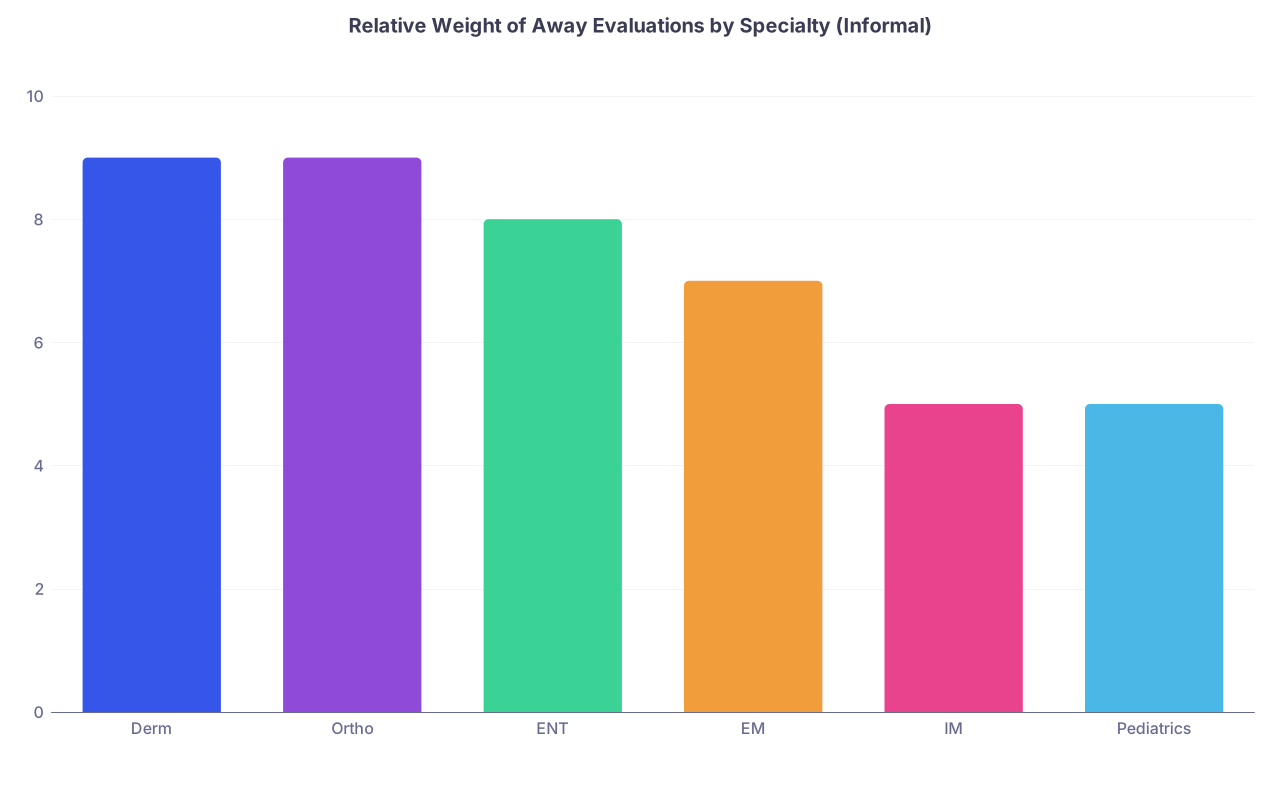
Not every specialty and program weighs these comments the same way. But if you think any program ignores them, you’re kidding yourself.
| Category | Value |
|---|---|
| Derm | 9 |
| Ortho | 9 |
| ENT | 8 |
| EM | 7 |
| IM | 5 |
| Pediatrics | 5 |
On a scale of 1–10 for away eval importance (my informal sense from hearing PDs talk):
- Derm, ortho, ENT, plastics, neurosurg: 8–10. A strong away eval is basically currency. A bad one can blacklist you.
- EM: historically huge; SLOEs (standardized letters) are built around this.
- IM, peds, FM: less central, but at top-tier academic programs, a standing-ovation away eval can still punch above your Step score.
Some subtle specialties—like radiology or pathology—use away comments more to screen out “weird fits” or professionalism issues than to anoint favorites. But they still read the words.
Behaviors That Lead to the Strongest Comments
Let me tell you what actually moves attendings from “safe” to “I want this student here.” It isn’t being the smartest person in the room.
I’ve watched dozens of visiting students swing their evals just by how they operated for four weeks.
1. Making the Residents’ Lives Easier
Attendings talk to their residents. Constantly. If the residents say, “Please get this student,” the attending’s eval magically gets more enthusiastic.
Students who win:
- Anticipate tasks without overstepping. You see that discharge is pending? Start the summary and checklist.
- Close loops. If you say you’ll call a consult, you don’t forget. If you draw labs, you follow up the results and report back.
- Handle unglamorous work without whining: scut, tracking down outside records, calling families for collateral info.
When residents say, “She functioned like an extra intern,” attendings usually echo that: “functioned at or above intern level.”
2. Speaking in the Attending’s Language
Some attendings value “synthesis.” Others are obsessed with differential diagnosis. Some care most about communication with patients. Watch what your attending emphasizes on rounds and mirror that.
If they keep saying, “So what? What’s your plan?” stop giving laundry-list presentations and start giving problem-based, concise, plan-driven summaries. They will notice.
The eval then writes itself: “Excellent clinical reasoning,” “strong ability to synthesize complex information,” “presented like a resident.”
3. Taking Feedback Without Ego
I have watched attendings mentally downgrade a student’s eval after a single defensive exchange.
You get called out on something. You have two options:
- Defend, justify, explain yourself to death.
- Say, “You’re right—that’s on me. I’ll fix that,” and then actually fix it.
Attendings don’t expect perfection. They do expect you to not argue. The student who visibly improves week-to-week after feedback gets comments like: “Very coachable,” “demonstrated steady growth,” “took feedback exceptionally well”—all green flags.
How to Nudge Attendings Toward Stronger Comments
No, you can’t ask them to write “top 5%.” But you can frame things.
1. The End-of-Rotation Check-In
Almost no students do this correctly. You should.
Near the last few days, say something like:
“Dr. X, I’ve really appreciated working with you this month. I’m very interested in [specialty] and especially in programs like this one. Is there any feedback you have for me, or anything I could have done differently to function more like an intern on your team?”
You’re doing three things:
- Signaling serious interest in their program.
- Asking to be evaluated relative to their residents.
- Giving them language for the eval: “function more like an intern.”
An attending who liked you but was on the fence about how strong to go may now feel comfortable saying you “functioned at the level of an intern” or “would be a great fit for our program.”
2. Making Your Interest Explicit (Without Groveling)
Faculty are not mind readers. I’ve seen great students lose “home court” advantage because attendings assumed they were just passing through.
If you genuinely would love to match there, say so simply:
“I just want you to know this is a place I’d be very excited to train. This rotation has really confirmed that.”
If they like you, this flips a switch in their brain: now they’re not just evaluating a generic student. They’re deciding whether to help someone who wants to join their team.
Suddenly you get: “We would be lucky to have [Name] here as a resident.”
3. Avoiding the Quiet Killers
There are a few things that tank evals faster than anything else:
- Being late. Once or twice and they remember it. Repeatedly and it’s going in the comments.
- Sneaky disinterest. Looking bored in cases you “don’t care about,” scrolling your phone on rounds, or vanishing when work piles up.
- Peer complaints. If a resident or fellow quietly tells the attending you’re weird, rude, or lazy, good luck.
You can be average clinically and still get strong comments if you are reliable, engaged, and easy to work with. Reverse that combination and you’re done.
What You Should Actually Aim to See in Your Comments
You won’t always get to see the full eval, but when you do, look for these ingredients. This is the language that signals to programs that you’re worth a serious look:
- Explicit “I want them here”: “We would be fortunate to have [Name] as a resident,” “I would strongly advocate for [Name] in our rank meeting.”
- Comparison to residents: “Performs at or above the level of our current interns,” “functioned like an additional PGY-1.”
- Top tier language: “Top 10% of students I have worked with in my career,” “one of the strongest visiting students this year.”
- Specific skills: “Excellent clinical reasoning,” “outstanding operative skills for level of training,” “communicates effectively with patients and team.”
If all you see is “pleasant, hard-working, enthusiastic,” you did fine. Not great. For some specialties, “fine” is enough. For others, especially if you’re trying to signal heavy interest in that single program, you probably didn’t move the needle.

| Step | Description |
|---|---|
| Step 1 | Rotate at Program |
| Step 2 | Resident Impressions |
| Step 3 | Attending Evaluation |
| Step 4 | Program Director Review |
| Step 5 | Automatic/High-Priority Interview |
| Step 6 | Neutral, Score-Based Review |
| Step 7 | Low Priority or No Interview |
| Step 8 | Strong Endorsement? |
FAQs
1. If my away eval is only “positive but generic,” should I still expect an interview from that program?
Do not count on it, especially in competitive fields. A generic positive eval usually just keeps you from being flagged negatively; it doesn’t push you into the “must interview” pile. If your scores and overall application are strong for that program, you might get an interview, but it won’t be because of the away. It will be in spite of a neutral rotation.
2. Can one mediocre attending eval sink my entire application for a specialty?
For most people, no. For a single program, absolutely. If the mediocre eval is from your away at a place you desperately want, that can seriously hurt your chances there. But across the specialty, other programs will weigh your home letters, other rotations, and your overall application. A single “meh” eval is not career-ending; a pattern of them is.
3. Are EM SLOEs and other standardized letters read differently than regular away evals?
They’re more structured, but the same principles apply. PDs look at comparative ranks, key phrases, and whether the writer is clearly endorsing you or just checking boxes. In EM, a “lower third” global assessment with generic positive comments is a problem. A “middle third” with strong, specific language can still be very workable, depending on the program.
4. Is it ever appropriate to ask an attending to edit or strengthen their written evaluation?
You do not ask them to “strengthen” an eval. That’s a fast way to make them regret supporting you at all. What you can do is, before they submit anything, ask for feedback on how you’re doing and what you could do to function more like their residents. That sometimes prompts attendings to re-evaluate you in a more resident-comparison framework, which then shows up naturally in their final comments. Once it’s written and submitted, you leave it alone.
In the end, away rotation evaluations are not mysterious. They’re just written in a code students are never taught to read. Strong comments say, “This is one of us,” and back it up with concrete comparisons and specific praise. Generic comments keep you neutral. Hedged or concern-laced comments quietly kill your chances at that program.
Your job on an away isn’t to be perfect. It’s to make it very easy for an attending to honestly write: “I would be happy to have this student as a resident here,” and for the residents to nod along when that line gets read out loud on rank night.