
The Silent Killer: Professionalism Errors That Derail Applications
It is 10:47 p.m. on a Tuesday. You just finished a brutal ward day, you finally sit down to check email, and there it is: “We regret to inform you that your interview has been cancelled.” No explanation. No follow‑up. Just gone.
Your scores are solid. Your letters were fine. You were starting to feel cautiously optimistic. And then, without warning, an interview evaporates.
I have bad news: that is rarely random. Programs do not cancel interviews for sport. The “silent killer” of residency applications is professionalism. Not just huge scandals. The small, quiet, day‑to‑day lapses that you do not think anyone noticed—or you hope they forgot.
They did not.
Let me walk you through the professionalism errors that quietly kill otherwise competitive applications, and how to avoid being the cautionary story your dean anonymously references in next year’s advising meeting.
The Myth: “If My Scores Are Good Enough, They Will Overlook Everything Else”
This belief derails more residency applications than a low Step 2 score.
You have heard some version of this: “If you have a 255+, you are safe.” Or, “Once you get the interview, it is all about fit.” Both are only half true, and the missing half is where professionalism lives.
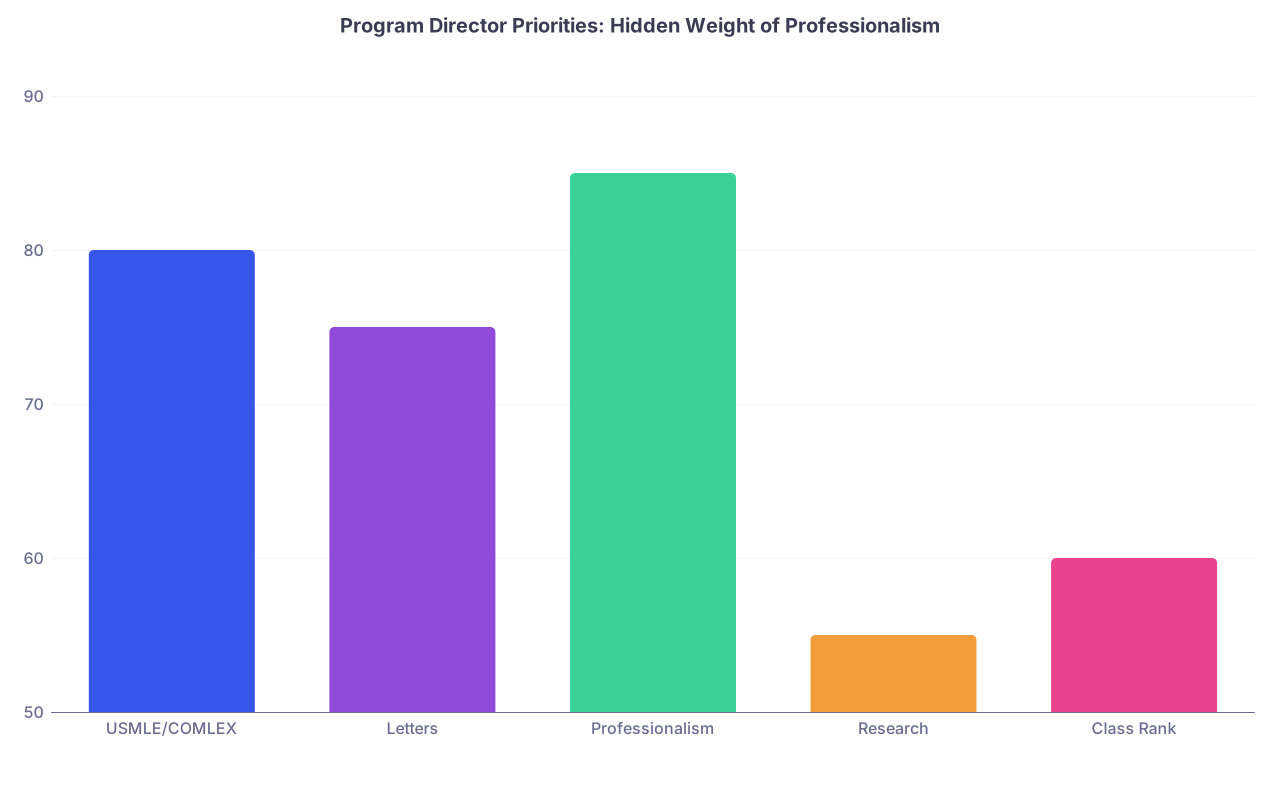
Programs absolutely screen for professionalism. Many put it at the top of the list.
| Category | Value |
|---|---|
| USMLE/COMLEX | 80 |
| Letters | 75 |
| Professionalism | 85 |
| Research | 55 |
| Class Rank | 60 |
Think of it this way:
- A mediocre applicant with spotless professionalism can still be “safe.”
- A strong applicant with professionalism concerns becomes a risk.
- Programs avoid risk.
The higher‑tier the program, the less tolerance they have. They can always fill a spot with someone who has similar scores and no drama.
So if you are assuming your metrics will “offset” that one unreturned email, that awkward comment, that late arrival, or that missing thank‑you, you are making a dangerous mistake. Programs weigh professionalism like a potential malpractice case. Once they are uneasy, you are done.
The Silent File Killers: Professionalism Red Flags You Do Not See
Professionalism errors are often invisible to you because they show up in places you never see: dean’s letters, phone calls between PDs, quiet comments in committees, nurse feedback, scrub techs venting to attendings.
1. The MSPE “Code Words” That Sink You
If you think the MSPE (Dean’s letter) is just a summary of grades, you are underestimating the level of subtext in those paragraphs. Programs can read the code. They have practice.
Some phrases that look harmless to you are essentially red flags translated for program directors:
| Phrase in MSPE | How PDs Often Read It |
|---|---|
| "Benefited from close supervision" | Needed hand-holding / concerns |
| "Improved over the course" | Started poorly / warning |
| "At times struggled with deadlines" | Reliability problem |
| "Challenges with time management" | Chronic lateness |
| "Had difficulty integrating feedback" | Defensive / hard to coach |
I have seen applicants genuinely confused: “But my comments say I improved a lot!” They missed the key part: why they had to “improve.”
Avoid this trap by:
- Not giving anyone a reason to document professionalism issues on rotations.
- Treating every clerkship—especially core ones—as part of your residency application, not just your transcript.
- Assuming any professionalism issue, no matter how “minor,” can end up in your MSPE.
If you have already accumulated one of those phrases, do not ignore it. You need a clear pattern of excellent, drama‑free evaluations afterward to show it was a one‑time issue, not a character trait.
2. The “Invisible” Feedback: Nurses, Coordinators, and Staff
Here is a line I have heard from faculty more than once: “Ask the nurses about them.” Or, “See what the coordinator thinks.”
You may think you are performing only for attendings and residents. You are wrong.
Common silent killers:
- Being dismissive or impatient with nurses or MAs.
- Ignoring pages, answering curtly, or sounding annoyed.
- Being “that student” who complains at the front desk about schedules.
- Rolling your eyes in the nurses’ station, thinking no one with influence saw it.
I know of a student who was ranked to match at a solid IM program. Then the program coordinator mentioned, almost in passing, “They were very rude to me when we were scheduling the interview.” That student dropped several positions on the rank list. They did not match there. They never knew why.
If you are polite, responsive, and humble with coordinators and staff, you get quiet advocates. If you are entitled or dismissive, you get quiet opponents. Programs listen to both.
Application‑Stage Professionalism Errors: Where People Sabotage Themselves
Your professionalism is not assessed only on rotations. Your ERAS, your emails, your scheduling, and your communications are all part of the data set.
3. Sloppy, Rushed, or Inconsistent Documents
You would be surprised how many ERAS applications look like this:
- Multiple different email addresses across platforms.
- Inconsistent dates between CV and ERAS entries.
- Typos in program names. (Spelling “Massachusetts” wrong is more common than you think.)
- Copy‑pasted personal statements mentioning the wrong specialty or program.
This communicates one thing: “I do not pay attention when it matters.”

Program directors assume: If you are careless with your own application, you might be careless with orders, prescriptions, or handoffs.
Avoid this by:
- Doing one dedicated, distraction‑free proofreading session of your entire ERAS.
- Having at least one detail‑oriented person (ideally faculty or advisor) check for inconsistencies.
- Keeping one master CV and updating everything off that, instead of multiple half‑updated versions floating around.
This is not about perfectionism. It is about not sending the message that you are casual with professional work.
4. Unprofessional Email Habits
Many students underestimate how much judgment is baked into email style.
Red flags I have seen:
- Casual tone with program directors or coordinators (“Hey, just checking in!”).
- No greeting or signature. One‑line emails sent like texts.
- Impatient follow‑ups within 24 hours: “Just bumping this to the top of your inbox.”
- Weird or inappropriate email addresses: gamer tags, jokes, or excessively personal accounts.
These may not destroy your application by themselves, but when combined with anything else, they quickly become “evidence of poor professionalism.”
Basic rules that are non‑negotiable if you want to stay out of the danger zone:
- Use a simple, professional email (Firstname.Lastname + number if needed).
- Always include a greeting and sign-off with your full name, school, and AAMC ID (when appropriate).
- Give people at least 2–3 business days before following up, longer close to ERAS crunch season.
- Keep emotion and frustration out of email. Always.
You are not texting your friend. You are writing something that can be forwarded to an entire selection committee with one click.
5. Interview Scheduling: Ghosting, Flaking, and Overbooking
Interview season exposes applicants’ professionalism under pressure. Programs know this. They watch how you handle it.
Common mistakes that hurt you more than you think:
- Accepting an interview, holding it for weeks, then cancelling last minute for a “better” program.
- No‑showing without an emergency and without calling.
- Double‑booking and asking the program to move heaven and earth to accommodate you at the last second.
- Sending guilt‑trippy or demanding messages when they will not reschedule.
| Category | Value |
|---|---|
| No history of no-show | 90 |
| 1 documented no-show | 55 |
| 2+ no-shows | 20 |
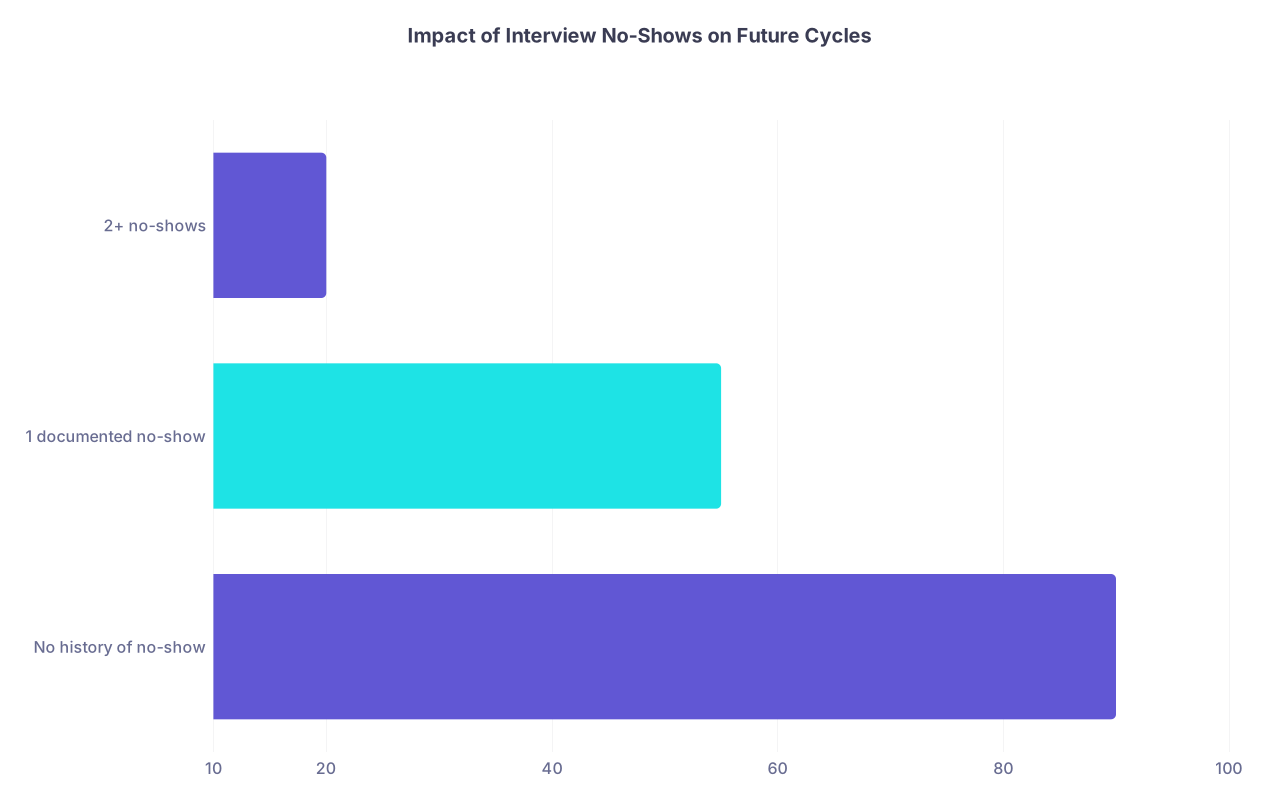
Programs talk. They track no‑shows. Some keep internal lists. If your school has multiple students no‑show or cancel late, that school gets a reputation. Then future applicants pay for your mistakes.
Simple rules that protect you:
- Do not accept more interviews than you can realistically attend.
- If you must cancel, do it as early as possible and with a brief, professional apology.
- If a true emergency happens, you or someone on your behalf must notify them as soon as you can.
Playing “interview Tetris” like it is a game is a fast way to look untrustworthy.
Behavior on Rotations: Where Professionalism Stories Begin
Most professionalism stories that destroy applications do not start in the dean’s office. They start on wards or in the OR.
6. Micro‑Lateness and the “Low‑Effort” Student
Being late once or twice is not usually fatal. Being “that student who is always just a little late” is.
I am not talking about showing up an hour after rounds. I am talking about:
- Consistently strolling in 3–7 minutes late.
- Sliding into conference after it starts, coffee in hand.
- Disappearing for 20–30 minutes without letting anyone know where you are.
Residents and attendings notice. They may not confront you. They might not even mention it in your face‑to‑face eval. But when they fill out the evaluation form, they remember.
I have seen narrative comments like:
- “Frequently arrived just after the team had started.”
- “Occasionally difficult to locate on the wards.”
- “Needed reminders to be present at the bedside.”
These all read as professionalism deficiencies to PDs.
Fix this:
- Decide your unofficial start time is 10–15 minutes earlier than what is stated.
- Text or page if you are delayed, every time, without exception.
- Stay visible and find ways to help instead of disappearing to the computer room.
You do not want to be the story that starts with, “We could never find them when we needed something.”
7. Talking Too Much, Complaining Too Openly
You are tired. The hours are ridiculous. Some rotations are poorly run. Yes, everyone knows this.
But here is where students harm themselves:
- Complaining loudly about hours, call, or scut work to residents or attendings.
- Making sarcastic comments about patients (“train wreck,” “social disaster”) where others can hear.
- Venting about other students, nurses, or staff on the unit.
You may think you are just “being real” or “bonding” with residents. What you are really doing is broadcasting that under stress, you leak frustration into the clinical environment.
There is a sharp line between honest feedback and unprofessional attitude. Programs care deeply about which side you live on.
Your filter during third and fourth year must be stricter than you think is necessary. You can vent. Just not there, not then, and not to those people.
8. Social Media: The Permanent, Searchable Liability
You would assume by now that everyone knows not to post unprofessional things on social media. I wish that were true.
Residency programs vary wildly in how much they search applicants online. But some do. And even if they do not, your faculty and dean might. Professionalism concerns that surface there can lead to negative comments in your MSPE.
Common disasters:
- Public posts complaining by name about a hospital, rotation, attending, or school.
- Party photos that cross from “normal life” into clearly impaired, reckless, or illegal behavior.
- Jokes about patients, even if “de‑identified.”
- “Dark humor” memes that paint medicine, patients, or colleagues in demeaning ways.

Do not assume “private” equals safe. Screenshots exist. People show things to each other. Things leak.
You do not have to erase your online life. But if you would feel uneasy with a selection committee seeing a post, fix your settings or delete it. Now, not after interview invites go out.
Letters and Back‑Channel Communication: What You Never Hear
You will never see most of what is said about you during selection. That is why professionalism issues feel like a “silent killer.”
9. The Lukewarm or Damning Letter of Recommendation
A mediocre letter in a competitive specialty is almost as bad as an openly negative one. And the fastest way to get a lukewarm letter? Professionalism concerns.
Typical wording in such letters:
- “Student X completed the rotation with us and met expectations.”
- “They were polite and receptive to feedback.”
- “I expect they will be a solid resident in the right environment.”
What is missing is the real message: enthusiastic support. Words like “outstanding,” “exceptional,” “I would rank this student at the top of our list.”
Faculty who have even small professionalism reservations often choose neutral, vague praise as a compromise. They do not sabotage you explicitly. They just do not advocate for you. That is enough to push you down, especially in competitive fields.
You avoid this by:
- Never assuming someone is a safe letter writer if your relationship is lukewarm or you had any conflict.
- Asking explicitly whether they can write you a “strong, supportive letter.” If they hesitate, thank them and ask someone else.
- Protecting your reputation so that when your name comes up, faculty think, “Reliable, easy to work with, no drama.”
10. Back‑Channel Phone Calls Between Programs
Here is a conversation structure I have heard, almost verbatim:
PD A: “We are thinking of ranking [Your Name]. You had them as a student, right? How were they?”
Faculty B: (long pause) “Good. Smart. We had a couple of professionalism issues, but they got better.”
PD A: “Ah. Got it.”
End of consideration.
No one writes you a letter saying, “We did not rank you because of an off‑the‑record remark.” You will simply never match there and never know why.
Your only defense is boring professionalism. No stories. No drama. Nothing memorable except that you showed up, worked, and acted like an adult.
Recovering From a Professionalism Hit (If You Already Made a Mistake)
Some of you are reading this already knowing you have a documented professionalism issue. An incident report. A dean’s meeting. A written warning. You cannot undo it. But you can avoid compounding it.
Key principles:
- Do not minimize. Programs hate rationalization more than they hate the original mistake.
- Own it cleanly, once, with a short explanation and clear evidence of change.
- Make sure every evaluation and letter after that event is flawless.
If asked in an interview:
- Briefly describe what happened without blaming others.
- State what you learned and what you changed.
- Give 1–2 specific examples of how you now handle similar situations differently.
What kills applicants is not the mistake. It is the pattern. Or the lack of insight.
The Uncomfortable Truth: Professionalism Is Mostly Boring
You will rarely be “praised” for professionalism. You will be punished for lapses.
The students who glide through the Match:
- Reply to emails on time.
- Show up early.
- Are courteous to everyone, especially staff.
- Turn things in when they say they will.
- Do not generate drama. Anywhere.
It is not glamorous. No one will write on your tombstone, “Always updated the team when running late.” But that is the level you need to hit if you want to avoid becoming the quiet cautionary tale in your class.

| Step | Description |
|---|---|
| Step 1 | Clinical Years |
| Step 2 | Professional Behavior |
| Step 3 | Strong MSPE & Letters |
| Step 4 | Code Words & Concerns |
| Step 5 | Positive Back-channel Calls |
| Step 6 | Negative / Cautious Calls |
| Step 7 | Interview + High Rank |
| Step 8 | No Interview or Low Rank |
| Step 9 | Pattern? |
Three Things To Remember
Professionalism is not a soft, secondary characteristic. Programs treat it as a safety issue. Once there are doubts, your scores and research cannot fully save you.
Most professionalism damage happens quietly: MSPE code words, staff comments, lukewarm letters, and back‑channel phone calls. If you are “memorable” for the wrong reasons, you will pay for it at the rank list stage.
The safest strategy is simple, consistent, boring professionalism: be early, be courteous to everyone, respond like an adult, and generate zero drama. If people cannot think of any story about you, that is a win.