
A failed exam or bad rotation will not kill your residency chances. Hiding it will.
If you are reading this, you probably have one of the following:
- A failed board exam (COMLEX/USMLE)
- A failed shelf or course
- A marginal or failed rotation
- A professionalism “incident” that shows up in your MSPE
And now you are worried that this one line in your record is going to define you.
It will—unless you rewrite the story around it. That is the job now.
This is not about “spinning” the truth. Program directors are not stupid and they talk to each other. This is about:
- Understanding how programs actually read your application.
- Controlling the narrative around your setback.
- Offering a concrete, believable plan that matches what you did next.
Let us build that, step by step.
How Programs Really See a Failure
, Personal Statement/Experiences](https://cdn.residencyadvisor.com/images/articles_svg/chart-relative-weight-of-application-components-in-scree-9299.svg "Relative Weight of Application Components in Screen")
| Category | Value |
|---|---|
| Board Scores/Failures | 30 |
| Clinical Grades | 20 |
| MSPE Comments | 20 |
| [Letters of Recommendation](https://residencyadvisor.com/resources/strong-residency-application/away-rotation-evaluations-what-attending-comments-actually-signal) | 20 |
| Personal Statement/Experiences | 10 |
Most students imagine a red “F” flashing on the screen and a PD slamming the “reject” button. That is not how this works.
Here is the reality I have seen sitting in rank meetings and application review rooms:
Board failure = yellow flag, not automatic rejection
- Multiple failures? That can become a red flag.
- Single failure with strong upward trend? Often acceptable, especially in non-ultra-competitive fields (IM, FM, Peds, Psych, PM&R, etc.).
Rotation failure = “okay, what actually happened?”
Attendings and PDs know rotations can be messy:- Misalignment with one attending
- Personal crisis
- Poor communication or immaturity you later outgrew
They want to know: was this a one-off or a pattern?
Context matters more than the raw outcome
Programs ask:- What changed after the failure?
- Who is willing to vouch for this person now?
- Is there a reasonable explanation that fits the rest of the file?
Silence is deadly
When there is a failure and:- No explanation in the personal statement
- No note in the Dean’s letter/MSPE
- No mention in letters
Programs assume the worst: lack of insight, lack of accountability, or a continuing problem.
Your job is not to pretend the failure was “actually a good thing.” Your job is to:
- Own it
- Contain it
- Show what changed after
That is the story we will construct.
Step 1: Diagnose the Damage (Objectively)
Before you start “rewriting the story,” you need an honest damage report. No drama. Just facts.
A. What exactly happened?
Write this down in one sentence first. If you cannot do that, you will ramble in your application.
Examples:
- “I failed Step 1 on my first attempt and passed on my second with a 225.”
- “I failed my third-year Surgery clerkship due to clinical evaluations but passed when I repeated it.”
- “I failed my OB shelf exam, repeated it, and scored in the 70th percentile.”
Then add 1–2 lines of context for yourself (not for the application yet):
- What were the real causes?
- Poor time management?
- Overcommitted (research, leadership, job, family)?
- Health or mental health issues?
- Language / transition challenges?
- Underestimating the exam / content?
If the only line you can write is “The exam was unfair” or “The attending hated me” you are not ready to explain this to a PD. You need to find your part in it, even if the situation was imperfect.
B. How does it look on paper?
Look at your record like a PD who does not know you:
- One failure and then:
- Strong later rotations?
- Improved shelves?
- Solid Step 2 CK?
- Good comments in MSPE?
Or:
- Multiple weak points:
- Borderline comments
- More than one failure
- Limited strong letters
You are either in “Isolated Event” territory or “Pattern That Needs Serious Framing.” Both are workable, but the second requires tighter work.
Step 2: Decide Where and How To Address It
You have several tools in ERAS (or CaRMS / equivalent) to control the story:
- Personal statement
- Experience descriptions
- “Additional information” or “significant experiences” sections
- Program-specific questions (if any)
- MSPE “Noteworthy Characteristics” (influence is limited, but you can talk to your Dean)
- Letters of recommendation (asking an attending to comment on your growth)
You do not need to talk about the failure everywhere. Over-explaining looks insecure. Under-explaining looks evasive.
General Rules
Major failure (boards, failed rotation)
- Address it directly in the personal statement or in a dedicated short paragraph in an “additional info” section if available.
- Avoid writing half your PS about it unless it genuinely changed your career direction.
Minor blip (single failed shelf, early preclinical slip)
- Brief acknowledgment is enough, often tied to your later improvement.
- Sometimes the MSPE explanation plus a one-line mention is adequate.
Professionalism or behavior issue
- You must address this clearly and humbly. This scares PDs more than an exam failure.
- Use the same three-part structure below, but be even more explicit about what changed in your behavior.
Step 3: Use a Tight, 3-Part Framework
Every explanation you give—personal statement, interview, email—should follow one structure:
- What happened (brief, concrete, no excuses)
- What you learned (insight, not cliché)
- What you changed and how it shows up now (evidence)
If you remember nothing else from this article, remember that.
1. What happened – 2–3 sentences, max
Bad versions:
- “I have always been a strong student, but sadly, due to unfortunate circumstances…”
- “My failure was actually a gift because…”
Good versions:
- “During my second year, I failed Step 1 on my first attempt. I underestimated the exam and tried to balance full-time research with exam preparation.”
- “I failed my surgery clerkship after receiving consistent feedback about slow information gathering and incomplete notes.”
No drama. No self-pity. No 10-sentence backstory about your childhood or your roommate.
2. What you learned – 2–3 sentences
If you say “I learned time management,” I stop reading. Too generic.
Be specific:
- “I learned that I cannot rely on last-minute cramming and that I needed a structured, daily approach with spaced repetition and question blocks.”
- “I realized that I was listening for the ‘right answer’ rather than for the patient’s entire story, and it made my assessments superficial and disorganized.”
- “I understood that I was resistant to feedback, and that my first reaction was often defensive rather than curious. That had to change.”
You are demonstrating insight, not self-flagellation. PDs want residents who can accurately self-diagnose and adjust.
3. What you changed – and proof that it worked
This is where most students fail. They talk about change with no evidence.
List specific actions + outcomes:
Examples:
- “I created a 10-week study plan with daily UWorld questions and weekly NBME self-assessments, met weekly with our learning specialist, and treated studying as my primary job. On my second attempt, I passed Step 1 and went on to score a 244 on Step 2 CK.”
- “On my repeat surgery rotation, I started each day with a written patient list organized by problem, pre-charted notes, and made a rule that I would present plans before being asked. My evaluations described me as ‘prepared,’ ‘thorough,’ and ‘much improved from prior rotation.’”
- “After a professionalism concern in my second year about late documentation, I worked with my advisor to create habits: writing notes before leaving the floor, using checklists, and double-checking orders with seniors. I have had no further professionalism issues, and multiple attendings have commented on my reliability.”
Evidence is what convinces PDs, not adjectives about yourself.
Step 4: Rebuilding Your Application Around the New Story
Now we apply this structure to each piece of your application so it is consistent and believable.
A. Personal Statement: Where to Put the “Failure” Paragraph
The personal statement is not your confession booth. It is a thesis about who you are as a future resident, with one section about how you handled adversity.
I like this layout:
- Opening – Why this specialty / a defining patient or clinical moment (not about your failure)
- Development – What kind of learner/teammate/physician you are becoming
- Setback section – 1 short paragraph using the 3-part framework
- Evidence of current strength – Rotations, roles, letters, concrete behaviors
- Closing – What you want from residency and what you offer
Example paragraph (board failure, IM applicant)
During my second preclinical year, I failed Step 1 on my first attempt. I approached the exam as I had prior tests, trying to balance a full-time research project with content review and questions, and I underestimated how much structure I needed. Working with our learning specialist and a faculty mentor, I built a detailed plan that prioritized daily question blocks, spaced repetition, and weekly practice exams. On my second attempt I passed and went on to score a 241 on Step 2 CK. More importantly, that experience forced me to become a deliberate, organized learner—the same approach I now bring to complex ward patients and to teaching my classmates.
Short. Direct. Cause → adjustment → proof.
You do not need a whole page explaining your emotions around the failure. Program directors are not hiring you for your emotional arc. They are hiring you for your reliability under pressure.
B. MSPE and Talking to Your Dean’s Office
You cannot rewrite your MSPE, but you can influence the framing if you talk to your Dean’s office early.
Do this:
- Schedule a brief meeting: “I would like to discuss how my Step 1 failure / surgery clerkship repeat is described in my MSPE so that it reflects the full context and my subsequent performance.”
- Be specific:
- Ask that your later improvements or repeat successes be mentioned in the same section, not pages apart.
- Share any written evaluations that highlight your growth.
You want language like:
- “The student initially struggled with X but showed significant improvement and successfully completed Y with strong evaluations.”
Not:
- “The student failed X.” Full stop.
You may not get everything you want. But if you approach this like a professional, most student affairs offices will at least avoid unnecessarily damaging language.
C. Experience Descriptions: Show the “After” Version of You
If you had a professional or clinical failure, you must show how you behave now, not just tell.
In ERAS experience entries, highlight:
- Reliability: “Consistently completed notes before leaving the floor.”
- Clinical reasoning: “Developed problem-based assessment templates that I still use on ward rotations.”
- Initiative: “Requested mid-rotation feedback and adjusted plan accordingly.”
You are building the case that the person who failed that exam/rotation is not who is applying now.
Step 5: Align Your Letters With the New Story
Quiet truth: a strong letter that explicitly addresses your growth is more powerful than any paragraph you write about yourself.
Who you need letters from (if you have a failure)
Someone who worked with you after the failure
- Ideal: an attending from the repeated rotation or from a similar, later rotation.
- Second best: a sub-I / acting internship attending in the same specialty.
Someone who can comment on your work ethic and reliability
- Chiefs, clerkship directors, research mentors who supervised you closely.
If there was a professionalism concern
You want at least one letter that says, in effect:- “I was aware of X issue early in their training. What I have seen since then is a resident-level student who is dependable, receptive to feedback, and trusted by the team.”
You cannot dictate their wording, but you can say:
“I did have a failed surgery rotation earlier in third year that I repeated successfully. If you feel comfortable, I would appreciate any comments on the progress you saw during our time working together.”
Most good attendings understand what you are asking and will help if it is true.
Step 6: Prepare for the Interview Question
If you have a failure, you should expect one of these:
- “Tell me about this failed exam.”
- “Can you explain what happened on your [surgery] rotation?”
- “I see there was a professionalism note in your MSPE—what was that about?”
You will answer using the same 3-part framework—but even tighter and calmer.
60–90 second template
State what happened
“In my second year, I failed Step 1 on my first attempt.”Name the cause honestly
“I tried to split my time between a demanding research project and studying, and I did not build the kind of structured daily plan that exam requires.”Explain what you changed
“I met with our learning specialist and my advisor, cut back on other commitments, and built a schedule with daily practice questions, spaced repetition, and weekly self-assessments.”Show the outcome
“I passed on my second attempt and later scored [X] on Step 2 CK. Since then I have used the same structured approach on the wards—preparing before rounds, using checklists, and regularly seeking feedback—and my clinical evaluations have reflected that improvement.”
Stop talking. Do not keep apologizing. Look them in the eye. Calm, factual, done.
If they push more, you can add detail. But most interviewers just want to see:
- You own it.
- You are not defensive.
- You know how to fix problems.
Step 7: Adjust Your Application Strategy, Not Just Your Story
Narrative alone will not overcome numbers in the most competitive specialties. This is where people lie to you: “You can do anything you put your mind to.” Not with a failed Step and a 218 CK in plastics. That is fantasy.
You need realism in your school list and specialty strategy.
| Specialty | Risk with Single Failure | Notes |
|---|---|---|
| Family Med | Low | Explain, show growth |
| Pediatrics | Low–Moderate | Strong Step 2 helps |
| Internal Med | Moderate | Academic IM more selective |
| Psychiatry | Low–Moderate | Fit and narrative matter |
| Neurology | Moderate | Watch academic programs |
| Gen Surgery | High | Need strong later performance |
If you have:
Single failure + strong recovery →
You can usually still match your target specialty if it is not ultra-competitive. Focus on:- Broad list (community + academic)
- Strong sub-Is
- Clear narrative and letters
Multiple failures or failure + low Step 2 →
You need to:- Broaden specialty choices (e.g., consider IM, FM, Psych, Peds, PM&R depending on interest)
- Apply widely
- Add preliminary / transitional year options if appropriate
Significant professionalism issue →
You must:- Show a long runway of clean, strong performance after the event
- Choose programs and specialties that have historically been more forgiving when convinced of true change
Do not burn an application cycle on magical thinking. Align your targets with your file.
Step 8: Concrete Rewrite Examples
Let us convert two typical “bad stories” into solid application language.
Example 1: Failed Step 1, Now Applying IM
Bad internal story (what students often tell themselves):
“I am dumb, programs will think I am dumb, I will never get into a decent IM program.”
Rewritten external story:
What happened:
“I failed Step 1 on my first attempt after trying to balance full-time research and exam prep.”What you learned:
“I learned that my previous ‘work hard and cram’ approach was not sustainable and that I needed structure, deliberate practice, and earlier feedback.”What changed:
“I worked with a learning specialist, created a day-by-day schedule, and treated exam prep as my full-time job. I passed Step 1 on my second attempt and scored 238 on Step 2 CK. On the wards, I have applied the same structured approach, and my most recent IM sub-I evaluations described me as ‘thorough, reliable, and prepared to function at an intern level.’”
That is a story programs can work with.
Example 2: Failed Surgery Rotation, Now Applying Psych
Bad approach in PS:
“I failed surgery because it was not the right specialty for me, but that showed me how much I love psychiatry.”
That sounds like running away.
Better approach:
Acknowledge the failure and behavior:
- “On my initial surgery clerkship, I failed due to consistent feedback that I was disorganized during pre-rounding and slow to complete notes.”
Show learning that is relevant to Psych:
- “The experience forced me to confront how I was processing patient information. I realized I was focusing on isolated data instead of the whole story, which affected both my efficiency and clinical reasoning.”
Show change:
- “In my repeat rotation and later clerkships, I created templates for gathering histories, practiced presenting concisely, and asked for mid-rotation feedback. Those habits carried directly into psychiatry, where understanding a patient’s narrative is central. My psychiatry attending later noted that I ‘integrate complex psychosocial details into clear, organized assessments.’”
Now the failure is not your identity. It is a turning point you handled like an adult.
Step 9: Use a Simple Planning Timeline
If you are 6–12 months from application, do this now:
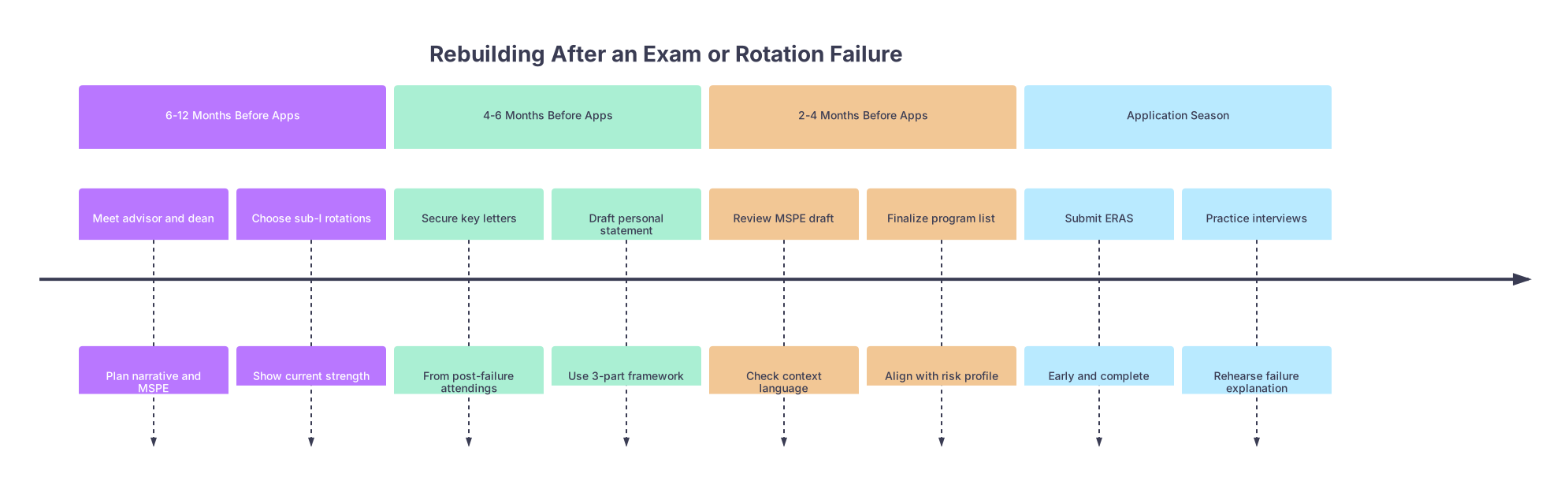
| Period | Event |
|---|---|
| 6-12 Months Before Apps - Meet advisor and dean | Plan narrative and MSPE |
| 6-12 Months Before Apps - Choose sub-I rotations | Show current strength |
| 4-6 Months Before Apps - Secure key letters | From post-failure attendings |
| 4-6 Months Before Apps - Draft personal statement | Use 3-part framework |
| 2-4 Months Before Apps - Review MSPE draft | Check context language |
| 2-4 Months Before Apps - Finalize program list | Align with risk profile |
| Application Season - Submit ERAS | Early and complete |
| Application Season - Practice interviews | Rehearse failure explanation |
If you are close to application and time is short, compress this:
- Get at least one strong recent rotation where you perform at your best.
- Lock down two letters from people who saw that performance.
- Tighten your personal statement to 1–2 sentences on the failure and more on your current strengths.
- Practice your interview answer until it sounds like you are stating your height. Neutral and matter-of-fact.
Final Thoughts: What Actually Matters Now
There are only three things program directors really care about after a failure:
Is this a contained, understood problem or an ongoing risk?
Your job: Show a clear cause, clear fixes, and clean performance since.Can I trust this person at 2 a.m. with real patients and real responsibility?
Your job: Provide recent evaluations and letters that describe you as reliable, prepared, and coachable.Does the story of this file make sense?
Your job: Make sure your personal statement, MSPE, letters, and interview answers tell the same coherent story of setback → insight → sustained improvement.
You are not the only applicant with a failure. The ones who match are the ones who do not hide, do not over-explain, and do not collapse. They diagnose the problem, fix it, and then show that version of themselves on every page of the application.