
Your Step score is not the death sentence everyone whispers about in the hallway.
Programs care about risk. Your job is to prove you are not a risk.
If your Step 1 or Step 2 score is weaker than you like, you do not need generic “work harder” advice. You need a rehab protocol: specific moves, in a specific order, that convert a liability into a contained, explainable, and partially redeemed weakness inside an otherwise strong, coherent application.
Let me walk you through that protocol.
1. First: Get Brutally Clear on the Actual Damage
You cannot fix what you have not accurately sized.
Forget vague labels like “low score” or “kinda bad.” Programs are looking at hard numbers and patterns. You should too.
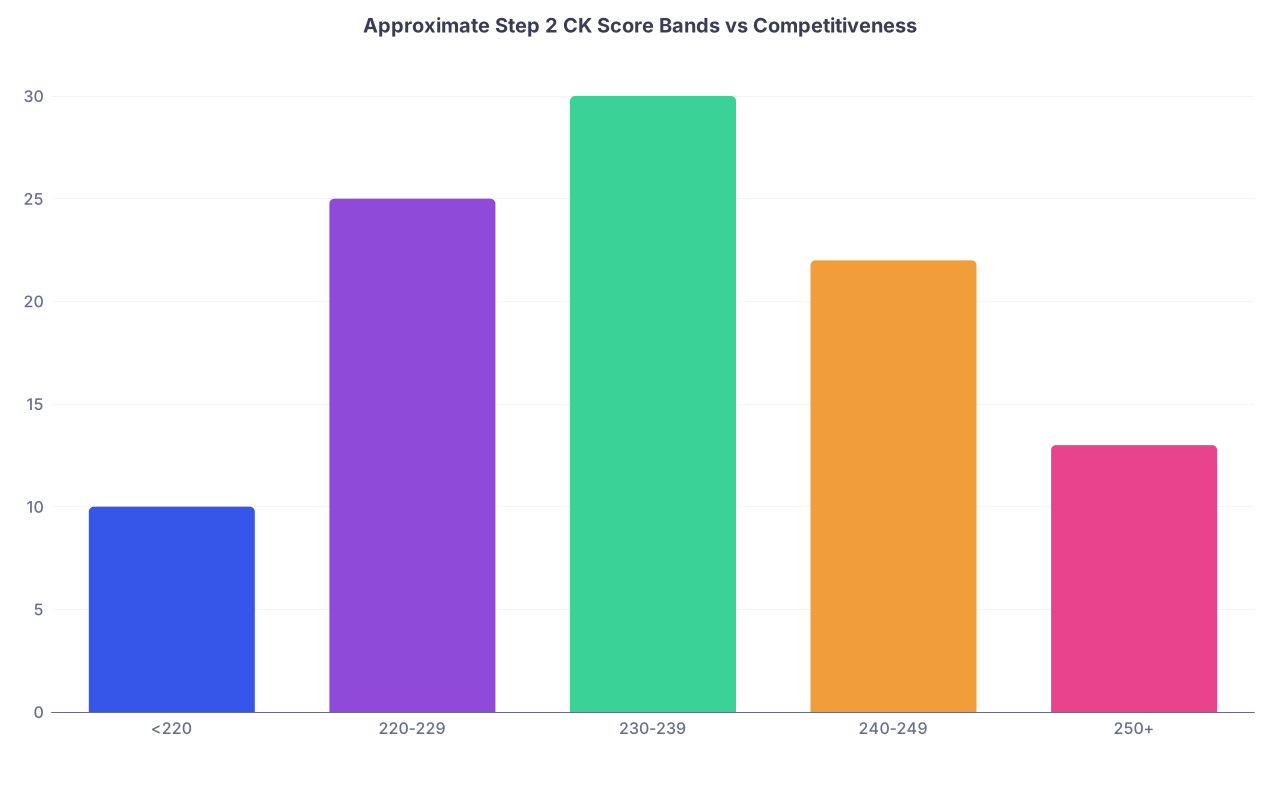
| Category | Value |
|---|---|
| <220 | 10 |
| 220-229 | 25 |
| 230-239 | 30 |
| 240-249 | 22 |
| 250+ | 13 |
These bands are general, but useful. For many core specialties (IM, FM, peds, psych, neurology):
- 250+: Strength
- 240–249: Solid
- 230–239: Serviceable / mid-range
- 220–229: Below average, needs compensation
- <220: Problematic, needs an aggressive rehab plan
Surgical subspecialties, derm, radiology, ortho, ENT, neurosurgery play in a harsher world. A “230” in competitive surgery is not the same as a “230” for community internal medicine.
Do this today
- Write down:
- Step 1: score or Pass (and any fail)
- Step 2: score (and if not taken, plan date)
- Any NBME shelves you failed, repeated, or barely passed.
- Compare your scores to your specialty’s typical match range. Use NRMP Charting Outcomes and your school’s match data.
- Identify your true status:
- Contained weakness: One low Step with otherwise OK board history.
- Pattern problem: Multiple low scores, failures, repeated exams.
The rehab strategy is harsher and more structured for pattern problems. But both are workable if you stop pretending and start engineering.
2. Decide: Change Specialty or Change Strategy?
Here is the hard call: sometimes the smartest rehab is changing the game, not just changing tactics.
If you are chasing ultra-competitive fields (derm, ortho, neurosurgery, plastics, ENT, integrated vascular, IR, rad onc) with significantly below-average scores and no extraordinary counterweight (tier-1 research, home program chair backing, national-level awards), you are trying to carry a piano up six flights of stairs.
Sometimes you can. Usually you cannot.

Quick reality check: when to strongly consider pivoting
You probably need to rethink specialty if:
- You have:
- Step 1: fail then pass, and
- Step 2: <230
and
- You are dead-set on derm, integrated plastics, ENT, neurosurgery, or ortho
and - You lack:
- Strong mentor-champion in that field
- Significant publications or a gap year of dedicated research
In that combination, you are not “differentiated.” You are unsafe from a program’s standpoint.
When you can likely stay the course
You can reasonably stay in your targeted specialty if:
- You have one of:
- Step 1: Pass, Step 2: 230–239 (for non-surgical competitive-ish specialties like EM, anesthesia, rads) plus strong other strengths
or - Step 2: ≥240 even with a prior Step 1 weakness
- Step 1: Pass, Step 2: 230–239 (for non-surgical competitive-ish specialties like EM, anesthesia, rads) plus strong other strengths
- You have:
- Strong clinical comments
- At least some research or leadership
- Advisors who are not quietly grimacing when you say your specialty
If your current advisors are evasive or vague, ask them directly:
“If I were your child, and these were my scores and goals, what would you tell me to do?”
Then actually listen.
3. Contain the Damage on Paper: Strategic Framing
You cannot erase a low Step score. You can decide what story it tells.
Programs look for how you handle weakness. They are hiring future colleagues, not test-taking machines.
Principles for framing a low score
- Own it briefly, clearly, and without excuses.
- Show what changed afterward (behaviors, systems, outcomes).
- Prove the change with data (later performance, concrete accomplishments).
This applies in:
- Your ERAS experiences descriptions
- Personal statement (if addressed)
- MSPE / Dean’s letter input
- Interviews
Example: How to (and how not to) address it
Bad (too defensive, too much drama):
“My Step 2 score does not reflect my strong clinical abilities. I had multiple family issues, and the test was not representative of my true knowledge.”
Better (short, accountable, forward):
“My Step 2 score is lower than I expected and prompted me to change how I prepare for high-stakes exams. I began using structured question blocks with detailed error analysis, weekly content review check-ins with a faculty mentor, and earlier, spaced preparation rather than compressed studying. Since then, I have passed all subsequent shelf exams on the first attempt and received strong evaluations in my clinical rotations.”
If you failed Step 1 or Step 2, you must address it, but not as the center of your story.
Bare-bones example:
“I failed Step 1 on my first attempt. I was underprepared and underestimated the exam. After that, I created a structured schedule with daily question blocks, weekly review with a learning specialist, and regular self-assessment exams. I passed on my second attempt and have since passed Step 2 and all clerkship shelves, while consistently improving my test performance.”
Do not dwell. Say it cleanly, then pivot hard to what you have done since.
4. Build a “Counterweight Portfolio” Around Your Scores
If your Step scores are weak, everything else needs to be unambiguously strong. You cannot afford “average” elsewhere.
Think of it as a seesaw. If one side is heavy (scores), you stack serious weight on the other side: clinical performance, letters, scholarly work, fit.
Here is what that counterweight portfolio should look like at minimum:
| Area | Target Standard with Low Scores |
|---|---|
| Clinical evals | Honors / strong comments in key rotations |
| Letters (LORs) | 2–3 specialty-specific, very strong |
| Research | At least some activity; more for competitive |
| Program signals | Away rotations, emails, geographic ties |
| Professionalism | Absolutely clean record, reliable reputation |
Now how to actively build each one.
Clinical performance: Your primary rehab tool
Programs trust what people say who worked with you for 4–12 weeks far more than they trust your personal essay.
Your job: become the intern your residents wish they had.
Concrete behaviors:
- Show up early. Always.
- Know your patients cold without being prompted.
- Close the loop on every task you are given.
- Pre-chart intelligently; have a plan for each patient.
- Ask for feedback early in the rotation, not only at the end.
Say this on Day 2 to your senior:
“I want to get better at functioning at an intern level. If you see anything that I am doing that is slowing the team down or that I could tighten up, please tell me directly. I will not take it personally.”
Then follow through. People notice.
Letters of Recommendation: You need “glowing,” not “good”
With low scores, mediocre letters will sink you.
You want letters that contain phrases like:
- “Top 5% of students I have worked with”
- “I would be thrilled to have them as a resident in our program”
- “Functioned at or above intern level”
You get those letters by:
- Choosing letter writers wisely
- Faculty who know you well, not just big names.
- People who have seen you on your best rotation in your chosen specialty.
- Making the ask correctly
Tell them the truth:
“I am applying in internal medicine. My Step scores are not a strength, so my clinical performance and letters matter a lot. Based on our work together on wards, would you feel comfortable writing a strong letter for my application?”
If they hesitate, back away. You do not want a “polite but generic” letter.
5. Use Step 2 Strategically (or Another Concrete Win)
Step 2 CK is sometimes your best shot at partial redemption.
If you have not taken Step 2 yet and your Step 1 was weak:
- You must:
- Prepare early, not in a 4–6 week cram.
- Use question banks from day one of clerkships (UWorld, AMBOSS).
- Take at least one NBME practice test and obey the number. If you are not scoring where you need, you delay and fix, not charge ahead hoping for magic.
If your Step 2 is already low, you lean harder on other performance markers:
- Shelf improvements over time
- OSCE / clinical exam scores
- Sub-I / acting internship comments
- Any measurable improvements (e.g., from bottom quartile to middle / upper on internal testing)
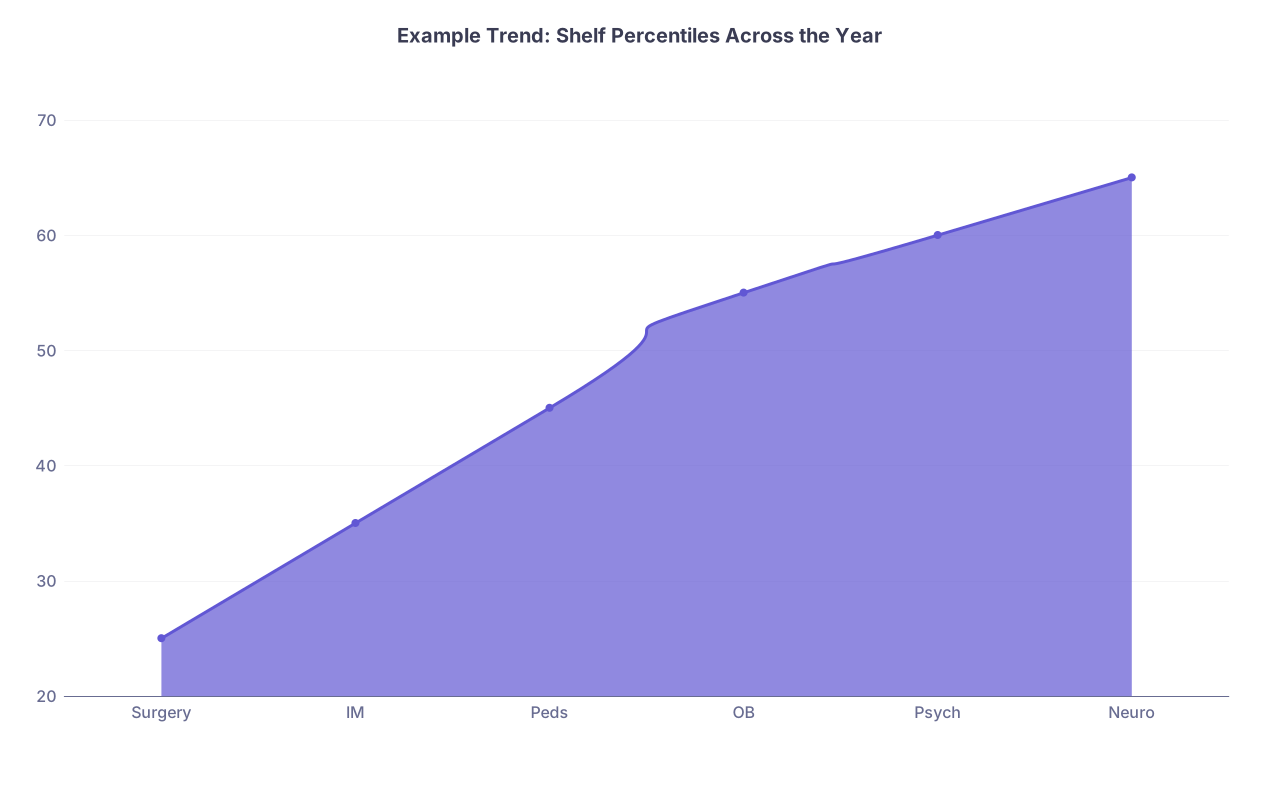
| Category | Value |
|---|---|
| Surgery | 25 |
| IM | 35 |
| Peds | 45 |
| OB | 55 |
| Psych | 60 |
| Neuro | 65 |
If you can show that your performance trend is upward and stable, you blunt the impact of one bad day.
6. Targeted Program Selection: Stop Wasting Applications
Spraying 80+ applications without strategy is lazy rehab. You do not have that luxury.
You need precision.
How to realistically categorize programs
Create three tiers for your chosen specialty:
- Reach: Above your score range, but possible with strong story / connections.
- Realistic: Programs where your scores are within or slightly below their usual range, but your other attributes are strong.
- Safety / anchor: Lower-tier or community programs more likely to be flexible on scores.
Use:
- NRMP Charting Outcomes
- FREIDA
- Your school’s match list
- Program websites (look at residents’ med schools and CVs)
- PD or advisor feedback
| Program Tier | Number of Programs | Characteristics |
|---|---|---|
| Reach | 10–15 | University, academic, moderate prestige |
| Realistic | 25–35 | Mid-tier university + strong community |
| Safety | 15–20 | Community, IMG-friendly, smaller cities |
You want a heavy middle. Avoid a list that is 80% reach because that is how people end up scrambling or not matching.
Signals that a program might be more forgiving
Programs are often more flexible on scores if:
- They are community-based
- They have a history of taking IMGs / DOs
- They are in less popular geographic regions
- They emphasize “holistic review” openly
- Their current residents have diverse training backgrounds
Do not confuse “I would like to live there” with “they will likely rank me.”
7. Away Rotations and Face-Time: High-Yield for Low Scores
If your scores are weak, your best move is to get in front of program directors and residents in person and prove you are good.
Away rotations (auditions) are not optional luxuries for you. They are rehab tools.

| Step | Description |
|---|---|
| Step 1 | Assess Score Damage |
| Step 2 | Clarify Specialty Strategy |
| Step 3 | Build Counterweight Portfolio |
| Step 4 | Select Programs Strategically |
| Step 5 | Schedule Away Rotations |
| Step 6 | Secure Strong Letters |
| Step 7 | Craft Application Narrative |
| Step 8 | Prepare for Interviews |
Pick aways where you have a real shot
You want programs where:
- Your school has placed residents before
- You (or mentors) know someone on faculty
- They are not hyper-elite name brands that screen brutally on numbers
During the away:
- Treat every day like a month-long interview.
- Be reliable, humble, and prepared. Never complain.
- Ask for feedback halfway through so you can course-correct.
- Before you leave, tell the PD or key faculty:
“I have really enjoyed working with your team. This experience confirmed that this is the kind of program where I would like to train. I know my scores are not the strongest part of my application, but I hope you have gotten a clear sense of how I work and learn on the wards.”
That line does two things:
- Shows insight and accountability.
- Invites them to evaluate the real you, not just the number.
If they respond warmly and specifically, that is a soft signal of support. If they respond with vague politeness, do not overinterpret it.
8. Rewrite Your Application Around Strength, Not Apology
Weak applicants center their low scores in their mental story and then accidentally center them in their written story.
You are not applying to be a professional test taker. You are applying to be a resident physician.
Your narrative needs to answer two questions for a program:
- Will this person make my life and my residents’ lives better, or harder?
- Is this someone I want in my hospital at 2 a.m.?
How to structure your personal statement with low scores
Do not write a “trauma memoir about my exam.” Your low score is a paragraph, not your entire essay.
Rough structure:
- Opening: Why this specialty and what kind of physician you want to be.
- Core clinical story or theme: One or two experiences that show your values and growth.
- Evidence of how you work: Work ethic, team functioning, patient ownership.
- Brief acknowledgment (if needed) of low score: 3–5 sentences max, framed as above.
- Forward-looking close: What you are seeking in a residency and what you bring.
Your experiences entries in ERAS should also be specific and performance-focused:
- “Led weekly pre-round huddles to ensure task completion.”
- “Coordinated follow-up for 20+ patients with limited English proficiency using interpreters.”
- “Designed and implemented a weekend discharge checklist that reduced delays on the general medicine service.”
Programs want doers. Not philosophers.
9. Interview Season: Do Not Get Blindsided by “The Question”
If your scores are low, they will come up. Maybe subtly. Maybe directly.
You want a practiced, honest, concise answer that:
- Accepts responsibility
- Shows insight
- Demonstrates change
- Ends on competence
Example script (adapt to your reality):
“My Step 2 score is not as strong as I would like. I underestimated how much consistent, early practice with questions matters and compressed too much of my studying into the last month. After that, I changed my approach. I did daily question blocks with detailed review and scheduled regular meetings with a faculty mentor to review weak areas. Since then, my clerkship evaluations and shelf scores have been much more consistent with how I perform day-to-day clinically. On the wards, I am organized, thorough, and very reliable. That is the level I would bring as a resident here.”
Deliver this calmly. Without self-pity. Then stop talking.
If they want more detail, they will ask.
10. Have a Backup Plan That Is Actually a Plan
Strong applicants with weak scores do not just “hope for the best.” They have contingencies.
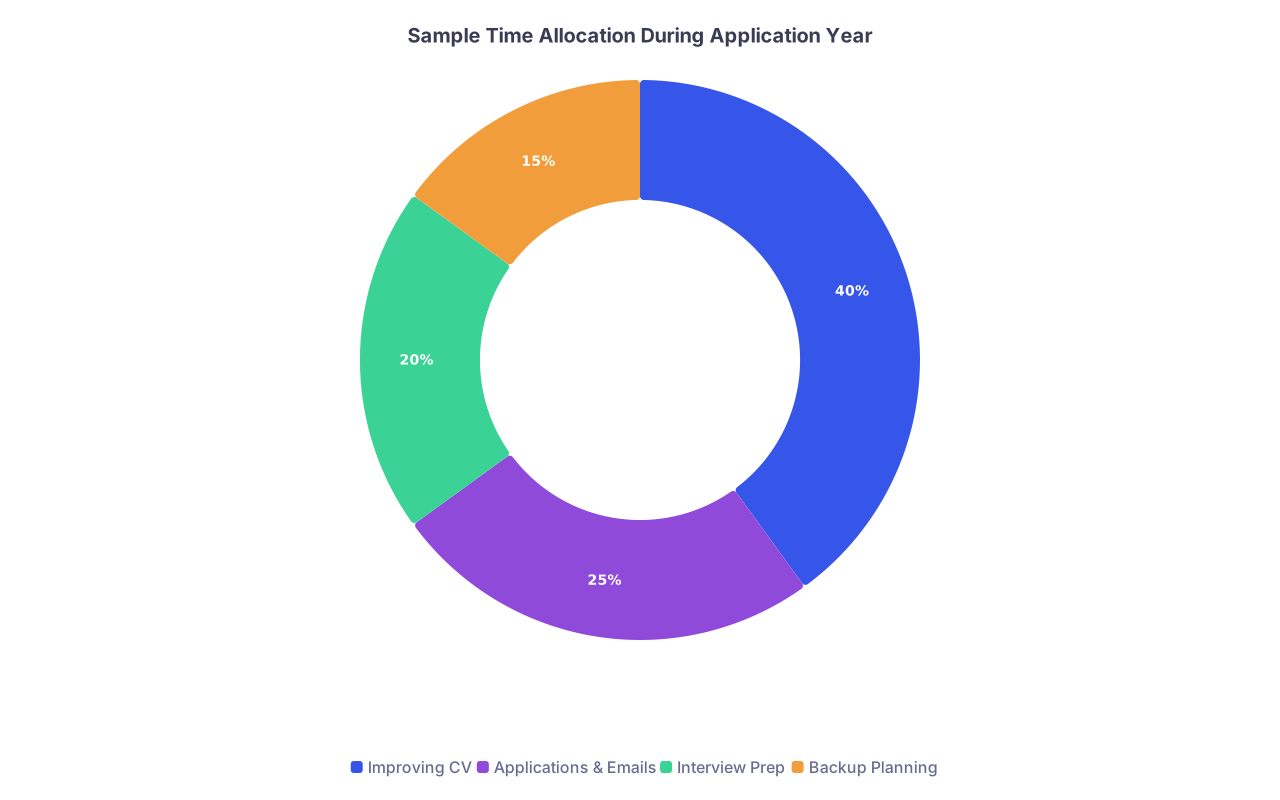
| Category | Value |
|---|---|
| Improving CV | 40 |
| Applications & Emails | 25 |
| Interview Prep | 20 |
| Backup Planning | 15 |
Reasonable backup components:
- A broader list of programs and locations than your dream scenario
- A parallel specialty that you would genuinely accept (IM vs FM; EM vs IM, etc.)
- A plan if you do not match:
- Prelim year in medicine or surgery
- Dedicated research year in your chosen field
- Extra clinical work (hospitalist scribe, research coordinator) that keeps you close to medicine and earning letters
Do not announce your backup all over the place. But have it. Quietly.
11. The Rehab Mindset: How You Carry This Matters
Programs are not just evaluating test scores, they are evaluating how you respond to setbacks.
I have watched people with Step failures match into solid programs because they:
- Owned the problem without drama
- Fixed the underlying behaviors
- Performed like monsters on the wards
- Showed up early, stayed late, and did the unglamorous work
- Treated every person—nurse, tech, clerk—with respect and consistency
And I have seen people with minor score dips tank themselves by:
- Making excuses
- Being defensive in interviews
- Acting entitled to certain programs or geographies
- Remaining average in everything else
Your scores are now fixed. Your response is not.