
The belief that only honors-stacked, straight‑A superstars match into good residencies is wrong. Not exaggerated. Wrong.
The people quietly running huge chunks of American healthcare right now? Many of them were “HP/Pass with a couple of blemishes” students who matched into strong programs, then outperformed half their supposedly flawless peers.
If you’re sitting on a transcript with some Passes, some High Passes, maybe a low shelf or a mediocre preclinical record, and you think that means “good programs are off the table” — that story is convenient for gunners. Not supported by data.
Let’s dismantle this cleanly.
What Programs Actually Rank You On (Spoiler: Not Just Grades)
Residency programs do not read your transcript the way anxious MS2s read Reddit. They look for signals, and grades are only one of them.
For years, NRMP’s Program Director Survey has asked PDs to rate what matters. The exact numbers shift, but the pattern is boringly consistent across cycles.
| Factor | How often it's cited as important* |
|---|---|
| MSPE/Dean’s Letter | Very frequently |
| Step 2 CK score | Very frequently |
| Letters of recommendation | Very frequently |
| Clerkship grades | Often |
| Personal knowledge of applicant | Often |
| Interview performance | Often |
*Not exact percentages; pattern based on repeated NRMP surveys.
Notice what is not there: “Only interview students with all honors.” That’s a myth med students tell each other in the library at 11 p.m. to justify their anxiety.
Programs care about:
- Consistency or an upward trend
- Proof you can handle clinical work
- Whether people like working with you
- Whether you seem like someone they can trust at 3 a.m. with a crashing patient
Grades feed a couple of those. But they don’t define all of them.
A student with mostly High Pass, one or two Honors in core rotations relevant to their specialty, solid Step 2, strong letters, and good interviews? That applicant gets interviews at very solid programs. I’ve seen it repeatedly in IM, peds, EM, FM, even mid‑tier surgical programs.
The Truth About “Average” Transcripts
Let’s be precise. “Average” in med school is not what you think.
Most U.S. MD schools normalize around a high baseline: the average student is still extremely capable. Many schools also moved to Pass/Fail preclinical and de‑emphasized letter grades in the first two years. Some even use Pass/High Pass/Honors in clinicals where the distribution is skewed against Honors — only 10–20% get it in a given rotation.
So the common pattern is something like:
- Preclinical: Pass across the board
- Clinical: Mostly High Pass, a couple Pass, maybe 1–3 Honors
- Maybe one ugly thing: a shelf exam < 10th percentile, a COMLEX attempt, or a rocky first rotation
That looks “meh” to you. To a program? That looks like: “Normal med student, probably safe to trust if other pieces look good.”
The red flags that actually cause problems are different:
- Fails/remediations, especially repeated
- A clear downward trend (Honors → HP → Pass as you go) with no explanation
- Very low Step 2 relative to peers in that specialty
- Unprofessionalism documented in MSPE
You can survive not being a transcript rockstar. You do not easily survive being unreliable or unsafe. Programs can live with “above average but imperfect.” They cannot live with “may not show up or may lie.”
Data: High Scores and Honors Help… but Not Like You Think
Yes, higher scores and better grades correlate with matching more competitively. No shock there. But the correlation isn’t all‑or‑nothing.
Look at match rates for U.S. MD seniors (historically around 92–95% overall). That obviously includes thousands of students who were not top of their class. If only “A‑only, all Honors” people matched well, your match rate would be closer to law school BigLaw numbers, not this.
What actually happens:
- Top‑tier applicants cluster at the very top programs.
- Solid but not perfect applicants spread across mid‑upper and mid‑tier programs.
- True strugglers (academically or professionalism‑wise) have more risk of SOAP or unmatched.
There’s also a brutal survivorship bias problem. You only hear from the 250 Step‑2, all‑Honors applicant who matched MGH because they post their resume online. The “HP/Pass, Step 230, matched a strong university IM program and is thriving” person doesn’t post spreadsheets. They just go to work.
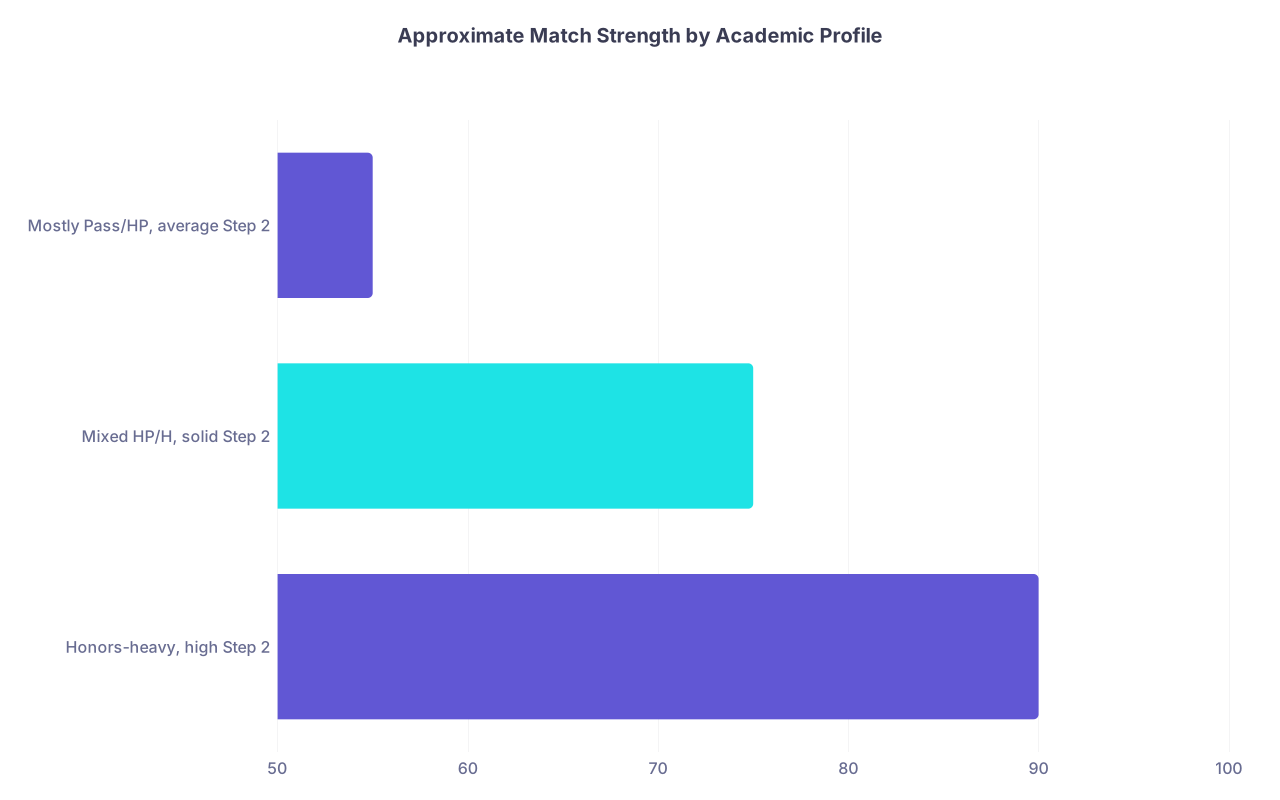
Here’s a rough idea of how different academic profiles can still land well. Is this exact? No. Is it directionally true? Yes.
| Category | Value |
|---|---|
| Honors-heavy, high Step 2 | 90 |
| Mixed HP/H, solid Step 2 | 75 |
| Mostly Pass/HP, average Step 2 | 55 |
Interpretation: the higher your academic profile, the more likely you are to crack the very top of your specialty. But “mixed HP/H” and even “mostly Pass/HP” applicants still land in strong programs, especially if they stack other strengths.
The Myth of the “Clean Sheet” Applicant
Another fantasy that needs killing: the idea that programs only want flawless, linear excellence. They don’t. They want people who can handle reality.
I’ve watched PDs in rank meetings. This is what actually gets said:
- “Her grades are good, not unbelievable, but every letter says she’s the one they’d want on call.”
- “He had a rough start in MS3, but look at the last three rotations — and the Step 2 jump. He figured it out.”
- “Yeah, the transcript is shiny, but did you see his interview evals? People thought he was arrogant and dismissive.”
Programs are selecting colleagues. Not lab animals. They know life is messy. A student who bombed one shelf then rebounded with improved scores and self‑awareness is less concerning than someone who’s technically perfect but cold, rigid, or entitled.
You don’t need to hide every flaw. You need to show that:
- You understand what happened.
- You took responsibility.
- You improved.
That’s a narrative, not a number.
Where Average Students Win: The Non‑Grade Levers
Here’s the real problem: many “average” students act like average is a life sentence, then stop competing on the variables they still control.
They over‑ruminate on the B in surgery… and under‑prepare for letters, Step 2, and interviews. That’s how you turn a manageable profile into a weak application.
If you’re not going to win on grades alone, fine. Win elsewhere.
Step 2 CK: Your Academic Redemption Arc
With Step 1 now Pass/Fail, Step 2 is the most visible standardized metric. It’s also the easiest place to show academic recovery.
I’ve seen students with:
- Mediocre preclinicals
- Some Pass/High Pass mix in clerkships
- But a Step 2 that was 10–15 points higher than faculty expected
suddenly get taken more seriously by programs that had them pegged as “borderline” from the transcript alone.
You don’t need a 270. You need a Step 2 that says: “I understand clinical medicine at a solid, residency‑ready level.” For many core specialties, that’s somewhere in the 230s–250s depending on competitiveness.
Step 2 is the point where lots of “average” students quietly reset the story admissions committees tell themselves about them.
Letters: The Single Most Underrated Weapon
A lukewarm letter from a huge name is mediocre. A detailed, enthusiastic letter from someone who clearly worked with you is gold.
The best letters for an “average” applicant sound like:
“Not the top test taker in the class, but I would rank them at the very top for work ethic, reliability, and team contribution. Residents repeatedly requested them on their team. They took ownership of patients on a level unusual for a student.”
That kind of letter does two things:
- Acknowledges your transcript is not perfect.
- Argues persuasively that it doesn’t matter because you’re the kind of person who makes residency work.
To get those letters, you need:
- To be noticeably reliable (show up early, stay a bit late, follow up on tasks without being asked twice).
- To ask for feedback early and actually implement it.
- To make one or two attendings really see your growth over a rotation, not just your test scores.
Average students who behave like the most dependable intern on the team routinely get astonishingly strong letters. And that moves rank lists.
Personal Statement, MSPE, and Narrative
Programs are not looking for purple‑prose trauma essays. They’re looking for a coherent, believable story of who you are as a physician.
If your story is: “I float through, get okay grades, and say generic things about helping people,” you’ll get ranked like background noise.
If your story is: “I had some rough spots, I learned X and changed Y, and here’s the pattern of commitment and follow‑through since,” programs listen.
Your MSPE often hints at growth: comments like “significant improvement over course of the year,” “readily incorporated feedback” — those counterbalance earlier mid‑range performance. Your job in the personal statement and interviews is to make that growth explicit without sounding like you’re begging for forgiveness.
One sentence like: “I struggled with efficiency early in third year and received Passes on my first two rotations; after targeted feedback and working closely with residents on organization, I improved to High Pass/Honors on my later core rotations” is enough. Own it. Move on. Then spend 90% of the real estate talking about what you now bring.
Fit and Interview Performance
The most delusional part of the “all A honors” myth is the idea that rank lists are sorted top to bottom by GPA and Step score.
Reality: by the time you get to the rank meeting, everyone on the list is academically safe enough. Now the conversation is, “Who do we actually want to work with?”
That’s where:
- You being normal, prepared, and curious
- You having a clear, non‑vague reason for the specialty and for their program
- You not trash‑talking others, not being weirdly competitive, not being checked‑out
beats someone with a slightly shinier transcript who came off as arrogant, disinterested, or immature.
I’ve watched programs drop “perfect” applicants down the list or off entirely because multiple faculty said variants of: “I don’t want that energy at 2 a.m. in the ICU.”
Average students who interview well and seem like good teammates consistently punch above their academic weight class in where they match.
Specialties Where Being “Average” Hurts More (and Less)
Let’s not sugarcoat. Some fields are brutally numbers‑heavy. Others really are more holistic in practice.
Very roughly:
- Hyper‑competitive: Derm, plastics, ortho, neurosurgery, ENT, some ROAD specialties
- Moderately competitive: EM (though evolving), anesthesia, radiology, OB‑GYN, certain fellow‑feeding IM programs
- Broadly accessible with smart strategy: IM, FM, peds, psych, pathology, many prelims, transitional years
In a hyper‑competitive specialty, being “average” academically means you’ll probably need:
- Heavy research
- Strong home‑program support
- Geographic flexibility
- Backup plans
In broad‑access specialties, average academics plus strong letters, Step 2, and interviews is absolutely enough to match into a strong, university‑affiliated, teaching‑heavy program.
Again: the myth is not “grades never matter.” The myth is “if you aren’t at the very top academically, strong programs are closed to you.” That’s simply not how the match data or real‑world rank meetings look.
What Actually Makes Your Application “Strong” as an Average Student
Strip the noise away. A “strong” residency application from a non‑honors robot usually looks like this:
- Academics: No catastrophic red flags, maybe some early stumbles, but stable or improving performance; Step 2 solid for the specialty.
- Clinical reputation: Residents liked working with you; you were trusted to follow through.
- Letters: At least two writers who clearly know you and go out of their way to vouch for your work ethic and growth.
- Narrative: Coherent explanation of your path, including any bumps, framed as development, not excuses.
- Fit: Realistic school list, thoughtful interviews, you look and sound like a future colleague, not a Step score with shoes.
That profile matches well. Often in places you, with your catastrophizing med‑student brain, have prematurely written off as “too good” for you.
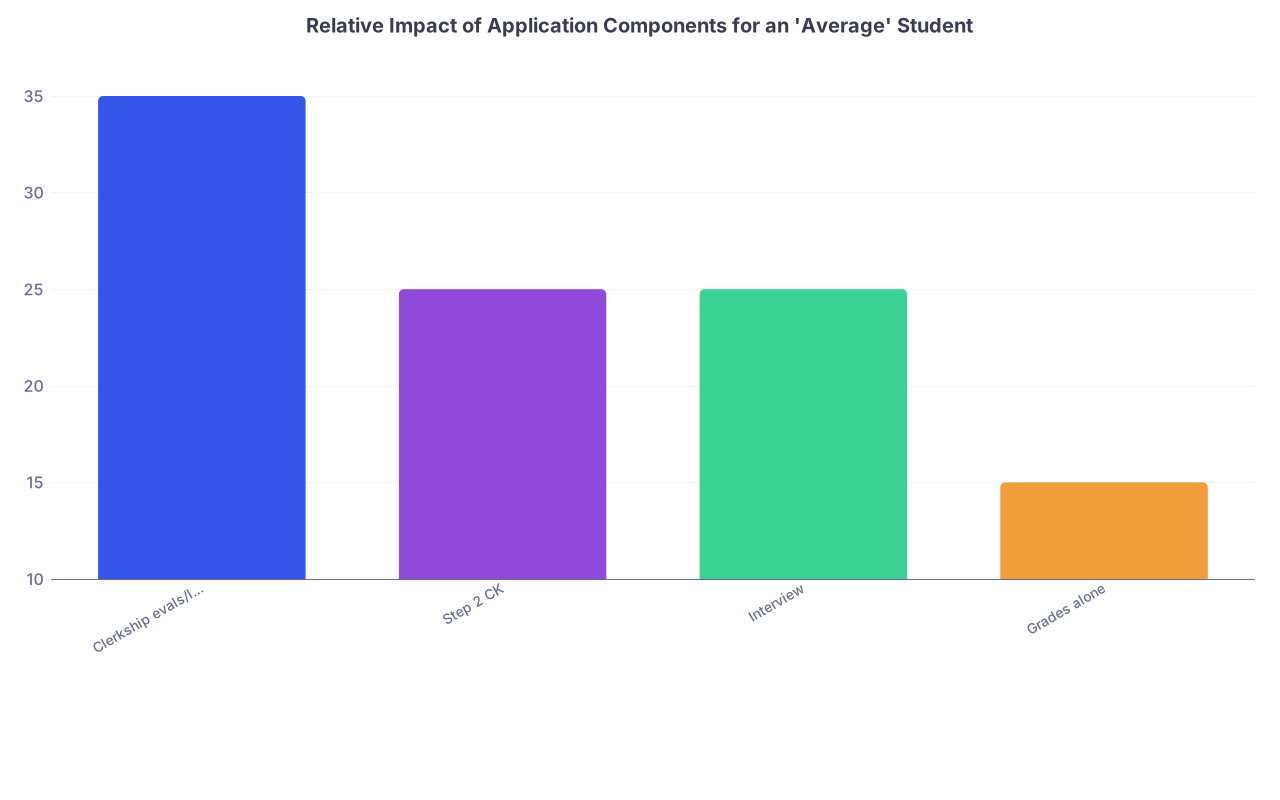
To drive the point home, here’s the rough reality of how different leverage points balance each other:
| Category | Value |
|---|---|
| Clerkship evals/letters | 35 |
| Step 2 CK | 25 |
| Interview | 25 |
| Grades alone | 15 |
Again: not precise percentages. But a useful mental model. Grades are in the mix, yes. They just aren’t the sun around which everything orbits.
Bottom Line: Stop Worshiping the Transcript
If you’ve read this far, you probably came in worried that less‑than‑perfect grades doomed you. They don’t.
Three takeaways and then I’m done:
- Programs rank humans, not transcripts. Solid (not perfect) academics plus strong letters, Step 2, and interviews routinely beat slightly better transcripts with weak human factors.
- “Average” med students match into strong programs every year by winning on growth, reliability, and fit instead of pretending they can rewrite their MS2 grades.
- Your job now is not to rewrite the past; it is to stack every remaining lever — Step 2, letters, narrative, interviews, and school list strategy — so your file screams: “Not flawless. Ready.”