
The fastest way to sabotage a strong residency application is to blow an away rotation.
You think “audition rotation” means “show how great I am.” Programs often read it as “show me all your blind spots under pressure.” A great month can quietly turn into a mediocre—or flat-out bad—evaluation because of a handful of predictable, avoidable mistakes.
Let me walk you through the traps I’ve seen tank students who were otherwise competitive on paper.
1. Misunderstanding the Real Job of an Away Rotation
The biggest mistake: thinking the goal is to impress everybody with how smart you are.
On an away, your actual job is simpler and less glamorous:
- Be low-maintenance
- Be reliable
- Make the team’s day easier
- Show you’d be a safe, sane intern in 12 months
If you forget that, everything else falls apart.
Common ways people blow this:
Trying to “shine” on every question
- Long-winded answers.
- Flexing obscure knowledge instead of giving a clean, concise plan.
- Correcting senior residents in front of attendings.
What gets documented? Not “brilliant,” but “hard to direct,” “doesn’t read the room.”
Acting like a mini-attending instead of a senior med student
- Giving orders to nurses.
- Writing notes with attending-level language and zero humility.
- Telling junior students what the “right” plan is and contradicting residents.
Programs do not want a “rockstar student.” They want a future intern who:
- Shows judgment
- Knows their lane
- Is safe when tired at 3 a.m.
If you aim for “helpful and dependable” rather than “most impressive student they’ve ever seen,” you’ll avoid a lot of silent demerits.
2. Being Invisible… or Worse, Selectively Visible
There’s a quiet way to fail an away: nobody remembers you.
Or worse: only one attending remembers you—and not in a good way.
Ways students unintentionally disappear
- Leaving the hospital the second the work slows down every single day
- Skipping teaching sessions “to pre-round” and never checking if that’s okay
- Hanging behind the group on rounds and never volunteering to help with tasks
- Never speaking up in conference, small group, or case discussions
Then eval time comes. The form lands in someone’s inbox. They think: “Who was this again?”
You get generic, lukewarm comments that don’t help your application at all.
On the flip side, selectively visible students show up big when attendings are watching and vanish when only residents are around. Everyone notices this. Residents talk.
How to avoid it:
- Be consistently present, especially for:
- Rounds
- Teaching conferences
- Post-op checks / ED follow-ups / discharge work
- Ask residents, “Is there anything I can help with before I head out?” every day
- If you need to leave early for something legitimate, tell someone and don’t make a habit of it
You don’t need to stay until midnight to prove dedication. But the student who’s always gone by 3:30 “because things were quiet”… doesn’t get a strong letter.
3. Breaking the Unwritten Cultural Rules
Every program has its own culture. Students get burned assuming what worked at their home institution will fly everywhere.
I’ve seen this exact pattern:
- Student from a “first-name basis” place calls attendings by their first name on day one at a conservative program.
- Or a very informal, joking style that fits their home residents is read as disrespectful somewhere else.
Instant bias. Hard to shake.
High-yield things you must read quickly
- Formality level
- Do residents say “Dr. Smith” or “Mike”?
- Do attendings stand for presentations or sit and chat?
- Pace of work
- Is pre-rounding expected at 4:30 a.m. or 6 a.m.?
- Do people pre-chart at night?
- How they handle hierarchy
- Do students present directly to attendings, or through seniors?
- Do nurses go through residents or directly to attendings?
The mistake is barging in with “This is how we do it at my school.”
Instead, spend the first 48–72 hours observing and quietly asking:
- “How do you prefer I present?”
- “Where do students usually help most on this service?”
- “What time do students usually arrive?”
Those questions alone will save you from being “the student who doesn’t get how we work here.”
4. Poor Communication: The Silent Grade Killer
Most bad away evals don’t come from one giant error. They come from repeated small communication failures.
Patterns that get documented:
Not telling anyone where you are
- Disappearing to see a consult or grab lunch without telling your resident.
- Missing an ED evaluation because “nobody paged me.”
Reality: If you’re on the team, your default location should be known.
Not closing the loop
- You’re sent to check a dressing, update a family, or track a lab…and never report back.
- Residents have to chase you for information.
That’s how you earn “unreliable” on your evaluation.
Hiding mistakes instead of escalating early
- You forgot to follow up a critical lab.
- You mis-typed a note.
- You lost track of a page.
Covering or “hoping it’s fine” is how you go from minor misstep to serious concern.
Basic fixes:
- Always say where you’re going:
“I’ll be in the ED seeing the new consult; I’ll be back by 11 unless they admit.” - Always close the loop:
“The CT is done; prelim read is no acute bleed. I updated the note.” - When in doubt, over-communicate with your senior, not your attending.
The intern they fear is the one who disappears and doesn’t tell anyone. Don’t audition as that person.
5. Overstepping Clinical Boundaries
Away rotations are not the time to test how “independent” you can be.
This is where students cross the line and end up with actual safety concerns in their evals:
- Giving medical advice without supervision
- Telling a patient to change home meds, adjust insulin, or stop anticoagulation without faculty/resident sign-off.
- Placing orders without explicit permission (in places that allow students to pend/submit)
- Especially for meds, imaging, or discharges.
- Doing procedures without appropriate supervision
- “I’ve done tons of these at my home school” doesn’t matter legally to them.
You’re being evaluated on judgment. Not bravery.
If the program thinks you might be unsafe with a real MD license, they will never rank you highly, no matter how enthusiastic or “hardworking” you are.
The safe script:
- “I’d like to suggest starting X. Does that seem reasonable?”
- “At my home institution I’ve done Y procedure—if it’s okay, could I assist or try under your supervision?”
If you’re not sure whether something is allowed, you ask first. Once you’re labeled “unsafe,” there’s no recovering that month.
6. Poor Professionalism in the Margins: Social, Email, and Social Media
Students obsess over how they look on rounds, then light themselves on fire after hours.
Social traps that get back to the program
- Getting drunk with residents and oversharing about:
- Ranking strategy
- Other programs you like better
- How dysfunctional you think this hospital is
- Gossiping about attendings, residents, or other students
- Going out the night before a busy day and showing up late, hungover, or sloppy
Residents may laugh with you in the moment. They rarely forget. And some will absolutely mention it anonymously on your eval.
Email and messaging sloppiness
- Casual, typo-filled emails to program coordinators
- Delayed responses to schedule changes or information requests
- No-shows or last-minute changes for optional but visible events (dinners, meet-and-greets) without a clear explanation
Program coordinators talk to program directors. Being rude, flaky, or disorganized with staff is a huge red flag.
Social media
Yes, people check.
Obvious mistakes:
- Public posts complaining about the rotation, hospital, or city
- Inappropriate photos while you’re visibly representing the institution (badge, coat, scrubs)
- Posting patient-related content that feels even slightly identifiable
If your Instagram or TikTok is public, assume someone from the program will see it. If you’re not willing to have an attending watch it on rounds, don’t post it during your away.
7. Looking Disinterested in This Program
You applied for this away. Presumably you want to match here—or at least give that impression.
Students lose points by:
- Constantly comparing this place to somewhere “better”
- “At [prestige program], they do it like this…”
- Openly ranking other cities or programs above this one in front of residents
- Never asking any questions about:
- The residency structure
- Education
- Fellowships
- Career paths from this program
If you act like this is just a backup option or a free month in a cool city, they’ll treat you like a low-priority applicant.
You don’t need to grovel or fake obsession. But you do need to look genuinely curious about what residency life here would be like.
Simple ways to show that:
- Ask juniors: “What surprised you about training here?”
- Ask chiefs: “What kind of resident thrives in this program?”
- Ask attendings: “What changes are you most proud of in the residency?”
Then shut up and listen. People remember students who seem sincerely interested in their environment.
8. Mismanaging Feedback and Mid-Rotation Corrections
Here’s where students turn a small issue into a bad evaluation: they get defensive when someone finally gives them feedback.
Typical scenario:
- Week 2: Resident says, “Your presentations are a little disorganized; try to be more concise.”
- Student explains for 5 minutes why their style is actually fine.
- Week 4: Same problem.
Documentation: “Difficulty accepting feedback, minimal improvement despite coaching.”
That kills your grade way more than the original problem.
What to do instead
When you get feedback:
- Say one sentence acknowledging it
- “Got it, I’ll focus on being more concise.”
- Clarify if needed with one brief question
- “Would you prefer I skip the full ROS unless it’s relevant?”
- Implement visibly within 24 hours
- Make it obvious you tried to change.
You do not need to agree with every piece of feedback. You do need to show:
- You can hear it without becoming fragile or argumentative.
- You can adjust your behavior on the fly.
Programs are screening for coachability. If they sense “rigid,” “defensive,” or “thin-skinned,” your rank position plummets.
9. Under-Preparing Clinically for the Specific Rotation
Another unforced error: showing up clinically underpowered for that specialty.
No one expects you to be a mini-fellow, but baseline preparation matters. Students get hurt when they:
- Don’t know the bread-and-butter problems cold
- Haven’t reviewed common orders, meds, or workflows
- Need repeated teaching on the same elementary topic
The subtext becomes: “Will this person be able to function as an intern here, at our pace, with our case mix?”
Be very wary of these patterns
- You’re on an ortho trauma away and don’t know:
- Open fracture management basics
- Compartment syndrome red flags
- DVT prophylaxis norms
- You’re on an EM away and constantly:
- Over-order scans
- Miss basic differentials
- Can’t present a focused ED patient in under a minute
You don’t need to master everything, but you do need to show you did real homework for this field, not generic Step 2 studying.
A simple rule:
If something is a classic shelf question in that specialty, you should not be learning it from scratch in week 3 of your away.
10. Forgetting That Evaluations Are Built from Resident Input
One of the most lethal misconceptions: “Only the attending’s opinion matters.”
Wrong.
Residents build your narrative. Attendings often ask:
- “What did you think of them?”
- “Would you want them as an intern?”
- “Any concerns?”
If one or two residents are lukewarm or negative, that’s enough to sink a glowing attending impression.
Specific ways people anger residents:
- Treating residents as stepping-stones to attendings
- Only showing enthusiasm when the big-name faculty are present
- Refusing scut work, or doing it with visible resentment
- Arguing about call schedules, sign-outs, or weekend coverage expectations
Remember: residents are tired. Busy. Overloaded. The student who makes their day smoother is gold. The student who adds friction is remembered twice as clearly.
Do not make the mistake of performing for attendings and ignoring the people who actually live in the program.
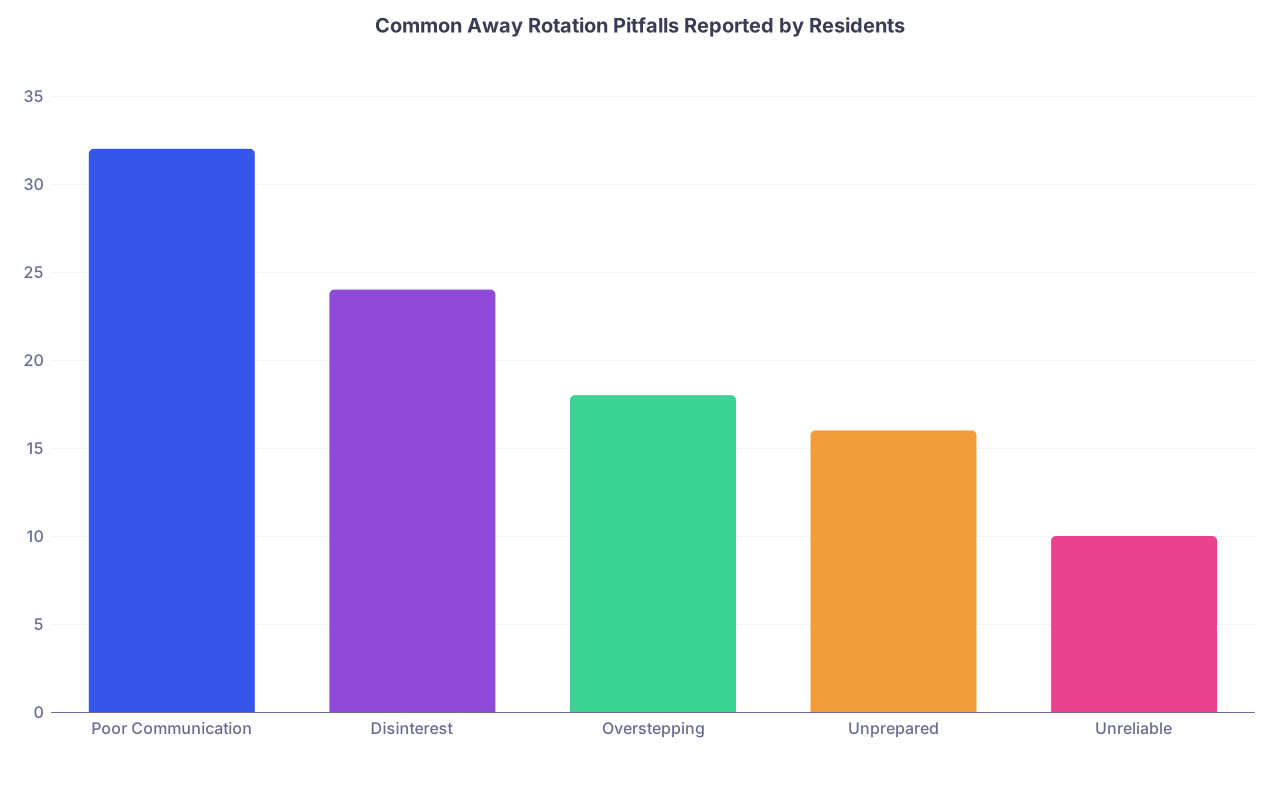
| Category | Value |
|---|---|
| Poor Communication | 32 |
| Disinterest | 24 |
| Overstepping | 18 |
| Unprepared | 16 |
| Unreliable | 10 |
11. Over-Selling or Mismanaging the “I Really Want to Be Here” Message
Another subtle trap: you think telling everyone “This is my #1!” ten times a day will guarantee a match.
What actually happens:
- If you oversell it too early, it rings insincere.
- If you tell multiple programs “You’re my #1,” people talk. Faculty move. Residents have friends. Word travels.
- If you say “I’m ranking you first” and then don’t, it can burn future bridges for your peers and your home school.
On rotation, your job is not to swear allegiance. Your job is to signal serious interest without lying.
Bad approaches:
- “I’m definitely ranking you number 1 if I get an interview.” (You don’t know that yet.)
- “I canceled other interviews because I like you more.” (Sounds manipulative, even if true.)
Better:
- “I’d be very excited to train here; this rotation has confirmed that.”
- “This program will be very high on my list.”
- “I can see myself fitting really well here.”
You can send a more explicit signal after interview season through appropriate, honest communication if you genuinely mean it.

12. Ignoring Logistics and Burning Yourself Out
One more way to ruin an away: mismanaging the basics of being a functional human for 4 weeks in a new city.
Students underestimate:
- Commute time from AirBnB to hospital
- Parking costs and availability
- Sleep debt from stacking aways back-to-back
- Financial stress from multiple months of rent, travel, and food
Then they show up:
- Late, because parking was full
- Exhausted, because they’re doing three aways in a row in different time zones
- Distracted, because money is imploding in the background
No one gives extra points for suffering. They only see:
- Tardiness
- Flat affect
- Inconsistent energy
You’re no good to any program if you’re running on fumes. Build in at least one breathing space month if you’re doing multiple aways. Plan housing and transit as obsessively as you plan your reading.

| Step | Description |
|---|---|
| Step 1 | Start Away Rotation |
| Step 2 | Ask residents about norms |
| Step 3 | Prepare clinically |
| Step 4 | Tell team where you are, close loops |
| Step 5 | Maintain consistency |
| Step 6 | Ask mid-rotation: How can I improve? |
| Step 7 | Implement within 24 hours |
| Step 8 | Finish month with solid relationships |
| Step 9 | Know expectations? |
| Step 10 | Communicating clearly? |
| Step 11 | Getting feedback? |

Quick Red-Flag Checklist: Behaviors That Turn a Good Month Bad
If you see yourself doing these, fix it immediately:
- You routinely leave without telling anyone where you’re going.
- You haven’t asked a single resident for feedback by the end of week 2.
- You talk more about how they do things at your home program than about how they do things here.
- You’re more focused on impressing “big name” attendings than being useful to residents.
- You feel defensive every time someone corrects you.
- You’ve been late more than once and blamed traffic/parking each time.
- You haven’t read independently about your patients’ main problems.
- You’re posting real-time snark about the rotation or hospital online.
Any one of those, repeated, is enough to drag you out of “rankable” territory.
FAQs
1. If I realize halfway through that I’ve made some of these mistakes, is the month already ruined?
No, unless you’ve done something egregious (patient safety or blatant unprofessionalism). Mid-course correction actually scores points if you handle it right. Own it briefly and specifically:
“I realized I haven’t been great about closing the loop on tasks—thanks for your patience. I’m making that my focus this week.”
Then fix it visibly. People remember the change; it signals maturity and coachability.
2. How many away rotations should I do to help, not hurt, my application?
For most competitive specialties, 1–2 targeted aways are enough. Doing 3–4 back-to-back often backfires: you’re exhausted, thinly spread, and more likely to make the exact mistakes we just went through. One strong away is far more valuable than three mediocre, burned-out ones.
3. What’s the best way to ask for a letter without being awkward?
Ask near the end of the rotation, ideally in person:
“I’ve really appreciated working with you this month. If you feel you know my work well enough, would you be comfortable writing a strong letter of recommendation for me?”
The key word is strong. If they hesitate, thank them and ask someone else. A neutral or lukewarm letter from an away can hurt more than it helps.
Remember:
- Your away rotation is not an exam of brilliance. It’s an audition for reliability, judgment, and professionalism.
- Most bad evaluations stem from communication failures, culture blindness, or defensiveness about feedback—not lack of raw knowledge.
- If you avoid the predictable pitfalls and focus on being consistently useful, teachable, and safe, your away can quietly become the strongest piece of your residency application.