
The ranking game starts long before you shake anyone’s hand on interview day. By the time you’re pouring coffee in the pre-interview lounge, the program director already has a mental – and often literal – list of who matters and who doesn’t.
You are not walking into a level playing field. Some applicants are effectively “pre-ranked” before they ever sit down for their first interview. And yes, that absolutely affects who gets a real shot and who’s just there to fill the schedule.
Let me walk you through how this actually works behind the scenes.
The Truth: There Are Two Rank Lists
Most applicants think the “Rank List” is built after interviews, when the committee meets and talks through everyone. That’s only half the story.
There are really two lists:
- A pre-interview stratification list
- The final NRMP rank list
The first one is never talked about publicly, but it’s the one that quietly shapes your fate.
Here’s what happens at many programs (I’ve seen this at mid-tier IM, competitive EM, and even some surgical programs):
A week or two before interview season kicks off, the PD or associate PD prints or pulls a spreadsheet of all invited applicants. Next to each name: Step scores, med school, AOA, research count, whether they rotated here, red flags, maybe a summary note from their app review. Then, they go through and:
- Mark obvious top-tier people (“must rank high if decent interview”)
- Flag potential problems (“only rank if interview is phenomenal”)
- Identify “courtesy interviews” (often home students, connections, or politically important people)
So when you walk in on interview day, you’re not neutral. You’re already in one of a few buckets – the program just hasn’t told you which.
The Quiet Sorting System: The Pre-Interview Score Sheet
Almost every program uses some version of a scoring or tiering system before interviews begin. It might be very formal. It might be the PD with a legal pad and highlighters. Either way, you’ve been sorted.
The typical variables that go into that pre-interview sort are not a mystery, but the weighting is what you rarely hear the truth about.
| Factor | Approx Weight in Pre-Interview Phase |
|---|---|
| Board Scores (USMLE/COMLEX) | 25–35% |
| Med School Reputation / Tier | 15–25% |
| Letters of Recommendation | 15–20% |
| Clinical Grades / Clerkships | 10–15% |
| Research / Scholarly Work | 5–15% |
| Personal Statement / Fit | 5–10% |
Are these numbers exact? No. But they’re close enough that you should take them seriously.
Two things applicants underestimate:
- School name and reputation still matter more than they want to believe. A PD skimming 800 apps simply recognizes “UCSF, Penn, WashU” and mentally bumps you up a tier.
- Letters of recommendation are pre-filtered more than read. They scan the letter writer’s name and institution before they read a single adjective. A strong letter from a big-name faculty often counts more than your entire personal statement.
And if you’re wondering what “personal statement / fit” means at this stage: it mostly means “did not say anything bizarre or concerning.” Very few people move up the pre-interview list because of a beautiful essay. Plenty move down because of weirdness, arrogance, or red flags.
The Hidden Categories You’re Placed In
No one in leadership will say it out loud this way on a Zoom info session, but here’s the reality. Before interview day starts, most PDs have quietly sorted interviewees into mental categories.
Roughly, those categories look like this:
- Tier 1: “Presumed top.” Barring a disaster, these people will end up in the top part of the rank list. They have strong metrics, usually solid schools, good letters, sometimes a connection to the program or a killer away rotation. The interview is mostly to confirm they’re normal, not to “evaluate from zero.”
- Tier 2: “Likely to rank.” Good profiles, nothing spectacular, no obvious red flags. Interview day performance actually matters for them; they’re the movable middle.
- Tier 3: “Fill slots / courtesy / long shots.” They got interviews for political, institutional, or “just in case” reasons. They can move up with a genuinely stunning interview, but most won’t.
What PDs will never tell you: these tiers affect who gets what kind of day.
At some programs, the PD spends extra time with Tier 1 and certain Tier 2 applicants. Senior faculty are more engaged. More thoughtful questions. More selling of the program. For Tier 3? They go through the motions. Smile, nod, move on.
I’ve literally heard an associate PD in the workroom say at 7:15 AM:
“Let’s be real, we’re mostly recruiting [names three people] today. The rest are probably going to land elsewhere.”
That was before the first interview even started.
How They Use Red Flags Against You Before You’ve Met Them
You think of “red flags” as stuff that comes up accidentally in conversation. That’s not how PDs treat it.
Red flags are pre-loaded into their brain before you even sit down.
Common examples that get highlighted on pre-interview lists:
- Step failures or large score gaps (Step 1 194, Step 2 262 – they will ask what happened)
- Unexplained leaves of absence
- A pattern of mediocre evaluations with vague comments
- Strange gaps in the CV timeline
- Behavior issues or professionalism comments in the MSPE
For some candidates, the PD’s sheet literally has:
“Ask about LOA 2019–2020.”
“Clarify professionalism incident noted in MSPE.”
“Step 1 fail – see explanation.”
So when you’re answering “Tell me about yourself,” they’re not listening like a blank slate. They’re watching you and thinking, “Can you handle this red flag conversation without imploding?”
If you come in oblivious or defensive, you confirm the pre-interview doubts. If you own it, explain it clearly, and show growth, you can neutralize it. But you need to understand: the “trial” starts way before you think it does.
Away Rotations and Home-Field Advantage: The Quiet Power Players
Away rotations are not “auditions” in theory. In reality, that’s exactly what they are.
Before interview season, there’s usually a separate internal list: students who rotated at the program and home students. That list is not neutral.
For many programs, it looks something like this:
- Home students and rotators are tagged as “priority” for ranking if they did well.
- If you rotated and were average or worse, you’re actually at a disadvantage compared to strangers with clean paper records.
I’ve sat in post-rotation debriefs where the attending says:
“She was fine. Nice enough. A bit slow, needed a lot of direction. I wouldn’t tank her, but I also wouldn’t fight for her.”
That one line can quietly move you from potential Tier 1 or 2 down into “only rank if we need to fill.”
So when rank season comes and they’re skimming the interview pool, they’re not starting from scratch. They’re cross-referencing: “Rotated with us? How did they do?” The ones with glowing rotation feedback are basically in a pre-favored tier before the interview. Everyone else is competing uphill.
The MSPE: How Much They Actually Read It
Students either over-respect or completely ignore the MSPE. PDs are in the middle. They use it selectively, but surgically.
On the pre-interview sort, what often matters from your MSPE:
- Class percentile or quartile language
- Any “concern” sections (professionalism, delays, repeated courses)
- Narrative descriptions that sound generic vs. specific
- Trends: “performed below expectations” early vs. “consistently exceeded expectations”
What PDs really watch for is consistency. If your ERAS screams “top-tier” and your MSPE is full of lukewarm phrases and quiet warnings, you’re not getting Tier 1.
And let me say this bluntly: the vague negative language in MSPEs is a code system.
Phrases like “met expectations,” “reliable,” “pleasant to work with” with no strong adjectives? That’s not a compliment. That’s “fine, but not special.” When I see “among the best students I have worked with in the last X years,” that person is automatically weighted higher in the pre-interview stack.
How PDs Use Step Scores – Even With Pass/Fail Step 1
The pass/fail change didn’t eliminate score-based filtering. It just moved the pressure.
Programs used to hard-screen on Step 1 score. Now?
- They look closely at Step 2 CK
- They care more about school reputation and clerkship narratives
- Some quietly still ask, “What was their Step 1 before P/F?” for international or old-cycle applicants
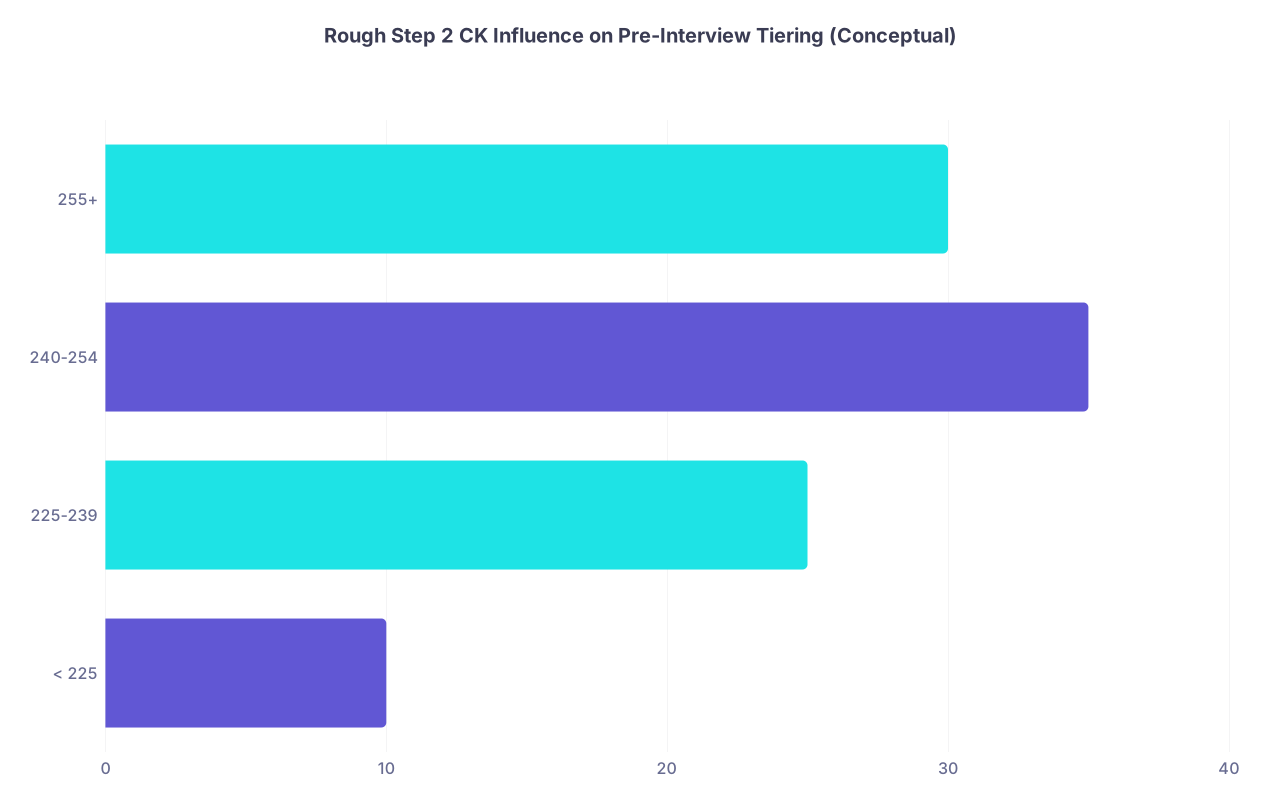
Before interviews, many PDs will have a sort of Step 2–weighted internal tiering. For example:
- 255+ in competitive specialties → automatically in the “take seriously” pile
- 240–250 range → context-dependent, but safe middle
- Under 230 in some fields → they may already be thinking “only rank if phenomenal”
They’ll never say those numbers out loud on a webinar. But the cut points exist. I’ve seen Excel filters set on them.
| Category | Value |
|---|---|
| < 225 | 10 |
| 225-239 | 25 |
| 240-254 | 35 |
| 255+ | 30 |
That chart isn’t about match odds; it’s about how much attention you’re likely to get pre-interview. Higher scores don’t guarantee anything, but they change how people walk into the room with you.
“Connections” and Backchannel Advocacy: The Stuff No One Admits Publicly
Here’s the part everyone suspects but doesn’t fully understand.
Advocacy happens. Quietly. And yes, it absolutely affects your position before interview day.
This is how it really shows up:
- A faculty member at your school emails the PD: “I’m sending you one of our best. Please look out for them.” That applicant is noted. Maybe moved from Tier 2 to Tier 1 preemptively.
- An alum of the program who’s now an attending elsewhere calls or texts the chief: “Hey, we have this student who would be a killer fit for you. Can you keep an eye on them?” Again, they’re tagged.
- Your own clerkship director mentions you to the PD at a conference. You just got quiet, invisible points.
Does it override a disastrous file? No. But for borderline candidates with decent numbers, this is the difference between “generic mid-pile” and “let’s make sure we actually pay attention when we meet them.”
And here’s the uncomfortable truth: PDs remember who advocates well and is usually right. If Dr. X has a track record of sending solid people, their word is weighted heavily. If you get advocacy from someone flaky who oversells everyone, it doesn’t help much.
Interview Day Logistics That Reveal Your Hidden Rank
You can often tell where you stand by how the day feels. There’s a reason.
PDs and coordinators subtly optimize attention where they think it matters.
Watch for these clues:
- You got paired with the PD or APD for one-on-one time, not just junior faculty. That’s rarely random.
- You’re in a group where multiple core faculty “happen” to be present for your sessions.
- After your interview, the PD or faculty follow up with additional emails, second-looks, or specific encouragement.
On the flip side, if you never meet the PD, all your interviews are with peripherally involved faculty, and no one follows up? You may have started and ended in the “nice to meet you, but probably not ranking you high” category.
Is this absolute? No. But it’s a pattern I’ve seen for years.
The Quiet Score Sheet Used During and After the Day
Even on interview day, most programs aren’t “starting from scratch” on how they score you. They’re updating a pre-existing number.
The internal form often has:
- Pre-interview data-based score (from everything we’ve already talked about)
- Interview performance score
- “Fit” or “enthusiasm” rating
- Free-text comments
What actually happens: the pre-interview rating sets the baseline, and the interview score nudges you up or down.
A Tier 1 with a decent interview will almost always still land high.
A Tier 3 with a solid interview might move up a bit, but rarely all the way into the top cluster unless someone specifically goes to bat for them at the rank meeting.
I’ve seen PDs say, bluntly:
“I know she interviewed poorly, but look at her file. We can not afford not to rank her high.”
And conversely:
“Yes, he interviewed nicely, but I’m not comfortable putting him ahead of these other candidates based on the paper record.”
What Actually Moves You Up Before the Day Starts
You can’t change your Step scores by November. But you’re not powerless.
Here’s what quietly boosts you in the pre-interview world, before anyone sees your face:
- Strong, specific letters from recognizable names in the field
- A rotation at that program with glowing feedback (not just “pleasant,” but “outstanding,” “top 10%,” “would recruit”)
- A clear, coherent CV narrative that matches the specialty – not random disjointed interests
- No unexplained gaps, no vague “leaves,” no shadow professionalism issues
- Someone credible advocating for you directly to the program
You’ll notice I didn’t say: “a beautifully written creative personal statement.” Because 90% of the time, that just doesn’t move the needle pre-interview unless it’s unusually strange or unusually perfect.

| Step | Description |
|---|---|
| Step 1 | ERAS Submitted |
| Step 2 | Initial Screen |
| Step 3 | Auto Reject / No Invite |
| Step 4 | Holistic Review |
| Step 5 | Pre-Interview Tier Assigned |
| Step 6 | Interview Invite Sent |
| Step 7 | Interview Day |
| Step 8 | Meets Basic Cutoffs? |
That “Pre-Interview Tier Assigned” box is where everything we’ve discussed actually lives.
How To Read Between the Lines As an Applicant
You won’t ever see the internal spreadsheet. But you can infer some things.
If you:
- Have mid-range numbers but strong institutional support and a rotation at that program
- Receive an early interview invitation
- Get meaningful face time with leadership on interview day
You’re probably not starting at the bottom.
On the other hand, if you:
- Got a very late interview invite
- Have no connection to the program, average numbers, and generic letters
- Spend the day mostly with residents and peripheral faculty
You may be fighting your way up from the middle or bottom of the pre-interview pile. Not impossible, but you should recognize the reality.
The Part You Can Control: Making The Pre-Interview Version of You Look Strong
You can’t redesign the game. But you can play it smarter.
That means before interview season:
- Choose letter writers strategically. Not just “people who like me,” but people who are known in the field, who write detailed letters, and who will actually advocate for you if asked or emailed.
- If you rotate at a place you’re serious about, treat it as a month-long audition. Being “nice” is baseline. You need to stand out as reliable, prepared, and engaged enough that attendings will remember your name in November.
- Clean up your narrative. Make your CV and personal statement tell a consistent story that screams, “I know why I want this specialty, and my choices reflect it.”
- Address any red flags head-on in your application so the PD isn’t walking in with unanswered suspicions.
And if you’re reading this late in the cycle? Focus on the advocacy piece. A quiet email from the right person on your behalf can do more for your pre-interview rank than another round of obsessing over your personal statement wording.
The Bottom Line
Three things to walk away with:
- You are being ranked – informally but very real – before interview day ever starts. Some of you walk in already “pre-favored,” others are starting in a hole.
- School name, letters from recognizable people, rotation performance, and quiet advocacy shape that pre-interview tier far more than your poetic personal statement.
- You cannot change everything, but you can be intentional: pick powerful letter writers, crush your away rotations, and get credible people to put your name directly in front of PDs before the day you show up in a suit.