
Last November, I watched a program director close a file after less than 12 seconds. “No Step 2. No real explanation. I’m not digging for it,” he said, and moved on. That applicant had three publications, glowing comments on rotations, and a LOR from a chair. Did not matter. Not that night.
You’ve been told a “strong” application is about being well-rounded, passionate, and hard-working. That’s brochure language. Inside the conference room, when we’re staring at 1,800 applications and 180 interview spots, the calculus is colder, faster, and much more predictable than anyone tells you publicly.
Let me walk you through what actually moves the needle.
The Reality PDs Won’t Put On the Website
Here’s the ugly truth: most program directors are not “holistically” reviewing 100% of applications. They can’t. There isn’t time.
There’s a triage process. Think of it like the ED. Some people get seen right away. Some get parked in the waiting room. Some are quietly discharged without much thought.
Behind closed doors, this is roughly how a big chunk of programs operate when ERAS opens:
- A coordinator or chief resident runs a filter: US vs. IMG, Step 2 minimum, year of graduation, visa status.
- Anyone failing those hard filters is never meaningfully read by the PD.
- The “maybe” pile gets a faster, more superficial review than you think.
- Only a minority of files get deep, thoughtful reading.
And here’s the part nobody likes to say out loud: by the time we’re really reading your personal statement, you’ve probably already cleared several silent, non-negotiable gates.
So let’s talk about those gates and what PDs actually prioritize.
The Non-Negotiables: What Gets You Screened In or Out
These are the things that can kill your application before anyone cares how “passionate” you are.
1. Step 2 CK (Now the De Facto Score Filter)
With Step 1 pass/fail, Step 2 CK is the sharpest weapon on the table.
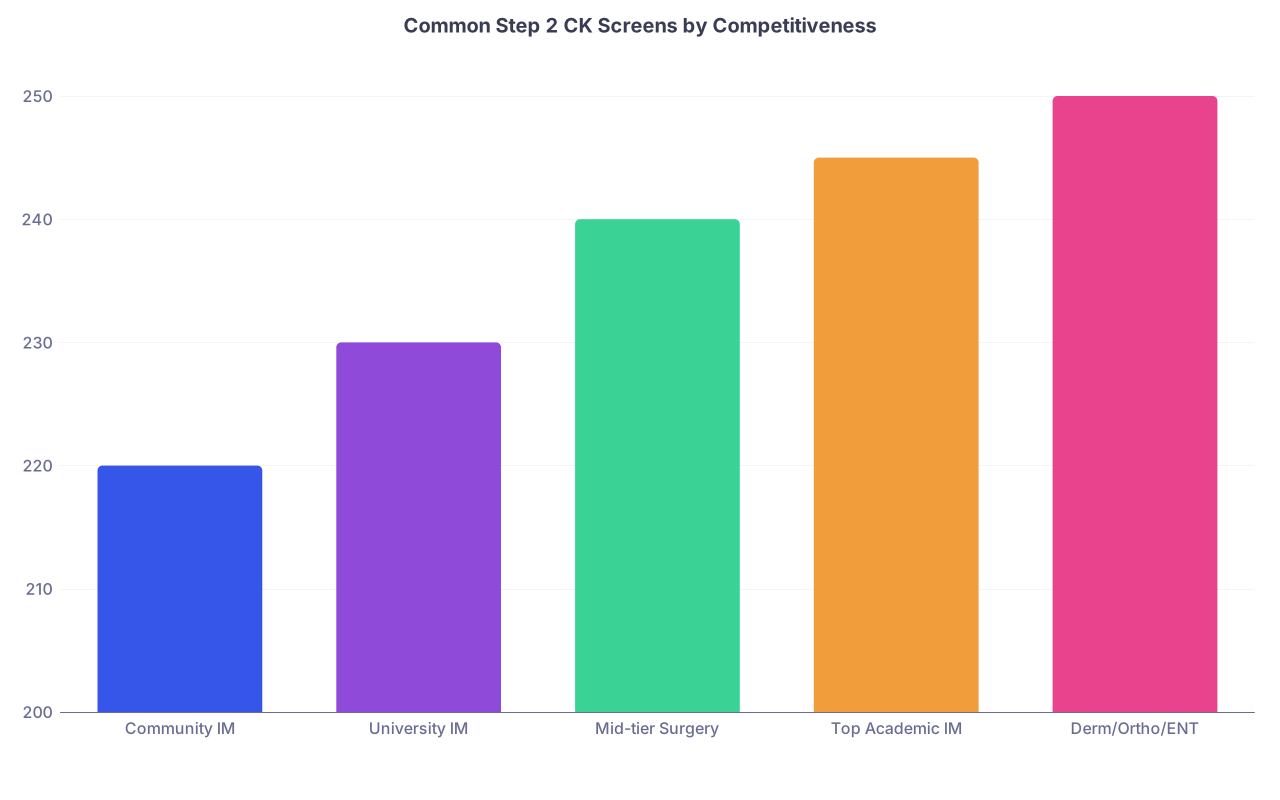
If you want numbers, here’s the kind of quiet, back-of-the-envelope cutoffs I’ve seen over and over:
| Category | Value |
|---|---|
| Community IM | 220 |
| University IM | 230 |
| Mid-tier Surgery | 240 |
| Top Academic IM | 245 |
| Derm/Ortho/ENT | 250 |
These are not “official” cutoffs. They’re the thresholds where a file starts to feel like work vs. risk.
Here’s how PDs think:
- A 260+ in a competitive specialty? You’re in the serious consideration pile unless your application is a train wreck.
- A 245–255? Plenty strong for most academic programs in medicine, peds, anesthesia, EM.
- Sub-220 in a competitive field? Someone has to really go to bat for you.
And yes, many programs will say, “We don’t have hard cutoffs.” That’s technically true. Functionally, though, filters get applied. If not automatically, then mentally: “Do I want to spend time rescuing this file when I have 200 others with fewer questions?”
What PDs actually prioritize regarding Step 2:
- That you took it on time (before ERAS opens, unless you have a compelling reason).
- That your score is consistent with the rest of your record. A 208 after high honors on every core rotation raises eyebrows.
- That you are not a risk to fail boards. Programs are terrified of poor board pass rates. Terrified.
If your Step 2 is weak, the question becomes: who is vouching for you so strongly that the PD is willing to override their fear? That leads to the next thing.
2. Failed Attempts and Red Flags
Failed Step, failed COMLEX, failed courses. PDs look for these like a hawk because remediation is painful for everyone.
Here’s the internal monologue I’ve heard a hundred times:
“I can rank a similar applicant with no failures and sleep at night. Why pick the risk?”
The key is not “Do you have a failure?” The key is “Is there a contained, compelling, cleanly explained story with a strong recovery?”
Things PDs scrutinize:
- Multiple failures vs. a single event
- Whether you rebounded strongly (e.g., Step 1 fail → Step 2 = 240+ with honors on clerkships)
- Whether your MSPE actually addresses it (not just a vague line)
- Whether anyone in your letters references growth, maturity, turnaround
If it looks like you tried to hide it—or your explanation is vague and hand-wavy—you get tossed. Quickly.
3. Recency and Gaps
Older grads and multi-year gaps are a bigger deal than people admit.
Unofficial rule:
- Less than 3 years out from graduation? Many programs will still give you a look.
- More than 5 years out and not in structured training? At a lot of places, your odds plummet unless you have something very strong (US clinical experience, research with someone known, or prior residency).
What PDs look for:
- Have you been in clinical medicine recently? Observerships, hands-on work, or at least something medically adjacent.
- Is there a coherent story? Immigration, illness, family crisis—if it’s real and well-documented, people can be surprisingly humane.
- Do letters speak to your current ability? A great letter from 2019 with nothing recent makes people nervous.
Most applicants with gaps write vague, defensive, or overly polished explanations that sound like PR. PDs are not fooled by this. A clear, direct, “I stepped away to care for a sick parent, then returned and did X, Y, Z to re-enter clinical work” lands far better.
The “Signals” PDs Read Faster Than You Think
Once you’re past the hard filters, now the PD is asking: “Is this someone I want in my program at 2 a.m. on call?” That’s the actual question.
And this is where the insider patterns matter.
4. School Reputation and Context
Nobody will say this on record, but I’ve watched it for years: where you trained changes how everything else is interpreted.
A 230 from a lower-tier Caribbean school is not read the same way as a 230 from a strong US MD program with aggressive internal grading. Fair? No. Real? Absolutely.
There’s a contextual ladder in most PDs’ heads:
| Factor | How It Usually Plays Out |
|---|---|
| US MD Top-Tier | More trust by default, more benefit of doubt |
| US MD Mid/Low-Tier | Neutral; rest of app decides |
| US DO | Improving; some bias remains in certain fields |
| US-IMG | Must be clearly above average to stand out |
| Non-US IMG | Needs standout metrics and strong US LORs |
You do not control where you went to school now. But you can control:
- How strong and specific your letters are
- How aggressively you communicate your performance within your context
- Whether your Step 2 and clinical comments show you outperform your “category”
A 245 and honors from a lower-profile school with a letter that says “top 5% I’ve worked with in 10 years” will get taken seriously anywhere. I’ve seen big-name PDs pause for that.
5. Clinical Performance: Not Just “Honors”
Most students overestimate how much PDs care about preclinical years and underestimate how much they care about your core clerkships and sub-I performance.
When we read your MSPE and transcript, we’re scanning for:
- Medicine, surgery, ICU, EM, or whatever is relevant to the specialty
- Patterns: rising? flat? erratic?
- How your narrative comments describe your judgment, work ethic, and independence
Let me be blunt: a student with “High Pass” but narrative comments like “takes ownership of patients, anticipates needs, strong intern-level skills” is more appealing than straight “Honors” with comments like “quiet, did assigned tasks, pleasant to work with.”
PDs know grade inflation is real. Narrative trumps label.
And one more thing:
Your sub-I / acting internship in the field you’re applying to is disproportionately important. That’s the closest thing to a “test drive” before residency. A lukewarm sub-I evaluation in your chosen specialty is a big problem. A glowing one can offset a lot.
6. Letters of Recommendation: The Hidden Currency
Letters are the one thing students systematically misunderstand.
You think: “Big name = good letter.”
We think: “Specific, comparative, and clearly written by someone who actually worked with you = gold.”
Red flags we see constantly:
- Generic, templated letters from the department chair who met you twice
- Letters with faint praise: “met expectations,” “pleasant to work with,” “would do well in any residency”
- Letters that say almost nothing about your independent thinking
What makes PDs pay attention:
- Clear ranking language: “Top 5–10% of students I’ve worked with in the last decade”
- Concrete behaviors: “Stayed late to call families,” “Handled cross-cover confidently on busy nights”
- Specialty-specific endorsements: a surgeon saying, “I would be happy to have this applicant as a categorical resident in our program.”
PDs absolutely read between the lines. A short, generic letter from someone who supposedly knows you well can hurt more than help.
If you’re smart, you’ll pick letter writers who:
- Actually worked with you closely
- Have seen you on tough days, not just your best
- Are known to write detailed letters, not fluff
And—this is insider level—PDs recognize each other’s writing styles and standards. A certain PD’s “top 25%” might mean more than another’s “top 5%.” We’ve read each other’s letters for years.
What PDs Notice in Your Personal Statement (and What They Ignore)
No one is sitting there line-editing your prose. This isn’t a creative writing contest. But the personal statement can quietly move you from “generic” to “let’s interview this one” or from “maybe” to “no thanks.”
Here’s how PDs actually use it:
- To check for red flags: arrogance, blame-shifting, melodrama, lack of insight
- To see if you have a coherent story that fits the specialty
- To sense whether you understand what the work is actually like
What gets ignored:
- Overly polished, cliché lines: “I knew I wanted to be a doctor when…”
- Trauma-dump narratives that don’t connect to your current professionalism
- Generic “I love teamwork” paragraphs that could be copy-pasted into any specialty
What subtly helps:
- A grounded sense of why this specialty, anchored in real experiences on the wards
- One or two concrete patient or team interactions that show how you think, not just how you feel
- A tone that sounds like an adult colleague, not a premed still trying to impress
If your statement feels like an application essay rather than a colleague introducing themselves, you missed the mark.
Research, Leadership, and All the Other “Nice-to-Haves”
Let me be uncomfortably honest about these.
7. Research
In highly academic programs (think top-tier IM, radiation oncology, neurosurgery, dermatology), research is more than window dressing. It’s a sorting tool and a predictor of “will this person produce papers under our name?”
But the nuance:
- First-author or substantial contributions in the field you’re applying to? Strong plus.
- Being part of a huge author list where your role is unclear? Mild signal at best.
- A pile of random, unrelated case reports thrown together late in M4? We can tell what that is.
What PDs really want to know:
- Can you see a project through from idea → data → manuscript?
- Did you work with someone they know and trust?
- Do you understand your own research when asked in an interview?
If you list 12 projects and can’t clearly explain one when questioned, you lose credibility fast.
8. Leadership, Volunteering, and “Stuff”
Everyone has leadership now. Everyone started a club, tutored, volunteered at a clinic. Most of it is background noise.
These things only matter when they answer one of the PD’s real questions:
- Will this person be reliable when on call at 3 a.m.?
- Will they show up, do the work, and not collapse under pressure?
- Are they the kind of person co-residents won’t complain about endlessly?
So, leadership that moves the needle:
- Longitudinal responsibility over time (running something for 2–3 years, not 3 months)
- Work that involved conflict, logistics, or actual management of people
- Experiences that clearly connect to residency skills: teaching, running sign-out, quality improvement, etc.
The rest? It fills space. It won’t save a weak application, but it can modestly strengthen a solid one.
The “Off-Record” Factors You’re Not Supposed to Know About
Here’s where I pull the curtain back on the stuff PDs talk about only among themselves.
9. Signals, Home Programs, and Away Rotations
Programs love known quantities. Known = lower risk.
Highest trust ranking in many PD brains:
- Their own students who rotated with them and did well
- Students from schools they know well, with strong LORs from colleagues they trust
- Away rotators who clearly impressed on service
- Everyone else
If you rotated at a place, got a strong letter, and the chiefs liked you? That counts more than you think. I’ve been in meetings where someone said, “The chiefs loved her on her sub-I,” and that essentially ended the discussion in her favor.
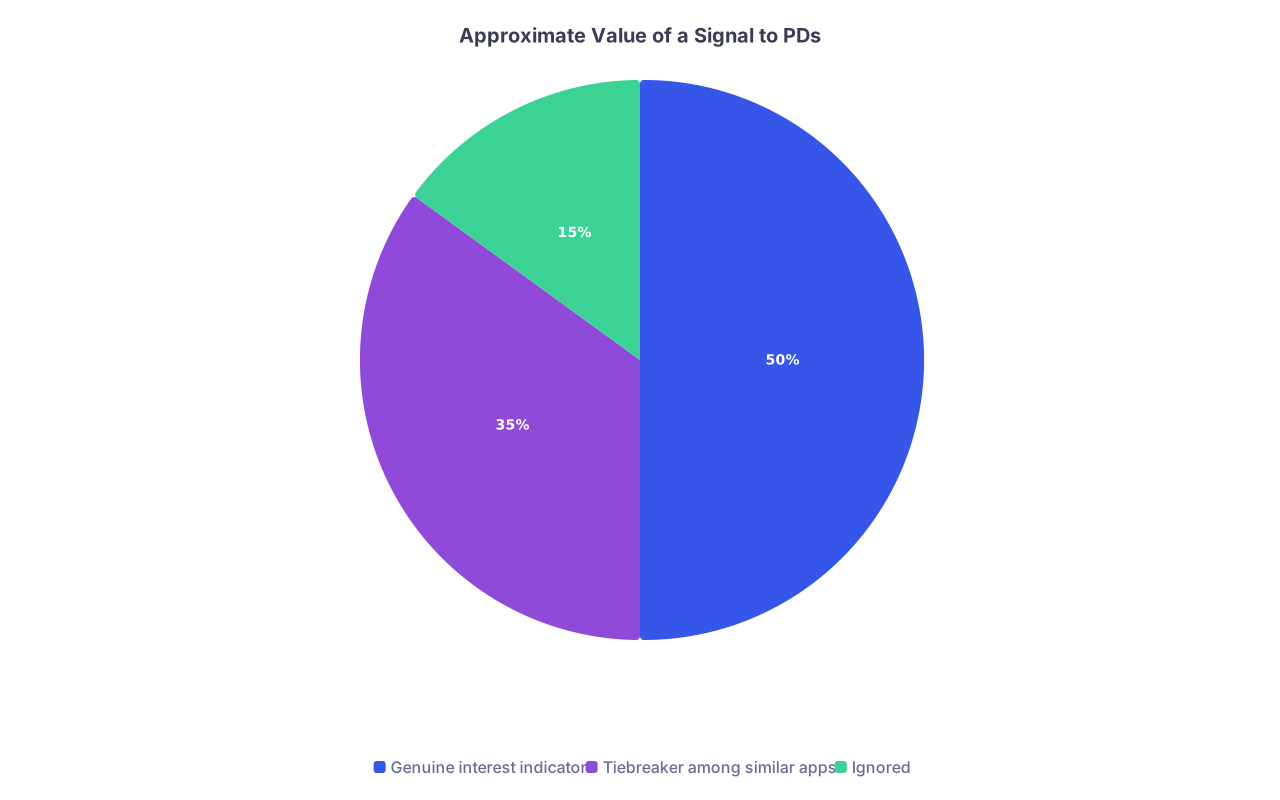
On the newer front: preference signaling. Don’t underestimate it.
| Category | Value |
|---|---|
| Genuine interest indicator | 50 |
| Tiebreaker among similar apps | 35 |
| Ignored | 15 |
Most PDs I know use signals to:
- Separate “we might be a backup” from “they definitely care”
- Decide how to allocate the borderline interview invites
- Prioritize which files they read more carefully
No, a signal won’t resurrect a weak application. But if you’re solid and in the middle of the pack, it absolutely can push you into the interview list.
10. Cultural Fit and “Would I Want to Work With You?”
This is the part that feels the most unfair because it’s the least objective, but it’s very real.
On paper, two applicants might look identical. Same scores, honors, research output. But the one whose narrative, letters, and experiences suggest:
- Humility without weakness
- Work ethic without martyrdom
- Team orientation without being a doormat
- Emotional stability
That one wins.
PDs fear three types of residents far more than they fear “average board scores”:
- The complainer / poisoner of culture
- The unreliable flake
- The ego bomb who can’t take feedback
So anything in your file that hints you’re low-maintenance, teachable, and able to function under stress? That’s gold.
And yes, PDs talk to each other off the record. If you were problematic as a student somewhere, or if you acted poorly on an away, that story can follow you.
How You Actually Make Your Application “Strong” in PD Terms
Let me translate all this into what a “strong” application really means internally.
A genuinely strong applicant is not the one with the flashiest CV; it’s the one who makes the PD’s decision easy.
They look like this:
- Solid, on-time Step 2 with no unexplained gaps or failures
- Clear, consistent clinical performance with strong, specific comments on core and sub-I rotations
- Letters from people who clearly worked with them and would trust them as an intern
- A believable narrative for why this specialty and why this kind of program
- Some evidence of durability: long-term commitments, follow-through, not a string of shallow one-offs
And then a small subset stand out even more:
- High Step 2
- Honors in key rotations
- Research or leadership that aligns with the program’s priorities
- Strong home or away rotation performance at that specific program or a peer institution
Those are the people everyone in the room is comfortable fighting for.

| Step | Description |
|---|---|
| Step 1 | ERAS Applications |
| Step 2 | Reject |
| Step 3 | Step 2 & Transcript Check |
| Step 4 | Read MSPE & Letters |
| Step 5 | Consider PS & Fit |
| Step 6 | Offer Interview |
| Step 7 | Meets basic filters? |
| Step 8 | Red flags? |
| Step 9 | Strong letters & comments? |
| Step 10 | Interview Worthy? |
If you want your file to survive that flow, you have to stop asking, “Is my application good?” and start asking, “Where would this PD hesitate or say no, and how can I remove that?”
FAQs
1. If my Step 2 score is average, what’s the single best way to strengthen my application?
Maximize what PDs trust most after scores: clinical performance and letters. Crush your sub-I in the specialty and at least one demanding core rotation (medicine, surgery, ICU, EM depending on your field). Then get specific, comparative letters from attendings who actually supervised you closely in challenging settings and are known to advocate strongly for good trainees.
2. How many research projects do I really need for a competitive academic program?
The number matters far less than the quality and coherence. One or two serious, meaningful projects—preferably in your specialty, where you can clearly explain your role and what you learned—are much more persuasive than 8–10 scattered abstracts, case reports, and “forthcoming” manuscripts you can’t discuss intelligently. PDs care that you can see a project through and function in an academic environment, not that you can accumulate PubMed IDs like baseball cards.
3. Is a mediocre away rotation worse than no away rotation at all?
At many places, yes. A weak or lukewarm performance on an away can quietly damage your chances, especially if the chiefs or attendings report back that you were unengaged, unprepared, or difficult to work with. If you’re going to do an away, treat it like a month-long audition. If you know you perform poorly in new environments under stress, you may be better off doing one very targeted away or none, and focusing on being outstanding at your home institution instead.
In the end, remember three things: PDs are scanning for risk, for reliability, and for people they can imagine calling “colleague” in a few years. Score well enough to avoid fear, build a clinical record that screams “I show up and do the work,” and get a few credible people to say, “Trust this one.” Do that, and your application stops being a gamble and starts looking like an easy yes.