
Most applicants structure their ERAS experiences in the worst possible way: passively, instead of strategically.
Let me be blunt. The “just list everything in order and hope they’re impressed” approach is lazy and costs people interviews every single cycle. Programs are drowning in applications. They are not reverse‑engineering your brilliance from a scattered, chronological dump of your past 10 years.
You have one job with your ERAS experiences: make it radically easy for a tired PD, APD, or senior resident reviewer to see impact, trajectory, and fit in 60–90 seconds.
That is where “impact‑first” vs “chronological” structuring comes in. This is not a cute stylistic choice; it is a tactical decision that affects how humans reading 60 files a night interpret your application.
Let me break this down specifically.
The Reality of How ERAS Experiences Are Read
Before we talk structure, you need to understand the actual reading environment.
Most programs are not lovingly reading every word of your ERAS. They are triaging. Think:
- 800–3,000 applications.
- Screeners with 30–80 files to clear before bed.
- 1–3 minutes per application in the first pass.
That means:
- They skim section headers.
- They glance at titles, organizations, and dates.
- They fully read only a subset of descriptions.
- They are looking for signals:
- Can you work hard and finish things?
- Do you have evidence of genuine interest in this specialty?
- Any leadership? Ownership? Responsibility?
- Any significant red flags or “wow” factors?
The ERAS “Experiences” section is not your diary. It is a signal‑generation tool.
So the core question is: how do you arrange and write experiences so that the right signals are unmissable?
Impact‑First vs Chronological: What We Are Actually Talking About
“Chronological” is straightforward: you list your experiences in order by date (within ERAS’s basic constraints), often defaulting to starting from the most recent and going backward. You let time dictate the sequence.
“Impact‑first” means you deliberately prioritize and frame experiences by importance and impact, not simply by when they happened, and you write descriptions to put outcome and responsibility first, then details.
You still have to respect ERAS fields and date ranges, but within that, you control:
- Which experiences get “most meaningful” treatment.
- How you title them.
- How you write the first line.
- Which ones you group, which you cut.
- How obviously they point to your specialty and strengths.
Impact‑first is a philosophy. Chronological is just a raw sorting principle. ERAS gives you more control than people realize—if you use it.
How ERAS Actually Structures Experiences (And Where You Have Control)
Look at what you can manipulate.
You have for each entry:
- Type (work, research, volunteering, leadership, teaching, etc.)
- Organization
- Position/Role Title
- Start and end date, hours per week, total hours
- “Most meaningful” flag with extended space (for some specialties/app cycles)
- Short descriptive text (your narrative)
Reviewers see:
- The list of entries with titles and organizations.
- The “most meaningful” highlighted entries.
- The descriptions, if they choose to expand and read.
What ERAS does not force you to do:
- It does not force you to list every small thing.
- It does not require you to use the title the organization gave you verbatim.
- It does not prevent you from grouping similar experiences.
- It does not require ultra‑precise chronological purity for interpretive benefit.
So “impact‑first” structuring touches:
- Which experiences you include at all.
- How many separate entries you create.
- How you title and categorize them.
- Which you tag as “most meaningful.”
- How you write the first 1–2 lines of the description.
Chronological thinking tends to throw all of that away in favor of “but that happened earlier so I will put it lower / describe it less.”
That is backwards.
What “Impact‑First” Actually Looks Like in Practice
Impact‑first is not just “put your best stuff at the top.” It is three concrete behaviors:
Lead with outcomes and responsibility, not tasks.
First line tells me: scale, result, or ownership.Cluster your experiences by function and signal.
Group smaller, similar items into a single coherent entry when the combined impact is stronger than each alone.Align your structure to your specialty story.
If you are applying to Internal Medicine, I should feel that from the distribution and emphasis of your experiences. Same for EM, Ortho, Psych, etc.
Let me show you the difference.
Chronological style description (what I see constantly):
“I volunteered weekly at the student‑run free clinic where I took vitals, roomed patients, and helped with basic documentation. I also helped with referrals and patient education materials.”
Impact‑first version of the same work:
“Coordinated care for >150 uninsured patients at a student‑run free clinic, managing vitals, intake, and follow‑up logistics across a multidisciplinary team. Led the rollout of a standardized discharge checklist that reduced missed follow‑up appointments from 32% to 18% over 6 months.”
Same clinic. Same hours. Completely different impression.
One gives “generic volunteer.” The other screams “ownership, systems thinking, measurable impact.”
When Chronological Emphasis Helps (And When It Hurts)
Chronological emphasis—“my experiences show a progression over time”—is not inherently bad. There are 3 situations where leaning on chronology actually helps:
Clear upward trajectory in responsibility.
Example: Scribe → Coordinator → Chief Scribe, all within the same system. You want the reviewer to see growth.Longitudinal commitments with evolving roles.
Example: 4 years in a diabetes education program, first as volunteer, then as curriculum lead. Here, continuity matters.Research with a clean pipeline narrative.
Example: Joined lab → abstract → poster → manuscript → oral presentation. Time progression is the story.
But pure chronological listing hurts you when:
- Your most impactful work occurred early (gap year job, pre‑med career, military, etc.) and gets buried below a swamp of “I attended a virtual journal club once a month.”
- You have lots of short, scattered roles that look like box‑checking.
- Your specialty alignment is late (you discovered EM M4), and your early years look off‑theme unless reframed.
In other words, chronological emphasis is a tool. Not the default.
Building an Impact‑First ERAS Experience List Step‑by‑Step
Let me walk you through how I actually do this with students.
Step 1: Dump everything into a working list
Not into ERAS. Into a doc.
Academic year, dates, role, organization, rough hours, 1–2 bullets on what you did and any numbers/outcomes you remember.
Include:
- Clinical jobs (CNA, EMT, MA, scribe, etc.)
- Non‑clinical work (teaching, consulting, IT, military)
- Volunteering (clinical, community, campus)
- Research (wet lab, clinical, outcomes, QI, education)
- Leadership (student orgs, committees, projects)
- Teaching/tutoring/TA roles
- Major hobbies with real structure (competitive sports, advanced music, etc.) if they show discipline or longevity
Do not filter yet.
Step 2: Score each experience for three things
I literally have people rate 1–5 for each category:
- Impact: Scope / outcomes / seriousness of responsibility
- Relevance: How clearly it supports your target specialty or core competencies (clinical exposure, teamwork, resilience, etc.)
- Distinctiveness: How non‑generic it is among your peers
Then I create a quick table like this:
| Experience | Impact (1–5) | Relevance (1–5) | Distinctiveness (1–5) |
|---|---|---|---|
| Gap year ICU nurse tech | 5 | 5 | 4 |
| 6‑month ortho research project | 3 | 4 | 3 |
| 3 different 1‑day health fairs | 1 | 2 | 1 |
| College barista job | 2 | 2 | 3 |
| Med school free clinic leadership | 4 | 5 | 4 |
You want your ERAS to spotlight 4–7 “anchor” experiences that are high on at least two of those axes. Those are your impact‑first pillars. Chronology is secondary.
Step 3: Decide what to collapse, what to cut, what to feature
This is where most people fail. They list every 3‑hour event as a separate “volunteer experience.” It looks like noise.
You:
Collapse:
Several similar, low‑to‑moderate impact experiences into a single entry.Example: “Community Health Outreach Volunteer, 2018–2022” with a sentence that you participated in 6 health fairs, 3 screening drives, etc.
Cut:
Tiny, non‑distinct items that add no signal.
Example: “Shadowed Dr X for 8 hours.” Gone. (Or folded into a “Shadowing” composite entry if needed.)Feature:
High‑impact experiences get their own entry, clear titles, and potentially “most meaningful” status.
ERAS gives you plenty of slots. But more entries does not mean stronger. After about 12–15 experiences, readers mentally tune out and pick a few titles to click.
Impact‑first structuring accepts that reality and loads the dice: you make sure the experiences they are likely to click are the ones that define your narrative.
Writing Descriptions: Impact‑First vs Task‑First
The first 1–2 lines of each description decide whether the reader bothers finishing it.
Task‑first writing sounds like:
- “Responsibilities included…”
- “I was responsible for…”
- “Duties involved…”
- “I helped with…”
Impact‑first writing leads with:
- Scope: how big, how long, how many.
- Ownership: led, created, designed, coordinated.
- Change: increased, reduced, improved, implemented.
Example: generic scribe vs impact‑first.
Chronological/task‑first:
“I worked as an emergency department scribe where I documented patient encounters, entered orders, and assisted providers with chart completion. I learned medical terminology and workflow in a busy ED.”
Impact‑first:
“Documented >1,200 emergency encounters in a high‑volume community ED, supporting 12 attendings across fast track and main ED. Developed rapid pattern recognition for acute presentations and created a resident‑used template for sepsis workups that reduced average charting time by ~3 minutes per case.”
Both are true. One sounds like you took a job. The other sounds like you changed the place you worked.
You are not lying. You are choosing to foreground outcomes instead of chores.
“Most Meaningful” Entries: Your Impact‑First Power Slots
If your ERAS cycle allows marking “most meaningful” experiences (or whatever variant that year’s platform supports), this is the closest thing you have to pinned tweets for your life.
These are not:
- The most prestigious entries.
- The longest by hours.
- The ones you feel the most sentimental about.
They are:
- The experiences that do the most work in explaining your professional identity and specialty choice.
For an Internal Medicine applicant, classic “most meaningful” candidates:
- Longitudinal free clinic leadership with complex patients.
- Substantial QI or outcomes research in a relevant area.
- Significant teaching role (peer tutor, curriculum designer).
- Prior career in nursing, RT, or paramedicine.
For EM:
- ED scribe / EMT with meaningful responsibility.
- Disaster response, EMS, or high‑acuity volunteer roles.
- ED‑related QI or operations work.
For competitive surgical subspecialties (Ortho, ENT, Plastics):
- High‑output subspecialty research with clear outcomes.
- Longitudinal involvement with surgeons, especially in OR‑adjacent roles.
- Leadership that shows grit, coordination, and resilience.
Impact‑first means you:
- Choose 2–3 experiences that together tell a coherent story: “This is who I am and why this specialty makes sense.”
- Use the extra space to connect the dots: skills learned, perspective gained, how it shaped your goals.
- Avoid repetition with your personal statement; instead, reinforce consistent themes with different angles or details.
Title and Category: Tiny Fields, Huge Signal
Program directors skim titles and categories to get a sense of your maturity and self‑awareness. These are under‑used impact‑first tools.
Bad titles (chronological/passive mindset):
- “Volunteer”
- “Member”
- “Research Student”
- “Shadowing”
Better titles (impact‑aware):
- “Clinic Coordinator – Student‑Run Free Clinic”
- “Lead Tutor – Physiology and Pathology”
- “Clinical Research Assistant – Heart Failure Outcomes”
- “Emergency Medical Technician – Rural EMS”
You are not inflating your role. You are describing it in a way that communicates function and responsibility.
Case comparison:
Chronological/weak:
Position/Title: Volunteer
Organization: Student‑Run Free Clinic
Impact‑first:
Position/Title: Clinic Coordinator & Patient Navigator
Organization: Student‑Run Free Clinic
Same role. One sounds generic, the other signals leadership and longitudinal involvement before the reviewer reads a single sentence.
Specialty Alignment: How Structure Signals Fit Before You Say a Word
An impact‑first ERAS application for IM should feel different from one for Ortho or Psych.
Look at a high‑level distribution:
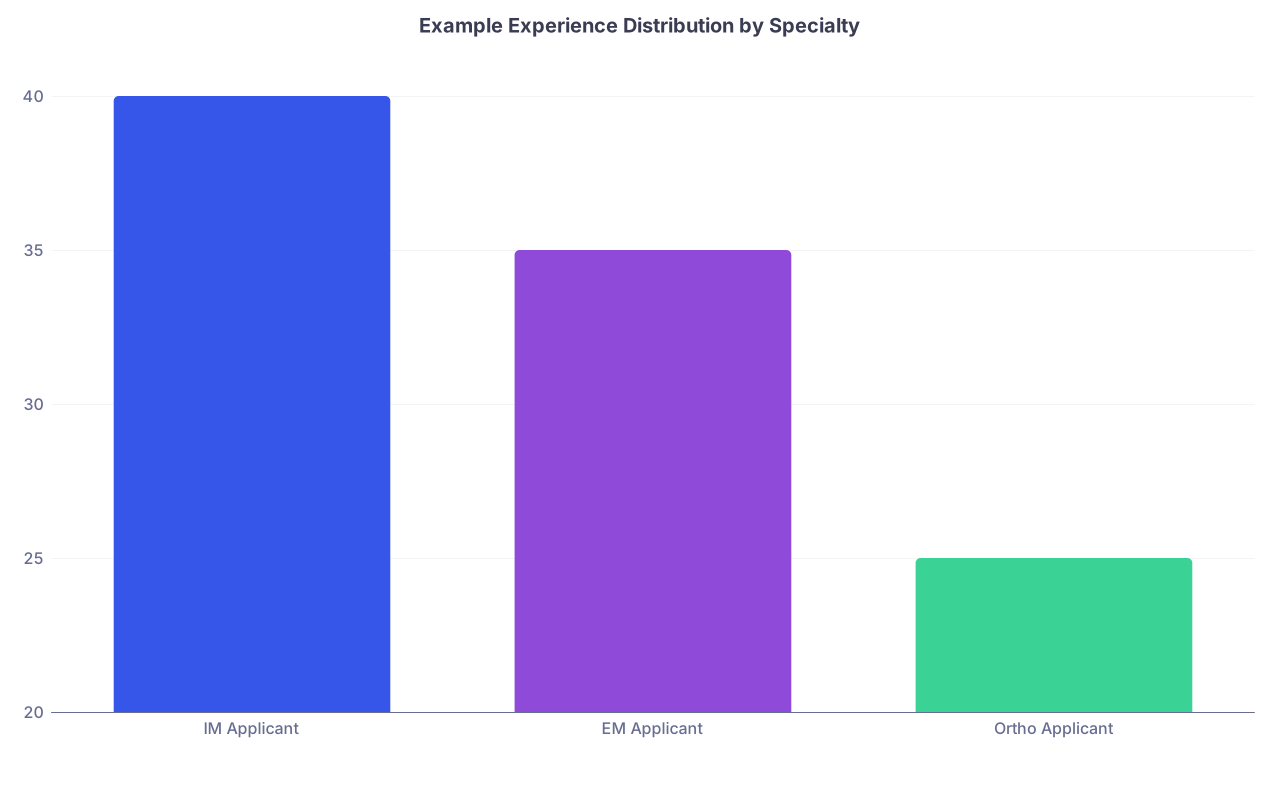
| Category | Value |
|---|---|
| IM Applicant | 40 |
| EM Applicant | 35 |
| Ortho Applicant | 25 |
Ignore the exact numbers; focus on proportion. For example, an Ortho applicant who has:
- 1 Ortho research project.
- 12 non‑orthopedic, scattered volunteering experiences.
- Zero OR exposure beyond core clerkship.
…is structurally saying: “I decided Ortho late, have minimal specialty‑specific investment, and am hoping my Step score bails me out.”
Impact‑first structuring for that same person might:
- Elevate the single Ortho research and the one sub‑I (with strong descriptions).
- De‑emphasize or collapse noise volunteering.
- Highlight pre‑med athletics or manual skill hobbies that actually map to the specialty (competitive gymnastics, woodworking, etc.).
- Use a “most meaningful” entry to explain the late discovery and rapid, deep commitment to Ortho.
You cannot invent experiences you did not have. But you can decide what to spotlight and how clearly the pattern emerges.
Longitudinal vs Fragmented: How to Handle “I Did a Bit of Everything”
Many students have a “sampler platter” of experiences. A little research. A few clinics. One summer camp. Shadowing five specialties. Chronological listing makes this look fragmented and unfocused.
Impact‑first structuring looks for longitudinal threads:
Health equity?
Group your community health fairs, health education workshops, and clinic interpreter work under one umbrella and show a 4‑year pattern.Teaching?
Combine TA roles, tutoring, and mentoring into a “Medical Education and Peer Teaching” portfolio entry, then feature the strongest single role as a standalone.Systems/leadership?
Highlight your most substantive leadership role and use 1–2 others to show this was not a one‑off.
A useful trick: sketch a quick mindmap of your experiences and see what natural clusters appear.

You then design entries around those clusters, not individual calendar events.
Non‑Traditional and “Old” Experiences: When They Still Matter
Chronological thinkers often bury or delete meaningful pre‑med or pre‑clinical experiences because “they’re old” or “not directly clinical.”
That is a mistake when:
- You had a substantial pre‑med career (nurse, RT, PA, paramedic, military medic, engineer in a relevant field).
- You had 2–10 years in a demanding non‑medical job that built skills relevant to residency (team leadership, crisis management, complex project execution).
- You have a long history in something that obviously shapes your professional identity (D1 athletics, professional music, serious caregiving responsibilities).
Impact‑first means:
- Those experiences get real space and thoughtful descriptions, even if they were 6–8 years ago.
- You explicitly tie the skills to residency: communication under pressure, shift work, dealing with death, complex systems.
For example, a former ICU nurse applying to Anesthesiology:
Task‑first, chronological:
“I worked as an ICU nurse for three years managing critically ill patients before medical school.”
Impact‑first:
“Cared for ventilated and hemodynamically unstable patients as an ICU nurse for 3 years, managing vasopressors, sedation, and invasive monitoring. This front‑line exposure to respiratory failure and peri‑intubation management is what drew me to Anesthesiology and still shapes how I think about physiology and team communication in high‑stakes moments.”
If that is buried under “M3 shadowing,” you have structurally sabotaged yourself.
Common Structural Mistakes That Kill Impact
Let me call out some patterns I see constantly:
Ten micro‑entries of low‑impact volunteering.
Health fairs, 1‑day events, random fundraisers. Separate entries for each. It looks scattered and unserious. Collapse.Over‑indexing on research by splitting one project into 5 entries.
“Lab member,” “Abstract submitted,” “Poster presented,” “Manuscript under review.” Just no. One well‑written research entry can capture the whole trajectory.Burying leadership inside generic descriptions.
“I was later elected co‑director” as the fourth sentence of a clinic description. Your leadership role should be visible in the title and first line.Treating shadowing as a major experience.
10 separate shadowing entries with 20–40 hours each. It reads like box‑checking. If needed, one consolidated shadowing entry with a brief summary is plenty for most specialties.Using precious description space for fluff.
“This opportunity taught me the importance of empathy.” That phrase tells me nothing. Show me one concrete scenario or responsibility that proves you learned empathy.
Impact‑first structuring is ruthless. If a sentence does not advance your case, it gets cut.
A Concrete Before‑and‑After Example
Let’s take a hypothetical IM applicant with these raw experiences:
- Gap year: 1 year full‑time MA in a primary care clinic.
- Pre‑med: 2 summers as a camp counselor.
- M1–M2: sporadic volunteering at health fairs and a food pantry.
- M2–M4: joined and then led a student‑run free clinic.
- Research: one cardiology outcomes project, abstract submitted, poster presented.
- Teaching: peer tutor for physiology and pathophysiology.
A chronological, task‑first ERAS might look like:
- Food Pantry Volunteer
- Health Fair Volunteer
- Camp Counselor
- Medical Assistant
- Student‑Run Free Clinic Volunteer
- Student‑Run Free Clinic Co‑Director
- Cardiology Research Volunteer
- Poster Presentation – ACC
- Peer Tutor
It reads fragmented and generic. The reviewer will truly read maybe three of those.
Impact‑first restructuring:
Anchor experiences (own entries, likely “most meaningful”):
- Clinic Co‑Director – Student‑Run Free Clinic
- Medical Assistant – Primary Care Clinic (Gap Year)
- Clinical Outcomes Research Assistant – Cardiology
- Peer Tutor – Physiology and Pathophysiology
Collapsed, supportive experiences:
- Community Health Outreach Volunteer (health fairs + pantry)
- Youth Leadership – Summer Camp Counselor
Descriptions lead with:
- Scale: “Coordinated care for ~300 uninsured patients annually…”
- Responsibility: “Led a team of 25 volunteers…”
- Outcomes: “Implemented a new no‑show policy that improved follow‑up from 55% to 72%…”
On a 60‑second skim, the reviewer now sees: longitudinal primary care exposure, serious clinic leadership, relevant research, real teaching, some community work, plus human‑sounding non‑clinical background. That is a coherent IM story.
Quick Visual: Impact‑First vs Chronological Flow
Here is a simple view of how decisions should flow when you write this section.

| Step | Description |
|---|---|
| Step 1 | List All Experiences |
| Step 2 | Score Impact/Relevance |
| Step 3 | Create Standalone Entry |
| Step 4 | Group into Composite Entry |
| Step 5 | Cut or Minimize |
| Step 6 | Consider Most Meaningful |
| Step 7 | Keep as Strong Support |
| Step 8 | High Impact or Key to Story? |
| Step 9 | Similar to Others? |
| Step 10 | Supports Specialty Narrative? |
If you are not doing something like this mentally when you build ERAS, you are operating on autopilot.
Where Chronology Still Matters (So You Do Not Look Disorganized)
Impact‑first does not mean ignoring time or creating a chaotic timeline.
You still need:
- No obvious gaps with zero explanation. If you took a year off, it should be anchored somewhere in experiences or an advisor’s note.
- Coherent date ranges. Do not overlap 3 “full‑time” roles.
- A visible, believable progression: it should look like you grow in responsibility and complexity over time.
But within those constraints, time is just a backdrop. Impact decides spotlight.
Final Thoughts: What You Should Actually Do This Week
If you are in the middle of ERAS drafting or revision:
- Make a separate document and list all experiences with rough scores for impact, relevance, distinctiveness.
- Pick your 4–7 anchors that tell your specialty story. Those get your best writing.
- Collapse low‑impact, repetitive items into 1–2 composite entries and cut dead weight.
- Rewrite your top experiences so the first line leads with scale, ownership, and outcome—not tasks.
- Check that your distribution of experiences, titles, and “most meaningful” flags would let a stranger guess your specialty and core strengths within 60 seconds.
If they cannot, your structure—not just your content—is the problem.
Key Takeaways
- Chronological listing is a default, not a strategy. Impact‑first structuring deliberately prioritizes high‑impact, high‑relevance experiences and makes their value obvious in the first line and the title.
- ERAS gives you more control than most people use: you can group, cut, and retitle experiences to create a coherent specialty narrative instead of a scattered resume.
- Strong applications are ruthless: they collapse noise, elevate true anchors, and use “most meaningful” entries and descriptions to highlight outcomes, responsibility, and growth—not just hours and tasks.