
Designing a Research Portfolio That Matches Your Career Story
It is late September. ERAS is submitted, your letters are in, and you are staring at your CV on VSAS/ERAS thinking: “My research looks…random.” A QI poster from second year. A case report in some journal you barely remember. A basic science project that has nothing to do with the field you are applying into. Meanwhile, your peers are casually saying things like, “Yeah, all my projects are in health services research in nephrology,” and you are wondering if you missed a memo.
You did not miss a memo. You missed a strategy.
Let me walk you through how people who look “put together” on paper actually got there—and how you can deliberately design a research portfolio that supports a coherent, believable career story instead of a cluttered list of disconnected bullet points.
Step 1: Decide What Story You Are Actually Telling
Before you touch your CV, you need to decide what story you want your application to tell. Not in some vague “I like helping people” sense. I mean in a way that can be mapped to specific research outputs.
Ask yourself three questions and write down the answers in one short paragraph each:
- What is my intended field and rough niche?
- How do I want programs to describe me in one sentence?
- What long-term role do I see myself in (academic, hybrid, community with a niche, etc.)?
Examples:
“I am applying to internal medicine, interested in cardiology, especially prevention and health disparities in underserved populations. If a PD introduced me, I would want them to say: ‘She is very serious about outcomes research in women’s cardiovascular health and has already produced work in that space.’ Long term, I see myself as an academic cardiologist running outcomes studies and leading a clinic for high‑risk women.”
“I am applying to general surgery, with an interest in surgical education and simulation. I want to be described as: ‘The resident who loves teaching and actually studies how to improve it.’ Long term, I want a hybrid academic job where I operate and direct a simulation-based curriculum.”
Notice what is happening there: field + sub-interest + method or focus (outcomes, education, QI, disparities, etc.) + future role. That gives you a blueprint for what your research portfolio should look like.
Anything in your portfolio should either:
- Directly support that story, or
- Be clearly framed as a formative stepping stone that led you to that story.
If you cannot connect a project to your story in 1–2 sentences, it is dead weight in an interview.
Step 2: Understand What “Coherent” Actually Means on a CV
Program directors and selection committees are not looking for 100% topic purity. They are looking for a pattern that makes sense.
Coherence does not mean:
- Every paper is about the exact same disease.
- You never touched an unrelated project.
- You have a perfectly linear path with no pivots.
Coherence does mean:
- There is a clear “center of gravity” to your work.
- Your more recent work clusters around your stated interest.
- You can explain how earlier, less-related projects shaped your direction or skills.
Think in clusters, not one-offs. A coherent portfolio usually has:
- A dominant thematic cluster (your main niche).
- One or two secondary clusters that are either:
- Methodological (e.g., QI methods, simulation, qualitative interviews), or
- Content-adjacent (e.g., global health in your specialty, health disparities, medical education within your field).
Let me make that concrete.
Example: Internal Medicine Applicant Interested in Cardiology
Stronger pattern:
- 2 abstracts on heart failure readmissions at regional cardiology meetings
- 1 manuscript under review on disparities in statin prescribing
- 1 QI project on improving inpatient telemetry utilization
- 1 early basic science project from M1 in kidney physiology
This reads as: “Cardio-focused outcomes/QI with an early basic science detour.”
Weaker pattern:
- 1 dermatology case report
- 1 neurology chart review
- 1 general IM QI project about discharge summaries
- 1 poster on COVID attitudes in med students
You can salvage this, but as written, there is no center of gravity.
Your job is to look at your own list and ask: “What, if anything, clusters?” Even if the cluster is small (two things), that can become the seed around which you rewrite your story.
Step 3: Map Your Current Portfolio (Brutally Honestly)
Do a 30–45 minute audit of your research and scholarly work. Not in your head. On a document.
Create a simple table and fill it out:
| Project | Field/Topic | Type | Role | Output | Year |
|---|---|---|---|---|---|
| HF Readmissions | Cardiology/Outcomes | Retrospective cohort | First author | Abstract, poster | MS3 |
| Telemetry QI | Hospital medicine | QI | Co-investigator | Local QI day | MS4 |
| Lupus Case Report | Rheumatology | Case report | Second author | PubMed indexed | MS2 |
| Med Student Burnout Survey | Med ed | Survey study | First author | Manuscript in prep | MS3 |
Then ask four very pointed questions:
- What 1–2 themes occur the most?
- What is my most recent work about?
- Where did I have the largest role (first author / primary driver)?
- What looks like pure randomness?
Usually you will find something like:
- A couple of projects in your target field → anchor.
- A handful of scattered case reports → noise unless framed.
- One methodologically significant project (big chart review / QI) → skill anchor.
This is where you decide: What do I elevate? What do I downplay? What do I need to reframe in my personal statement or interviews so it fits the story?
Step 4: Decide Your Research “Angle”: Content vs Method
A lot of students get stuck because they think their story has to be disease-based (“I do research in lupus”). That is one option, but not the only one. You can build a coherent portfolio around:
- A content area: heart failure, epilepsy, sepsis.
- A population: underserved patients, older adults, women’s health.
- A method: quality improvement, education research, health services, oncology trials.
- A setting: global health, telemedicine, rural care.
You need to choose a primary angle.
Why? Because programs want to hire people who look like they will eventually “own” something: a clinic, a research line, an education niche. Your research portfolio is your early evidence of that.
For example:
- EM applicant: “My angle is resuscitation and airway management in the ED.”
- Peds applicant: “My angle is chronic disease self-management in adolescents.”
- Psych applicant: “My angle is health services research on access to care for serious mental illness.”
Once you pick an angle, you look back at your portfolio and ask: “How can I reinterpret each project through this lens?”
Even an apparently random dermatology case report can become: “That was my introduction to how chronic disease affects quality of life and got me interested in long-term disease management,” which then feeds into your peds chronic disease narrative.
Step 5: Aligning Your Portfolio With Different Career Endpoints
The same portfolio reads differently depending on what you say you want to become. You must choose an endpoint that is believable given your body of work.
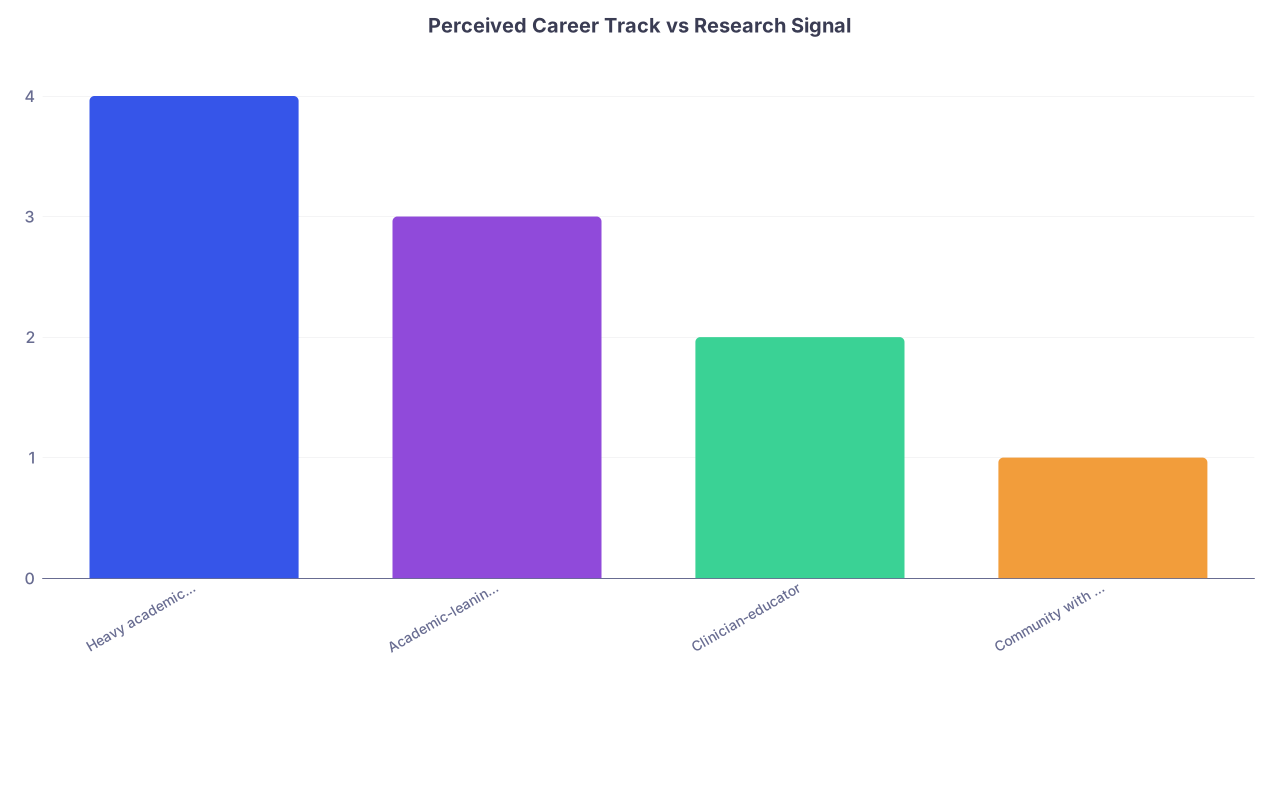
Here is how PDs implicitly categorize people:
| Category | Value |
|---|---|
| Heavy academic track | 4 |
| Academic-leaning hybrid | 3 |
| Clinician-educator | 2 |
| Community with niche | 1 |
Roughly:
- 4 = Strong sustained research productivity with clear mentorship and trajectory.
- 3 = Solid pattern of scholarly work, maybe less volume but good coherence.
- 2 = Mostly education/QI/curriculum projects; research present but limited.
- 1 = A few scattered projects, mostly case reports, low signal.
You do not need to be a “4” to match at good academic programs. But your claimed destination should match your signal.
Examples:
If you say: “I want to be an NIH-funded physician scientist,” but have:
- 1 poster, 1 case report, and no longitudinal bench work
You sound naïve or dishonest.
- 1 poster, 1 case report, and no longitudinal bench work
If you say: “I see myself as a clinical educator who participates in team-based QI and education projects,” and you have:
- 2 QI projects, 1 med ed abstract, some teaching awards
That reads as aligned and believable.
- 2 QI projects, 1 med ed abstract, some teaching awards
Decide your lane:
- Heavy academic track: you need multi-year involvement, multiple outputs, clear mentor endorsements, likely at least one submission as first author.
- Academic-leaning hybrid: a coherent topic area, 3–6 total outputs (abstracts/posters/papers), and talk credibly about continuing in residency.
- Clinician-educator/QI track: less volume but very clear involvement in curriculum, QI, or simulation work with outcomes or dissemination.
- Community with a niche: a smaller portfolio but clearly leaning toward a specific population or clinical issue.
Then go back to your personal statement and experiences and remove language that overpromises. Nothing erodes trust faster than heroically ambitious statements that your CV does not support.
Step 6: Reshaping What You Already Have (Without Fabricating Anything)
You cannot time-travel and redo M1. But you can control:
- What you emphasize.
- How you group things.
- How you talk about what you learned.
Strategy 1: Group by theme, not by chronology, when you speak
In interviews and personal statements, do not present your projects as a random walk:
“First, I did a dermatology project. Then in second year, I worked on neurology. Then…”
Instead:
“I have gravitated toward understanding chronic illness and its long-term consequences. Early on, that meant a dermatology case report exploring severe psoriasis and its psychosocial effects. More recently, I have focused that interest in cardiology, looking at long-term outcomes after heart failure admission and disparities in follow-up care.”
Same projects, different narrative.
Strategy 2: Elevate your most on-theme project
If you have exactly one project that aligns perfectly with your stated interest, that is your flagship. You must:
- Know the methods cold.
- Understand the limitations and next steps.
- Be prepared to talk about your exact role.
You want the interviewer thinking: “They only have one major project in this area, but they really own it.”
Strategy 3: Reframe old or off-topic work as skill-building
For earlier basic science or unrelated projects:
- “That experience taught me how to manage data, work with a statistician, and stick with a long-term project, which made my subsequent outcomes work much more efficient.”
- “Doing that neurology review introduced me to literature search, systematic review methods, and the discipline of writing, which I then brought to my GI research.”
The worst thing you can say is: “I just did it for the CV.” You can think it; do not say it.
Step 7: Fill Strategic Gaps Before Interview Season (Even Late)
You are not done shaping your portfolio when ERAS is submitted. Application review continues, and PDs notice “in progress” and “submitted” work if it fits your story and sounds real.
Identify gaps:
- You say you are interested in health disparities but have zero work on disparities → gap.
- You claim you love QI but your only outputs are bench science → gap.
- You want to be an educator but have nothing beyond “tutored MS1s” → gap.
There are three relatively fast ways to patch gaps without pretending:
- Join an ongoing project in your field with a clear, specific role and realistic timeline for an abstract or submission.
- Do a small, tightly scoped QI/education/retrospective project that you can at least present locally.
- Write or co-author a review article with a mentor that aligns with your niche.
If you start these early in MS4 or even late MS3, by the time you are on the interview trail you can say:
- “I am currently working on X, we have completed data collection and are preparing an abstract for [meeting].”
- “I am co-authoring a review on Y with Dr. Z; we are targeting submission this winter.”
Do not manufacture unrealistic timelines. A rushed, sloppy project hurts more than it helps if anyone actually reads it.
Step 8: Tailor by Specialty – What Different Fields Actually Care About
Specialties do not weigh research the same way. Designing your portfolio without acknowledging this is a category error.
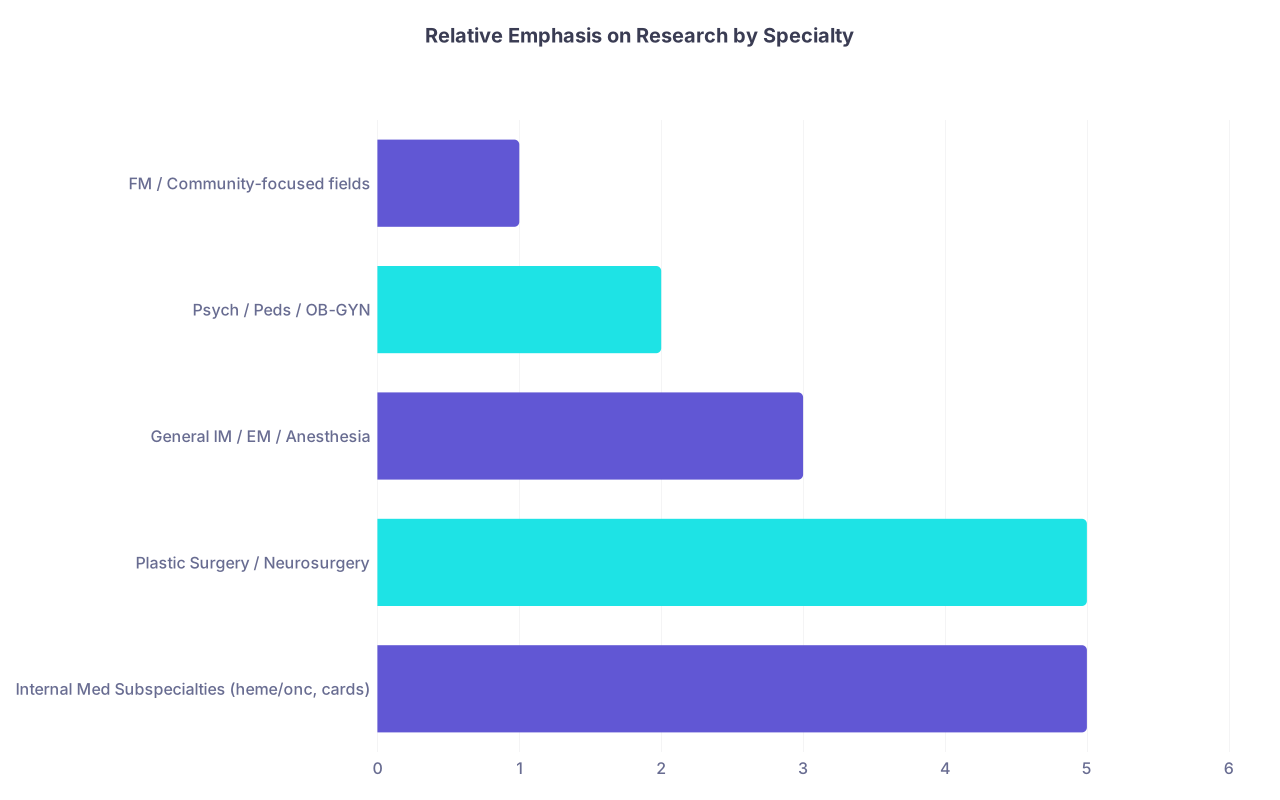
Here is a very rough, honest spectrum of how research-heavy different fields are, from PD eyes:
| Category | Value |
|---|---|
| Internal Med Subspecialties (heme/onc, cards) | 5 |
| Plastic Surgery / Neurosurgery | 5 |
| General IM / EM / Anesthesia | 3 |
| Psych / Peds / OB-GYN | 2 |
| FM / Community-focused fields | 1 |
A few practical points:
Competitive surgical subspecialties (plastics, neurosurg, ENT, ortho)
They like to see:- Multiple outputs in the specialty.
- Early and ongoing involvement.
- Clear mentorship and productivity. Random med ed projects will not carry you here.
Internal medicine aimed at cards/onc/GI/pulm-crit at academic centers
Strong signal:- Outcomes, translational, or clinical trials in your intended subspecialty.
- At least 2–3 abstracts and 1+ manuscripts (submitted/accepted). Pattern matters more than raw count.
EM, anesthesia, general IM at mid-tier academic or solid community programs
Good signal:- Some research, ideally within the field.
- Or strong QI/education work; they want people who can improve systems and teach. Your story can be more method-oriented (e.g., resuscitation protocols, perioperative safety).
Psych, peds, OB-GYN
Variable. Big-name academic departments still care about research. Community-heavy programs may treat research as a nice-to-have.
Coherent interest (e.g., child psych outcomes, high-risk obstetrics QI) stands out.FM and some community programs
They care more about fit, clinical performance, and genuine interest in their patient population.
Research that highlights commitment to underserved care or system improvement can be a plus, but nobody needs a K award plan in FM.
Align your “career story” accordingly. Do not posture as R01-track in a specialty and program type that clearly does not prioritize that path.
Step 9: How to Present Your Portfolio in the Application Itself
The same projects can look very different depending on what you write in:
- Work/activities descriptions.
- Personal statement.
- Supplemental essays.
- Interview answers.
Activities section: stop writing useless blurbs
Bad: “Assisted with data collection for a retrospective chart review of patients with heart failure.”
Better: “Coordinated a retrospective cohort study of 450 heart failure admissions to identify predictors of 30-day readmission. Independently abstracted data, created REDCap instruments, and drafted the results section of the abstract submitted to [conference].”
You are translating “random RA work” into “I understand methods and I took initiative.”
Focus on:
- Your role (described concretely, not vaguely).
- The scope (sample size, time span).
- Outcome (poster, manuscript, internal changes in practice).
Personal statement: one or two projects, deeply
Do not list every project in your personal statement. That is what the CV is for. Pick:
- One flagship project that most directly supports your career story.
- One secondary project if it highlights a different dimension (e.g., teaching, QI).
Tell the story:
- Why you chose the project.
- What you actually did.
- What changed in how you think or what you want long-term.
If you never once mention any of your research in the personal statement, PDs will assume it is ornamental or not that important to you.
Interviews: own your numbers and your gaps
Be prepared with:
- A 60–90 second “research summary” story:
- “Overall, my research has focused on X, with Y methods, under the mentorship of Z.”
- A deep dive on your main project (methods, limitations, next steps).
- A clear bridge to future work:
- “In residency, I would like to continue this work by doing…”
If you have clear gaps, preempt them honestly:
- “I came to research relatively late, so my portfolio is smaller, but this last project really crystallized for me that I enjoy outcomes work, and I plan to expand on that in residency.”
Programs would rather hear that than a defensive, overpolished answer.
Step 10: Design the Next 3–5 Years, Not Just the Application
The whole point of matching your research portfolio to your career story is that you will have to live that story after you match. If your “story” is fake, residency will expose it quickly.
Think in two arcs:
Now → End of Med School
- Finish and disseminate what you have.
- Start 1–2 projects that will carry into intern year or early residency.
- Build relationships with mentors who can advocate for you.
Residency → Early Attending
- What niche do you want to be known for in 5 years?
- What type of institution can realistically support that?
- What training (fellowship, MPH, research track) matches that direction?
A lot of applicants forget that research in med school is more about:
- Showing you can ask questions.
- Showing you can persist.
- Showing you can finish something.
The exact content matters less than whether your trajectory and story feel honest and convergent over time.
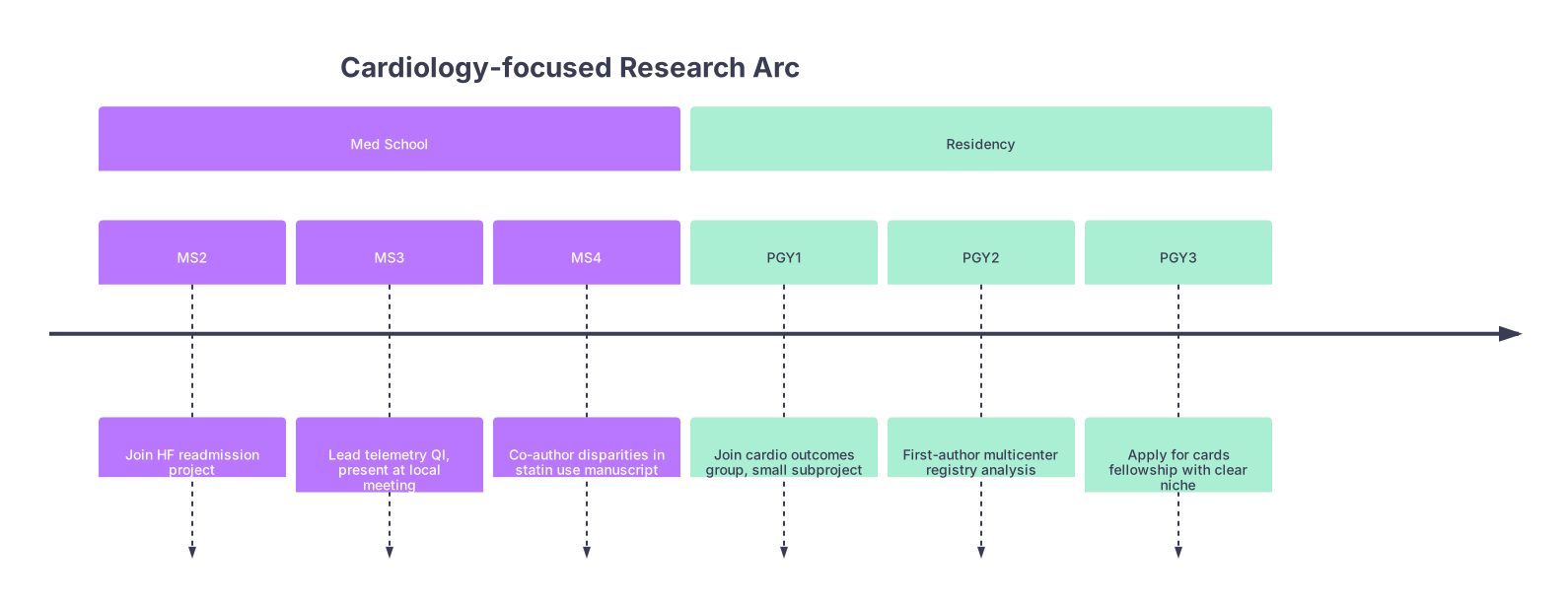
To make this concrete, here is an example of how a sane research arc might look for an IM applicant interested in cardiology:
| Period | Event |
|---|---|
| Med School - MS2 | Join HF readmission project |
| Med School - MS3 | Lead telemetry QI, present at local meeting |
| Med School - MS4 | Co-author disparities in statin use manuscript |
| Residency - PGY1 | Join cardio outcomes group, small subproject |
| Residency - PGY2 | First-author multicenter registry analysis |
| Residency - PGY3 | Apply for cards fellowship with clear niche |
None of this requires you to cure heart failure. It requires you to keep pulling on the same thread.
A Quick Reality Check: Common Mistakes I See
Let me be blunt about a few patterns that hurt otherwise solid applications:
“Random case report collector”
Ten case reports on ten unrelated topics is not a research portfolio. It is a scavenger hunt. One or two are fine, especially early. But they should fade into the background as you build more meaningful work.“Everything is ‘submitted’”
If every project is “submitted” with no clear status or timeline, seasoned readers roll their eyes. They know what that often means. It is better to have fewer real outputs than a graveyard of “submitted” manuscripts never heard from again.“Overclaiming your role”
Saying “co-first author” when you did minor editing, or implying you designed a study you barely understood. People will ask you questions. If you cannot answer basic methodological follow-ups, it looks bad fast.“Incoherent personal statement/CV mismatch”
Saying your passion is “global health in surgery” when your entire portfolio is anesthesia QI in a US tertiary center. You can still be interested in global health, but either show something or frame it honestly as aspirational, not your main identity.
If You Are Starting Late or Have Almost Nothing
You are M4, applying now, and reading this thinking: “Too late.” It is not.
Here is the honest playbook:
Stop pretending you are research-heavy if you are not.
Frame yourself as a clinically-focused applicant who has:- Dabbled in a project or two.
- Learned a few skills.
- Is open to doing more, especially in X area.
Salvage any project for a coherent theme.
- You did a burn unit project in surgery and a peds chronic illness survey? Your theme can be “longitudinal impact of severe illness on patients and families.” Not perfect, but a start.
During interview season, ask about realistic scholarly opportunities in your claimed niche.
- PDs like people who have specific interests even if they are early, as long as you do not posture.
If you have time pre-Match (or even during a research elective), do one small project that clearly aligns with your field and story.
- A narrowly focused chart review.
- A resident-led QI project you help execute and document.
- A simple med ed intervention with pre/post surveys.
Put it on your CV as “ongoing” with precise language about your role and stage.
Key Takeaways
Decide your story first: field + angle (content or method) + believable career endpoint. Then shape your research portfolio to support that, not the other way around.
Coherence beats volume. A small number of well-aligned, well-understood projects in your specialty or niche is stronger than a long list of unrelated case reports.
You do not need to be a future R01 investigator, but you do need your claimed ambitions to match your actual body of work. Design your portfolio—and how you present it—so that programs can see a clear, honest trajectory they would be comfortable investing in.