
25–35% of U.S. MD seniors match in the exact same metropolitan area where they went to medical school.
For all the talk about “being open geographically,” a large minority of people never actually leave home base. And once you zoom out to region instead of city, the percentages get even more lopsided.
Let me walk through what the data shows about geographic preference and match outcomes—and what that means for how you play the game.
The Reality: Most People Do Not Go Far
The NRMP does not care about your wanderlust. It cares about data. And the data are blunt.
Multiple NRMP and AAMC analyses over the past decade converge on a few consistent patterns (numbers vary slightly by year, but the structure holds):
- A majority of U.S. MD seniors match in the same census region as their medical school (Northeast, Midwest, South, West).
- A substantial chunk stay in the same state.
- A meaningful minority never leave the city.
To put structure on this, let us look at a reasonable, representative breakdown based on aggregated patterns from NRMP/AAMC reports and large school-specific outcomes.
| Level of retention | Approximate share of matched seniors |
|---|---|
| Same city / commuting metro area | 25–35% |
| Same state (including same city) | 45–60% |
| Same census region | 65–80% |
| Different region (true relocation) | 20–35% |
These are broad ranges across specialties and schools. But the story is clear: staying “local-ish” is the default, not the exception.
Programs know this. They assume it. A PD once told me point blank: “If you have five ties to this city and say you’re ‘open to new regions,’ I treat that as ‘you’re trying to stay.’”
So the question is not whether geographic preference matters. It is how it interacts with your odds.
How Geography Affects Match Probability
You care about probability. “Does signaling I want to stay local help me match here?” “If I want to move coasts, does that hurt me?” Let us quantify what is actually going on.
Home-region vs out-of-region odds
Across big NRMP outcomes data and school-level match lists, a consistent pattern emerges:
- Matching within the same region vs out of region often shows an odds ratio somewhere in the 1.5–2.5 range in favor of staying within region for many core specialties (IM, peds, FM, psych, OB/Gyn).
- That effect is stronger in:
- Less competitive applicants (lower class rank / no AOA / average Step 2)
- Community-focused specialties (FM, IM, peds)
- Regions with dense program networks (Northeast, Midwest)
Translated into simple terms: if you are an average-strength applicant, your chance of matching somewhere in your region is meaningfully higher than your chance of matching somewhere of equivalent competitiveness out of region, all else equal.
For highly competitive applicants (top quartile, great letters, strong research), the regional penalty nearly disappears. They can move coasts much more freely.
“Home” programs vs “away” programs
There is also the specific “home program” effect.
Across specialties, home med students are:
- Disproportionately represented in residency classes relative to their share of the national applicant pool.
- Especially favored in primary care and internal medicine, less so in ultra-competitive fields but still present.
Many internal medicine or pediatrics programs will have 20–50% of their intern class from their own medical school. Some state schools run higher.
Why? The data behind decisions:
- Lower risk: faculty already know your work ethic.
- Lower attrition probability: home students are more likely to stay in the area, have local support networks, and less likely to quit/transfer.
- Transaction cost: programs do not need to interpret “fit” from a 30-minute interview—they have 2–4 years of direct observation.
So if you are at a school with a solid home residency and you want to stay, data are on your side. If your home program is weak or non-existent in your desired specialty, you lose a major geographic advantage.
Who Actually Stays Local? Patterns by Specialty and Profile
Now to the more precise question: who stays local? It is not random. There are clear patterns by specialty, competitiveness, and life stage.
1. Specialty differences: local vs mobile fields
Let us categorize some broad specialties by their tendency to keep people close.
| Specialty group | Tendency to stay local (region) | Comments |
|---|---|---|
| Family medicine | Very high (70–85%) | Strong state/regional workforce link |
| Internal medicine (categorical) | High (65–80%) | Lots of home + regional matches |
| Pediatrics | High (65–80%) | Similar to IM, slightly more mobile |
| Psychiatry | Moderate-high (60–75%) | Regional but more coastal shifts |
| OB/Gyn, General Surgery | Moderate (55–70%) | More cross-region for name programs |
| EM, Anesthesiology | Moderate (50–65%) | Fairly mobile, but still regional |
| Highly competitive (Derm, Ortho, etc.) | Mixed (40–65%) | Strong programs pull from everywhere |
Those ranges are approximate, but the ranking is solid. Primary care and internal medicine are the most geographically sticky.
I have read through dozens of school match lists that look almost absurdly local in FM and IM: half the class in-state, many in the same two or three metro areas.
In contrast, anesthesiology and EM show a more scattered pattern—people moving coasts, especially to big-name academic centers or lifestyle-friendly metros.
2. Applicant profile: strong vs average vs marginal
Geography interacts with strength of application. You can think of three broad strata.
Top-quartile applicants (great scores, honors, strong research):
- Much higher mobility.
- More likely to leave region for brand-name institutions.
- Still, many choose to stay local for family, cost of living, relationships.
Data-wise, these applicants are “geography optional.” They are not forced to stay.
Middle-of-the-pack applicants:
- Geographic ties matter the most here.
- Odds of interview offers get a noticeable bump at:
- Home programs
- State schools
- Regions where they have strong ties (college, family, long-term residence)
If you are in this group and you do not signal or explain any regional connection, your application often looks “riskier” to programs that assume you might not rank them highly.
Marginal applicants:
- Geography is sometimes the only major plus they have.
- Programs that are struggling to fill or are less competitive often lean heavily on locals because they are more likely to stay in the area post-residency.
- I have seen FM programs that practically function as “regional workforce pipelines,” with >80% local or in-state residents.
In other words, the weaker your paper stats, the more geographic alignment becomes a critical lever.
How Programs Actually Interpret Your “Preference”
Programs are not reading tea leaves. They are pattern-matching. They use a few crude but powerful proxies to infer geographic preference and likelihood of ranking them highly.
Proxies that scream “local preference”
From repeated PD and resident comments, here are the big flags that you want to be (or are stuck) local:
- Medical school in the same city or state
- Undergraduate in the same state
- Family explicitly mentioned in the region
- Long-term address history in the area
- Multiple rotations or away rotations in the same city/region
- A personal statement that anchors your identity to that city/region
If they see 3+ of those, they assume you are a “geographic fit” unless you explicitly say otherwise.
Signals that you are geographically flexible
Programs infer you are more mobile when they see:
- Education spread across multiple regions (e.g., undergrad in the Midwest, med school in the West, now applying to the East)
- Prior military or partner’s career that involved relocations
- Multiple away rotations across distant regions instead of clustering in one
What matters is consistency. If you say in your interview, “I really want to be near family in Texas,” but you applied heavily to the Northeast with no Texas apps, programs notice the inconsistency. And usually discount your stated preference.
Data-Driven Strategy: How To Use (or Break) Geographic Gravity
Now the practical question: how should you use this if you want to stay local—or if you want to leave?
I will break it into two scenarios.
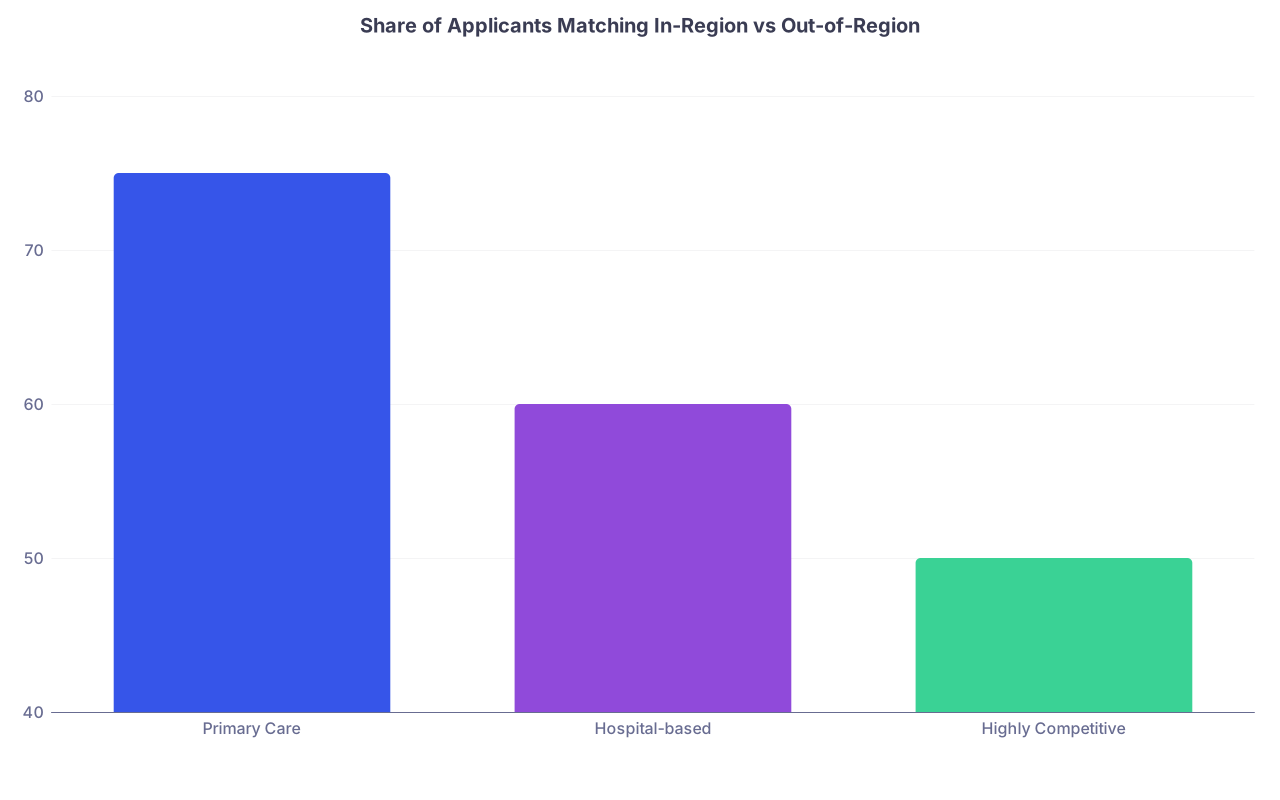
| Category | Value |
|---|---|
| Primary Care | 75 |
| Hospital-based | 60 |
| Highly Competitive | 50 |
Scenario 1: You Want To Stay Local
If your goal is to stay in your current city or region, data are on your side. But only if you play it correctly.
1. Maximize your “home field” advantage
The data show a clear home-program advantage, especially in IM, peds, psych, FM.
You should:
- Make yourself known to your home department early (M3, early M4).
- Do rotations with potential letter writers who are respected in that department.
- Attend conferences, grand rounds, resident teaching sessions. Be visible.
Every hour you spend building a reputation at your home program yields more ROI than generic “networking” at faraway places.
2. Build a clearly regional application footprint
Programs like to see that your choices make sense.
Typical strong local profile:
- Med school in-state.
- At least one away rotation in the same state or neighboring state.
- Majority of applications targeted to local/neighboring states and region.
- Personal statement with a coherent story about roots, family, community, or long-term commitment to the area.
Programs literally sit in meetings saying things like, “She is from here, she went to school here, her family is here—she is likely to stay.” That is how they think.
3. Do not assume “local” is enough if the program is very competitive
There is a myth that being local is some golden ticket at top-20 name programs. It is not.
The home-field bump is real, but it does not erase large gaps in objective metrics. If you are substantially below a tier-one program’s typical Step 2 or class-rank profile, local ties help, but not enough to drag you over the line alone.
So if your #1 choice is:
- A highly ranked academic IM program in a major metro
- Or a competitive specialty at the big flagship in your city
You still need the basics: solid scores, strong letters, real clinical performance. “But I am local” will not rescue a weak file.
Scenario 2: You Want To Leave (Different Region, New City)
Here is where applicants sabotage themselves. They say “I want to move to the West Coast” but structure their application in a way that screams, “I probably will not rank you highly.”
1. Understand your baseline odds
If you are average-strength for your specialty, you should assume that your in-region probability is materially higher than your out-of-region probability.
That does not mean you cannot move. It means you cannot be casual.
For example, if:
- Your Step 2 is around the national mean for your specialty.
- You have solid but not spectacular letters.
- No major red flags.
Then your chances at an average California or Northeast program with no ties are simply lower than at a similar program in your current region that sees you as a plausible “long-term” resident.
So if you are fixed on leaving:
- You need to over-apply to the target region.
- You likely need more interview volume there than you would locally to get the same match probability.
2. Manufacture real geographic ties
Programs are skeptical of “I just love the city” with no evidence. You can create some data points:
Do an away rotation in the target region.
One month in Seattle or Boston is a strong signal: “I spent actual time here and still want to come.”Use personal relationships strategically.
If you have a partner, spouse, or close family in that region, say it clearly. PDs respond to this because it predicts stability.Align your application footprint.
If 70–80% of your applications are still in your current region and a handful in your “dream” region, you are signaling that the dream region is aspirational but not committed. Programs read that.
3. Avoid screaming “flight risk”
Programs do not want to be the safety you rank 14th behind 13 local options.
Red flags from a PD’s perspective:
- You applied to a tiny handful of programs in their region while blanketing another region with applications.
- Your personal statement is loaded with language about “serving my home community in X” when X is not their region.
- You have deep, obvious ties to another place (house, kids in school, spouse in a highly location-bound job) with no explanation for why you would move.
You can fix this with coherent narrative:
- If you are moving for a partner’s job, say that.
- If you want a certain climate or practice style that is uniquely associated with that region, say that.
- If your long-term goal is academic medicine and this region’s programs fit that better, articulate it.
It will not fully equalize your odds with a local, but it will bring you into a realistic range.

| Step | Description |
|---|---|
| Step 1 | Applicant Profile |
| Step 2 | High Mobility |
| Step 3 | Geography Matters More |
| Step 4 | Emphasize Local Ties |
| Step 5 | Build New Region Ties |
| Step 6 | Home & Regional Programs |
| Step 7 | Aways, Coherent Narrative |
| Step 8 | Strong or Average? |
| Step 9 | Wants to Stay Local? |
Common Misconceptions About Geography and Matching
Let me cut through a few bad takes I hear every year.
“If I apply broadly, geography will not matter.”
Wrong. Programs still use geography as a tie-breaker, especially below top-tier applicants. Applying to 80 programs does not magically erase the local bias.“Programs do not care where I am from; they just want the best student.”
Also wrong. Even elite programs routinely discuss “fit,” stability, and long-term likelihood of staying in the area. Community-facing and primary care programs are explicit about this.“If I do an away rotation, that guarantees interest from that region.”
No. An away is a signal, not a ticket. But your odds of a serious look go up sharply when you have a positive, well-documented month in that region.“If I say I am willing to move anywhere on my personal statement, that proves I am flexible.”
Programs believe your behavior (education, rotations, application distribution) more than your prose. Data > declarations.
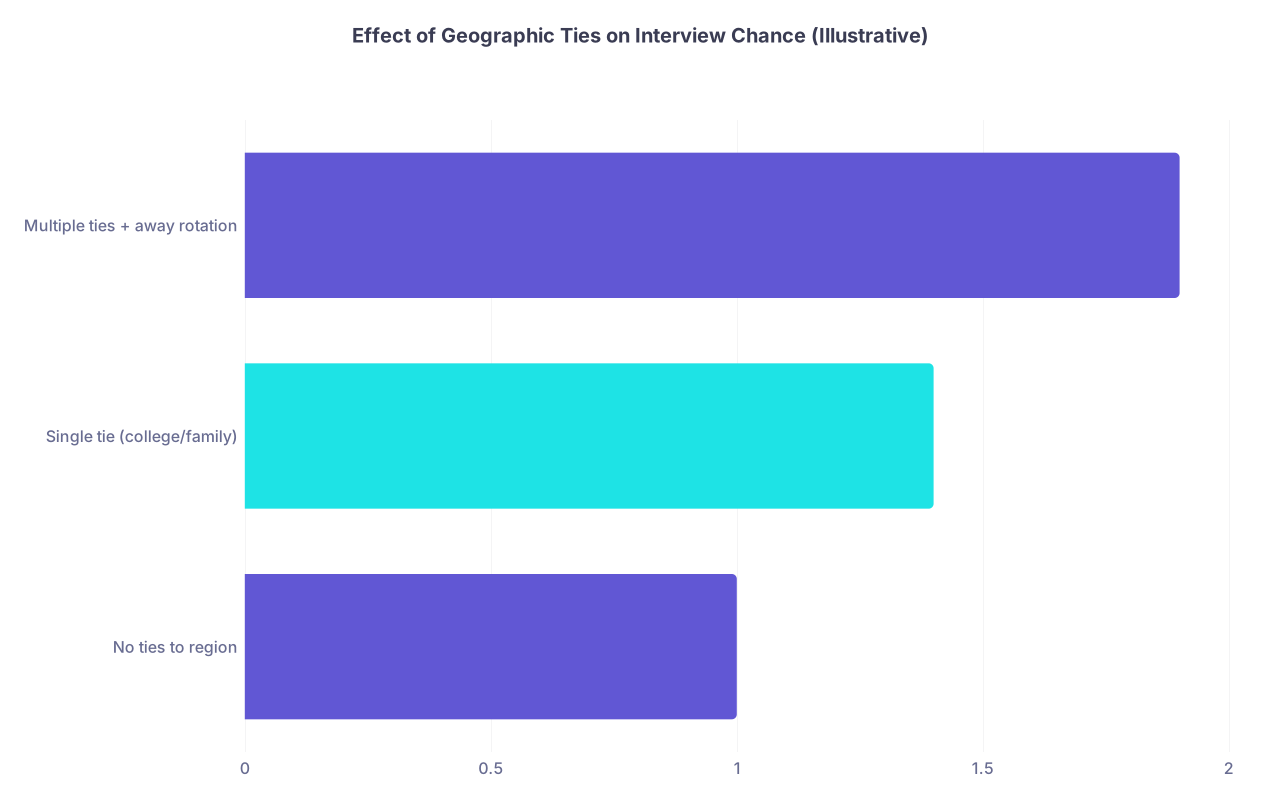
| Category | Value |
|---|---|
| No ties to region | 1 |
| Single tie (college/family) | 1.4 |
| Multiple ties + away rotation | 1.9 |
(Indexed odds ratio: 1.0 = baseline applicant with no ties; 1.4 = 40% higher relative odds of interview)
These relative effects are stylized, but they match conversations with PDs and published analyses: multiple, coherent geographic ties routinely move you from the maybe pile to the interview list.
Bottom Line: Who Actually Stays Local?
If you strip out the noise and just look at patterns, three clear groups emerge:
Locals by inertia
- Primary care, IM, peds, psych applicants with average stats.
- Strong home and state programs.
- They match close to home because every force pushes that way.
Locals by choice
- Competitive applicants who could leave but stay for family, cost of living, or institutional loyalty.
- Highly common in residents with spouses/kids and those buying early into a city’s lifestyle.
Mobile by necessity or ambition
- Applicants from regions with few programs in their specialty.
- People chasing specific program reputations, research niches, or lifestyle cities.
- Often stronger applicants, or those whose home region cannot absorb them.
The data are unambiguous: geography does not decide your fate, but it bends the probability curve. Hard.
If you want to work with that curve instead of against it, your strategy is simple:
- Align your stated preferences with your actual application behavior.
- Use home and regional ties aggressively if you want to stay.
- Create real, documentable ties if you want to move.
Three key points and then I am done:
- Most residents stay in their region; a large minority stay in their exact metro.
- Home and regional ties raise your odds, especially if you are not in the top tier of applicants.
- Programs believe your pattern of choices more than your words—structure your aways, applications, and narrative so the data about you tell the story you want.