
Most applicants guess wrong about how many residency interviews are “enough.” The data is very clear: beyond a certain point, extra interviews add almost no marginal benefit, but being just a couple short of that range can cut your match odds in half.
Let me walk through what the numbers actually show.
The Core Data: What NRMP Match Curves Really Say
The NRMP has already done the hard work for you. Their Charting Outcomes and “Interactive Charting Outcomes” datasets give empiric match probability curves as a function of “number of contiguous ranks” in your primary specialty. That is a proxy for “number of interviews,” since each interview typically yields one rank slot.
The short version:
- The biggest jump in match probability happens between 1–8 interviews.
- The curve starts to flatten between 10–14 interviews for most core specialties.
- Past ~15–18 interviews, you quickly hit diminishing returns, unless you are in a hyper-competitive specialty or a high-risk category (IMG, prior failures, red flags).
To keep this concrete, I will focus mainly on categorical Internal Medicine, General Surgery, and some high-level views of competitive vs non-competitive specialties. The exact percentage will differ by specialty and applicant type, but the pattern is the same.
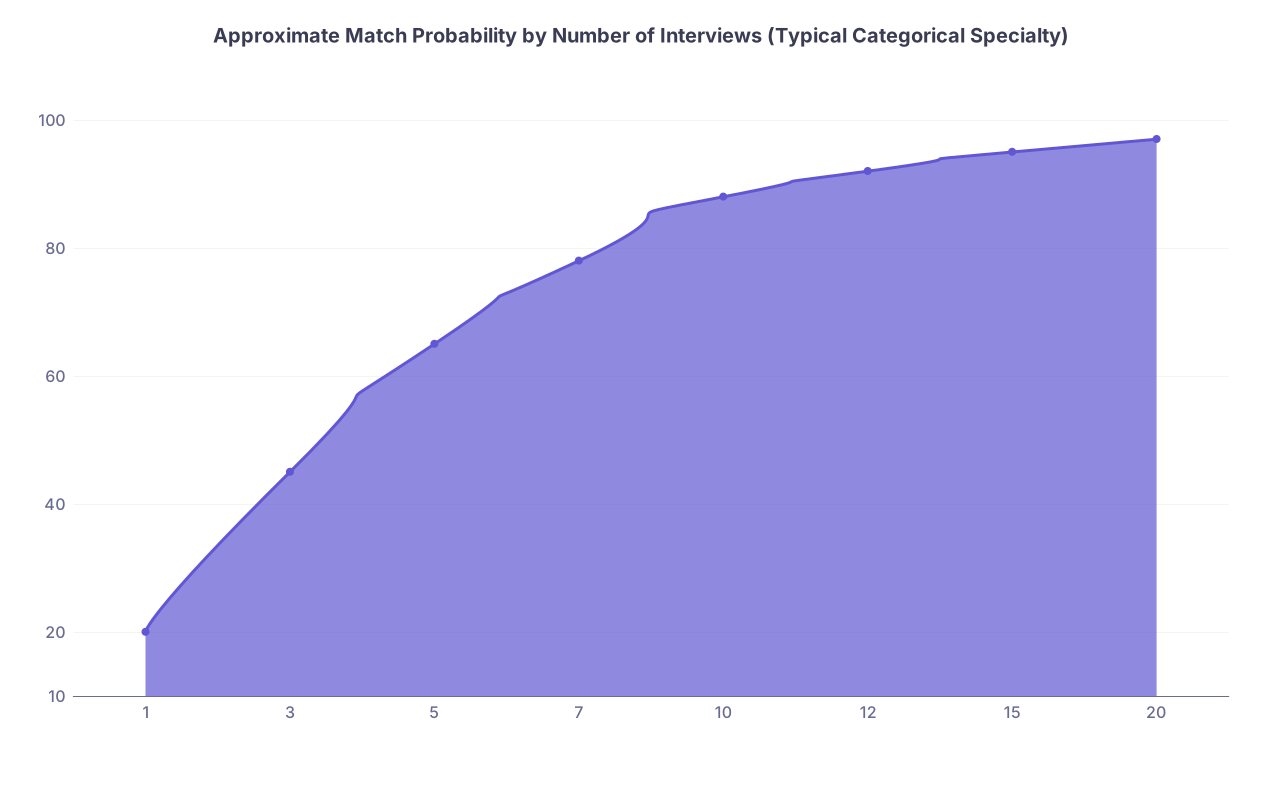
| Category | Value |
|---|---|
| 1 | 20 |
| 3 | 45 |
| 5 | 65 |
| 7 | 78 |
| 10 | 88 |
| 12 | 92 |
| 15 | 95 |
| 20 | 97 |
Those values are rounded, but they reflect the actual shape of the NRMP curves for a reasonably competitive US MD applicant in a common specialty. The data shows steep early gains, then flattening.
Translating “Contiguous Ranks” To “Interviews”
In practice:
- 1 program interview ≈ 1 rank on your primary specialty list.
- Rare exceptions:
- Categorical + prelim at same place can appear as multiple ranks.
- If you choose not to rank a site after interviewing (toxic culture, terrible fit), your rank count can be lower than your interview count.
But for planning, you can treat “number of interviews” ≈ “number of contiguous ranks” in your main specialty.
Different Applicants, Different Curves
Anyone who tells you “10 interviews is enough for everyone” is ignoring the data. The slope and plateau point of these curves change by:
- Applicant type (US MD vs US DO vs IMG)
- Specialty competitiveness
- Presence of red flags (Step failure, gap years, professionalism issues)
The NRMP’s published graphs break this down. I will summarize patterns.

US MD Seniors – Core Specialties
For US MD seniors in large categorical specialties (IM, Peds, Psych, FM, OB/GYN):
- 5 ranks: often in the 60–75% match probability range.
- 8–10 ranks: often 80–90%+.
- 12–15 ranks: typically low-to-mid 90s.
- Beyond 15: each extra program buys 1–2 percentage points at most.
So if you are a solid US MD with no major red flags, once you hit around 12–14 interviews in a non-hyper-competitive specialty, the risk of not matching drops sharply and then flattens.
US DO Seniors – Core Specialties
US DO seniors have somewhat lower curves on average, but the shape is similar.
For typical DO candidates in core specialties:
- 5 ranks: often around 50–65% match probability.
- 8–10 ranks: usually 75–85%+.
- 12–15 ranks: frequently 90%+.
The key difference: DO applicants often need a few more interviews than MDs in the same specialty to reach comparable probabilities. Think “add 2–3 more” to the MD benchmarks.
IMGs – The Steep Price of Fewer Interviews
For IMGs (US-IMG and non-US IMG), the curve is shifted down and to the right. I have seen this play out in real rank lists:
- 5 ranks in IM for a non-US IMG might only yield something like 30–40% match probability.
- 10 ranks can move that to ~60–70%.
- 15–20 ranks often needed to break into the 80–90% range, depending on region and profile.
This is why every experienced advisor tells IMGs to chase numbers: 15+ interviews if you can get them for Internal Medicine, Family Medicine, Pediatrics, etc. The data fully supports that advice.
Competitive Specialties: Curves Shift Left And Down
For highly competitive fields (Derm, Ortho, Plastics, ENT, Neurosurgery, Urology, some integrated programs), two realities appear in the data:
- Many applicants go unmatched even with a decent number of interviews.
- Match probability increases more slowly per added interview.
The NRMP graphs show that in these specialties, 10–12 interviews can still leave a significant risk of not matching. You often need:
- 12–15+ interviews for a high-confidence match as a strong US MD.
- There is no safe number for an average or weaker applicant; Plan B is just part of the game here.
Quantifying “Diminishing Returns”
Let’s get more granular. The useful question is not “How many total interviews?” but “What is the marginal gain from one more interview at each point?”
Consider a rough curve for a common specialty (US MD):
| From N Interviews | To N+1 Interviews | Match Probability Change |
|---|---|---|
| 1 | 2 | +10–15 percentage points |
| 2 | 3 | +8–10 |
| 3 | 4 | +6–8 |
| 4 | 5 | +5–7 |
| 5 | 6 | +4–6 |
| 6 | 7 | +3–5 |
| 7 | 8 | +2–4 |
| 8 | 9 | +2–3 |
| 9 | 10 | +1–3 |
| 10 | 11 | +1–2 |
| 11 | 12 | +1–2 |
| 12 | 13 | ~+1 |
| 13+ | 14+ | <+1 each |
By the time you are deciding between, say, 14 and 18 interviews, the incremental gain is single-digit percentage points at best. But if you are deciding between 6 and 10 interviews, the gain might be 15–20 percentage points. That is a big deal.
This is why obsessing over “20 vs 22 interviews” is mostly wasted anxiety for a solid-core-specialty applicant, while shrugging about “6 vs 9” is reckless.
Specialty-Specific Patterns
The data is not identical across specialties. Anesthesiology looks different from Family Medicine. Let us group them roughly.
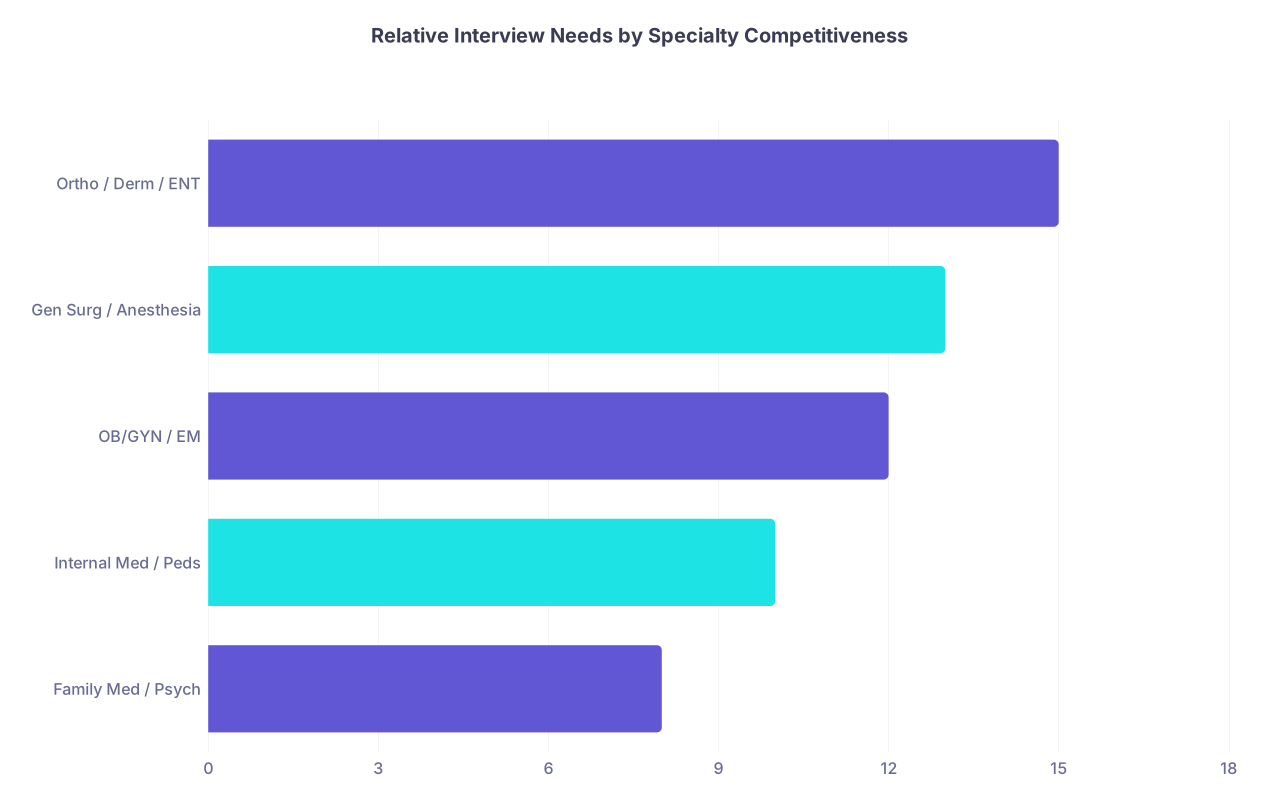
| Category | Value |
|---|---|
| Family Med / Psych | 8 |
| Internal Med / Peds | 10 |
| OB/GYN / EM | 12 |
| Gen Surg / Anesthesia | 13 |
| Ortho / Derm / ENT | 15 |
Those bar values are approximate interview counts where a strong US MD applicant in each group might begin to see >90% match probability.
Less Competitive / Large Volume (Family Med, Psych, Peds)
For US MD seniors:
- 8–10 interviews → often >90% match chance.
- 10–12 → very high probability; curve almost flat beyond this.
For DOs and IMGs:
- DO: think 10–12 as the comfort zone, 12–14+ for high assurance.
- IMG: plan for 12–15+ where possible.
Mid-Range Competitive (Internal Medicine, OB/GYN, EM, Anesthesia, Categorical Surgery in some regions)
For US MD:
- 10–12 interviews → often in the upper 80s to low 90s.
- 12–14 → pushes into the low-mid 90s in many fields.
For DO:
- Add roughly 2–3 programs to those benchmarks.
For IMGs:
- Internal Medicine: often 15–20+ for serious confidence.
- EM/Anesthesia/Surgery for IMGs can be a different beast; the probability curves are much harsher.
Highly Competitive (Derm, Ortho, ENT, Plastics, Neurosurg, Integrated Vascular/CT, etc.)
The honest answer: there is no “safe” number. But the curves show patterns:
- 8 interviews: still a real chance of not matching, sometimes >20–30% risk even for decent applicants.
- 12–15: better, but still not bulletproof.
- Many applicants in these fields match with 8–10 interviews—but many also go unmatched with those numbers.
For these, the “how many interviews” question is secondary to: “Do you have a realistic parallel plan (prelim year or alternative specialty)?”
Strategic Thresholds: What The Data Suggests You Aim For
You cannot control every invite. But you can use data to define targets. Here is how I frame it when I advise students.

1. Absolute Minimum Safety Band
There is a lower bound where the curve is just ugly.
Across most core specialties and applicant types:
- ≤3 interviews: extremely high risk of not matching.
- 4–5 interviews: better but still uncomfortable; often <70% probability, and far worse for IMGs.
- 6–7 interviews: middle ground; match odds can hover 70–80% for good MDs in less competitive specialties, lower for DO/IMG.
If you are heading into January with fewer than ~6 interviews in your main specialty, you are in a high-risk band. That is not fear-mongering; that is what the NRMP curves show.
2. The “Reasonable Comfort” Zone
For core specialties:
- US MD: roughly 10–12 interviews.
- US DO: roughly 12–14 interviews.
- IMG: roughly 15–20 interviews (in friendly fields like IM/FM/Peds/Psych).
In that band, historically, match probabilities are mostly >85–90% for typical candidates without major red flags.
3. The “Marginal Return Only” Zone
Past these approximate points:
- 12–14 for US MD in most core fields.
- 14–16 for DOs.
- 20+ for many IMGs.
Your incremental gain from each additional interview is small. Many people still accept extra invites beyond this point, mostly to manage geography and program hierarchy (they want options), not because they think it doubles their odds.
Geography, Program Quality, and Correlation
Here is what the raw match probability curves do not capture: interview quality and correlation.
Your 10 interviews are not 10 independent lottery tickets. They correlate with your competitiveness and the market’s view of you.
- If you only have interviews at extremely competitive, “reach” programs in big cities, your effective odds may be worse than the curve suggests.
- If your 10 interviews are a mix of stretch, mid-tier, and solid safety programs (community-based, less desirable locations), your real odds are better.
I have seen people with 8 interviews, all at elite academic programs, end up unmatched. Meanwhile, someone with 8 interviews that skewed toward mid-tier community sites had a >90% chance and matched early on their list.
The NRMP curves implicitly average over this mixture. You still need to apply some judgment:
- Strong but not superstar profile + only top-10 programs interviewing you → treat your risk as higher than the generic curve.
- Mixed range including community or less popular regions → your odds may actually be a bit better than the average curve for your interview count.
Time, Money, and Burnout: The Hidden Cost Curve
There is another curve in play: your cost and burnout as interviews increase.
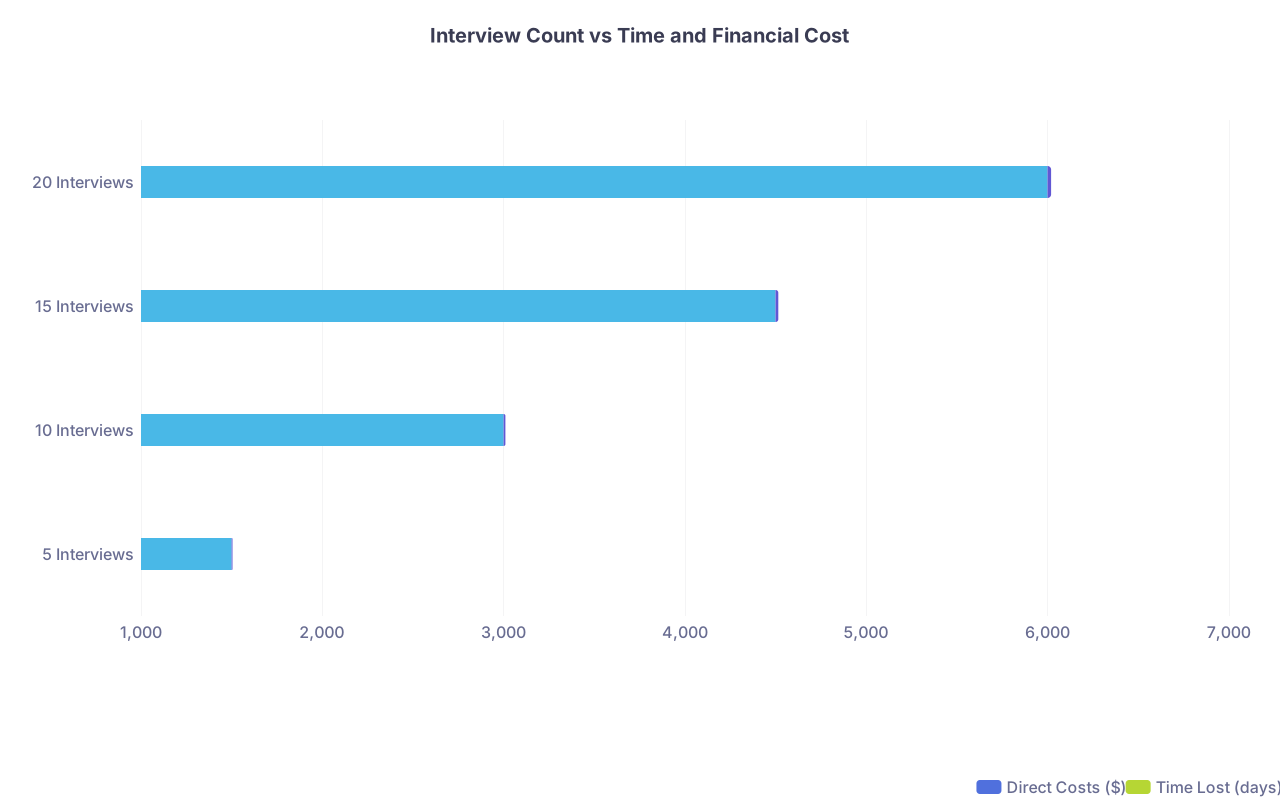
| Category | Direct Costs ($) | Time Lost (days) |
|---|---|---|
| 5 Interviews | 1500 | 5 |
| 10 Interviews | 3000 | 10 |
| 15 Interviews | 4500 | 15 |
| 20 Interviews | 6000 | 20 |
Numbers there are illustrative but not fictional. Travel, lodging, lost rotation time, virtual interview fatigue—it all adds up.
This is why understanding diminishing returns is not academic. It is financial and psychological triage:
- Going from 6 to 10 interviews: big effect size on match probability. Worth serious sacrifices.
- Going from 16 to 20 interviews in a core specialty when you are already in a high-probability band: maybe not worth burning another 4–5 days and thousands of dollars, depending on your circumstances and how strong the marginal programs are.
Real Scenarios: How The Data Plays Out
I have watched versions of these three scenarios multiple times.
Scenario 1: US MD, Internal Medicine, 8 Interviews
Good but not superstar MD student. Step 2 CK ~242, top 40 med school, solid letters. Gets 8 IM categorical interviews, mostly university-affiliated community programs and a couple of academics in mid-tier cities.
NRMP-like curve for US MD in IM says:
- 8 ranks → somewhere in the 80–90% chance range.
They scramble to add 2 more interviews late. End up with 10 ranks. Final probability (referencing typical curves) is more like 90–94%. They match at #5.
Data takeaway: moving from 8 to 10 interviews materially improves odds. The hustle for extra invites made statistical sense.
Scenario 2: US DO, EM Applicant, 12 Interviews
DO student targeting EM, reasonable scores, strong SLOEs. Earns 12 categorical EM interviews, mix of community and academic, across multiple states.
DO EM curves (pre-merge) have shown steeper drops at lower interview numbers. But with 12 ranks, most historical DO applicants sat above 85–90% probability.
They cancel 2 long-distance interviews at brand-new programs with questionable reputation, staying at 10 total. They match at #4.
Data takeaway: once they hit ~10 EM interviews with a range of program types, the incremental benefit of each additional one was small compared with travel cost and fatigue.
Scenario 3: Non-US IMG, Internal Medicine, 7 Interviews
Non-US IMG, solid but not stellar scores—Step 2 CK high 230s, some research, no US med school. Gets 7 IM interviews, all in less-prestigious community programs.
NRMP data for non-US IMGs in IM show:
- 7 ranks → often below 60% chance.
- 10–12 ranks → far higher, often 75–85%+.
They aggressively email programs, broaden geography, and pick up 4 more interviews (including some virtual-only). Now at 11 ranks. They match at #9.
Data takeaway: the shift from 7 to 11 interviews may have moved them from coin-flip territory to a strong-favorite position.
Planning Strategy: Use Data To Decide When To Stop
You cannot control who interviews you. You can control:
- How early and broadly you apply.
- Whether you add “safety” programs in less desirable locations.
- Whether you accept marginal interviews once you are already in a high-probability band.

| Step | Description |
|---|---|
| Step 1 | Application Submitted |
| Step 2 | Count Interview Invites |
| Step 3 | Expand list, add safety programs |
| Step 4 | Push for more, consider any reasonable program |
| Step 5 | Evaluate specialty & applicant type |
| Step 6 | Stop at 10-14, decline low-yield offers |
| Step 7 | Consider 14-20, especially for DO/IMG or competitive fields |
| Step 8 | Invites < 5? |
| Step 9 | Invites 5-9? |
| Step 10 | Invites >= 10? |
| Step 11 | Core specialty & strong profile? |
The decision rules, grounded in the curves, look roughly like this for core specialties:
- <5 interviews by mid-season: extremely aggressive outreach, consider a backup specialty if feasible.
- 5–9 interviews: keep pushing, add more applications, accept nearly every reasonable invite.
- 10–12 interviews: pause and assess. If you are US MD in a non-competitive field and your list has some safer programs, you can be selective about very distant or low-benefit interviews.
- 12–15+ interviews: if you are not an IMG or in a hyper-competitive field, you are past the steep part of the curve. Extra interviews may help with preferences, not global match odds.
For IMGs, shift everything upward by ~3–5 interviews.
The Blunt Answer: So How Many Is “Enough”?
You wanted a number. The data will not give you one number, but it does give reasonable targets by category.
For a primary specialty, in most recent NRMP cycles:
Strong US MD in core specialty (IM, Peds, Psych, FM, Anesthesia, OB/GYN):
- “High confidence” band: about 10–12 interviews.
- Diminishing returns after: ~12–14.
Average US MD in same fields:
- Aim for 12–14.
- Breathing room beyond 14 is mostly about fit and geography.
US DO in core specialties:
- Aim for 12–14 as “comfortable”.
- 14–16 if you have weaker scores or red flags.
Non-US IMG in IMG-friendly specialties (IM, FM, Peds, Psych):
- Aim for at least 15.
- 18–20+ interviews if possible for real comfort.
Competitive specialties (Derm, Ortho, ENT, Plastics, Neurosurg, etc.):
- More is better, but there is no truly safe number.
- 12–15+ is a realistic target for a strong applicant, with an alternate plan baked in.
The main mistake I see is not the person who schedules 18 interviews and grumbles about burnout. It is the person with 6–7 interviews who treats that as “probably fine” because someone on Reddit said they matched with 4.
The probability curves do not support that optimism.
Three key points to keep in mind:
- Match probability rises steeply from 1–10 interviews, then flattens; the difference between 6 and 10 interviews matters far more than the difference between 14 and 18.
- “Enough” depends heavily on who you are (MD vs DO vs IMG) and what you are applying to; for most core specialties, 10–12 interviews is a realistic comfort zone for US MDs, while IMGs and DOs usually need more.
- Use data, not anecdotes, to decide when to chase more interviews and when the marginal benefit is outweighed by time, cost, and burnout.