
The most dangerous myth in residency applications is that bigger programs automatically mean better match odds. The data does not support that. Volume and probability are not the same thing.
If you treat “large program = safer, small program = risky” as truth, you are misunderstanding how the Match actually behaves. And you are very likely misallocating your applications.
Let’s walk through what the numbers say when you stop guessing and start doing the math.
1. What “Program Size” Really Means In the Match
Program size is not about prestige. It is a simple count: how many categorical or advanced positions a program offers per year.
Rough cut:
- Small: 1–5 residents per year
- Medium: 6–15 residents per year
- Large: 16+ residents per year (many big IM, Peds, EM, Psych programs)
But sheer seat count is useless without context. You care about:
- How many people apply
- How many actually get interviews
- How far down the rank list the program goes
- How your own profile compares to the typical matched resident
Here is a simple structural comparison:
| Size | Positions/Year | Typical Interview Slots | Typical Rank List Length |
|---|---|---|---|
| Small | 1–5 | 15–60 | 20–80 |
| Medium | 6–15 | 60–200 | 80–250 |
| Large | 16–40+ | 150–400+ | 200–600+ |
The core point: large programs expand everything—seats, interview slots, rank list length. That does not automatically translate into better individual odds unless you see applicant volume and selectivity alongside it.
2. The Math: Why “More Seats” Can Be Misleading
Think like a statistician, not like a panicked MS4. Your question is not “Is this a big program?” but “What is my conditional probability of matching here given my profile?”
We almost never have perfect program-level public data, but we can understand the dynamics with reasonable models.
Say:
- Program A (small) has 4 categorical spots.
- Program B (large) has 24 categorical spots.
Now layer on applicants and interviews:
- Program A receives 600 applications, interviews 50, ranks 70.
- Program B receives 3,000 applications, interviews 300, ranks 400.
If you get an interview, your rough, naive “per-invite” odds look like this:
- Program A: 4 positions / 50 interviewees ≈ 8%
- Program B: 24 positions / 300 interviewees ≈ 8%
Same ballpark. Different scale, similar conditional odds.
That is the piece students routinely miss. Once you are at the interview, large and small programs often have comparable per-invite match odds, because both design their interview volume and rank lists around their seat count and historic fill.
Here’s a stylized comparison:
| Program Type | Positions | Interviews | Rough Per-Invite Odds |
|---|---|---|---|
| Small | 4 | 50 | 8% |
| Medium | 10 | 110 | 9% |
| Large | 24 | 300 | 8% |
The data story: interview odds and interview quality shift more than raw seat count.
3. Acceptance Rates: Small vs Large Programs
Let me quantify how “safety” actually behaves when you move across program sizes. We cannot scrape ERAS, but internal program stats and NRMP charts give very consistent patterns.
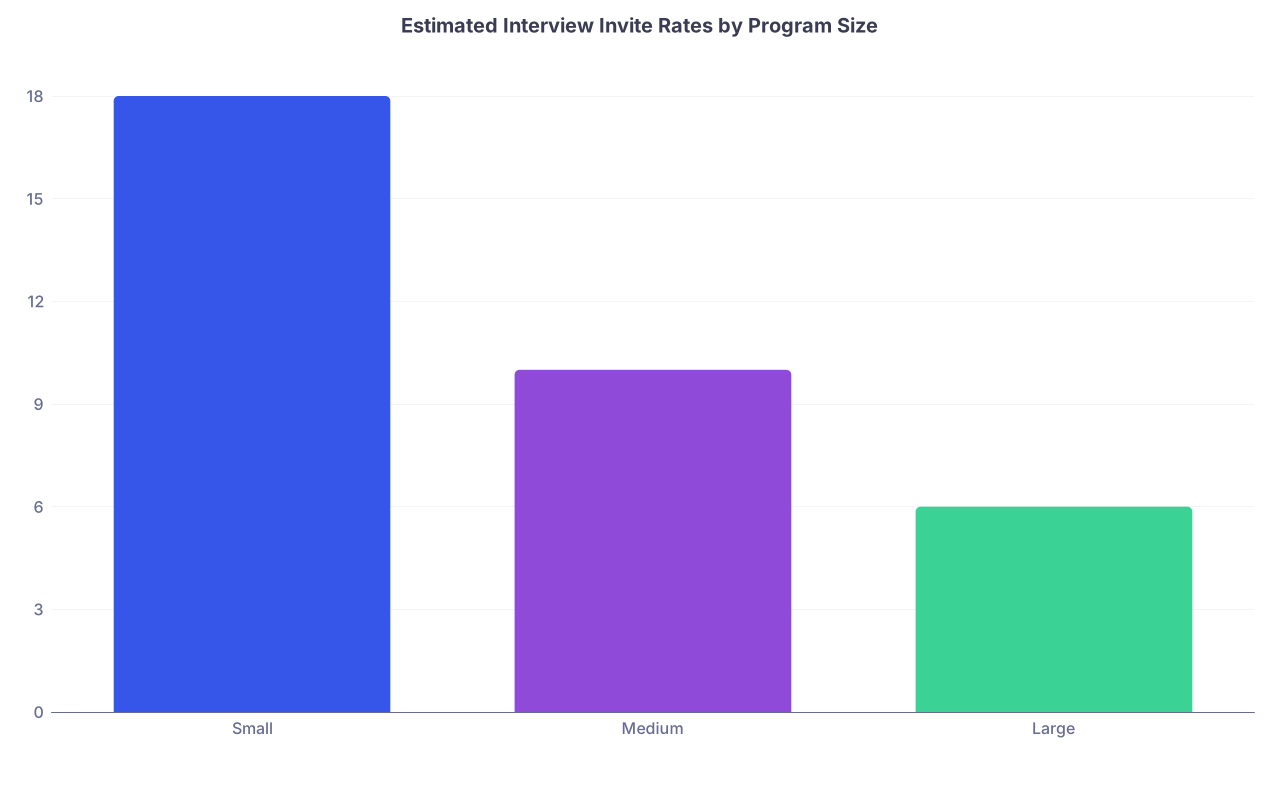
Rough pattern (varies by specialty and competitiveness):
- Large academic programs:
- 2,000–5,000+ applications per year (IM, Peds, EM, Psych)
- 3–10% of applicants receive interviews
- Mid-size community or hybrid programs:
- 800–2,000 applications
- 5–15% receive interviews
- Small programs:
- 300–1,000 applications
- 8–25% receive interviews
Visualized:
| Category | Value |
|---|---|
| Small | 18 |
| Medium | 10 |
| Large | 6 |
That is the harsh reality: your probability of getting any shot (an interview) tends to shrink as you move toward massive, name-brand programs—especially if your metrics are average.
The flip side: small programs might interview a higher fraction of their applicant pool, but they often:
- Have narrower “fit” expectations (regional ties, language, specific interests).
- Are more vulnerable to “one bad interview” ending your chances, because there are only 2–4 interview days, 1–3 faculty decision-makers, and fewer seats.
So you see the pattern: program size is not linearly related to your match odds. It interacts with selectivity, geographic preferences, and your own competitiveness.
4. NRMP Data: How Many Interviews You Actually Need
Forget vibes. Look at NRMP Charting Outcomes and Program Director Survey.
For most core specialties:
- U.S. MD seniors commonly need ~10–14 ranked programs in a competitive specialty and fewer (8–10) in less competitive ones to achieve ~90–95% match probability.
- DO and IMG applicants typically need more—often 1.3–2x as many ranked programs for a similar overall match probability.
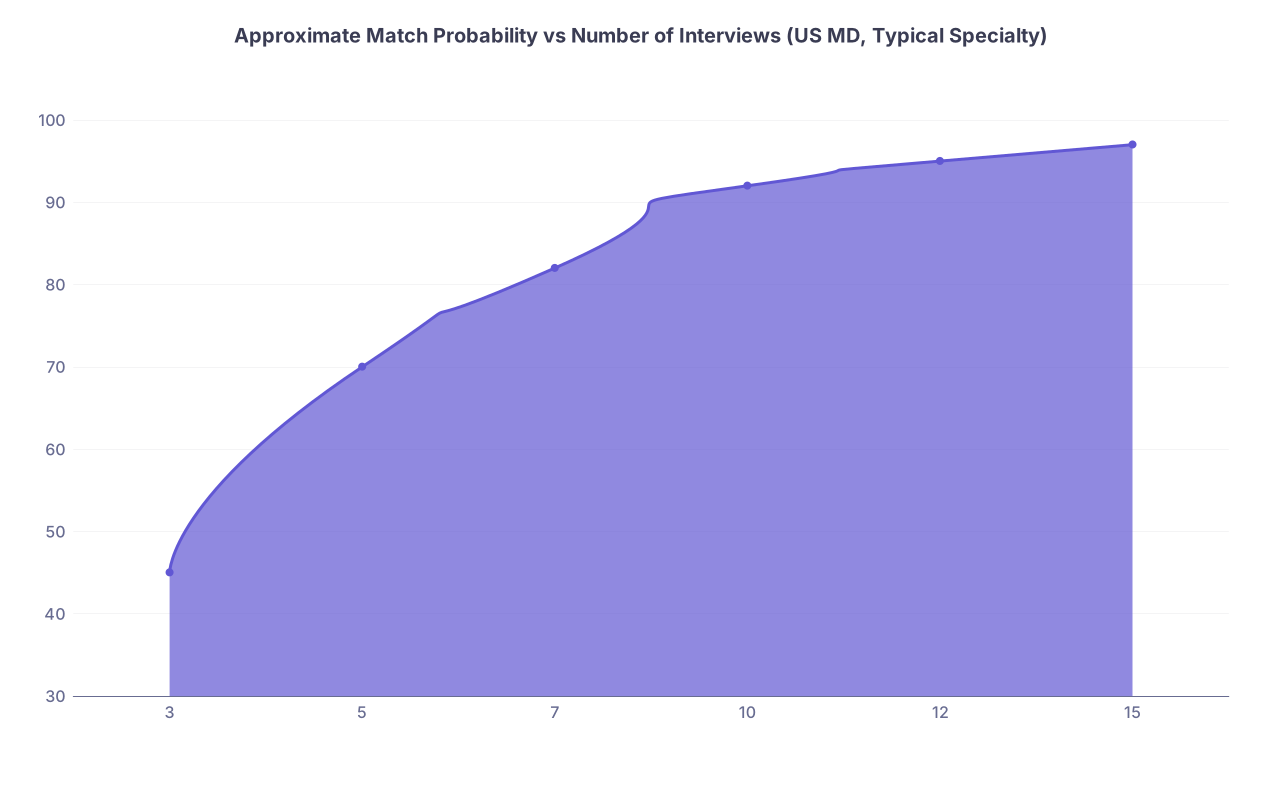
NRMP also gives a clear relationship between number of interviews and probability of matching. For many specialties, something like this pattern emerges:
| Category | Value |
|---|---|
| 3 | 45 |
| 5 | 70 |
| 7 | 82 |
| 10 | 92 |
| 12 | 95 |
| 15 | 97 |
What does this have to do with program size?
Because “fit” and selectivity drive whether you land 3 interviews or 13. And those are overwhelmingly determined by:
- Specialty competitiveness
- Your scores and grades
- Your alignment with the program’s “type” (academic vs community, region, mission)
Program size modifies that equation but does not dominate it.
I have seen applicants hoard 20+ applications to giant IM and EM programs with famous names, then end up with 2–3 interviews because they misread how selective those programs are relative to their CV. That is not a program size problem. That is a misunderstanding of the distribution.
5. Fit vs Size: What the Data Suggests About Strategy
Let me be blunt: “fit” is a fuzzy word. PDs use it to justify decisions that are 70% pattern recognition and 30% rationalization.
But if you watch their behavior in aggregate—who they interview, how they rank—you can infer what “fit” tends to mean statistically for different program sizes.
Large Programs: Volume, Variance, and Brand
Characteristics I see again and again:
- Massive applicant pools.
- Strong signal of “ceiling” metrics: Step 2, class rank, AOA, research.
- More tolerance for diverse backgrounds and niche interests because they have enough residents to cover all needs (research track, clinician-educator, QI, global health).
Data consequences:
- Strong CVs (≥ mean Step 2 + 1 SD, honors-heavy) can have very good hit rates at large academic programs.
- Average or below-average CVs may be screened out before human review, especially if there is no geographic or institutional tie.
Do they fill every seat? Almost always.
Do they dip deeper down the rank list? Often yes. A 24-seat program might rank 350–600 applicants and go rather far down that list, because the competition between similar large-name programs is intense.
Small Programs: Narrower Aperture, Higher Interview Rate
Small programs—especially community-heavy—often show different behavior:
- Modest applicant volumes.
- Lower absolute score thresholds but tighter non-score filters:
- Must be from the region, or
- Has clear commitment to community medicine, or
- Speaks a needed language, or
- Has consistent primary care / underserved interest.
I have watched small community programs with “average” metrics fill with residents who all have deep local ties. That is not random.
Consequences:
- If you match the program’s demographic and mission profile (local med school, local rotations, letters from local physicians), your interview odds can be excellent.
- If you do not, you may be effectively at 0% no matter how strong your scores.
The data story on fit: program size amplifies the role of institutional and geographic alignment at the small end, and amplifies pure metrics + institutional pedigree at the large end.
6. How Program Size Interacts With Your Applicant Profile
Stop asking “Are large or small programs better for me?” and start asking “Given my profile, where does the probability mass actually lie?”
Let’s break profiles into rough quartiles by competitiveness (for a given specialty):
- Q4: Top 25% (high Step 2, strong grades, research, strong letters)
- Q3: 50–75% (solid numbers, some strengths but not elite)
- Q2: 25–50% (average metrics, decent letters, some weaknesses)
- Q1: Bottom 25% or red flags (low scores, failures, gap, visa issues)
Now overlay program size qualitatively:
| Profile Quartile | Small Programs | Large Programs |
|---|---|---|
| Q4 (Top) | Strong odds if geographic/fit | Strong odds, especially academic |
| Q3 | Good if local/mission-aligned | Variable; depends on brand and region |
| Q2 | Best shot at local/community | Often filtered out at big names |
| Q1 | Need extreme alignment / backup | Very poor odds almost everywhere |
This is not theoretical. I have sat in rooms where:
- A Q2 applicant with deep local roots got 10 interviews from small and mid-size community IM programs and matched comfortably—after being completely ignored by the giant flagship university across town.
- A Q4 applicant with national-level research piled up 18 interviews from large academic programs, then ranked almost all big-name centers, and matched high on their list with minimal small-program consideration.
Your portfolio should reflect the actual distribution of probability for your quartile and your specialty.
7. Practical Application Strategy: How Many of Each Size?
Let’s translate this into a tactical plan. Assume a mid-competitive specialty like IM, Peds, Psych for a U.S. MD without major red flags.
Say you are in roughly the 50–75th percentile for that specialty. You are planning to apply to 40 programs.
A rational size mix might look like:
- 10–12 large academic centers
- 15–20 medium-sized academic or community-affiliated programs
- 8–12 small community programs, especially in regions where you have ties
If you are stronger (Q4):
- You can skew more heavily toward large and medium academic centers.
- Still include some smaller programs in key geographic areas as anchors.
If you are weaker (Q2 or DO/IMG in a crowded field):
- Increase total applications. 60–80+ is not crazy for some profiles.
- Shift the median program size down; emphasize mid-size and small programs where geographic and mission fit are clear.
- Only target a handful of large academic programs where you have real ties or a plausible niche (specific research, mentors, sub-interest).
You are essentially managing a portfolio of probabilities, not chasing prestige logos.
8. Common Misconceptions About Program Size and Match Odds
There are a few persistent errors that I see every cycle.
“Large program = backup / safety”
Data says: usually wrong.
Large program + high prestige + central location = higher applicant volume and often tougher filters. For an average applicant, those large programs can be near-zero probability.
Your safety net is not “large vs small”; it is “selectivity vs your metrics and ties.”
“Small program = risky because fewer spots”
Also wrong in many cases.
Yes, a single program with 4 spots exposes you to more variance if something goes sideways. But across your whole list, 6 small programs with 4 spots each (24 total) are statistically comparable to one large program with 24 spots—if:
- Your interview odds at the small programs are comparable or better
- You are not counting on just one of them to save you
Think about distribution across many programs, not the spot count at a single one.
“Fit is mystical and unknowable”
Fit is partially noisy, but it is not random. Patterns emerge:
- Did you complete a rotation there?
- Do your letters come from people in their network?
- Do your stated career goals match what they can actually offer (research vs community practice)?
- Do you look like their current residents in training path and interests?
Watch what the program selects year after year. That is the best data you will get on what “fit” means there.
9. Interpreting Program Data Like an Analyst, Not a Tourist
You will not get perfect transparency, but you can approximate.
Here is how I would dissect a program from a data lens:
Count positions
- Categorical vs prelim vs advanced.
- Check growth or shrinkage over recent years.
Estimate competitiveness
- Use reputation, location desirability, and affiliation (big-name academic center vs standalone community).
- Cross-check with how many people you know applying or matched there, and their profiles.
Identify fit patterns
- Scroll residents’ bios: med schools, regions, research vs community vibe.
- Check how many IMGs, DOs, or non-local graduates they take.
Classify program “tier” for you
- Probable reach, target, or safety, based on your metrics and background.
Then decide how many of each category you are willing to carry. It is exactly portfolio allocation. Just with your career.
10. Bottom Line: What The Numbers Say About Size and Fit
Three points, no fluff:
Program size by itself does not determine your match odds. Your conditional probability of matching at a large vs small program after interview is often similar. The bigger lever is whether you get the interview at all.
“Fit” is largely about alignment with a program’s historical patterns—region, mission, academic vs community orientation, and resident profile. Small programs tend to require tighter non-score fit; large programs lean harder on metrics and institutional pedigree.
A strong residency application strategy balances program sizes across reaches, targets, and safeties, guided by NRMP data on interview numbers. You are managing a probability distribution, not chasing an illusion that seat count alone equals safety.