
The public story about residency applications is incomplete. The real game is decided by filters you never see.
Let me walk you through what actually happens behind those closed doors when your ERAS hits a program’s server—and why perfectly good applicants get auto-deleted before a single human being reads a word of their personal statement.
How Programs Really Screen You (Before Anyone Reads a Word)
Inside the committee room, there’s one brutal reality: there are far too many applications and not nearly enough time.
A mid-tier internal medicine program might get 3,000–4,000 applications for 20–30 spots. A competitive surgical subspecialty can easily see 600–800 apps for 3–5 positions. No one is reading all of those front to back. Not even close.
So programs build “walls.” Hard and soft filters. Some are obvious (Step scores, attempts). Some are much uglier and never discussed publicly.
Here’s a simplified version of what actually happens when your application arrives:

| Step | Description |
|---|---|
| Step 1 | ERAS Application Submitted |
| Step 2 | Imported into Program System |
| Step 3 | Auto Reject / Never Reviewed |
| Step 4 | List Reviewed by Coordinator/Resident |
| Step 5 | Faculty/PD Review Subset |
| Step 6 | Interview Offers Sent |
| Step 7 | Hard Filters Applied |
| Step 8 | Soft Filters & Sorting |
Most applicants who are screened out are lost at the “Hard Filters” and “Soft Filters & Sorting” levels—long before the PD even knows your name.
Let’s break down the filters no one wants to talk about.
Filter #1: Step Scores… But Not the Way You Think
Everyone knows scores matter. What you do not see is how they get used.
Step 1 is Pass/Fail now, but the culture that grew up around score worship did not die. It just shifted.
The unspoken score cut-offs
Programs will swear up and down they “holistically review.” Some mean it. Plenty don’t. Behind the scenes, many places still start with a cold numeric cull.
For Step 2 CK, this is what I’ve actually seen typed into their software more than once:
- Minimum Step 2 CK: 230 or 235 for mid-tier IM
- 240–245 for mid/high-tier academic programs
- 250+ effectively required for competitive fields (ortho, derm, ENT, plastics, neurosurg) at strong academic centers
And here’s the part applicants miss: it’s not just the minimum they care about—it’s distribution.
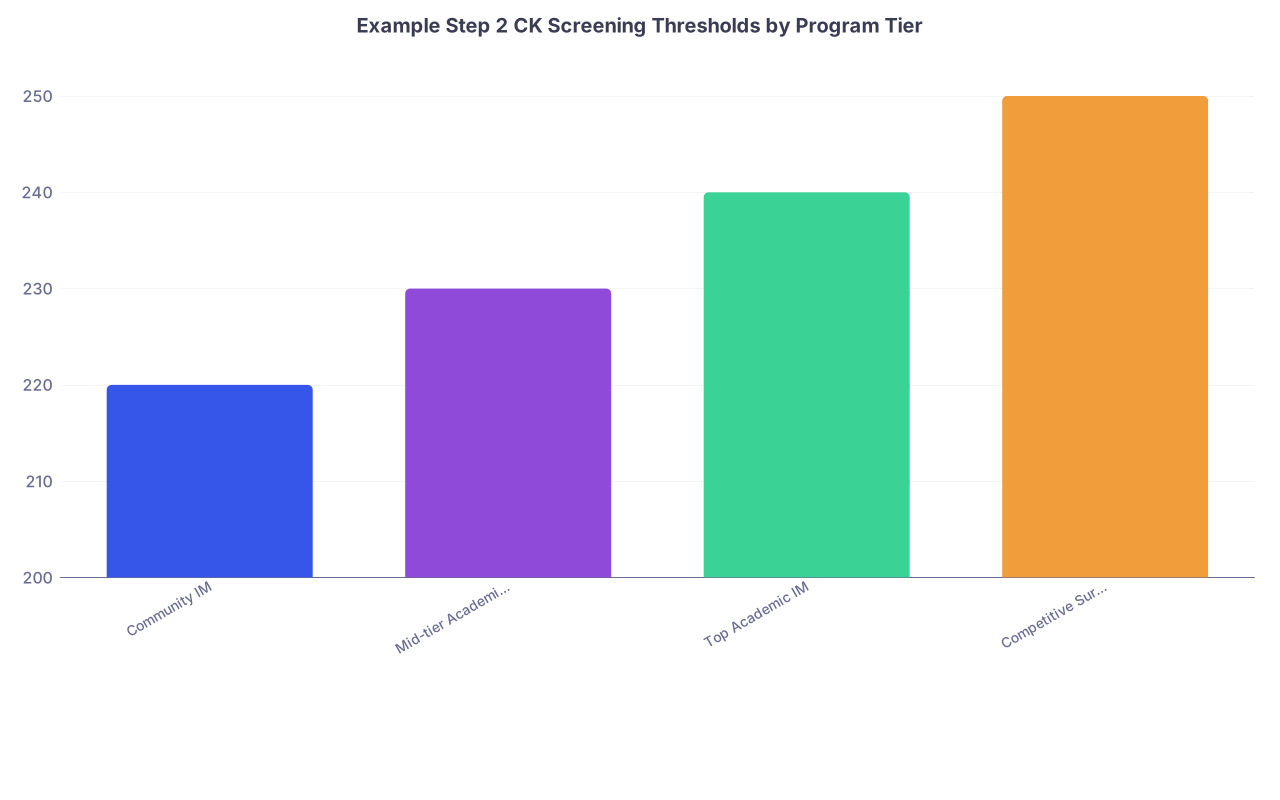
| Category | Value |
|---|---|
| Community IM | 220 |
| Mid-tier Academic IM | 230 |
| Top Academic IM | 240 |
| Competitive Surgical | 250 |
If they get fewer applicants than expected, someone loosens the filter by 5 points. If they’re flooded, they tighten it by 5–10 points. You are not being judged in some objective vacuum; you’re being sorted by supply-and-demand in that specialty, in that region, that year.
The “too low” vs “too high” problem
Here’s a dirty secret: a few community or lower-resourced programs quietly screen out very high scores.
Why? They assume you’re a flight risk and will rank them low. Picture a community FM program where the PD literally said in a meeting: “If they have a 265, they’re not coming here. Don’t waste an interview.”
So yes, you can be “too strong” for some programs. Nobody tells you that part.
Step 1 pass/fail is not neutral
With Step 1 now P/F, many PDs mentally treat:
- “Straight pass” from a US MD as: fine, proceed
- Multiple attempts or barely passing (if they dig into the transcript or MSPE hints): red flag
- For IMGs, a pass on Step 1 is sometimes viewed with more suspicion; some older PDs still believe scored Step 1 was a better “filter”
They’ll never write that in a policy. You’ll hear it in side comments over coffee: “We don’t know what to do with pass/fail so we lean harder on Step 2 and school name.”
Filter #2: School Name, Region, and “Feeder” Patterns
This is where the myth of pure merit dies.
Programs develop habits. They like what’s familiar. They go back to the same wells.
I’ve watched coordinators sort the list in their software by “School” and say, “Let’s grab the usuals first.”
The unofficial “feeder school” system
Many programs have a quiet internal map of “trusted” schools. It’s not formal, but it’s very real. Something like:
- Home institution and regional med schools
- Schools that have historically sent strong residents
- Schools where faculty trained and have bias toward
| Program Type | Preferred/Feeder Schools (Typical) |
|---|---|
| Northeast academic IM | Nearby MD schools, strong Northeast MDs |
| Midwest community FM | In-state MD/DO, local DO schools |
| Competitive surgical | Top 30 MD schools, home institution |
| University psych program | Regional MD/DO, known previous trainees |
So two identical applicants—same Step 2, same grades—but one’s from “State U COM” that they’ve loved before, the other from an unknown newer Caribbean school? One gets pulled into the “review further” bucket. The other stays buried in the unreviewed pile.
Geographic bias is very real
Programs assume:
- Midwest students are more likely to stay in the Midwest
- West Coast MDs are less likely to come to a small Southern town
- NYC folks might not tolerate rural Idaho
So when they filter, they’ll often favor:
- In-state and regional schools
- Applicants who wrote region-specific signals in their application or personal statement
- People who rotated there
You think you’re applying “broadly.” They’re often thinking “Who is actually likely to come here and be happy?”
Filter #3: US MD vs DO vs IMG – The Quiet Sorting
They may not type it as a “filter,” but the culture functions like one.
Here’s the behind-the-scenes reality:
- Some academic programs essentially treat US MD as default. Everyone else has to prove they “belong” there.
- DO applicants get plenty of respect in many fields now—but there are still dinosaur attendings in certain specialties muttering, “We don’t take DOs,” even when that’s technically untrue.
- IMGs face a separate, harsher layer of filtration that most US grads never see.
At one internal medicine program, I watched the coordinator run three separate reports:
- US MD only
- DO only
- IMG only
The committee started with list #1, filled 80% of interviews, sprinkled in a handful from list #2, and used list #3 almost exclusively for prelim and a few categorical spots they struggled to fill. That wasn’t a one-off.
The hard IMG filters no one talks about
Many programs quietly set IMGs to a different bar:
- Higher Step 2 thresholds (e.g., 240 for US grads, 245–250 for IMGs)
- Absolute requirement: Step 2 on first attempt
- Filters for graduation year (often 5 years or less)
- Filters for visa type: some programs won’t sponsor H-1B at all; some only J-1; some effectively do not want to touch visas despite “accepting IMGs”
If you’re an IMG with a 232 Step 2 and a 2016 graduation year applying to a competitive university program claiming they’re “IMG friendly” because they have exactly one IMG resident? Your file likely never reaches a human.
Filter #4: Year of Graduation and “Gaps”
Programs are obsessed with recency—even when they pretend otherwise.
You know those vague phrases: “prefer graduation within 3–5 years”? That’s often not a preference. It’s a filter.
The silent YOG cut
I’ve watched it live: they set Year of Graduation filter to ≥ 2021. That’s it. Everyone before that is gone.
Why? PDs believe:
- Recent grads are “fresher” clinically and academically
- Older grads may be harder to train, more set in their ways
- Gaps can signal visa limbo, repeated failures, or weak clinical engagement
Is that always fair? No. But it’s common.
If you’re an older grad, your options narrow quickly to:
- Community programs more open to nontraditional paths
- Programs with historically more IMGs
- Places with high service demands where they’ll trade recency for filling slots
And if you have a long “research gap” or “family circumstances” gap, you must explain it clearly in your application. Vague “pursued research opportunities” with no output and no recent clinical work is a red flag that triggers an unspoken “skip this one.”
Filter #5: Red Flags and “Problem Words” in the MSPE and LORs
Here’s the one that burns applicants who thought everything was fine.
The MSPE (Dean’s letter) and your LORs are combed for euphemisms. Committee members have developed a whole bilingual ability in “polite academic English” vs what it really means.
Phrases I’ve heard PDs stop on:
- “Requires closer supervision than peers”
- “Improved steadily during the rotation” (often coded for: started poorly)
- “Will be a solid clinician in the right environment” (translation: not here)
- “Performed at an appropriate level” when everyone else is “outstanding,” “excellent,” “superb”
And then there are giant red flags:
- “Concerns were raised…”
- “Encountered professionalism issues…”
- Failed a clerkship and remediated
- Multiple incomplete or withdrawn rotations
These do not always lead to an auto-reject. But in a crowded stack, they push you to the bottom fast.
Filter #6: Research and “Academic Fit” – Especially in University Programs
University programs, especially in internal medicine, neurology, psych, and any competitive specialty, run a quiet academic compatibility filter.
It goes something like this:
- No research at all? Tough sell at a research-heavy program.
- One poster from a student-run project? Fine for community, underwhelming for academics.
- Multiple abstracts, one or two decent papers, maybe a national presentation? Now you look like their people.
They’re not always explicit about this, but I’ve sat in ranking meetings where someone said: “We’re a research department. If we fill with zero-publication residents, our pipeline dies.”
So they sort:
- Publications listed in ERAS
- Evidence of sustained interest (same topic repeatedly)
- Letters from known researchers
An IMG with great research and a 240+ can sometimes leapfrog a US grad with mediocre academics at these programs. But the bar is high.
Filter #7: Program-Specific “Personality” and Hidden Priorities
Programs have personalities. They will never fully describe them on a website because it would look terrible.
I’ve seen filters built around:
- “We are a high-intensity, high-volume surgical service—avoid anyone who looks too ‘soft’ or ‘psych-oriented.’”
- “We’ve had issues with residents commuting 90 minutes each way and burning out—strong preference for local addresses.”
- “We’re trying to increase diversity; bump URiM applicants higher in the review list.”
- “We just matched three residents from X Caribbean school and it did not go well—cool down on that school this year.”
None of that shows up in their public-facing description. But it absolutely alters who gets pulled for interviews.
Often, they’ll prioritize:
- Applicants who did an away rotation with them and didn’t cause problems
- People with credible local ties (family, partner, grew up in state)
- People whose interests match unspoken needs (QI, underserved, specific fellowships)
Filter #8: “Signals,” Emails, and How You Present Yourself Pre-Interview
In the era of signaling (especially in certain specialties), programs use:
- ERAS signals
- E-mails from you
- Advisor contacts
As a pseudo-filter for interest.
Let me be blunt: generic “I am very interested in your program” emails do almost nothing. But:
- A concise, specific note referencing actual knowledge of the program + a real connection (rotated there, strong regional tie, mentor there)
- Signals used strategically on the right program tier
- A faculty mentor directly emailing the PD they know and vouching for you
These things push you into the “actually look at this application” pile.
I’ve seen an application bypass the Step 2 filter because a big-name attending emailed: “This student is outstanding. Please look even though their score is below your usual threshold.” Not common, but it happens.
Filter #9: The ERAS “Quick Look” – What They Really Scan in 30 Seconds
Once you pass hard filters, a human finally opens your file. But you still do not get a full read. Not at first.
Most reviewers skim in this order:
- Name, school, degree (MD/DO/IMG)
- Step 2 CK score and attempts
- Medical school and graduation year
- Clerkship grades snapshot
- Research/publications section
- Experiences: quick scan for major red flags or standout commitment
- Any obvious regional tie in personal statement first paragraph
Then they close it. Often in under a minute. And they decide:
- Yes: put in “interview” or “high interest” bin
- Maybe: middle bin (may or may not ever be touched again)
- No: soft reject, never sees committee
This is why beautifully crafted personal statements get no traction in some cases. You’re being cut long before anyone reads paragraph two.
What You Can Actually Do About These Hidden Filters
You cannot rewrite how programs behave. But you can stop playing completely blind.
You should be doing three things strategically:
Targeting by reality, not fantasy.
If your Step 2 is 228, stop wasting half your applications on university IM programs that historically list an “average Step 2” of 245. You’re donating money. Focus on community and hybrid programs that’ve actually taken people like you.Making your distances smaller.
Look at where you’re atypical: older grad, IMG, DO, lower score, no research, changing specialties. Then deliberately compensate:- Older grad? Get very recent, documented clinical work with strong letters.
- IMG? Aim higher on Step 2, secure credible US clinical experience with real faculty LORs.
- No research but applying academic? At least get some QI, case reports, or meaningful scholarly work with clear output.
Giving them reasons to override the software.
The only way people break the filters is when something stands out:- A powerful letter from someone they trust
- A very clear, specific regional or personal fit reason
- Outstanding commitment in one domain (e.g., 5 years of ED nursing before med school applying EM)
Your job is to make the “quick look” impossible to ignore.
Visual Snapshot: Where Applicants Get Cut
Here’s how the funnel typically looks at a busy program.
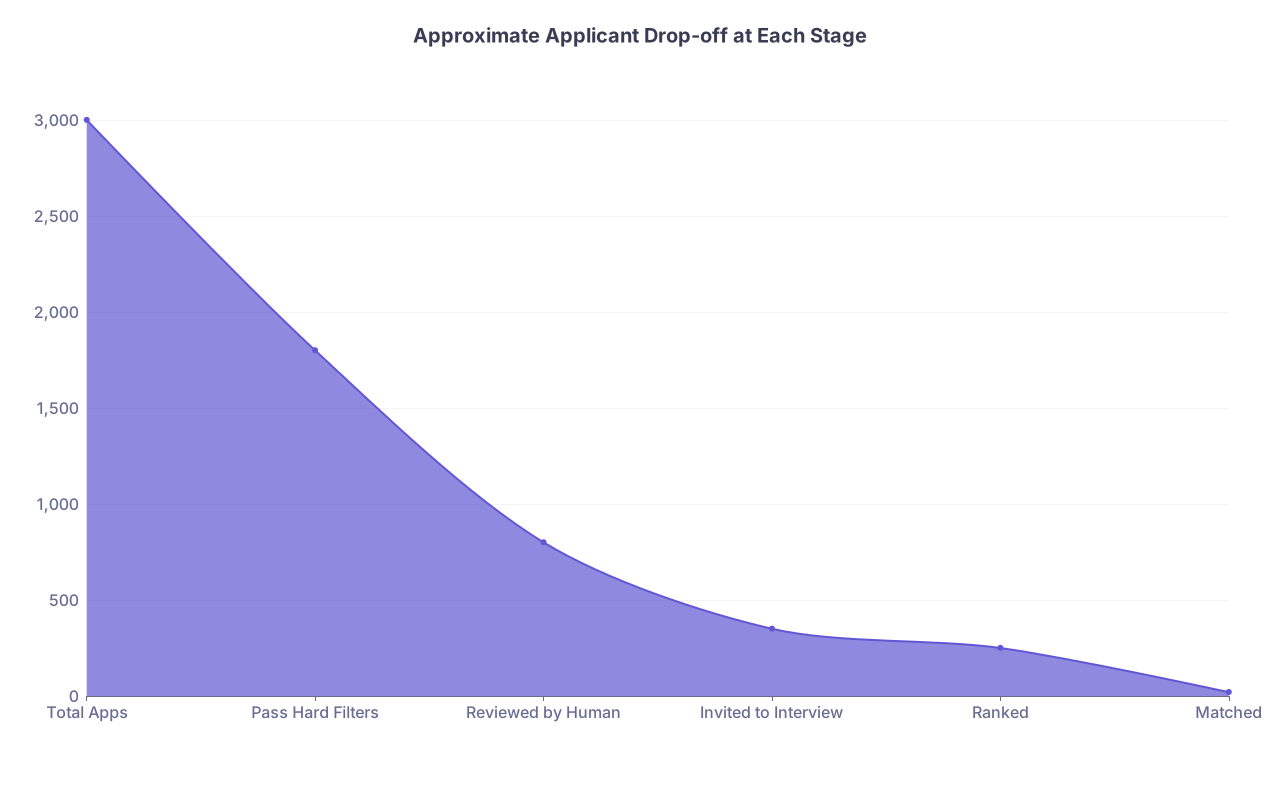
| Category | Value |
|---|---|
| Total Apps | 3000 |
| Pass Hard Filters | 1800 |
| Reviewed by Human | 800 |
| Invited to Interview | 350 |
| Ranked | 250 |
| Matched | 20 |
That’s the reality you’re walking into. Thousands in. A couple dozen out.
FAQ: The Things You’re Probably Still Wondering
1. Can a strong letter or connection really override low scores or harsh filters?
Yes, sometimes. But don’t romanticize it. This usually happens when:
- The letter writer is personally known and respected by the PD or key faculty.
- The program is not oversaturated with high-score applicants.
- Your other metrics are at least close to workable (e.g., 228 in a program that likes 235, not 195 in a place that screens at 240).
It’s an exception, not the rule. But I’ve seen applicants 5–10 points below an informal cutoff get interviews because a trusted faculty member called and said, “This one is the real deal.” Without that, they never make it through the initial cull.
2. How do I figure out if a program has a hard cutoff or is truly holistic?
You won’t get a straight answer if you email and ask. But you can infer:
- Look at their current residents’ med schools, graduation years, and known Step ranges if shared or reported on forums.
- Check if they list “average Step 2” and compare to yours. If they brag about a 245+ average and you’re at 220, that’s not your program.
- Ask upperclassmen and recent grads from your school where people with your stats actually matched. That’s often more accurate than anything you’ll hear at an open house.
3. I’m an older IMG grad with a low score. Is there any realistic path?
It’s uphill. That’s just honest. But some people do find a way by:
- Securing sustained, hands-on US clinical experience with credible LORs.
- Targeting community-heavy, IMG-friendly regions (certain parts of New York, New Jersey, the Midwest, some Southern states).
- Being ruthless about specialty choice—switching from something like radiology or surgery to FM, psych, or IM at programs known to take IMGs. You’re not competing in the same lane as a fresh US MD. You need a different map, not the generic one.
4. Should I email programs to say I’m interested or ask if I’m “still under consideration”?
Most of those emails do nothing and occasionally annoy. The ones that can help:
- Are concise, specific, and sent to programs where you truly have a regional tie, previous rotation, or credible connection.
- Arrive early in the season or just before interview offers go out—not spammed weekly.
- Sometimes come from a faculty advocate instead of you directly. “Still under consideration?” emails after silence for weeks rarely move the needle. If you want to stand out, give them something to work with: a clear reason you fit their program, not a generic “I love your diverse patient population” sentence they’ve seen 500 times.
If you take nothing else from this, remember three things:
Most cuts happen before anyone truly reads your file. Programs are not lying when they say they’re overwhelmed—they really are, and they build crude filters to cope. Your job is not to be “good enough” in the abstract. It’s to be strategically above their hidden lines, or compelling enough in one dimension that someone decides you’re worth breaking the rules for.