
The most decisive ERAS work for many students happens long before applications open.
By June of MS3, your application is either quietly powerful or quietly mediocre. The difference is rarely Step scores alone. It is what you do between January and June of third year.
I will walk you through that six‑month window. Month by month, then week by week, then what a good “day in the life” should look like if you want a strong residency application.
This is not generic “do research and be nice on the wards” advice. This is: “In March, you email X; by mid‑May, you have Y done; if not, you are behind.”
Big‑Picture Timeline: January–June of MS3
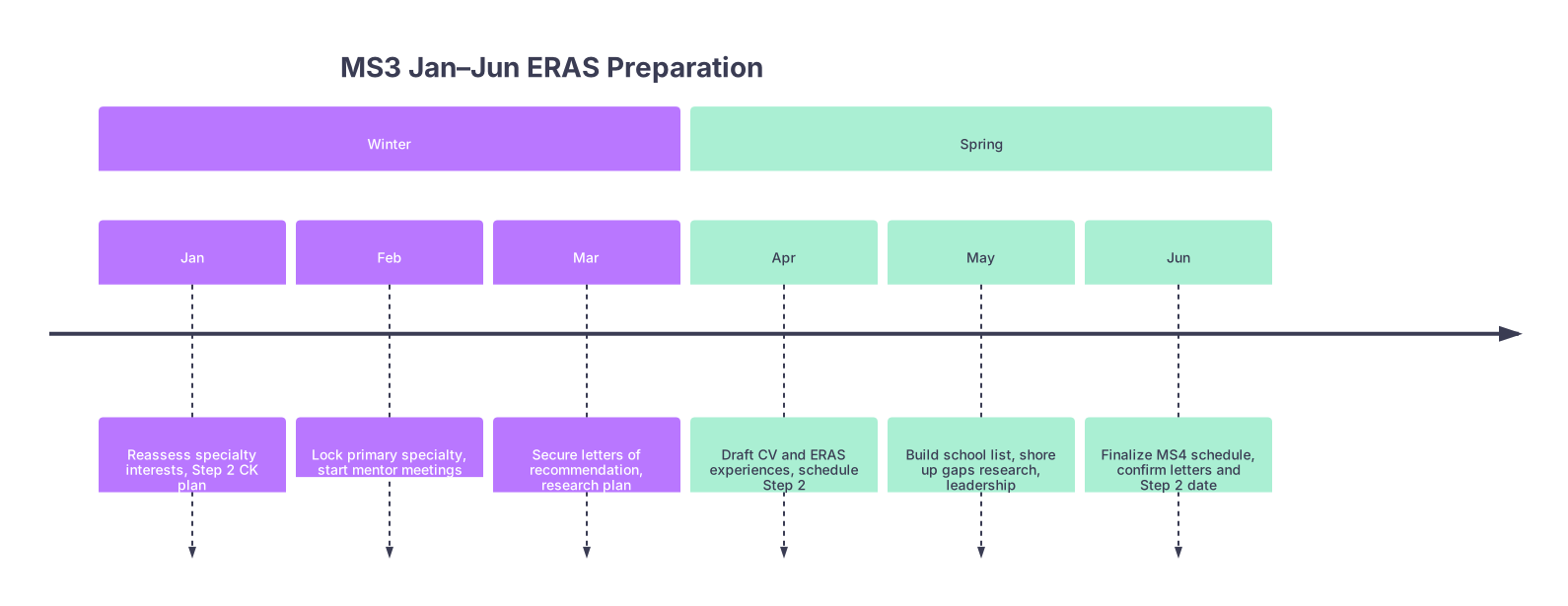
| Period | Event |
|---|---|
| Winter - Jan | Reassess specialty interests, Step 2 CK plan |
| Winter - Feb | Lock primary specialty, start mentor meetings |
| Winter - Mar | Secure letters of recommendation, research plan |
| Spring - Apr | Draft CV and ERAS experiences, schedule Step 2 |
| Spring - May | Build school list, shore up gaps research, leadership |
| Spring - Jun | Finalize MS4 schedule, confirm letters and Step 2 date |
At this point in MS3 (January–June), your priorities should cluster into four pillars:
- Specialty clarity – deciding where you are pointing ERAS
- Performance and evaluations – finishing MS3 strong with actionable narratives
- Concrete outputs – letters, research, leadership, teaching, and a coherent CV
- Step 2 CK and logistics – exam timing and MS4 schedule aligned with your goals
Here is how that breaks down.
January: Reality Check and Direction Setting
January is not about panic. It is about clarity.
Week 1–2: Hard Audit of Where You Stand
You start the year by asking four blunt questions:
- What are my grades on rotations so far? (Honors / High Pass / Pass trends)
- How did Step 1 go (if you took it) and what does that imply for specialty competitiveness?
- Which rotations have I actually enjoyed, not just “done well on”?
- What does my current CV look like if I had to submit it tomorrow?
Pull everything into a simple doc:
- Rotations completed + grades
- Any formal comments or especially good eval quotes
- Research activities (with status: “in progress / submitted / accepted”)
- Leadership and teaching roles
- Volunteer / community work since starting med school
At this point you should be able to say, out loud, a tentative specialty direction, even if it is “Top two: IM vs anesthesia” or “Probably pediatrics, keeping med‑peds open.”
If you are still at “no idea,” that is a problem. Fixable, but a problem.
Week 3–4: Specialty Exploration, But Focused
January is your last reasonable month for broad exploration.
Actions by end of January:
- Shadow 1–2 half‑days in any still‑serious specialty contenders
- Talk to at least:
- 1 resident in each potential specialty
- 1 faculty or program director (PD) level person if you can swing it
You are not asking those people “Should I do derm?” You are asking:
- What CV patterns do you see in successful applicants?
- What are common weak points that keep otherwise good students out?
- What should I be doing this spring if I want to be taken seriously?
Start a running list of specialty‑specific expectations. Competitive fields (derm, ortho, ENT, plastics, urology) have a different bar than FM or psych. Pretending they are the same is how people quietly tank their chances.
February: Commit to a Direction and Build Your Mentor Network
By February, you stop being “open to everything.” You pick a primary direction.
Week 1: Lock Primary and Backup Strategy
At this point you should:
- Name one primary specialty
- Name one realistic backup (not fantasy; something that matches your scores and performance)
If you are going for something competitive, you must know:
- Your Step 1 status relative to that specialty
- What typical matched applicants at your school look like
If your school has a departmental “specialty advisor” spreadsheet or session and you have not gone? Do it this week.
Week 2–3: Identify and Meet Core Mentors
You need three types of mentors:
- Career / specialty mentor – senior faculty, section chief, or PD level
- Clinical mentor – attending who saw you work on rotation and liked you
- Research mentor – someone producing projects in your field (or adjacent)
By end of February you should have:
- Met (or scheduled) at least one 1:1 mentoring meeting in your primary specialty
- Emailed your strongest clinical attendings to thank them and keep a connection warm
- Identified at least one realistic research opportunity (chart review, QI, case series, something)
Script for that first mentor email is simple:
- Who you are
- What rotations you have done
- Your tentative specialty choice
- Two sentences about your academic performance
- A direct ask: “Could I meet for 20–30 minutes to get your advice on building a successful application in X?”
If you send five good emails, you will get at least one excellent mentor. I have seen too many students wait until June to send the first one. They regret it.
Week 4: Start a Real CV and Track Document
Create two core documents:
- Running CV (2–3 pages) – everything, including non‑medical work
- ERAS‑style experiences spreadsheet with columns:
- Category (Work / Volunteer / Research / Leadership / Teaching)
- Organization
- Role
- Dates
- Hours (approximate)
- Supervisor name + contact
- Bullet points describing what you actually did
You will be glad you built this early when you are not guessing in August if you worked 120 or 260 hours at that free clinic.
March: Lock Letters and Cement Your Reputation
March is letter month. If you wait until July, you will get generic trash.
Early March: Identify Your Letter Writers
You want a minimum of:
- 2 strong clinical letters in your primary specialty OR closely related
- 1 strong medicine or surgery letter (depending on your field)
- 1 “character / longitudinal” letter (advisor, research PI, dean’s letter writer)
| Target Specialty | Core Specialty Letters | Medicine/Surgery Letter | Research / Other |
|---|---|---|---|
| Internal Medicine | 2 IM | 1 additional IM or Subspecialty | 1 Research/Advisor |
| General Surgery | 2 Surgery | 1 Additional Surgical | 1 Research/Advisor |
| Pediatrics | 2 Peds | 1 IM or Peds Subspecialty | 1 Research/Advisor |
| Psychiatry | 2 Psych | 1 IM or Neuro | 1 Research/Advisor |
| Competitive (Derm/Ortho/ENT) | 2–3 Specialty | 1 Medicine or Surgery | 1–2 Research-Focused |
At this point you should list:
- Every attending who has explicitly praised you
- Rotations coming up that might yield a high‑impact letter (sub‑I, AI, “dream rotation”)
Decide:
- Who you will directly ask in March
- Who you will try to impress first, then ask in April/May
Mid–Late March: Ask Early, Ask Well
When the timing is right (ideally near the end of the rotation, when they have seen your best work):
Ask in person if possible:
- “Dr. X, I am planning to apply to [specialty]. I really enjoyed working with you on [rotation]. Would you feel comfortable writing a strong letter of recommendation for my residency application?”
Follow with an email that includes:
- Your CV
- Brief personal statement draft or paragraph on your goals
- Reminder of specific cases or projects you did with them
- Deadlines (you can say “by early July” at this stage)
Do not skip the word “strong” in that ask. It gives them an out if they cannot genuinely support you.
By end of March you should have at least two verbal yeses from credible letter writers.
April: Translate Your Work into ERAS‑Ready Outputs
April is when you start turning your life into bullet points.
Week 1–2: Draft ERAS Experience Entries
You are not submitting ERAS yet, but you are drafting as if you were.
For each meaningful activity from your spreadsheet:
- Pick the ERAS category it will live under
- Write 2–3 specific, outcome‑focused bullet points:
- “Led a 5‑student QI project that reduced ED discharge paperwork errors by 18% over 6 months.”
- “Coordinated weekly teaching sessions for 20+ first‑year students, covering core physical exam skills.”
You want a mix of:
- Responsibility (what you were trusted with)
- Impact (what changed because you were there)
- Skills (teaching, leadership, QI, research design, etc.)
Your goal by end of April:
- Every substantial experience you plan to list on ERAS has at least rough bullets drafted
- You can see, on one page, what your “story” looks like: maybe it is “teacher,” “advocate,” “researcher,” “systems fixer” — something coherent.
Week 3–4: Plan Step 2 CK Timing and Prep Strategy
For ERAS strength, Step 2 timing matters more than most MS3s realize.
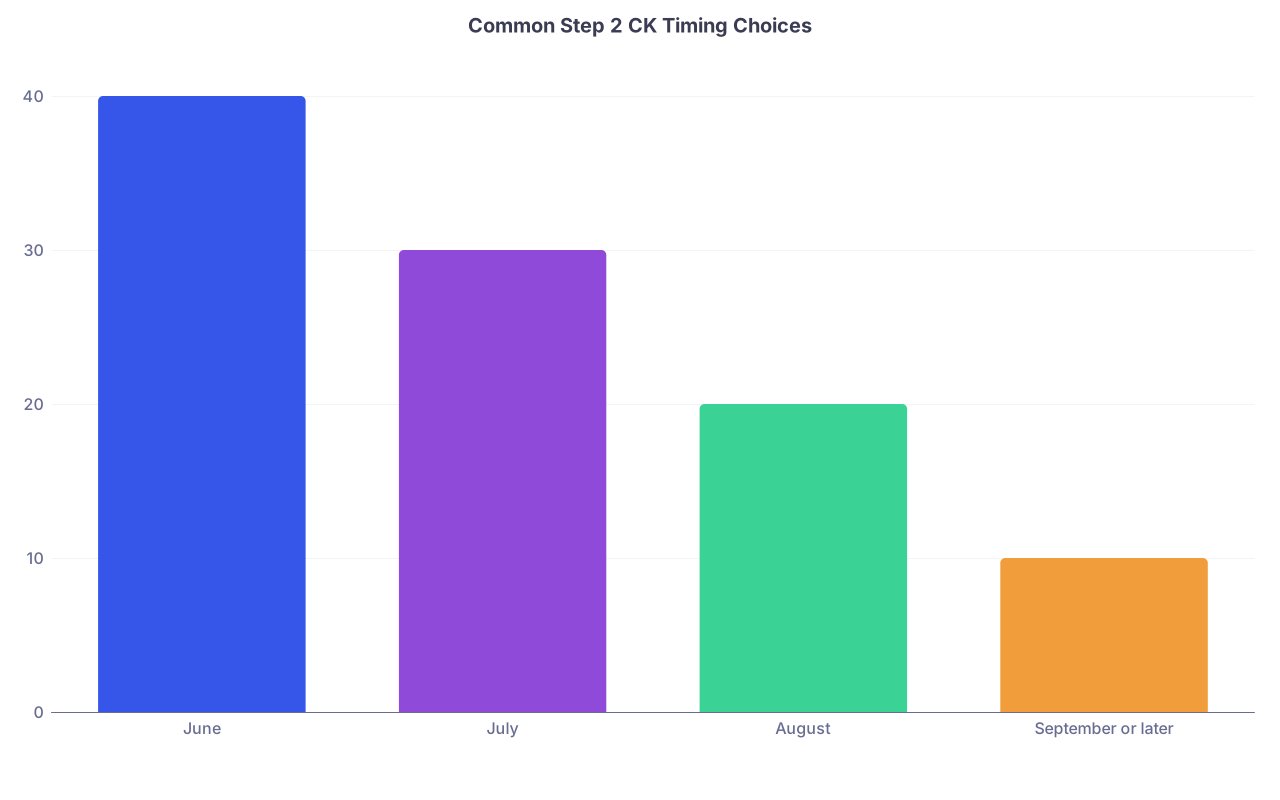
| Category | Value |
|---|---|
| June | 40 |
| July | 30 |
| August | 20 |
| September or later | 10 |
Basic rule:
- Stronger Step 1, less competitive field – Step 2 can be later (July–August)
- Weaker Step 1 or competitive field – you want a strong Step 2 in hand before programs rank you → test by late July at the latest
In April, you should:
- Pick a test month, ideally June or July
- Backward‑plan 6–8 weeks of serious prep
- Make sure your MS4 schedule allows for that (no brutal sub‑I in the two weeks before your exam)
If you are still on heavy rotations in June, you must be realistic. Many students book an early July exam and then push; do not count on that safety net. It can wreck your application timing.
May: Patch the Gaps and Polish the Narrative
May is your last real chance during MS3 to fix obvious weak spots.
Week 1: Identify Gaps Ruthlessly
Look at your emerging profile and ask:
- Do I have zero research in a research‑heavy field?
- Do I lack leadership or teaching experience entirely?
- Am I missing a credible letter writer in my chosen specialty?
- Are my clinical grades trending down, flat, or up?
Rank gaps by:
- How much they matter for your specialty
- How fixable they are between now and September
Then you aggressively pursue the top 1–2.
Example moves:
- No research in IM or neuro → join a chart review or QI project that can at least be a submitted abstract by fall
- No sustained service / advocacy → pick one meaningful ongoing activity you will commit to (e.g., free clinic, school health program), not five random one‑offs
- Weak clinical comments → intentionally ask for mid‑rotation feedback, then overcorrect visible issues (notes, presentations, punctuality, initiative)
Week 2–3: Build an Early Personal Statement Skeleton
You do not need a finished personal statement. You do need a clear spine.
At this point you should be able to answer in writing:
- Why this specialty, tied to specific patient encounters or longitudinal experiences
- What you bring that is different from other applicants (concrete skills and temperament, not clichés)
- What kind of resident and future physician you see yourself as
Turn that into:
- One paragraph of “origin + growth” in the specialty
- One paragraph about 1–2 defining clinical experiences
- One paragraph about your strengths and what you want from training
You will revise this a dozen times later, but having something now makes mentor conversations much more productive.
Week 4: Build a Draft School / Program List
You are not obsessing over program names yet. You are mapping tiers.
For your primary specialty, categorize:
- Reach / top programs
- Target / realistic
- Safety / backup within the same field, if applicable
Factor in:
- Geographic constraints
- DO vs MD friendliness
- Program size and culture (academic vs community, heavy research vs clinical workhorse)
Doing this in May forces you to confront reality while you still have months to adjust. If your dream list is 80% programs where the median matched Step 2 is 260+ and you are a 230–235 student, someone needs to say it out loud. May is the time.
June: Lock the Foundation and Confirm Deliverables
By June, MS3 is wrapping up. At this point you should not be guessing about anything important.
Week 1–2: Finalize MS4 Schedule Around Application Strength
June is where many students quietly sabotage their ERAS.
Your MS4 schedule should:
- Front‑load:
- 1–2 sub‑Is / AIs in your chosen specialty (ideally June–September)
- Time for Step 2 CK prep if not already taken
- Leave space:
- Lighter rotations around your exam
- Flex weeks or electives where you can interview later
Bad idea: July sub‑I in your desired specialty with Step 2 in mid‑July and no prep time. You will do both poorly.
Run your schedule by:
- Your specialty advisor
- At least one resident in your field
- Someone who has just matched in that specialty from your school
If they all wince at the same piece of your plan, change it.
Week 3: Confirm Letters and Give Writers What They Need
By late June, you should:
- Re‑email every letter writer who agreed, confirming:
- That ERAS will open in June and letters can be uploaded
- Your updated CV and draft personal statement
- Your ERAS ID as soon as you have it
You want all core letters uploaded by late August. That means you nudge in June, not in September.
If you realize you have only one truly strong letter in your specialty at this point, you need to fix that fast: arrange an away, a sub‑I, or a late MS3 / early MS4 elective with someone who can see you at your best.
Week 4: Lock Your Story and Metrics
By the end of June, here is what a strong ERAS foundation looks like:
- Specialty choice: Clear primary, realistic backup
- Letters: 2+ strong specialty letters verbally committed, 1–2 others lined up
- Clinical record: Trend of solid or improving MS3 performance, with specific comments you can quote
- Research / projects:
- At least something “real” for research‑heavy fields (poster, manuscript under review, QI with data)
- Clear, honest descriptions ready for ERAS
- Step 2 plan:
- Date scheduled
- Study plan tied to actual calendar time, not wishful thinking
- ERAS materials:
- Drafted experience bullets
- Skeleton personal statement
- Updated CV
You are not “done.” But the structure exists. Now the rest of the summer is execution, not emergency construction.
A Strong MS3 Day, January–June
Let me make this painfully concrete. If you are still on core rotations during this period, your days should roughly look like this:
On service (days):
- 6:00–7:00 – Pre‑round, notes, be visibly useful
- 7:00–5:00 – Be present, volunteer for tasks, ask for feedback once a week
- 6:00–7:00 – Light Step 2 or shelf questions (20–40), review missed topics
- 7:00–8:00 – Once or twice a week, 30–60 minutes of:
- Updating your CV
- Drafting experience bullets
- Emailing mentors / letter writers / research contacts
On lighter days / weekends:
- 2–4 focused hours on:
- Step 2 prep
- Research / project work
- ERAS writing and planning
Notice what is not on that list: random extracurriculars that do not fit your narrative, endless passive Anki without clinical application, or obsessively refreshing Reddit about “competitiveness.” Those are time sinks. This six‑month window is not generous.
Key Takeaways
- By March, you should have a clear primary specialty direction, core mentors identified, and at least two strong letter writers verbally committed.
- By June, you should have your MS4 schedule optimized, Step 2 plan set, ERAS experiences drafted, and obvious CV gaps addressed or actively being filled.
- Day‑to‑day from January to June of MS3, you are playing a dual game: excel on the wards while steadily converting your experiences into the concrete outputs ERAS actually rewards.