
The last 30 days before ERAS opens will not fix a weak application—but they absolutely can sink a strong one.
You’re in the danger zone now. People blow this month by fussing with fonts, rewriting their personal statement 17 times, or ignoring letters until it’s too late. At this point you should be doing targeted, high-yield finishing touches only.
Here’s your day‑by‑day, week‑by‑week guide to not messing it up.
Overview: Your Last 30 Days Game Plan
At this stage, your priorities are:
- Lock content that affects how you’re perceived (personal statement, experiences, CV).
- Secure what you don’t fully control (letters, MSPE timing, transcript).
- Build the “story” of your application across documents.
- Prepare the logistics so ERAS submission on Day 0 is boring, not a crisis.
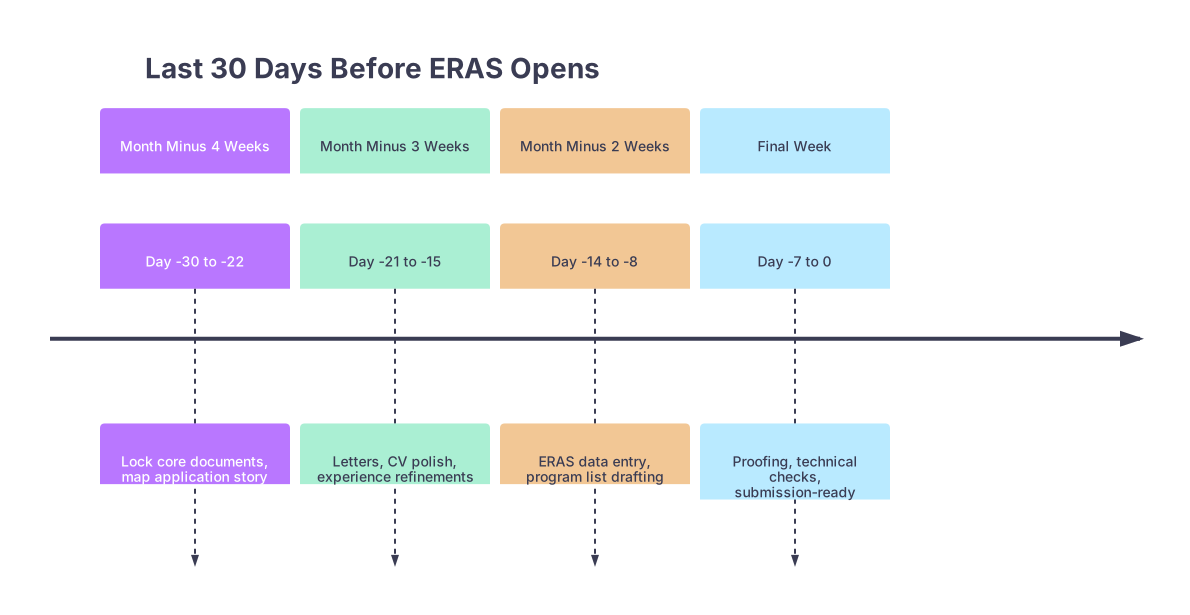
Think in four phases:
| Period | Event |
|---|---|
| Month Minus 4 Weeks - Day -30 to -22 | Lock core documents, map application story |
| Month Minus 3 Weeks - Day -21 to -15 | Letters, CV polish, experience refinements |
| Month Minus 2 Weeks - Day -14 to -8 | ERAS data entry, program list drafting |
| Final Week - Day -7 to 0 | Proofing, technical checks, submission-ready |
Now let’s walk it chronologically.
Days -30 to -22: Lock the Spine of Your Application
At this point you should stop “brainstorming” and start finalizing.
1. Personal Statement: Final Major Revision (Then Stop)
If you’re still in outline mode a month out, you’re behind. You need a near-final draft within this week.
Focus on:
- One clear theme. Not “I like medicine.” Something like:
- “I’m the resident who owns follow‑up and continuity.”
- “I’m clinically calm and procedural under pressure.”
- One anchor story that shows you in action, not thinking deep thoughts in the call room.
- Direct language. Less “I have always aspired…” and more “On night float last January, I…”
At this point you should:
- Do a ruthless cut:
- Remove every generic line you’ve seen in classmates’ statements.
- Kill the detailed childhood origin story unless it truly matters to your trajectory (e.g., long-term caregiver, refugee background).
- Align content with your specialty:
- IM: intellectual curiosity, complex patients, longitudinal care.
- EM: decisiveness, team communication, resuscitation comfort.
- Surgery: technical interest, stamina, coachability, OR focus.
- Run it past:
- One person from your specialty (resident or faculty).
- One person who knows you well and will call BS.
Then lock it. After Day -22, only allow micro‑edits (typos, word choice), not structural rewrites. People wreck strong statements by endlessly tinkering.
2. Experience Entries: Turn Bullet Lists into Evidence
Your ERAS experience section often gets more weight than the personal statement. Many applicants treat it like an afterthought. That’s a mistake.
At this point you should:
- Identify your 8–12 highest‑yield experiences:
- Core clerkships and sub‑I/AI.
- Leadership roles with actual responsibility.
- Research with tangible outcomes (abstracts, posters, pubs).
- Longitudinal volunteering/advocacy.
- For each one, convert from description → impact.
Bad:
“Volunteer at student‑run clinic. Took histories and vitals.”
Better:
“Led intake team for student‑run clinic serving ~40 uninsured patients/month; created new triage workflow that cut average wait times from ~90 to 50 minutes.”
Use this quick template for each entry:
- 1 line: Role + setting + scope (who/where/how big).
- 1–2 lines: What you actually did (concrete tasks).
- 1 line: Measurable or observable impact.
- 1 line (for a few key entries): What you learned that applies to residency.
At this stage, you’re not inventing new experiences. You’re upgrading the ones you already have.
3. Map Your Application Story Across Documents
Your application is not a stack of unrelated pieces. Programs read patterns.
At this point you should:
- Open a blank page and write:
- 2–3 traits you want PDs to walk away with (e.g., “reliable team player,” “data‑driven,” “great with complex social situations”).
- Then check each element:
- Personal statement: supports those 2–3 traits?
- Top 5 experience entries: show them in action?
- LORs (from what you know of them): likely to echo those strengths?
If your statement screams “health equity” and your experiences show zero underserved work, something is off. Realign now.
| Category | Value |
|---|---|
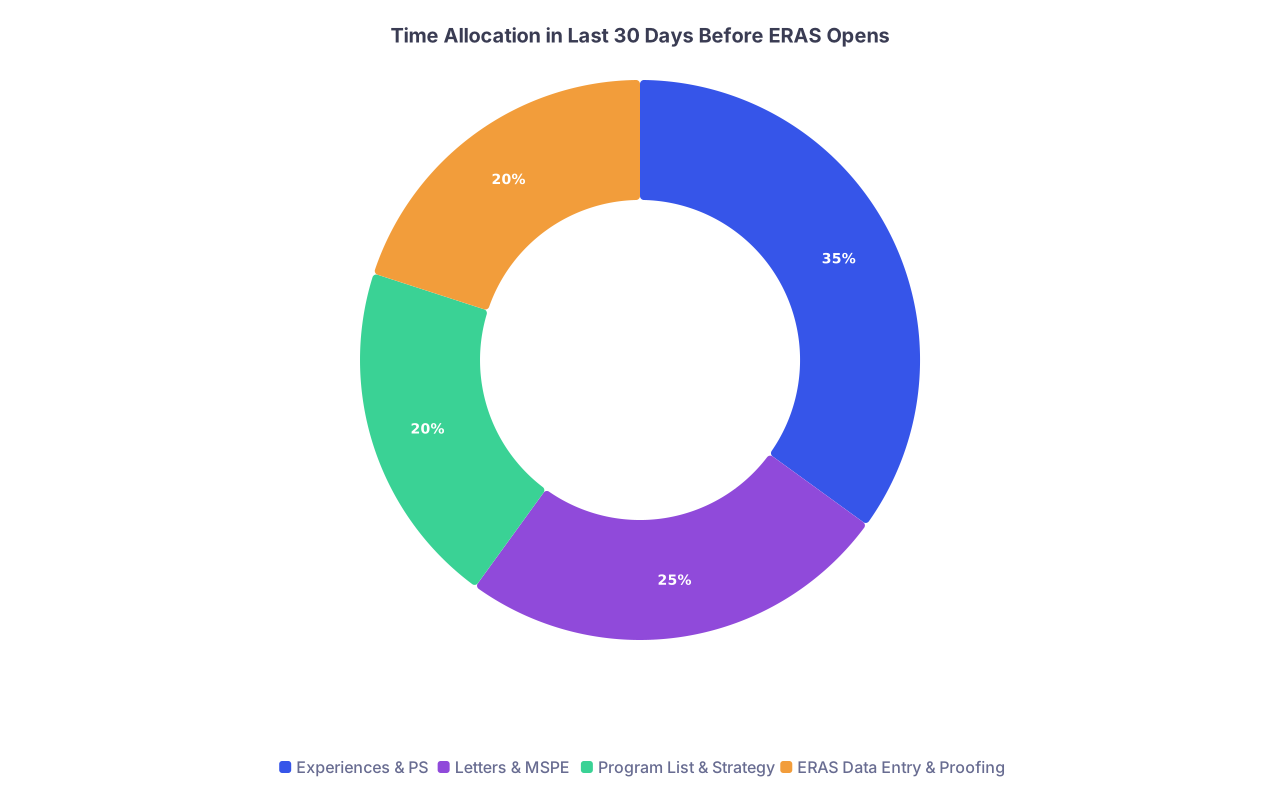
| Experiences & PS | 35 |
| Letters & MSPE | 25 |
| Program List & Strategy | 20 |
| ERAS Data Entry & Proofing | 20 |
Days -21 to -15: Lock Letters, Polish CV, Quiet Fixes
This week is about everything you don’t fully control and everything that makes you look disorganized if it’s wrong.
4. Letters of Recommendation: Confirm, Don’t Assume
If you think “they said they’d write it months ago, so I’m sure it’s fine,” you’re being naive. Faculty forget. People sit on letters.
At this point you should:
- Open your letter status list and check:
- Do you have the right mix for your specialty? (e.g., IM: 2–3 strong IM clinical letters, maybe 1 research; Surgery: 2 surgery letters minimum, ideally from where you did a sub‑I).
- Do you have the minimum AND at least one extra to cover a weak or generic one?
- Send the polite but direct nudge to any delayed writer:
- Keep it short: remind them of your timeline and why you valued working with them.
- Attach your CV and personal statement again.
- Decide on backups:
- If someone high‑status is clearly flaky, line up a reliable mid‑level faculty who actually knows you.
At this stage, I’d much rather have a specific, detailed letter from an AP or hospitalist than a bland, 3‑sentence letter from the famous chair.
5. CV and Transcript: Clean, Consistent, Credible
Your CV and ERAS entries should tell the same story. Sloppy mismatches look bad.
At this point you should:
- Cross‑check:
- Dates align across CV, ERAS experiences, and transcript.
- Positions and titles are consistent (don’t be “Co‑Director” in one place and “Volunteer” in another).
- Abbreviations are decipherable to someone outside your school.
- Fix dead space:
- If you took a leave, remediation, or LOA: draft a 1–2 sentence factual, non‑defensive explanation. Keep it ready; don’t improvise later.
Do a quick credibility check:
- Anything that sounds exaggerated?
- Any research “in progress” that’s actually dead? Be honest. If there’s no realistic path to completion, downgrade it.
6. Research & Publications: Present Them Like a Grown‑Up
Program directors are used to seeing low‑quality, inflated research sections.
At this point you should:
- Categorize each item accurately:
- Published / In press → cite properly (journal, year, volume if available).
- Submitted → list as “submitted,” not “in press.”
- Posters / presentations → identify the conference and level (local/regional/national).
- Avoid padding:
- Twelve separate “presentations” that are the same poster at different hospital hallways looks silly.
- Identify 1–2 projects to highlight in interviews, and make sure your experience entries and PS do not contradict the role you actually had.
Days -14 to -8: ERAS Data, Program List, Strategy
Now you’re moving from content to infrastructure.
7. ERAS Profile: Fill Everything, Then Ruthlessly Edit
At this point you should do a full ERAS pass:
- Fill in:
- Demographics, exam scores, medical school data.
- Experiences (import your polished text).
- Awards, honors, AOA/Gold Humanism if applicable.
- Then step away for a few hours and return with fresh eyes to:
- Cut redundancy. If the same story shows up in two places, condense.
- Check tone: consistent, professional, no slang, no “LOL clinic was wild” energy.
Watch out for:
- Overstuffed experience list with 25 tiny roles. Better to group:
- “Short‑term volunteer events (health fairs, screenings, one‑day events)” as one entry with aggregate impact.
- Typos in hospital or program names. They make you look careless.

8. Build and Tier Your Program List
Program list building the night before ERAS opens is how people end up applying chaotically.
At this point you should:
- Draft a preliminary list:
- Use at least three tiers:
- Tier 1: Reach but realistic.
- Tier 2: Solid matches for your stats and background.
- Tier 3: Safety programs you’d still actually attend.
- Use at least three tiers:
- Check your competitiveness honestly:
- Step 2 score, class rank, red flags.
- For competitive specialties, look at NRMP Charting Outcomes data, ask mentors, and don’t live in fantasy land.
Here’s a simple way to think about distribution for a mid‑competitive applicant (adjust based on specialty and your stats):
| Tier | Approx % of Applications | Notes |
|---|---|---|
| Reach | 20–25% | Strong academics/research |
| Target | 50–60% | Core of your list |
| Safety | 20–25% | Places you’d still attend |
At this point you should also:
- Flag any programs with:
- Additional essays.
- Specific LOR preferences.
- Dual applications (e.g., categorical + prelim).
You do not want to discover the surprise supplemental question the night before you plan to submit.
9. Personalize Without Wasting Time
This is where applicants overdo it. You’re not writing 80 love letters.
At this point you should:
- Identify 5–10 programs you truly care about:
- Geographic must‑haves (partner, family, visa constraints).
- Ideal training environment (strong research, specific clinical niche).
- For those programs:
- Jot 1–2 bullets each: Why them, specifically.
- This is less for ERAS text (you have limited room) and more for:
- Future emails to PDs/PCs.
- Pre‑interview communication.
- Interview answers (“Why our program?”).
Don’t waste time writing fake‑specific content for 70 programs you barely know.
Final 7 Days: Proof, Polish, Tech Checks, Freeze
This last week is about removing friction and not sabotaging yourself.
10. Full Application Read‑Through as a PD
At this point you should:
- Print everything or export to PDF:
- Personal statement.
- CV.
- ERAS common app (preview).
- Experience list.
- Read in this exact order, pretending you’re a busy PD with 90 seconds per applicant:
- Photo (if already chosen).
- Exam scores.
- Experiences.
- Personal statement.
Ask yourself:
- If I stopped after 90 seconds, what 3 adjectives would I use for this applicant?
- Do those match what you intended? If not, you haven’t aligned your pieces.
Fix only what affects clarity or coherence. Don’t spin into a rewrite vortex.
11. Final Personal Statement Pass: Micro‑Edits Only
At this point you should have:
- No more structural changes.
- No more new paragraphs.
You’re looking for:
- Typos and grammar.
- Awkward phrasing.
- Overly formal, robotic sentences you can simplify.
Read it aloud once, start to finish. If you’re bored or cringe at any line, polish just that line. Then stop.
12. Technical & Professional Details: Low‑Effort, High‑Impact
Small things that will not get you an interview, but absolutely can cost you one if you screw them up.
At this point you should:
- Choose your ERAS photo wisely:
- Neutral background, sharp image, professional attire.
- No white coat stethoscope glamor shots, no selfies, no distracting jewelry.
- Check your email:
- Professional address. If you’re still using something from high school, create a new one.
- Test messages to/from that email to ensure deliverability.
- Set your voicemail:
- Clear, professional, no music, no group mailbox.
Quick checklist for the last 72 hours before opening:
- ERAS account works, password known.
- All scores released and entered accurately.
- Letters requested and assignment plan mapped.
- Program list saved and tiered.
- Personal statement attached appropriately (especially if using specialty‑specific versions).
13. Strategy on Submission Day (Day 0)
No, you don’t need to hit submit at 12:01 a.m. But you also shouldn’t be editing at 11:59 p.m.
At this point you should:
- Plan to submit:
- Once you’ve done one last quick pass of:
- Program assignments.
- Personal statement selection per specialty.
- LOR assignment per program if needed.
- Once you’ve done one last quick pass of:
- Accept imperfection:
- There will be minor things you’d tweak if you had all the time in the world.
- That’s fine. PDs care more about clarity, consistency, and substance than about you using “engendered” instead of “created.”
Take screenshots or save confirmation PDFs for your records. You do not want to argue with anyone later about whether an application was submitted on time.
| Category | Value |
|---|---|
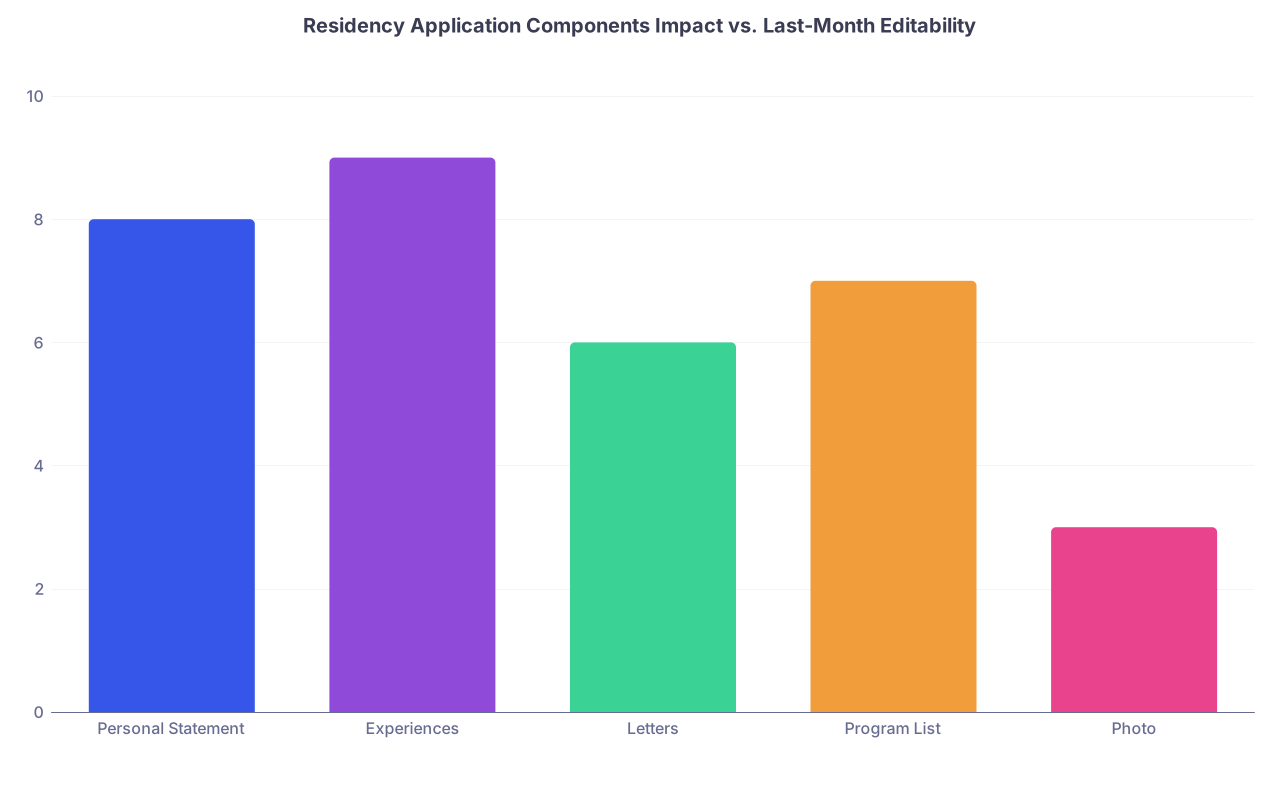
| Personal Statement | 8 |
| Experiences | 9 |
| Letters | 6 |
| Program List | 7 |
| Photo | 3 |
14. Day 0–2: Stop Editing, Start Preparing for Interviews
Once ERAS is in, your attention needs to pivot.
At this point you should:
- Draft early versions of:
- “Tell me about yourself” answer.
- “Why this specialty?” answer that aligns with your application.
- 1–2 patient stories you can use for multiple questions.
- Build a simple tracking sheet:
- Programs, dates applied, interview invites, responses, communication log.
Don’t obsessively refresh your email in the first 48 hours. Most programs are not moving that fast.

The Bottom Line
In the last 30 days before ERAS opens:
- Lock the spine of your application early—personal statement and experience entries should be essentially done by Day -21 so you’re not rewriting under pressure.
- Use the middle window to secure letters, clean your CV/transcript story, and build a realistic, tiered program list that matches your actual competitiveness.
- Reserve the final week for proofing, technical checks, and tiny adjustments—not major overhauls—so submission day is calm, controlled, and professional instead of chaotic.