
The biggest myth about ERAS is that your application is “set” a year in advance. It isn’t. The six months before ERAS opens can move you from borderline to lock.
You’re in the last real window where actions still change outcomes, not just packaging. So we’re going to walk month-by-month from 6 months out to submission, then zoom into the last 4 weeks and final days. At each point: what to strengthen, what to ignore, and what to finish.
Six Months Before ERAS (Mid-December to Early January): Reality Check and Positioning
At this point you should stop guessing and confront your numbers and narrative.
This week, do three blunt assessments:
- Score positioning
- USMLE/COMLEX: List your scores and compare to your target specialties.
- If you do not have Step 2/Level 2 yet, you’re on a clock.
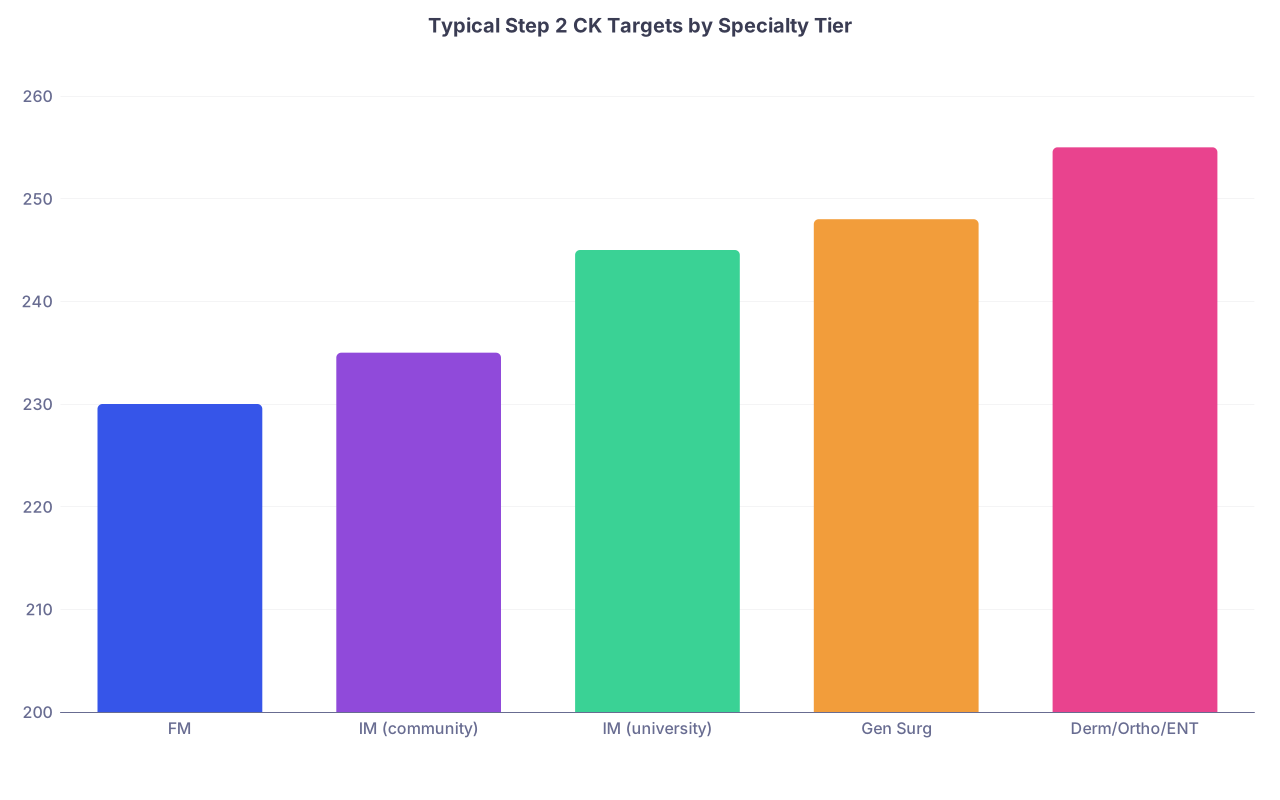
| Category | Value |
|---|---|
| FM | 230 |
| IM (community) | 235 |
| IM (university) | 245 |
| Gen Surg | 248 |
| Derm/Ortho/ENT | 255 |
If your Step 1 is low or pass-only, Step 2 becomes your weapon. Six months out, you still have time to launch a serious study block.
Specialty commitment
- By now you should have:
- 1–2 home rotations in your intended field or closely related
- At least one faculty who knows you well enough to write a real letter
- If you’re still “between IM, EM, and maybe anesthesia,” you’re not ready. You need to decide a primary path in the next 4–6 weeks.
- By now you should have:
Experience gaps Look at your CV like a program director:
- Any large holes? (No recent clinical activity, no continuity of anything)
- Extremely narrow profile? (Only OR, no outpatient; or only one type of setting)
- No leadership, no teaching, no quality improvement?
At this point, you should make a 6‑month “ERAS Map” on a single page:
- Column 1: Months (−6, −5, −4, −3, −2, −1)
- Column 2: Rotations
- Column 3: Letters to secure
- Column 4: Score/Step 2 timeline
- Column 5: Scholarly/leadership items to finish
- Column 6: Admin (CV, PS, MSPE stuff, program list)
You want it all visible. No magical thinking.
Five Months Before ERAS: Fix the Biggest Weak Link
By five months out, you choose your main repair project. You can’t fix everything. You fix the thing most likely to get you screened out.
At this point you should pick ONE primary priority:
Common scenarios:
Weak or missing scores → Step 2/Level 2 becomes Priority #1
- Schedule your exam for roughly 2–3 months before ERAS opens.
- Build a 6–10 week dedicated block even if it overlaps rotations; you’ll just suffer for a bit.
- Commit to a resource plan (e.g., UWorld full pass + 2 NBME + UWSA; no more shopping for resources).
Mediocre clinical evals / no strong letters
- You need one “all-star” rotation in your specialty in the next 2–3 months:
- Work with letter‑writing attendings (ask seniors who actually writes).
- Show up early, close notes, volunteer for admits, follow up labs.
- Your explicit goal: leave with 1–2 power letters, not just “to whom it may concern” fluff.
- You need one “all-star” rotation in your specialty in the next 2–3 months:
Thin CV (no scholarship, no leadership)
- You’re not doing a full RCT in five months. You’re aiming for:
- 1–2 abstracts or posters (local, regional, doesn’t matter)
- A quality improvement project with measurable outcome
- A real teaching role (M1 small group, near-peer tutoring, OSCE coaching)
- You’re not doing a full RCT in five months. You’re aiming for:
At this point you should:
Lock in your rotation schedule until ERAS:
- Ideally 1–2 blocks in your specialty
- 1 audition/sub‑I if possible
- Avoid random electives that don’t help your story
Identify 3–5 target programs in each competitiveness tier and study them:
- What do they emphasize? Research? Underserved care? QI?
- Does your application reflect any of that? If not, that’s your mini-project.
Four Months Before ERAS: Lock Rotations, Letters Strategy, and Step 2 Date
Four months out, your foundation should be set. Now it’s about execution and documentation.
Rotation & letter planning
At this point you should have a letters map:
| Role/Source | Target Number | Ideal Timeline |
|---|---|---|
| Home specialty faculty | 1–2 | Next 2 months |
| Sub‑I / audition attendings | 1 | Within 1 month after rotation |
| Non-core supporter (IM, surgery, etc.) | 1 | Anytime before ERAS |
| Research/mentor letter (if research-heavy specialty) | 1 | 3 months before ERAS |
Actions for this month:
Tell potential letter writers early:
- “I’m applying to internal medicine this cycle. I’d be honored if you might consider writing a strong letter if things keep going well.”
- Yes, use the word strong. You want them to self‑select out if they can’t.
Document your work as you go:
- Keep a running note on your phone with:
- Interesting cases
- Procedures you actually did
- Feedback quotes from attendings and residents
- This becomes gold for your personal statement and experiences section.
- Keep a running note on your phone with:
Step 2 / Level 2 timeline
By now, if you’re taking it this cycle, you should:
- Have a test date scheduled.
- Be consistently doing questions (500–1000 done, minimum).
- Have 1 NBME or COMSAE on the calendar within the next 3–4 weeks.
If you’re struggling on practice tests, don’t hide from it. Four months out you still have options:
- Consider moving the test 2–3 weeks later, but not into the ERAS crunch.
- Block serious daily question time, even if it means painful tradeoffs.
Start your personal statement outline (not full draft)
At this point you should not be writing purple prose. You should be deciding:
What is the through-line of your story?
- Example: “Teacher → communicator → future academic internist”
- Example: “College athlete → discipline and teamwork → surgery”
What 2–3 specific clinical moments will anchor your essay?
- Not generic “I like helping people.”
- Real scenes with details you remember: the patient who fired you, the night you stayed late, the mistake you almost made.
Jot fragments. Don’t polish.
Three Months Before ERAS: Build the Application Skeleton
Three months out, the game shifts from “improve raw data” to “package it coherently.”
At this point you should:
1. Draft your ERAS experiences list (outside the ERAS portal first)
Make a simple document with:
- Header: Activity name, role, location, dates, approx. hours.
- Then 2–3 bullet points per activity:
- One about what you did
- One about impact/outcome
- One about skills or qualities it shows
Example:
- Internal Medicine Sub‑I – University Hospital
- Managed 6–8 patients daily, wrote full notes, and pre‑rounded independently.
- Led family meetings for 3 complex discharges, incorporating social work and PT.
- Consistently cited in evaluations for “ownership” and “reliable follow-through.”
You’re not writing like a poet. You’re writing like a resident who gets things done.
2. First full personal statement draft
At this point you should have a draft that:
- Has a clear first paragraph that actually says what specialty and why.
- Uses 1–2 specific stories, not 8 tiny ones.
- Ends forward‑looking: what kind of resident/physician you want to be.
Do not send this to 10 people. Choose 1–2 brutally honest readers:
- A senior resident in your specialty.
- One non‑medicine friend for clarity and BS‑detection.
3. Solidify program tiers and rough list size
You don’t need a final list, but you need a realistic range.
Rough target ranges:
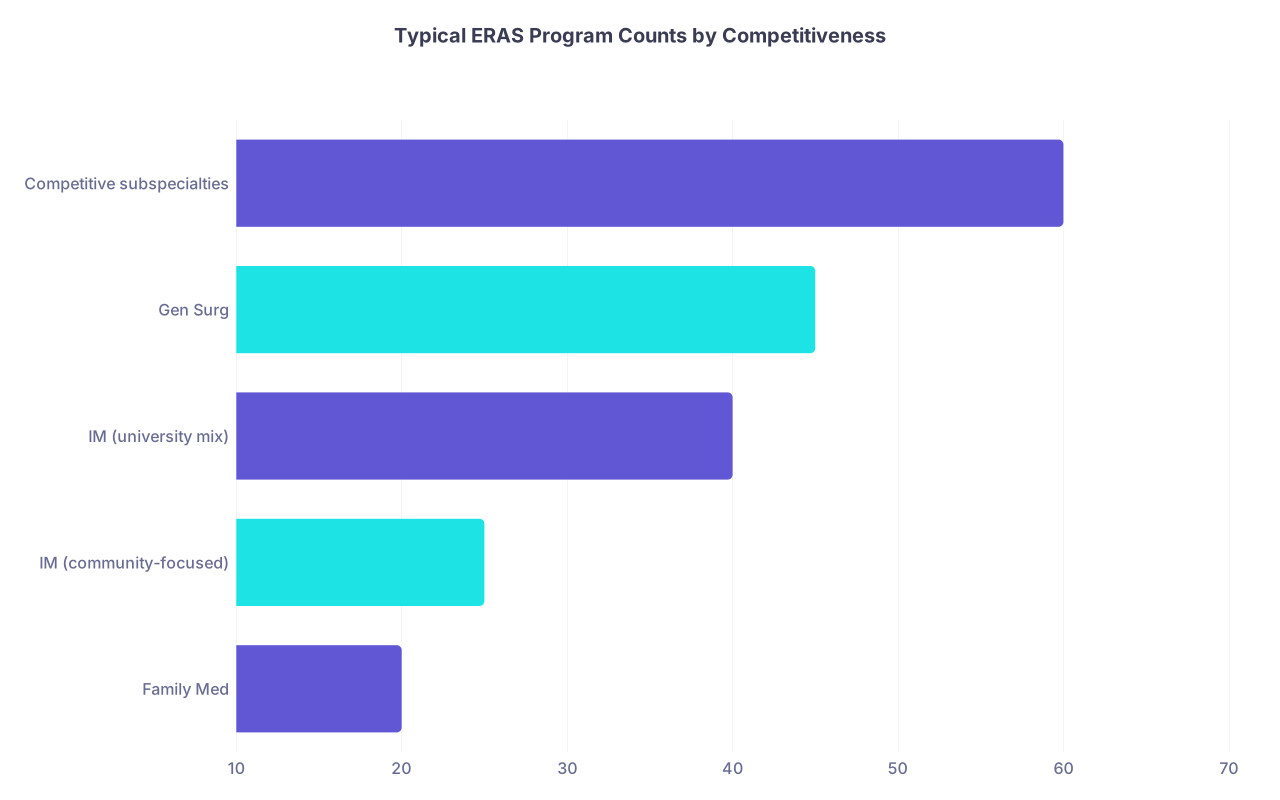
| Category | Value |
|---|---|
| Family Med | 20 |
| IM (community-focused) | 25 |
| IM (university mix) | 40 |
| Gen Surg | 45 |
| Competitive subspecialties | 60 |
Adjust up if:
- You’re an IMG/DO for highly competitive fields.
- You have below‑average scores or red flags.
At this point you should start a simple spreadsheet with columns:
- Program name
- City/state
- Program type (community vs academic)
- Your initial interest level (1–3)
- Any obvious deal‑breakers/requirements
Do not get lost in Reddit rumors. Just build the framework.
Two Months Before ERAS: Convert Work Into Letters and Evidence
Two months out, everything you’ve been doing has to convert into something visible.
Lock in letters
At this point you should:
Formally request letters from everyone on your list.
- In person if possible: “Would you be comfortable writing a strong letter of recommendation for my application to ___?”
- Follow up with a concise email including:
- CV
- Personal statement draft (or at least bullet outline)
- Brief list of projects/patients you worked on with them
- Deadline that’s 2–3 weeks before you actually need it
Decide which letters are core vs. optional:
- Core for most specialties:
- 2 letters from the specialty
- 1 from IM or surgery for procedural/clinical skills
- Optional add‑ons:
- Research mentor
- Department chair (only if they know you beyond 2 minutes in their office)
- Core for most specialties:
Final push on Step 2 / Level 2
At this point you should be:
- Within 2–3 weeks of your exam date.
- Hitting your target range on at least one practice test.
- Doing daily blocks of questions like it’s your job.
If your practice scores are far below where you need (not 5 points, but 15–20):
- You may need to:
- Move the test later (but still before programs start reviewing applications).
- Reassess your specialty or program tier.
- Talk to your dean or trusted mentor this month, not in September.
Refine your application story
You’re not adding new major activities now; you’re upgrading what you have:
Turn random volunteer hours into a coherent theme:
- “Longstanding interest in underserved care” backed by:
- Free clinic work
- Street medicine elective
- Community health project
- “Longstanding interest in underserved care” backed by:
Turn your scattered research into a trajectory:
- “Progression from literature reviews → data collection → poster presentations”
This is the month to kill anything that doesn’t fit:
- 3‑hour workshop from M1 year? Cut.
- That one shadowing day? Cut.
- You want depth, not clutter.
One Month Before ERAS: Build the Actual ERAS Application
Here’s where people underestimate the work. The ERAS portal itself will eat more hours than you think.
Four weeks out: ERAS data entry
At this point you should:
Start entering biographical and education data:
- This is boring but error-prone. You do not want to mess up dates or exam numbers.
Paste in your refined experiences descriptions:
- Check for:
- Repetition
- Vague language (“helped with,” “exposed to”)
- Passive voice everywhere
- Check for:
Polish your personal statement:
- Cap revisions to 2–3 more passes.
- Stop adding new anecdotes. Cut for clarity. Tighten language.
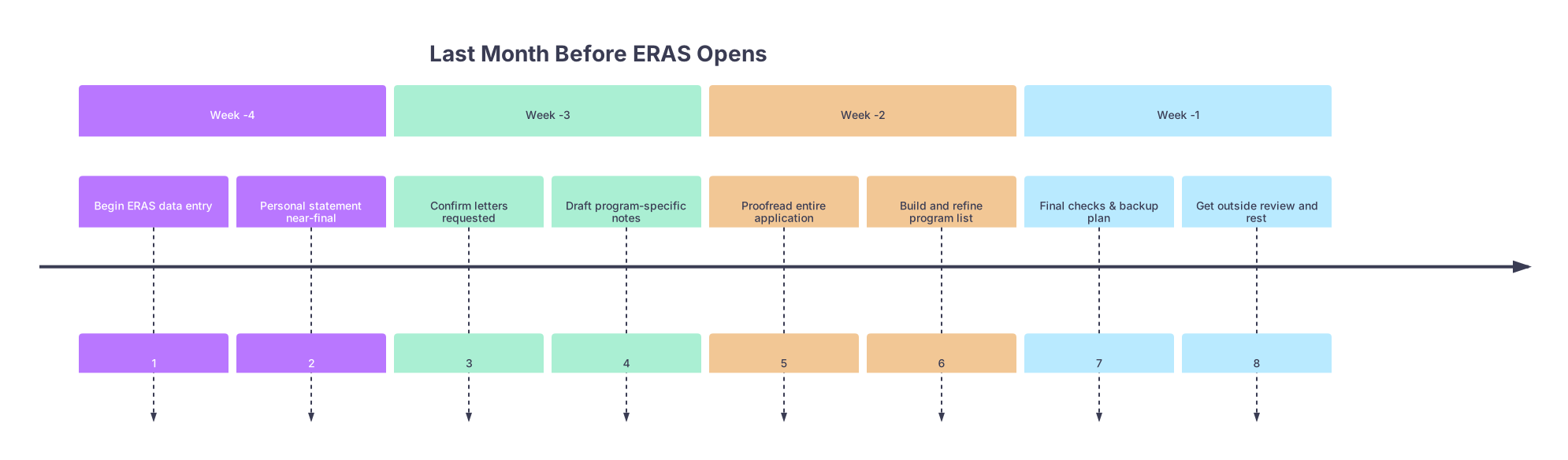
| Period | Event |
|---|---|
| Week -4 - Begin ERAS data entry | 1 |
| Week -4 - Personal statement near-final | 2 |
| Week -3 - Confirm letters requested | 3 |
| Week -3 - Draft program-specific notes | 4 |
| Week -2 - Proofread entire application | 5 |
| Week -2 - Build and refine program list | 6 |
| Week -1 - Final checks & backup plan | 7 |
| Week -1 - Get outside review and rest | 8 |
Three weeks out: Letters and MSPE reality check
At this point you should:
- Confirm in ERAS that letters are:
- Requested
- Being uploaded (or at least acknowledged) by your writers
- If someone’s radio silent:
- Send a brief, polite nudge.
- If still no response in a week, activate a backup letter writer.
Also:
- Meet with your dean’s office if possible:
- Ask bluntly: “Given my file, what programs and tiers should be my focus?”
- They often know unwritten rules (e.g., which programs rarely rank your school).
Final Two Weeks Before ERAS: Tighten, Don’t Reinvent
These last two weeks are for polishing, final targeting, and sanity‑saving.
Two weeks out: Whole-application proofread
At this point you should:
- Print (yes, print) a PDF of your ERAS draft.
- Go line by line:
- Dates consistent?
- No duplicated activities?
- No weird capitalization or acronyms without explanation?
Get one trusted person to do a full read:
- Preferably someone in your specialty or a recent graduate.
- Ask them specifically:
- “What are my top 3 strengths as they appear here?”
- “What are 1–2 things that seem weak or confusing?”
If their answer doesn’t match what you thought you were emphasizing, fix it now.
Refine program list with data, not vibes
You’re not playing fantasy football. You’re deciding where your next 3–7 years go.
At this point you should:
- Finalize your program spreadsheet:
- Group by:
- “Reach”
- “Realistic”
- “Safety”
- Group by:
- Use actual data where possible:
- Geographic connections
- Alumni match lists from your school
- Program requirements (Step 2 mandatory? Visas? DO/IMG friendly?)
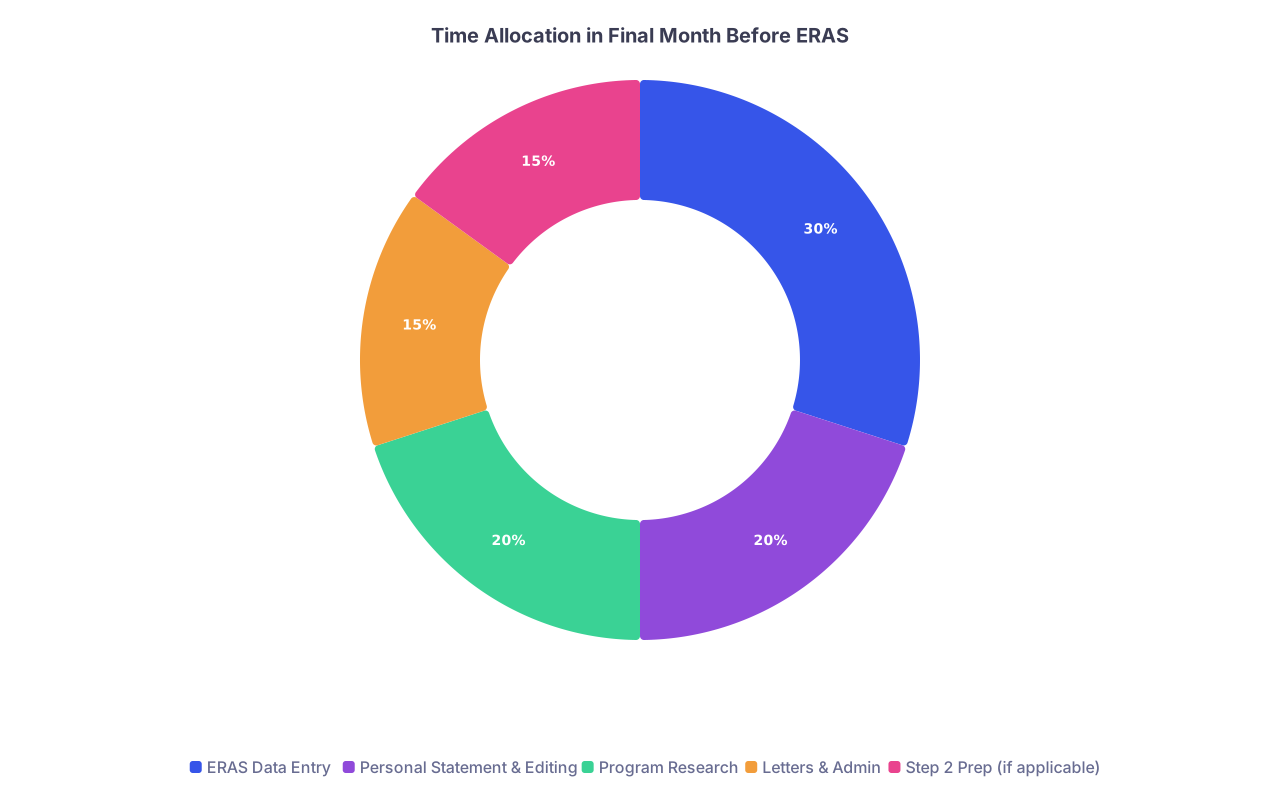
| Category | Value |
|---|---|
| ERAS Data Entry | 30 |
| Personal Statement & Editing | 20 |
| Program Research | 20 |
| Letters & Admin | 15 |
| Step 2 Prep (if applicable) | 15 |
If your list is all “reach” programs because they sound cool, you’re setting yourself up to scramble. Be honest.
Final Week and Final 48 Hours: Last Pass, Then Hands Off
This is where smart people sabotage themselves by making big changes late.
One week out: Lock content
At this point you should:
- Freeze:
- Personal statement content (only micro‑edits allowed now).
- Experiences list (no new items unless critical).
- Final check that:
- All intended letters are assigned correctly.
- USMLE/COMLEX transcript release is authorized.
Do a 24–48 hour cooling off period:
- Don’t open your personal statement.
- Don’t rewrite entire sections.
- Let your brain reset.
Final 48 hours: Micro‑edits and mental prep
Now you:
Re‑read your entire application once:
- Fix only clear typos, grammar errors, and formatting weirdness.
- Do not change structure or content themes.
Re‑check:
- Name spelling (exactly as on your exams and school records).
- Contact info.
- Program designations and filters.

Then stop. Hit submit when the window opens (or as early as your plan allows). Go outside. Touch grass. You’ve done what you can in this six‑month window.
The One Thing You Should Do Today
Open a blank page and build your six‑month ERAS map:
- Down the left side, write: “−6, −5, −4, −3, −2, −1 months.”
- Across the top, write: “Rotations | Letters | Exams | Projects | Admin.”
- Fill each box with exactly one concrete task for that month.
If you can’t fill it honestly, that’s your signal to adjust rotations, schedule Step 2, or line up a powerhouse letter. Start that map now, before this “last chance” window quietly turns into “too late.”