
The worship of class rank and AOA is wildly overstated—especially by medical students.
Programs care far more about whether you look like someone they can trust at 3 a.m. than whether your school calls you “top 15%.” The problem is that students obsess over the wrong metrics and then misread the data they do see.
Let’s tear this apart properly. Class rank, AOA, Gold Humanism. Who actually cares, how much, and where does the real leverage live?
The Big Picture: Where These Honors Actually Sit in the Match Pecking Order
If you look at how applicants talk, you’d think AOA is the golden ticket and Gold Humanism is a personality trophy. That’s not how program directors think.
The NRMP’s Program Director Surveys over the years (2016, 2018, 2020, 2022) are brutally clear. When PDs rank what matters for interview offers and rank lists, class rank and AOA sit in the middle of the pack, sometimes lower.
Across most specialties, these consistently outrank AOA, Gold Humanism, and explicit class rank:
- USMLE/COMLEX scores (yes, even with Step 1 pass/fail, Step 2 CK is king now)
- Clerkship grades, especially core clinical rotations and Sub-I
- Strong letters from known faculty
- Overall interview performance
- Perceived professionalism, “fit,” and red flags (disciplinary issues, leaves, nasty comments in MSPE)
Class rank and AOA sit in the “nice to have, not decisive on their own” category. They function as moderate positive signals, not as primary decision drivers.
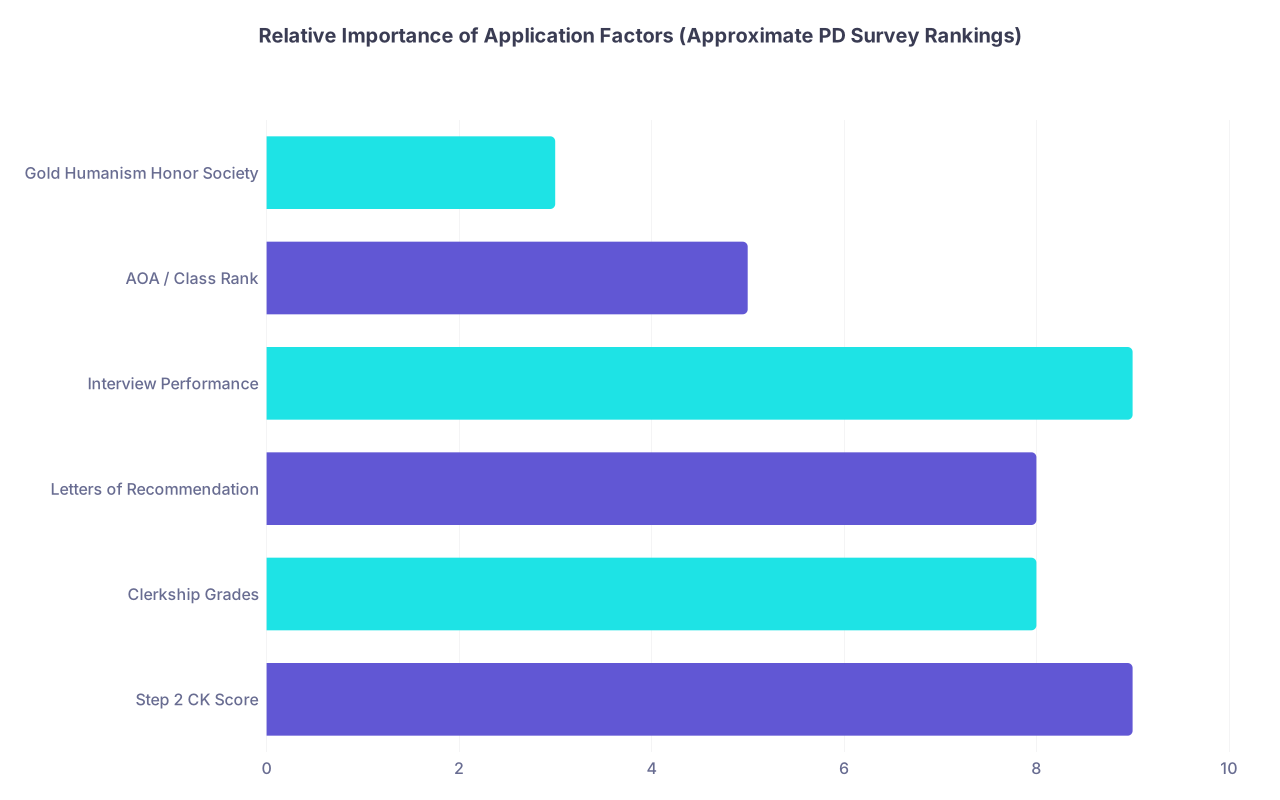
| Category | Value |
|---|---|
| Step 2 CK Score | 9 |
| Clerkship Grades | 8 |
| Letters of Recommendation | 8 |
| Interview Performance | 9 |
| AOA / Class Rank | 5 |
| Gold Humanism Honor Society | 3 |
Are they meaningless? No. But they’re not what anxious MS2s on Reddit think they are. If your entire strategy is “must get AOA or I’m dead,” you’re optimizing the wrong variable.
Class Rank: The Most Misunderstood “Metric” in the Game
Let me be blunt: “class rank” is a mess.
Different schools:
Different grading systems. Different curves. Different distributions. Some don’t even calculate rank. Many hide it. Others only give rough bands like “top third” in the MSPE. Some are P/F for pre-clinicals. Some are H/HP/P. You cannot compare a “top 10%” at one school to a “top 10%” at another in any clean way.
But here’s what actually happens:
- At relatively unknown schools, a clearly strong rank (top 10–25%) helps PDs trust your transcript.
- At big-name schools, rank matters less because the brand itself already signals ability.
- For competitive specialties (derm, plastics, ortho, ENT, neurosurg, IR), top-of-class helps open doors, but always paired with strong Step 2 CK, honored clinicals, and real letters.
Programs rarely say “we only interview top 25% of class.” They do something subtler. They scan your MSPE:
“Top third.” “Outstanding.” “Among the best I have taught.” They aggregate impressions. Rank is a contextual nudge, not a hard cutoff.
Here’s where students get fooled:
Every matched PGY-1 they meet with AOA/top 10% becomes “proof” that you need rank to match. Survivorship bias. You aren’t seeing the solid, mid-pack students who matched fine because they had great clinical performance, grounded letters, and didn’t set their sights on 100% reach programs.
Programs, especially in IM, FM, peds, psych, EM, and even many surgical programs, will absolutely rank:
- A mid-class student with strong clinical comments, clear Step 2 CK, and fantastic letters
over - A top 10% class rank student with mediocre interpersonal feedback or weird professionalism comments
I’ve watched this happen. People in the “middle third” with clean narratives and strong letters sliding easily into good academic IM programs; “top 10%” students sidelined because of lukewarm evaluations or a stiff, arrogant interview.
Key point: Class rank is a weak, noisy, highly school-dependent signal. It matters most when everything else is equal—and in the Match, everything else is almost never equal.
AOA: Prestige, Gatekeeper, or Overhyped Badge?
Here’s the uncomfortable truth: AOA is both useful and overvalued, depending on who you talk to.
Programs in ultra-competitive specialties and elite academic hospitals still treat AOA as a trust mark. Why?
Because it roughly correlates with:
- Strong clerkship performance
- High exam scores
- Good faculty relationships
- A certain level of reliability and conscientiousness
Is it always fair? No. Is it perfectly predictive? Definitely not. But it’s a quick visual shorthand: “this person did very well relative to their peers.”
| Specialty Type | AOA Helpful? | AOA Often Expected at Top Programs? |
|---|---|---|
| Dermatology, Plastics, Ortho | Strongly | Often, yes |
| ENT, Neurosurgery, IR | Strongly | Often, yes |
| Competitive Academic IM | Moderate | Sometimes |
| EM, OB/GYN, General Surgery | Mild–Mod | Rarely required |
| Peds, FM, Psych | Mild | Almost never |
Where people get this wrong:
“No AOA = I’m doomed.”
Completely false for most specialties and most programs. The majority of matched residents in the U.S. are not AOA. In many specialties, AOA is rare enough that PDs just don’t treat it as a standard.“AOA guarantees top-tier programs.”
Also false. I’ve seen AOA students get shut out of reach specialties because they had mediocre letters, generic research, or gave robotic interviews. AOA opens the door. It doesn’t walk you through it.“Step 1 going P/F makes AOA everything now.”
Wrong. Step 2 CK filled the void. PDs explicitly report leaning heavily on Step 2 CK and clerkship performance after Step 1 went pass/fail. AOA is one more data point, not the replacement.
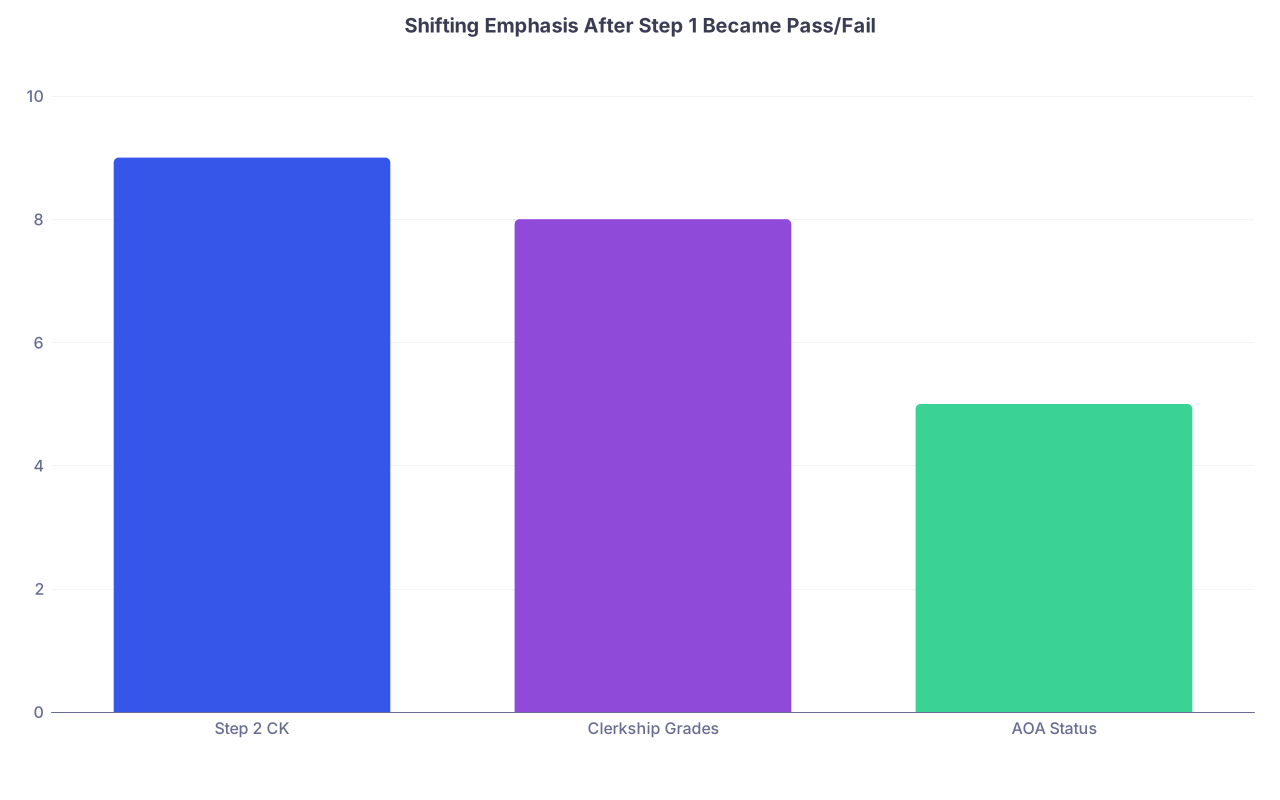
| Category | Value |
|---|---|
| Step 2 CK | 9 |
| Clerkship Grades | 8 |
| AOA Status | 5 |
One more harsh angle: AOA selection processes can be political, biased, and opaque. Students from underrepresented backgrounds and those with non-traditional paths often get the short end of the stick. Many PDs know this. Some quietly discount AOA a bit because they know the playing field is skewed.
So where does AOA truly bite?
- If you’re aiming at the top 10–20 programs in derm, ortho, neurosurg, ENT, plastics, IR, radiation oncology, and elite academic IM—lack of AOA can be a small disadvantage at the very top end.
- But it’s much less decisive once you widen your net. High Step 2 CK, honored sub-Is, and letters from known people can easily offset no AOA.
If you’re not in a hyper-competitive field, AOA is essentially a nice line on the CV that bumps you slightly up within your tier—not a pass/fail criterion.
Gold Humanism: Soft Signal or Serious Asset?
Gold Humanism Honor Society (GHHS) gets dismissed as the “nice person award.” That’s lazy thinking.
The selection process is very different. Nominations often come from peers and faculty focusing on:
- Humanistic behavior
- Teamwork
- Empathy
- Reliability
- Being the person people want on their team
In other words, the stuff that governs whether your team is happy or miserable on a call night.
Now, does GHHS get ranked highly as an “objective metric” in PD surveys? No. It usually lands below exam scores, grades, AOA, and letters in “importance.” But that’s only half the story.
Here is how GHHS really functions:
- It reduces fear of the unknown. If your MSPE says nothing scary, your letters are positive, and you’re GHHS, PDs subconsciously think: “Ok, at least other humans like this person.”
- In specialties that care a lot about patient communication and teamwork (peds, FM, psych, EM, IM), GHHS can be a quiet tie-breaker.
- It can offset mild concerns. I’ve seen PDs say stuff like: “Comments are a bit reserved, but GHHS and strong narrative from their advisor suggests they’re good on teams.”
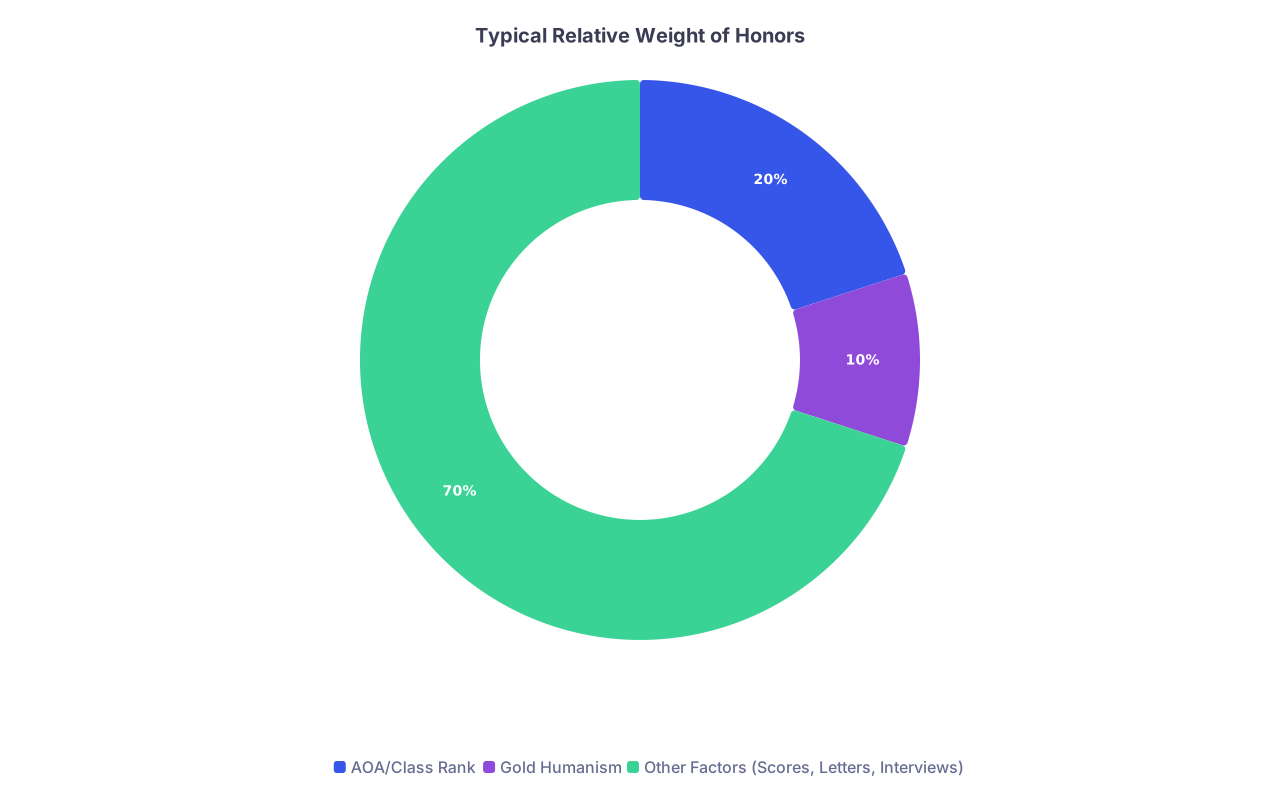
| Category | Value |
|---|---|
| AOA/Class Rank | 20 |
| Gold Humanism | 10 |
| Other Factors (Scores, Letters, Interviews) | 70 |
Students underestimate how much program directors fear toxic personalities. One malignant resident can tank morale for an entire program. GHHS doesn’t prove you’re perfect, but it’s a reassuring marker that someone, at some point, saw genuine humanity in you.
Is GHHS a “must have”? No. Many great residents never get near it.
Is it useless window dressing? Also no. It’s a positive contextual signal in an environment where everyone is terrified of making a bad character bet.
How Programs Actually Weigh These Signals Together
You’re not being graded on isolated badges. PDs look at patterns.
Here’s the rough mental framework many (especially academic) programs actually use, even if they’d never write it down this way:
- Strong Step 2 CK + Honors in key clerkships + Solid letters = “This person can do the work.”
- AOA/class rank = “They excelled academically relative to peers.”
- GHHS + positive narrative comments = “People liked working with them.”
- School reputation = “We understand their grading culture and trust their training.”
- Research, away rotations, etc. = “Do they fit our niche?”

| Step | Description |
|---|---|
| Step 1 | Application Received |
| Step 2 | Screen Out |
| Step 3 | Review Clerkship Grades & Comments |
| Step 4 | Assess Letters & Fit |
| Step 5 | Note AOA / Class Rank |
| Step 6 | Note Gold Humanism & Professionalism |
| Step 7 | Interview Performance |
| Step 8 | Rank List Decision |
| Step 9 | Step 2 CK / Exams Acceptable? |
| Step 10 | Any Red Flags? |
| Step 11 | Invite to Interview? |
Notice something? AOA, class rank, and GHHS live in the middle of the process, not at the entrance gate and not at the final decision point. They color the narrative; they rarely define it alone.
And in the interview + rank-list stage, a real human encounter trumps a line on your CV nine times out of ten. A stellar applicant on paper who interviews poorly drops fast. A slightly less decorated applicant who clearly “fits” the culture climbs fast.
I’ve sat in ranking meetings where AOA didn’t even get mentioned once. But someone’s teamwork, humility, or weird interpersonal dynamic did. Over and over.
If You’re Not AOA / Not Top of Class: What Actually Moves the Needle
Here’s what you should take from all this if you’re sitting middle third, no AOA, no GHHS, and spiraling:
You’re not out. Not even close.
The data and real-world behavior say:
- Step 2 CK is now the main hard filter for many programs. A strong score helps more than a fancy honor society line.
- Clinical evaluations and narrative comments carry heavy weight. “A joy to work with,” “takes ownership,” “excellent with patients” > “ranked in top 20%.”
- Letters from people programs know and trust can completely overshadow lack of AOA.
- A sane, well-constructed application list (a mix of reach/target/safety) dwarfs the effect of one missing badge.
If you want an uncomfortable but useful framing:
AOA and class rank tell programs: “This person played the med school points game extremely well.”
Gold Humanism tells them: “This person is probably good to work with.”
Scores, letters, and honest performance in 3rd/4th year tell them: “This person will or won’t survive residency.”
Guess which one they care about when they think about real call schedules, real patients, and real team dynamics?
The Bottom Line
Strip away the mythology, and here’s what the match data and real PD behavior actually show:
Class rank and AOA are moderate positive signals, not golden tickets or requirements. They help most at the extreme competitive end and when everything else is equal—which is rare.
Gold Humanism is a subtle but meaningful character signal. Not a top-ranked metric, but a quiet reassurance that you are someone people trust and like working with. That matters more than students think.
Scores, clinical performance, letters, and interviews still dominate. Programs care far more about whether you can safely and sanely do the job than whether your school pinned another cord on you at graduation. Honors help, but they aren’t the spine of your application. Your real work is.