
Step scores still drive most interview invites. “Holistic review” mostly decides who wins among people who already cleared the numbers gate.
If you think that’s cynical, start talking to PDs off the record. I’ve heard the same lines over and over in different hospitals:
“We do holistic review… after we filter.”
“We’d love to read every personal statement, but we have 4,000 apps.”
“We start with Step 2 filters, then look at the rest.”
Let me walk you through what actually happens, supported by the data that exists, not the glossy brochure version.
The Myth of Pure Holistic Review
Programs publicly love the phrase “holistic review.” It sounds fair, progressive, humane. The AAMC pushes it. DEI offices champion it. Websites repeat it like a mantra.
But in practice? For most programs, “holistic” does not mean, “We thoughtfully read every single application in full and ignore board scores.” It means:
- They use numerical cutoffs (Step 2 CK now, sometimes COMLEX, sometimes class rank) to shrink a massive pile of applications into something humanly reviewable.
- Then, within that filtered group, they partially behave holistically.
The main bottleneck is volume. Mid-tier IM or FM programs are getting 3,000–5,000+ applications. Competitive specialties like ortho, derm, ENT, plastics? Thousands of apps for under a dozen spots.
Nobody is reading 4,000 applications line by line.
And the data backs this up:
- Multiple NRMP Program Director Surveys over the years show USMLE scores consistently rank among the top factors for granting interviews. Even after Step 1 went pass/fail, PDs reported shifting weight to Step 2 CK, not abandoning scores.
- In the 2022 NRMP PD Survey, Step 2 CK was in the top 5 most important factors for interview offers for a majority of specialties. Many put it above everything else except “perceived commitment to specialty” and SLOEs in EM.
The reality: holistic review modifies the game. It does not erase it. Numbers still matter a lot.
What Step Scores Actually Do in 2025+
Step 1 is pass/fail now, so the fetish for three digits moved almost entirely to Step 2 CK. Programs adapted in the most predictable way possible: they replaced one screening metric with another.
Here’s the basic role of scores now:
Automatic filter – A lot of programs set a hard Step 2 cutoff in ERAS (even if they pretend they don’t). I’ve seen:
- 220 for some community programs
- 230 for many mid-tier academic programs
- 240+ for competitive specialties and top-tier places
Rank list tiebreaker – Even when holistic elements matter, if two applicants look similar, the higher Step 2 score wins more often than anybody wants to admit. Faster decision, easier justification.
Risk signal – Very low Step scores trigger concern: test-taking issues, knowledge gaps, potential board failure as a resident (which hurts program accreditation).
Here’s the punchline: you do not need a monster score for most non-competitive specialties. But you do need to clear the invisible floor.
| Specialty Group | Safer Zone (Interview Likely if Other Parts OK) | Risk Zone (Heavier Holistic Lift Needed) |
|---|---|---|
| Highly competitive (DERM, PLASTICS, ENT, ORTHO, NEUROSURG) | 250+ | < 240 |
| Mid-competitive (ANES, EM, RAD, GAS, NEURO, OB/GYN) | 240+ | < 230 |
| Less competitive (IM, PEDS, FM, PSYCH, PATH) | 230+ (academic), 220+ (community) | < 220 |
Are there exceptions? Yes. I’ve seen a derm resident with a 236 Step 2 at a strong program. But those stories always come with a “but”: crazy research, strong connections, unique background, home program advocacy.
Those are exceptions, not the model.
What “Holistic Review” Really Means on the Ground
Once you clear the numerical gate, then holistic review becomes real. But it’s not some mystical black box. Programs are looking at a fairly reproducible set of things, just not in the way students often imagine.
The main “holistic” factors that actually move the needle:
- School reputation and home institution ties
- Letters of recommendation (especially from known faculty)
- Sub-I / audition rotation performance
- Genuine specialty commitment
- Research and scholarly work (heavily specialty-dependent)
- Red flags (remediation, professionalism issues, significant gaps)
And yes, things like personal statement and extracurriculars get read — but almost never before you pass whatever initial sorting they do.
Let’s visualize the rough weighting for interview decisions for a mid-to-upper-tier academic program in a moderately competitive specialty (say Anesthesiology or EM):
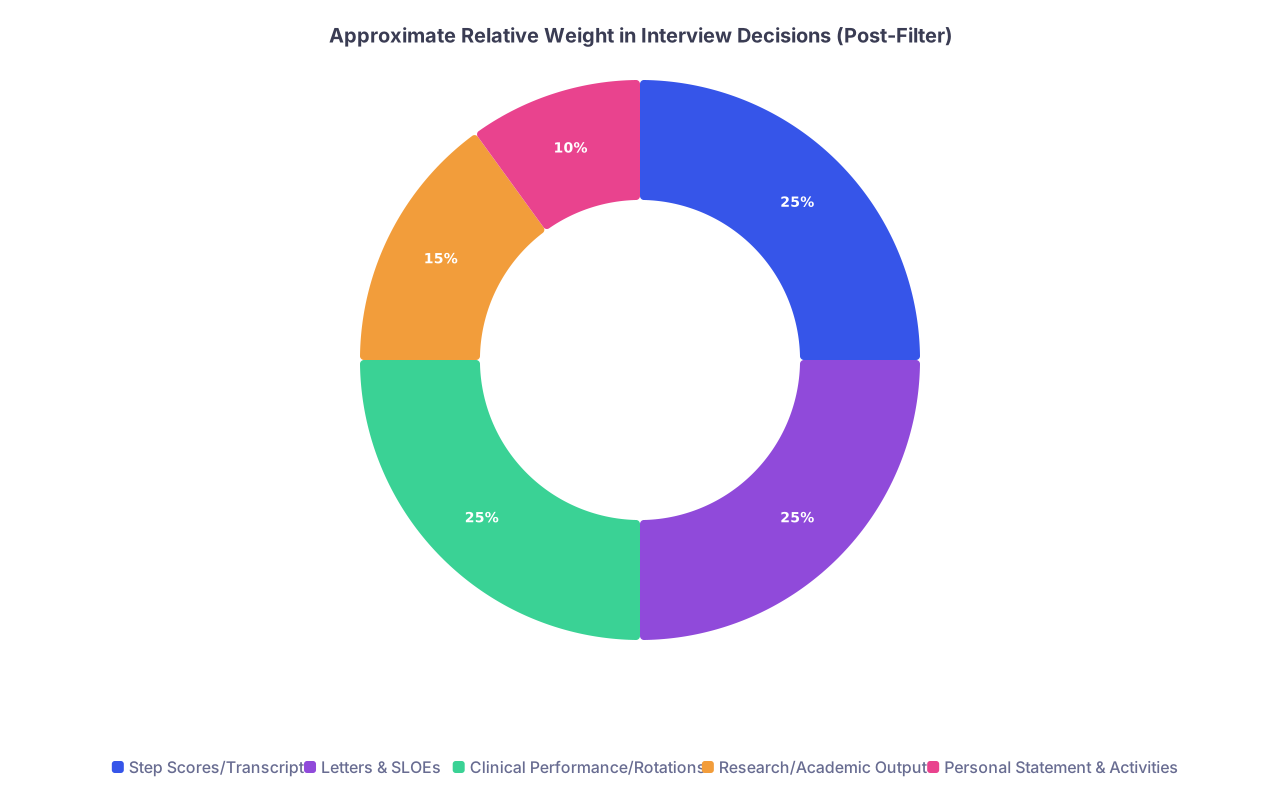
| Category | Value |
|---|---|
| Step Scores/Transcript | 25 |
| Letters & SLOEs | 25 |
| Clinical Performance/Rotations | 25 |
| Research/Academic Output | 15 |
| Personal Statement & Activities | 10 |
This isn’t an official pie chart from NRMP. It’s what you hear when PDs and APDs stop speaking in PR language and start talking practically.
Notice what’s missing? MCAT, undergrad GPA, your high school being “a good school.” Nobody cares.
When High Step Scores Don’t Save You
Here’s where people get burned: strong Step 2, average everything else, applying like the score alone should carry them. Then they’re stunned when the interview list looks thin.
Things that routinely sink high-scorers:
Weak or generic letters
“Hardworking, punctual, pleasant to work with” translates to “fine but not special.” Programs want “top 5% of students I’ve worked with,” “exceptional clinical reasoning,” “independent but knows limits.”No visible commitment to the specialty
You’re applying EM with zero EM research, no EM leadership, vague PS, and only a two-week EM rotation? Programs sense you’re shotgun applying.Mediocre or concerning clerkship comments
Narrative comments with phrases like “needed frequent supervision,” “required prompting,” “struggled with time management” carry more weight than a 250.Red flags
Remediation, leaves with no coherent explanation, professionalism citations, exam failures. Programs will pass over a 255 with red flags for a 235 who looks stable and coachable.
So no, Step scores are not everything. They’re just the first and often the fastest way to make the “no” pile big and the “maybe” pile manageable.
When Lower Step Scores Still Get You Interviews
Flip side: I’ve watched applicants with 220s get into solid academic IM and EM programs because the rest of the file was undeniable.
Patterns that rescue lower scores:
Phenomenal advocacy from faculty
A direct call or email from a respected PD/chair saying, “This is someone you want. They’ll crush your program,” matters far more than a 10–15 point score delta.Outstanding Sub-I / audition rotation
Crush the sub-I at your home program or a realistic away site:- Show up early
- Know the patients cold
- Volunteer to present
- Be relentlessly reliable and teachable
Then get a letter that actually says that.
Compelling story that matches your record
Not “sob story for pity points,” but a coherent narrative. Non-traditional background, real work experience, military service, high-level athletics, meaningful community work that ties into your interests. Programs like adults with evidence of grit.Strategic list building
Low-score applicants who do well don’t apply only to reach programs. They build lists heavy on:- Home institution
- Programs they rotated at
- State / regional programs that like their school
- Community programs with realistic thresholds
That combination can and does punch through test-score bias — but it requires intention. Not vibes.
How Programs Actually Process Applications (The Funnel)
Here’s the typical (if ugly) process for many programs:

| Step | Description |
|---|---|
| Step 1 | All Applications Received |
| Step 2 | Score & Eligibility Filters |
| Step 3 | Auto Reject or Low Priority |
| Step 4 | Initial Screen by Coordinator/Resident/Faculty |
| Step 5 | Shortlist for Committee Review |
| Step 6 | Committee Holistic Discussion |
| Step 7 | Interview Invitation List |
Key truths inside that funnel:
- Many apps never get “holistically” read. The filter killed them.
- At the initial screen C, people skim: scores, school, letters, red flags, research, personal statement for obvious issues.
- Only the shortlisted group gets true, meaningful holistic review.
So the real strategic question isn’t “scores vs holistic.” It’s:
How do I make sure I survive the filter, then stand out in the shortlist?
Specialty Differences: Who Actually Cares About What?
Some specialties lean more heavily on certain pieces. Broad strokes:
Derm, Plastics, Ortho, ENT, Neurosurg
Scores and research are king. Holistic factors still matter, but Step 2 under ~240 makes life very hard unless you’re bringing serious research firepower or institutional backing.Radiology, Anesthesia, EM
Solid scores plus evidence of commitment. EM especially cares about SLOEs and rotation performance. Anesthesia loves strong IM/pulm/care rotations and reasonable Step 2.IM, Peds, FM, Psych
Much more forgiving on scores, especially community and many mid-tier academic programs. But they care intensely about reliability, teamwork, and no drama. Letters and narrative comments are heavily weighted.OB/GYN, Gen Surg
Step still matters, but your OR performance, grit, and letters from surgeons sometimes win over superstar scores without proof of work ethic.
So yes, holistic review looks different depending on what you’re aiming for.
If You’re Still Pre-Step or Pre-Application: What Actually Matters Most
Let me cut through the noise:
If you haven’t taken Step 2 yet:
- A strong Step 2 is still the single most scalable, controllable way to unlock interview doors across a wide range of programs.
- But it’s not enough to coast on. You can’t “Step your way out of” terrible clinical performance or weak letters.
If you already have your Step 2 and it’s lower than you wanted:
- You’re not dead in the water for most specialties. But you’ve lost your margin of error.
- You must:
- Choose targets realistically
- Maximize sub-I performance
- Secure at least 2–3 strong, targeted letters
- Be smart about where you rotate and where you apply
If your Step 2 is excellent (>245+ in many fields):
- You’re in range for a lot of programs. That doesn’t mean you’re entitled to them.
- You still need:
- No red flags
- Solid narrative comments
- At least one letter that calls you “top X%”
- A personal statement that doesn’t make people roll their eyes or doubt your maturity
FAQs
1. Can a strong Step 2 score compensate for a pass-only Step 1 from a lower-ranked med school?
Partially, yes — but only partially. A high Step 2 (say 250+) from a lower-prestige school can absolutely get you past many filters and force programs to take you seriously. It functions as an external validation of your knowledge.
However, it does not fully erase:
- Limited home program connections in competitive specialties
- Fewer big-name letter writers
- Less robust research infrastructure
You’ll still be at a disadvantage compared with a similar-scoring applicant from a top-20 with strong mentorship and branding. But compared to classmates with lower scores, your Step 2 is a powerful differentiator. Use it, then double down on strong letters and smart program selection.
2. If a program says they “don’t have score cutoffs,” should I believe them?
Not literally. Almost every program has some form of threshold, even if it’s “we rarely interview below X unless there’s something compelling.” They might not use a hard ERAS filter, but PDs and screeners intuitively triage by score bands.
When they say “no cutoff,” usually they mean:
- They occasionally make exceptions
- They look at context (US vs IMG, step improvement, personal circumstances)
- They consider the whole file for borderline scores
But if your Step 2 is sitting 20+ points below what that specialty’s Matched averages look like in NRMP data, assuming you’ll be evaluated “purely holistically” is wishful thinking.
3. What’s the most underrated factor for getting interviews besides Step scores?
Consistently strong, specific advocacy in letters and behind-the-scenes communication. Not just “good letters,” but letters that say things like:
- “Top 5% of students I’ve worked with in the last 10 years”
- “Functions at the level of an intern already”
- “We’d be thrilled to have them in our own program”
And sometimes, quiet emails or calls between PDs or faculty carry more weight than any line on your CV. You cannot control who calls whom, but you can absolutely control: who you work with, how hard you work, and whether you make it easy for someone to feel confident staking their reputation on you.
Key points to walk away with:
- Step scores do not decide everything, but they still control the gate for most programs. Holistic review mostly happens after you pass that gate.
- High scores without strong letters, clinical performance, and specialty fit will underperform. Lower scores with outstanding advocacy and smart strategy can still match very well.
- The real game is not “scores vs holistic.” It’s: clear the score filter, then give programs undeniable reasons to say yes when they actually look at you.