
What actually happens to those 10,000-word ERAS applications people brag about in group chats—do they impress programs, or get mentally thrown in the trash by the second paragraph?
Let me be blunt: the myth that “more words = stronger application” is one of the most persistent, self-sabotaging ideas in the residency process. And it’s fueled by two things: fear and bad advice from other applicants who have never sat on the other side of the table.
You’re not competing to write the longest ERAS. You’re competing to be the clearest signal in a noisy pile.
This is where most people get it completely wrong.
The Myth of “Use the Max Word Count or You’re Not Serious”
You’ve heard some version of this:
- “If you don’t max out the personal statement, they’ll think you didn’t try.”
- “You should fill every activity box to show you did a lot.”
- “Longer answers prove commitment.”
No. What longer answers usually prove is that you cannot self-edit.
Program directors and faculty repeatedly say the same things when interviewing season rolls around. I’ve heard versions of this in real selection meetings:
- “If I see more than one dense page of text, I skim.”
- “After 50 apps in a sitting, long-winded statements are a punishment.”
- “If they can’t summarize their impact in one or two lines per experience, that’s a red flag.”
Let’s anchor this in how ERAS is actually consumed, not how pre-meds fantasize it’s read.
Most reviewers are reading applications:
- Between cases
- Between patients
- After clinic when they’re exhausted
- With 40–100 applications queued up, today
So if your strategy is “I’ll win by volume,” you’re betting against human attention span, cognitive fatigue, and time constraints. That’s a losing bet.
What the Data and PD Surveys Actually Show
No, there isn’t a magical “best word count,” and anyone claiming “optimal length = X words” is making it up. But we do have hard data and consistent survey findings about what matters.
1. Program directors care about signal, not word count
Look at NRMP Program Director Surveys over the years. You’ll see the same things near the top:
- USMLE/COMLEX scores (or pass status now)
- Clerkship performance
- Letters of recommendation
- Class ranking / honors
- “Perceived commitment to specialty”
- Professionalism / “red flags”
Notice what’s missing: “length of personal statement” or “length of descriptions.”
When PDs talk about the personal statement or experience section, they talk about:
- Red flags avoided
- Coherence of story
- Evidence of insight
- Fit with specialty
Not length.
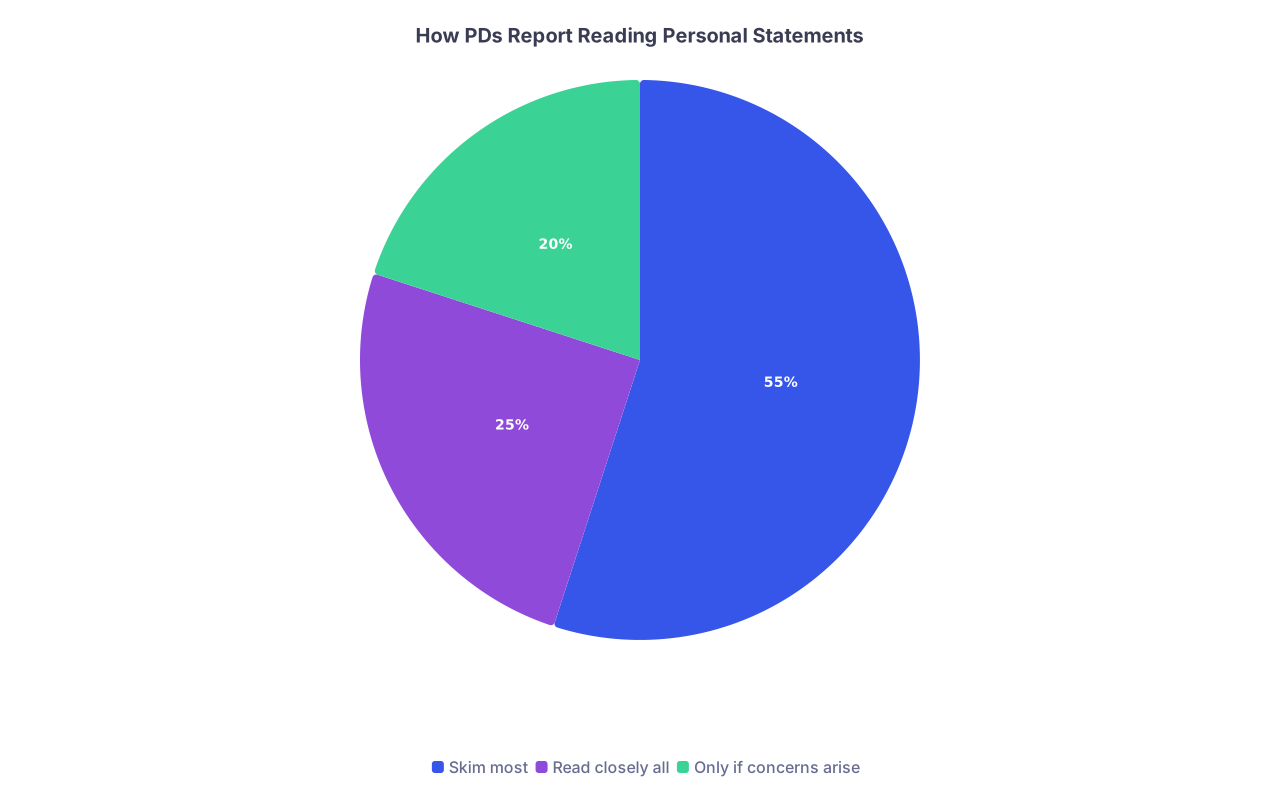
2. Reading behavior contradicts the “longer is better” myth
Informal polling and talks from PDs and faculty consistently reveal patterns like:
- Many skim personal statements unless something unusual stands out.
- Experience entries are scanned for roles, duration, and impact, not literary flair.
- Extremely long entries trigger skimming, not deeper reading.
| Category | Value |
|---|---|
| Skim most | 55 |
| Read closely all | 25 |
| Only if concerns arise | 20 |
Is this precise to the decimal? Of course not; this is an illustrative breakdown based on common PD comments and small surveys. But it captures the reality: most readers skim. And skimming punishes bloat.
The applications that stand out are not the ones with the most words. They’re the ones that are easiest to remember after reading 30 others.
Long vs Focused: What Actually Happens in a Reviewer’s Brain
Let’s walk through two extremes.
Applicant A: Maxes out everything
- 3,500+ characters in the personal statement
- Every meaningful experience extended to the max
- Marginal volunteer work inflated into mini-essays
- Repetitive “reflection” paragraphs tacked everywhere: “This taught me the value of empathy, teamwork, leadership, and patient-centered care…”
Applicant B: Focused, ruthless editor
- Personal statement ~2/3 of the character limit, tight and specific
- Experience descriptions short, concrete, impact-oriented
- Only “most meaningful” experiences get real narrative space
- No recycled clichés about “lifelong calling” every other sentence
Who looks stronger?
If you’re thinking “the one who shows more depth,” you’re right—but depth isn’t the same as length. Depth shows up when a reviewer can answer, quickly and clearly:
- Who is this person professionally?
- What do they actually do well?
- What do they care about in this specialty?
- Any concerns? Any clear strengths?
Applicant A often buries those answers under adjectives and generic reflections. Applicant B makes those answers obvious.
Faculty brains are pattern-recognition machines under time pressure. They’re hunting for:
- Signals of responsibility and follow-through
- Evidence of maturity and insight
- Red flags (or the absence of them)
- Concrete examples backing up your claims
Every extra paragraph that doesn’t add new signal is just static.
The Personal Statement: Where People Most Aggressively Sabotage Themselves
Let me take on a few specific myths.
Myth 1: “If I don’t fill the character limit, they’ll think I didn’t try”
This is the dumbest one, and still incredibly common.
I’ve read excellent statements that were 2/3 of the allowed length. I’ve also read absolute sludge that used every character.
Program readers are not counting characters. They’re asking:
- Does this answer why this specialty?
- Does this show how they’ve tested that interest in real life, not just vibes?
- Do I get any sense of how they think or work with others?
- Are there any unexplained issues that should have been addressed but weren’t?
Once those are answered, you gain nothing from generic filler. You only risk sounding like everyone else.
The most common killer? Generic closing paragraphs:
“I am excited to continue to grow as a compassionate, team-oriented physician and would be honored to train at your program.”
I have seen some version of that sentence in hundreds of statements. It carries no information. It’s verbal packing peanuts.
Myth 2: “I need to tell my entire life story”
No, you need to tell a coherent slice of your story that maps to your current professional identity.
Your reader does not need:
- Your childhood illness arc unless it clearly shaped real decisions and behavior later.
- Every country you traveled to on mission trips.
- A full rehash of your CV in prose form.
A strong personal statement does three things, efficiently:
- Shows why this specialty, with specifics
- Shows that your behavior over time matches that interest
- Shows how you function on teams and handle difficulty
That’s it. Everything else is optional.
Experience Descriptions: Where Brevity Actually Signals Maturity
People wildly overestimate how much prose is needed in the ERAS activities section. They treat each one like a mini-personal statement. That’s not how it’s read.
Reviewers scan for:
- Role and responsibility level
- Time commitment and duration
- Growth or impact
- Alignment with specialty or core professionalism
A surgical PD scrolling ERAS at 11 p.m. is not craving a paragraph about how serving on the wellness committee “deepened your appreciation of holistic patient care.” They want to know:
- Did you show up consistently?
- Did you organize anything?
- Can you work with others without drama?
| Style | Example Line for a Student-Run Clinic Role |
|---|---|
| Bloated | "In this profoundly meaningful role, I had the immense privilege of serving a diverse and vulnerable patient population, which taught me invaluable lessons about empathy, advocacy, patient-centered care, and the value of interprofessional teamwork." |
| Focused | "Led weekly student-run clinic sessions (3 yrs); organized staffing schedule, created new intake workflow that cut wait times ~20%." |
Which one gives you a clearer sense of what this person actually did?
The second one. Every time.
The first line is something anyone could write whether they did 10 hours or 300. The second line is anchored in action and outcome.
That’s the pattern you want: action + scope + impact. If you can do that in one or two lines, stop there. Don’t pad.
“Most Meaningful” Experiences: The Only Place Long Might Help
There is one part of ERAS where a bit more length can be useful: the “most meaningful” experiences. But even here, longer is not automatically better.
Here, extra characters make sense if you’re doing something specific with them:
- Explaining your decision-making or growth over time in that role
- Connecting it credibly to your specialty choice
- Showing how you respond to setbacks or complexity
Not recycling buzzwords. Not narrating a generic “patient who changed everything” story with no details that distinguish it from the thousands of others.
You’re allowed to be human here, but stay concrete. One good, specific anecdote beats three vague “this showed me the importance of…” paragraphs.
What Focused Storytelling Actually Looks Like
Let’s put numbers on this so it’s not theoretical hand-waving.
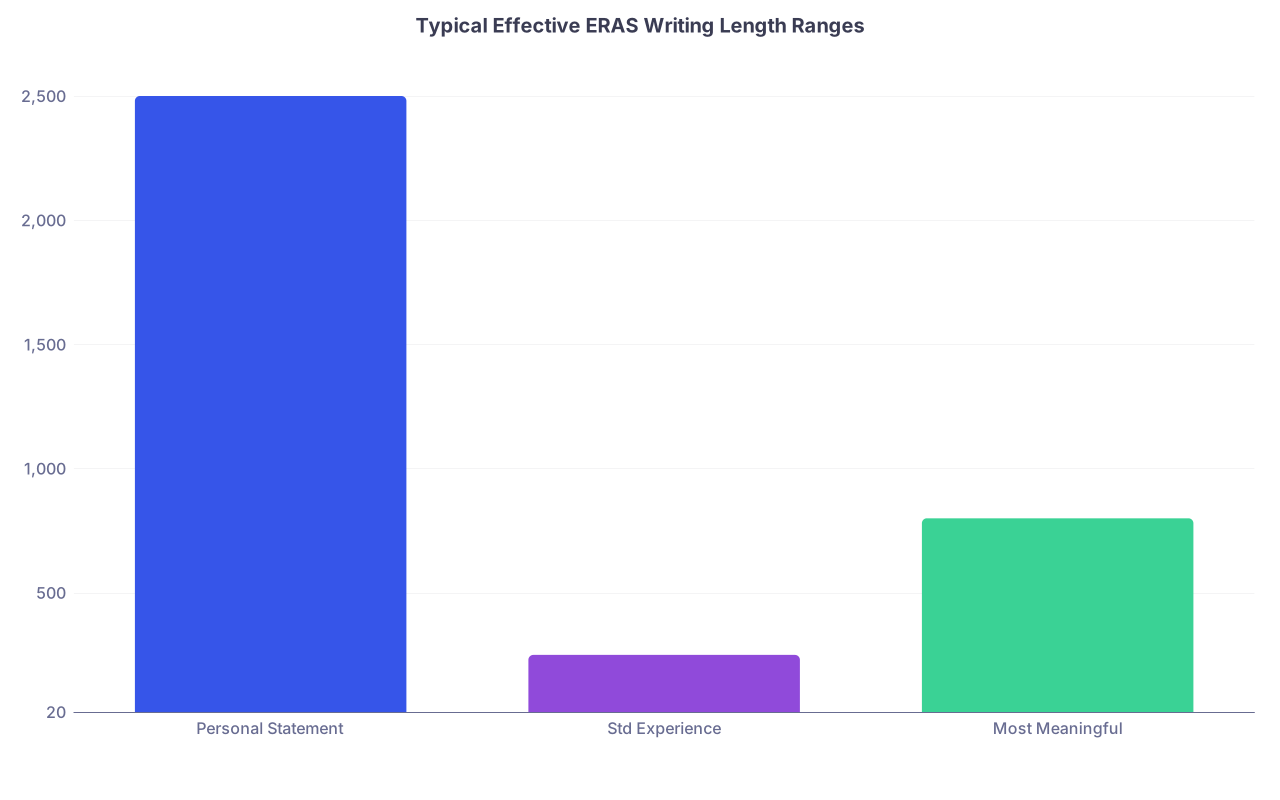
Approximate “healthy” ranges (not rules, but reality-based guardrails)
| Category | Value |
|---|---|
| Personal Statement | 2500 |
| Std Experience | 250 |
| Most Meaningful | 800 |
Roughly:
- Personal statement: Often strongest around 1.5–2.8k characters, not 3.5k with padding
- Standard experiences: 1–3 concise lines (maybe 150–300 characters)
- “Most meaningful”: Sometimes 600–1000 characters if you’re actually saying something new
Again, these are not hard caps or magic numbers. They’re approximate zones where:
- You have room to be specific
- But not enough room to ramble endlessly without noticing
If you’re at the upper limit on everything, you’re almost certainly bloated.
Why Applicants Gravitate to Maxing Out Word Counts
This obsession with using every character isn’t random. It comes from anxiety and a bad model of how selection works.
Pre-meds were trained to “do more, fill more, show more.” In undergrad, long essays often get more partial credit. In residency selection, that logic fails.
Residency programs are not grading you on effort. They’re triaging for:
- Safety (no red flags)
- Fit (does your trajectory match this specialty and program?)
- Signal (strengths that justify an interview invite)
Long entries feel “safe” to anxious applicants because empty space feels like missed opportunity. But to a tired reader, dense text blocks feel like work. Unnecessary work.
The real flex in ERAS is restraint plus clarity. Showing that you know what matters and you’re confident enough to leave white space.
A Simple Editing Test: Add, Then Subtract
When you draft, sure, write long. Get it out. But judging your application by first-draft length is like judging a painting halfway through.
The power move is what you cut.
Use this test on every paragraph and every experience entry:
- Does this sentence add a new piece of information, or is it a rephrased feeling/virtue?
- Could someone else with a very different career path write this same line?
- If I delete this line, does anything important actually disappear?
If the answer to #3 is “not really,” cut it. If lines are interchangeable with the average med student platitude, cut or rewrite.
You should be mildly uncomfortable with how much you delete. That usually means you’re getting closer to signal.
The Only Time “Too Short” Is a Real Problem
Let me be balanced here. Being concise doesn’t mean being cryptic.
You can go too short if:
- Your personal statement reads like a sterile bullet list of events with zero insight
- Your experience descriptions are just titles and no sense of what you did
- You don’t explain obvious red flags (course failures, leaves of absence, big gaps)
Programs don’t need maximum words, but they do need enough context to not feel like they’re taking a blind risk on you.
If your application raises questions and you aggressively avoid answering them anywhere, that’s not “focused storytelling.” That’s evasive.
Focused ≠ minimal. Focused = intentional.
Turning This Into a Practical Strategy
Here’s a tighter way to think about your ERAS writing:
- Use just enough space to be concrete.
- Spend more characters where you have more genuine depth.
- Refuse to pad weak areas with abstract reflection.
Structure your effort like this:
- Personal statement: prioritize specificity over origin-story drama.
- Experiences: one punchy line > three vague ones.
- “Most meaningful”: show actual growth, not just repeated adjectives.
- Red flags: address them clearly, briefly, without a sob story.
And yes, it is absolutely fine—often smart—to be under the character limit in multiple places if everything that needs to be said is already said.

| Step | Description |
|---|---|
| Step 1 | Draft Long |
| Step 2 | Identify Core Points |
| Step 3 | Cut Generic Lines |
| Step 4 | Add Specific Actions/Impact |
| Step 5 | Final Focused Version |
| Step 6 | Still Repetitive? |
This is what strong applicants actually do, whether they call it this or not.
FAQ (3 Questions)
1. Is it bad if my personal statement is only ~2,200–2,500 characters?
No. If it clearly answers why this specialty, shows your behavior matches that interest, and gives a sense of how you work with others, you’re done. Readers won’t penalize you for not filling space; they will penalize you (silently, by skimming) for padding.
2. Should I write long and then cut down, or aim for brevity from the start?
Write long first. Then be ruthless. Most people need a messy first draft to find their real story. The quality difference comes from editing—cutting clichés, tightening examples, and collapsing repetitive ideas into one clear sentence.
3. How many “most meaningful” experiences should I actually expand on?
Use them only where you have real depth: long-term roles, leadership, major research, or experiences that genuinely shaped your specialty choice or professional identity. If an experience was minor or generic, leave it as a short, factual entry and don’t force it into a “transformative” narrative.
Key takeaways:
More words do not equal more strength. Programs are hunting for clarity and concrete signal, not maximum character counts. Your job is not to fill space—it is to make your story the easiest one in the stack to understand, remember, and trust.