
Ignoring your subinternship feedback is one of the fastest ways to cap your residency ceiling.
Let me break this down specifically. Subinternships (AIs, acting internships, sub-Is—same thing) are the closest thing to a four-week audition you get before residency. Programs do not just care how you performed; they care how you responded to being evaluated, corrected, and pushed.
If you treat feedback as a box to check, your file will look flat: generic comments, vague praise, nothing that moves a rank list. If you mine that feedback strategically and act on it, you can convert a decent application into a strong one—even without a 260+ or Phi Beta Kappa halo.
We are going to talk about that second path.
1. Understand What Subinternship Feedback Actually Signals
Sub-I feedback is not one thing. It is three different signals that flow into your application.
- Real-time clinical performance (how you actually function on the team).
- Written evaluations that feed into your MSPE / Dean’s letter.
- Letters of recommendation, especially “this student did a subinternship with us” letters.
Each of those can be strengthened after the fact if you know how to use feedback correctly.
How programs read your sub-I feedback
Program directors do not read every line of every form. They skim for patterns and strong phrases. They want to know:
- Did you function at an intern level (even in a limited way)?
- Did you show growth across the month?
- Would this team trust you at 2 a.m. with a sick patient and no hand-holding?
- Did attendings and residents like working with you or merely tolerate you?
Here is what they do not care about:
“Shows up on time, eager to learn” as your top line comment. That is a baseline human expectation, not a strength.
They notice comments like:
- “Started the month needing significant guidance; by week 3 was independently developing appropriate plans.”
- “Sought feedback proactively and adjusted quickly—saw clear improvement in presentations and notes.”
- “Functioned at or near intern level in managing 4–5 patients; we would gladly have them back as a resident.”
Those phrases do not appear out of thin air. They appear when you deliberately use feedback all month long.
2. The Two Critical Types of Feedback You Must Capture
During a sub-I, feedback comes in two main flavors: formative (day-to-day, real-time) and summative (written evaluations and letters). You need both. And you need them aligned.
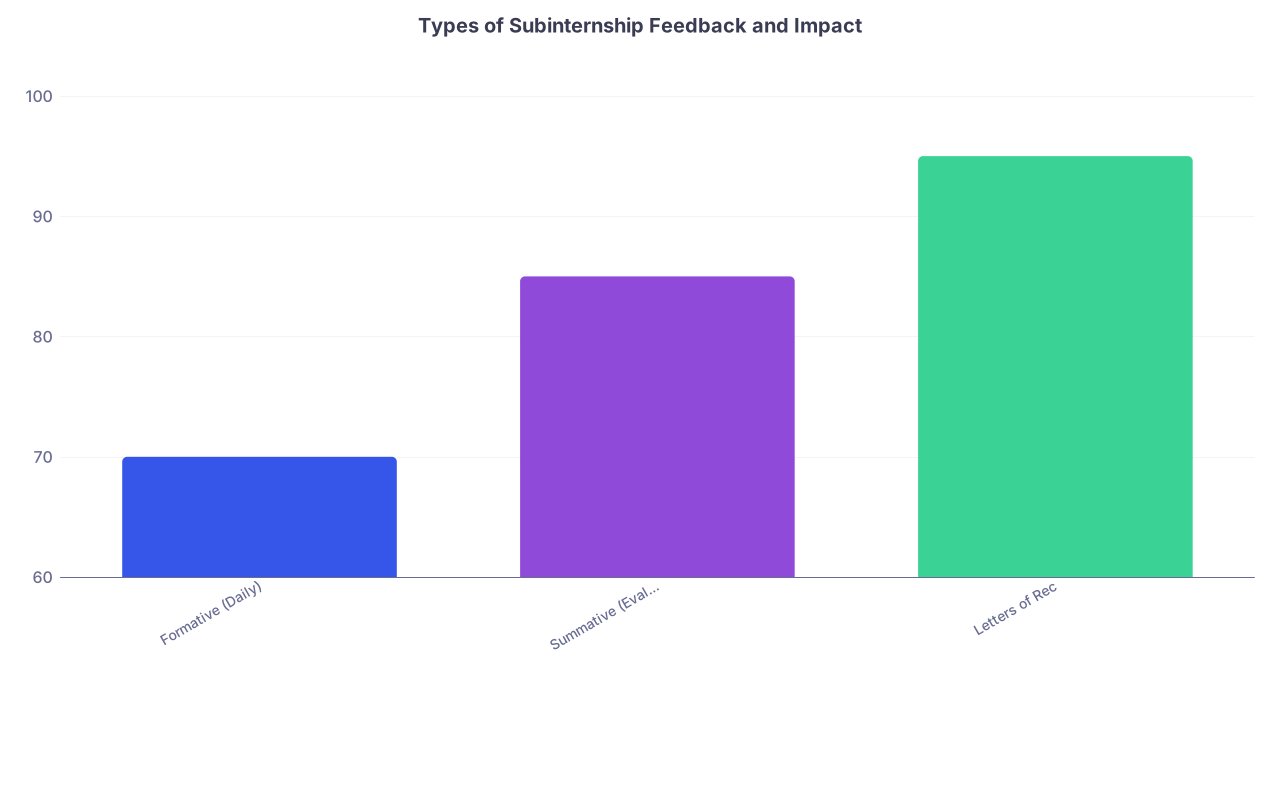
| Category | Value |
|---|---|
| Formative (Daily) | 70 |
| Summative (Eval Forms) | 85 |
| Letters of Rec | 95 |
Think of those numbers as “impact on how competitive you look for that specialty at solid programs.” Letters are king. But you never get a strong letter without showing a story of growth through formative feedback.
Formative feedback: the daily fuel
This is the “Can I give you some feedback?” moment. Or the resident catching you after rounds:
“Your plans are fine but your assessment is too long—cut to the chase.”
That feedback affects:
- How people talk about you in the workroom.
- What they remember when they sit down to write your evaluation.
- Whether they use the phrase “rapid improvement” in your letter.
The mistake I see constantly: students nodding, saying “thank you,” then changing nothing visible. Residents notice that. Attendings notice that. Your file shows it.
You need to:
- Ask for targeted feedback (we will get to scripts).
- Make a visible, specific change within 24–48 hours.
- Call it out: “I tried to shorten my assessments today like we discussed yesterday; is this closer to what you had in mind?”
Now the evaluator has a mental before/after. That is exactly what becomes a powerful sentence in your letter.
Summative feedback: what ends up on paper
Summative feedback is the stuff that actually lands in your MSPE, internal forms, and letters. It has three components:
- Numerical ratings (if your school uses forms).
- Narrative comments.
- Overall grade (Honors/HP/Pass etc.).
You have relatively little control over the grade at the end—by the time you ask “How am I doing?” in week 4, the die is cast. But you have considerable control over what kind of story the narrative comments tell.
Your goal: Convert “pleasant, hard-working student” into “identifiable growth arc and clear intern readiness.”
3. A System for Capturing and Using Feedback During the Rotation
You need a simple system. Not a 20-tab spreadsheet. Something you actually use at 9 p.m. after a call day.
Here is a lean structure I have seen work well.

| Step | Description |
|---|---|
| Step 1 | End of Each Day |
| Step 2 | Log 1-3 Feedback Points |
| Step 3 | Identify 1 Change for Tomorrow |
| Step 4 | Tell Senior/Resident Your Focus |
| Step 5 | Execute Change on Rounds |
| Step 6 | Ask for Quick Check-In |
| Step 7 | Week-End Review |
| Step 8 | Adjust Focus Areas |
Step 1: Daily micro-log
End of day. Two minutes. Nothing fancy.
Write:
- One thing someone explicitly corrected or suggested.
- One thing you did better than the prior day.
- One “next step” skill (e.g., manage sign-outs more independently).
Example entry:
- Feedback: “Your SOAP notes are too long; cut irrelevant data.”
- Better today: Asked to pre-round on 2 extra patients; still finished before team.
- Next step: Tomorrow, present assessment first, then supporting data.
You are not journaling emotions here. You are building a trail of specific behaviors. This is what you will use:
- In your mid-rotation check-in.
- When you ask for a letter later.
- In your ERAS experiences and personal statement.
Step 2: Proactive mid-rotation check-in
If your sub-I has no formal mid-rotation eval, you create one.
Script to your senior resident at the end of week 1 or 2:
“Can I get 5 minutes for focused feedback? I want to be sure by the end of the month I am functioning as close to an intern as possible. What are 2–3 specific things I should work on over the next week?”
Then shut up and write down what they say. Push for specifics:
- “When you say my presentations are disorganized—can you give me an example from today?”
- “How would an intern do that differently?”
- “If I fixed one thing in the next 3 days that would change the way you see me, what would it be?”
This does two things clinically (you get better) and one thing politically: it signals that you are coachable and ambitious. That exact phrase—“very receptive to feedback, clearly wanted to function at intern level”—shows up in letters when you behave like this.
Step 3: Visible follow-through
If someone tells you, “Own your patients more,” that is vague. You translate it into actions:
- Arrive with your own plan and contingency plan.
- Call the nurse yourself about an issue instead of punting to the resident.
- Page consults after the plan is confirmed, not waiting for someone to hand you the number.
Then, a few days later, you circle back:
“You mentioned earlier in the month you wanted me to own my patients more. I have been trying to independently handle pages and propose plans. Is that closer to what you meant, or are there other gaps I am not seeing?”
Now you are giving them language:
- “Started the month fairly dependent on the team; ended the month taking ownership of patient care.”
That line is gold in your file.
4. Turning Feedback into Stronger Evaluations and Letters
Let us get very concrete. How does all this feedback hustle translate into an objectively stronger application?
There are three main vehicles:
- The written evaluation on the sub-I.
- The letter of recommendation.
- How you frame your own narrative in ERAS.
The evaluation: seeding the right narrative
You cannot write your own evaluation, obviously. But you can seed the content.
People remember:
- Trajectories.
- Specific “moments.”
- Phrases they themselves used in feedback.
So, if your senior has said to you, “Your notes are finally at intern level,” that is exactly the phrase that tends to show up in written comments if you have reminded them of your growth later.
Near the end of the rotation, you can say:
“At the start of the month I remember you told me my notes were too long and scattered. I have been working on tightening them up and organizing assessments better. I feel more comfortable now, but I would really appreciate your perspective on how I have improved and what I still need to work on.”
You are not asking, “Please write this in my evaluation.” You are jogging their memory that there was a change. People write what they recall. You control what they recall by making your growth visible and explicit.
Letters of recommendation: converting growth into narrative
Strong letters do not just say “hard-working, team player, smart.” They tell a story.
Here is the difference:
Weak, generic sub-I letter:
“X is a bright and pleasant student who completed a subinternship on our service. They were punctual, professional, and well-liked by the team. I am confident they will make a good resident.”
Stronger, growth-focused letter:
“When X began their subinternship, their presentations were detailed but unfocused. We discussed strategies to prioritize assessment and plan, and within a week they were delivering concise, intern-level presentations. By the end of the rotation, they were managing a 5-patient census with appropriate independence, anticipating issues, and communicating effectively with nursing staff. This capacity for rapid development, combined with their calm, reliable presence, makes me strongly confident they will excel as an intern.”
You do not dictate that letter. But the second letter only happens if you (a) invite critical feedback, (b) actually improve, and (c) remind the writer of that arc when you request the letter.
When you ask for the letter, attach a short, tight reminder email including:
- Your dates on the rotation.
- 3–4 specific examples of feedback you received and how you addressed it.
- What you are applying to and why.
Something like:
“On the first week, you mentioned that my assessments were too narrative-heavy; after practicing the structure you suggested, I was able to present more focused plans later in the rotation. You also encouraged me to take more ownership of communication with nursing and consultants, which I worked on in the last two weeks by independently handling most of my patients’ pages. I would be grateful if you are able to comment on my growth and readiness to function as an intern.”
That is not manipulative. It is jog-the-memory-then-get-out-of-the-way helpful.
5. Using Sub-I Feedback Directly in Your ERAS Application
Most students underutilize sub-I feedback when writing their own materials. You should be doing the opposite.
Your feedback history gives you:
- Concrete examples for your personal statement.
- Stronger descriptions for ERAS “Experiences.”
- Talking points for interviews.
- A way to show pattern recognition across rotations.
Personal statement: show growth, not perfection
Programs do not want robotic perfection. They want learn-fast, self-correcting interns.
Instead of “I learned to be more efficient,” write:
“On my medicine subinternship, my senior pulled me aside after the first call day and told me I was ‘reporting everything and prioritizing nothing.’ I spent the next week practicing structuring my assessments and plans the way our interns did, starting with the clinical question and my proposed approach. By the end of the month, I could cover a 5-patient census in under five minutes, and I felt comfortable advocating for the plan I believed was best while staying open to correction.”
That is feedback leveraged into narrative. It shows humility, responsiveness, and concrete change.
ERAS experiences: translate feedback into skill language
In the description of a sub-I (or even a generic “Inpatient Medicine” entry), do not just say “participated in morning rounds and wrote notes.”
Instead:
“Functioned in an acting intern role managing 4–5 patients, integrating early feedback on presentation structure and note clarity to reach intern-level independence in daily care plans, order entry (where permitted), and direct communication with nursing and consult teams.”
You are essentially embedding the outcomes of feedback into your skillset description.
Interview: answering “Tell me about a time you received critical feedback”
This question is a layup if you actually used your sub-I feedback intelligently.
Bad answer: “I was told to be more confident, so I tried to be more confident.”
Better answer drawn from your logs:
“On my surgery sub-I, the chief told me I needed to stop trying to include every lab value in my pre-op presentations and instead lead with the operative plan and key risks. That day I went back and wrote out a 3-sentence template I practiced for each case. I asked him a few days later if the change matched what he had in mind, and he said, ‘Now you sound like an intern, not a third-year.’ That stuck with me—I have used that approach on every subsequent rotation and it has made my communication much more efficient.”
That sounds like someone who will not need months of remediation as a PGY-1.
6. Aligning Multiple Sub-Is: Showing a Cohesive Pattern
One sub-I is a snapshot. Two or three are a trend. You want that trend to scream:
- Coachable.
- Consistently improving.
- Intern-ready.
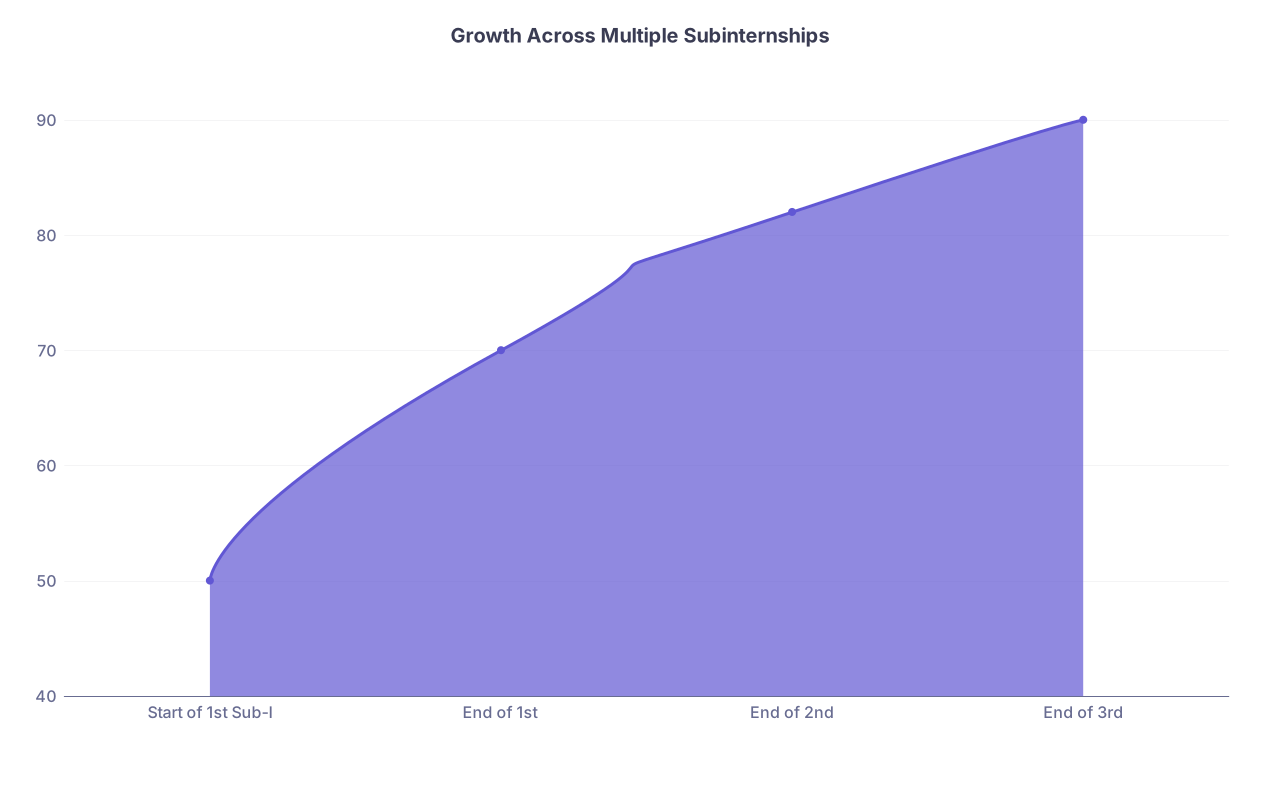
| Category | Value |
|---|---|
| Start of 1st Sub-I | 50 |
| End of 1st | 70 |
| End of 2nd | 82 |
| End of 3rd | 90 |
Think of that line as your “perceived intern readiness” over time. You want every rotation to nudge it upward.
Look for recurring themes
After each sub-I, look back at the feedback:
- Are you repeatedly hearing “too quiet on rounds”?
- Or “needs to anticipate next steps better”?
- Or “great with patients, could be more decisive with plans”?
If the same thing shows up twice, it is now your responsibility to fix it before the next one. Not the system’s.
Between sub-Is, set a 2–3 item “feedback plan”:
- In X rotation, I will focus explicitly on:
- Speaking first when asked for plans.
- Proactively checking results and updating residents without being asked.
- Tightening presentations to 2–3 minutes per patient.
Then at the next sub-I, tell your senior on day 1:
“One thing I am actively working on this month is being more concise and decisive in my plans—on my last sub-I I tended to over-explain. Please feel free to call it out early if you see me slipping into that.”
You have now told them exactly how to interpret your behavior: as someone intentionally improving, not someone oblivious.
When feedback is conflicting
Sometimes different teams give you opposite messages.
- One attending: “You need to be more assertive; speak up.”
- Another: “You are too aggressive; slow down and listen more.”
That is real. I have watched it happen more than once in the same month.
You do not contort yourself to please everyone. But you show you can calibrate.
Use this framing in interviews or in your own reflection:
“On one sub-I I was told I needed to take more initiative in proposing plans; on another I was told I sometimes moved too quickly without the full story. What I took from that is that assertiveness is only valuable when it is paired with curiosity. I have been practicing asking one or two focused clarifying questions before I propose a plan, which has helped me be both more efficient and more accurate.”
Programs like that kind of synthesis. It is mature and grounded.
7. Special Situations: Negative or Lukewarm Feedback
Not all feedback is flattering. Some of you had a sub-I that went sideways. The question is not “How do I hide this?” The question is “How do I prevent that from defining me?”

If you got mediocre feedback or a Pass
First: do not ask that person for a letter unless you have no alternatives.
Second: do a cold, unflinching review of what you were told.
Ask yourself:
- Was this about knowledge gaps you can close (e.g., weak in acid–base, arrhythmias)?
- Was it about professionalism/time management?
- Was it about communication style (too quiet, too dominant, disorganized)?
Then deliberately address it before the next sub-I. And when you succeed elsewhere, you can reference that in interviews:
“On my first sub-I I received feedback that my time management was not where it needed to be for an intern, particularly in pre-rounding. I took that seriously, spoke with other residents about their systems, and by my next rotation I was able to consistently pre-round on 5–6 patients and be ready for the team without staying far into the night. The feedback stung, but it forced me to adopt a better process that I still use.”
That is how you prevent one mediocre month from poisoning your file.
If you get frankly negative or personal feedback
If the feedback crosses into inappropriate or personal territory (you know what I am talking about—comments about your background, identity, or irrelevant nonsense), document it and discuss it with your dean’s office. That is not “feedback to work on”; that is a professionalism problem on their side.
For standard, harsh-but-legit critiques though, own them. You do not need to volunteer every failure in your application, but you must not repeat the same pattern twice. Programs notice repeated patterns.
8. Practical Tools: Scripts, Logs, and Structures
Here is where we make this operational for you, not theoretical.
Simple weekly feedback log template
You can copy this into a notes app:
Week X – Service Y
- Biggest piece of feedback I received:
- One example of how I applied it:
- Result (what changed for me or the team):
- What I want my senior/attending to be able to truthfully say about me at the end of this week:
Keep each bullet to one or two sentences. This becomes a goldmine when you write ERAS or ask for letters months later.
Feedback request scripts you can actually say
To attending at end of clinic or rounds:
“Dr. __, can I get 2 minutes of specific feedback? I am working on functioning at an intern level and would appreciate one thing I should start doing, stop doing, or change for the rest of the month.”
To senior on call:
“You work with a lot of sub-Is. Compared to others at this point in the rotation, what is one thing I could do in the next week that would make you more confident in me as a future intern?”
These are targeted and show you are not fishing for compliments.
Letter request email skeleton
Subject: Letter of Recommendation – [Your Name], [Rotation, Month/Year]
Body:
- 1–2 sentences reminding them who you are and when you worked with them.
- 1 short paragraph with 3–4 concrete, feedback-linked examples of your growth.
- 1 sentence about your specialty choice and what you hope they can comment on.
- Thank you + attached CV.
You are not writing your own letter. You are supplying them raw material they can either use or ignore. But most appreciate the reminder.
9. Comparing Two Students: Who Actually Leveraged Feedback?
Let me put two archetypes side by side. You have seen both on your rotations.
| Feature | Student A: Passive Receiver | Student B: Feedback Leverager |
|---|---|---|
| Feedback-seeking | Rarely asks | Structured weekly check-ins |
| Response to critique | Nods, minimal change | Visible adjustments in 24–48h |
| Growth described in evals | “Consistent performance” | “Rapid improvement” |
| Letters of recommendation | Generic, short | Narrative, specific, strong |
| ERAS/PS use of feedback | Absent | Concrete growth stories |
| Program director impression | Fine, average | Coachable, high-ceiling |
Student B does not necessarily have a higher Step score. Sometimes they do not even have better raw knowledge. But they almost always match better.
Because residency is four years of high-speed feedback. Programs are betting on who will adapt fastest, not who knows the most nephron physiology on day one.
10. Visualizing Your “Feedback to File” Pipeline
One last way to think about this. You want a clean, unbroken pipeline from “feedback received” to “file strengthened.”

| Step | Description |
|---|---|
| Step 1 | Feedback on Sub-I |
| Step 2 | Daily Log |
| Step 3 | Behavior Change on Rotation |
| Step 4 | Stronger Evaluations |
| Step 5 | Better Letters |
| Step 6 | Concrete Stories for ERAS/PS |
| Step 7 | Program Director Reads Strong Narrative |
| Step 8 | Higher Rank List Position |
Any break in that pipeline—and your hard work evaporates into “pleasant, hardworking student” mediocrity on paper.
Your job is to keep the pipeline intact. Every month. Every sub-I.

FAQ (Exactly 6 Questions)
1. What if my subinternship did not have any formal written feedback available to me?
You still had informal feedback. Go back through your memory and reconstruct specific corrections, suggestions, and “you’re doing better at…” comments. Write them down now. For ERAS and interviews, you do not need the official written comments; you need concrete stories of how you responded to feedback and changed your behavior. For letters, when you email your attendings, you can reference those remembered moments and how you acted on them. That gives them material even if you never saw the formal form.
2. Should I ever correct or push back on feedback from a resident or attending?
Yes, but very selectively and tactfully. If feedback is factually wrong or based on a misunderstanding, you can clarify: “I think I may have miscommunicated earlier—what I intended was X.” But in most cases, your first move is to understand, not to defend. Ask for examples: “Can you give me a specific instance where that showed up, so I can see what you are seeing?” If after that you still disagree, mentally note the difference in style or expectation. Then calibrate to this team’s expectations for the duration of the rotation. You do not win points in a sub-I by debating your seniors.
3. How many sub-I letters do programs expect, and does the quality of feedback matter more than the number?
For most core specialties (IM, peds, surgery, etc.), 1–2 strong sub-I letters is usually enough, alongside a department or chair letter if your specialty expects one. Quantity beyond that rarely helps. A single, vivid, growth-focused letter from a sub-I where you clearly leveraged feedback is more powerful than three bland “hard-working” letters. I would rather see one letter that says “grew into an intern-level role” than multiple letters that read like copy-paste “meets expectations.”
4. Can I use negative feedback as a primary story in my personal statement, or does that raise red flags?
You can, if you handle it correctly. Programs do not penalize you for having ever struggled; they penalize you for staying stuck or blaming others. If you use negative feedback, be precise and brief about the problem, then spend more space on what you did about it and how you are different now. Do not pick a catastrophic professionalism failure as your centerpiece. A clinical performance or communication issue that you corrected and then demonstrated improvement on another rotation is much safer and often compelling.
5. What if I did my sub-I at a place I am not applying to—does that feedback still help my file?
Absolutely. The value of sub-I feedback is not limited to home or target institutions. The letter from that site still counts. The growth stories still belong in your ERAS and interviews. And the skills you solidified (presentations, notes, patient ownership) transfer directly. Programs care that you have functioned in an acting-intern role somewhere credible and used feedback well, not that it was at their specific hospital. If it was at a respected academic site, that can even be a bonus signal of external validation.
6. How do I handle a situation where my resident gave me great real-time feedback but my attending barely knew me and wrote a lukewarm eval?
Classic problem. The fix is upstream. On future sub-Is, you deliberately create more exposure to the attending: volunteer to present on your patients, ask one or two high-yield questions about management, and request brief feedback directly from them mid-rotation. For the current situation, if the resident was the one who actually saw your growth and they are eligible to write letters, ask them for the letter, not the attending. In your ERAS descriptions and interviews, you can still use the concrete feedback-and-growth examples from that month, regardless of what the attending wrote. The story of how you changed is still yours to tell.
Key Takeaways
- Subinternship feedback is only valuable if you convert it into visible behavior change that people remember and write about.
- A simple system—daily logging, proactive mid-rotation check-ins, and targeted follow-through—turns generic “hard-working” comments into specific “intern-ready, rapid growth” narratives.
- The best residency files weave sub-I feedback into evaluations, letters, ERAS entries, and interview stories to show one thing clearly: you learn fast and you get better.