
The worst residency applications are not weak. They are incoherent.
What “Clinical Theme” Actually Means
Let me be precise. Program directors are not looking for “well-rounded” in the vague premed sense. They are looking for pattern recognition: does your file tell a consistent story about who you are as a future physician?
A coherent clinical theme is that story.
It is the through-line that connects:
- How you chose and sequenced your clerkships and electives
- The patients and pathologies you cared enough to write about
- The research and QI projects you picked
- The leadership and teaching roles you took on
- The letters you requested
- The way you talk about all of this in your personal statement and interviews
Done well, your application makes a reviewer think:
“Of course this person is applying to our field. This trajectory makes sense.”
Done poorly, you look like someone who woke up in August of fourth year and said, “I guess…internal medicine?”
Let me walk through how to build that theme, not just retroactively describe it.
Step 1: Define Your Theme Before You Chase Rotations
Most students start backwards: they sign up for rotations, then try to stitch together a theme later. That is the slow, painful way.
Start with a working hypothesis. Not a life mission. A specific clinical identity that is believable for someone at your stage.
Examples of strong, concrete themes:
- “Physician for complex, underserved adults with multiple chronic conditions” (IM)
- “Patient-centered surgeon focused on oncologic care and multidisciplinary teams” (Surgery)
- “Clinician-educator in academic pediatrics with an interest in medical education and communication” (Peds)
- “Generalist family physician with a focus on rural continuity care and addiction medicine” (FM)
- “Emergency physician interested in systems, triage, and prehospital care” (EM)
Notice what these are not:
They are not “I like science and people.” They are anchored in patient type, setting, or role.
You need three elements:
- Clinical domain – the specialty and core environment (inpatient, outpatient, OR, ED).
- Population or problem – who you are drawn to (kids, geriatrics, underserved, cancer, trauma, etc.).
- Professional role – what kind of physician you see yourself as (diagnostician, proceduralist, educator, systems person, community doc, etc.).
You do not have to be certain this will be your life for 30 years. You only need a clear enough story that your choices in M3–M4 look intentional.
Step 2: Align Core Clerkships With Your Emerging Identity
You do not control the order of all core rotations. But you have more control than you think over how each one supports your theme.
Two realities:
- Program directors skim your clerkship comments and grades ruthlessly.
- They are asking: “Does this performance fit the kind of resident we need?”
Your job is to use every core clerkship to generate evidence for your clinical theme. Even in rotations outside your chosen field.
Let me break it down by examples.
If your theme is: complex adult medicine (Internal Medicine)
On:
Internal Medicine:
- Seek patients with multi-morbidity, social complexity, frequent readmissions.
- Volunteer for longitudinal follow-up: call families, update consultants, write detailed notes.
- Ask attendings to comment on your diagnostic reasoning and follow-through in evaluations.
Surgery:
- Focus on peri-operative medical care, optimization, and handoffs.
- Be the student who knows the medicine: anticoagulation plans, diabetes management, delirium risk.
Psych:
- Learn to manage functional symptoms, depression in chronic disease, adherence issues.
Family Med / Outpatient:
- Emphasize continuity, preventative care, and coordinating care among specialists.
You are showing: “Wherever I am, I see the whole patient and track complex cases.”
If your theme is: surgical oncology track (General Surgery)
On:
Surgery:
- Ask to rotate on oncologic services if available (HPB, colorectal with cancer cases, breast).
- Follow patients from clinic → OR → post-op visits.
- Make your case presentations tight and structured around staging, margins, adjuvant therapy.
Internal Medicine:
- Understand chemo-related complications, nutritional issues, palliative conversations.
OB/GYN:
- If exposed to Gyn Onc, pay attention. Volunteer for those cases. Learn staging systems.
You are showing: “I function well in procedure-heavy, team-based, longitudinal cancer care.”
The important point: you interpret each rotation through the lens of your theme, then behave accordingly.
Step 3: Electives – Where Your Theme Becomes Obvious
Electives are not random sightseeing. They are most powerful when they look like chapters in the same book.
Think in three categories:
- Home specialty depth – “I know what I am signing up for.”
- Adjacent skills – areas that logically complement your niche.
- Exploratory but explainable – outliers you can justify in one sentence.
Here is how that looks concretely.
| Theme | Core Elective | Adjacent Elective | Explorable but Coherent |
|---|---|---|---|
| Complex adult IM | Sub-I in IM | Nephrology consults | Palliative care |
| Surgical oncology | Surgical oncology | GI oncology clinic | Radiology (body imaging) |
| Rural FM | Rural FM elective | Addiction medicine | OB ultrasound |
| Pediatric academician | Peds wards sub-I | Peds heme/onc or NICU | MedEd elective |
If I scan your ERAS and see:
- IM Sub-I
- Nephrology
- Cardiology consults
- Palliative care
- QI elective on readmissions
I immediately know: “They are serious about inpatient complex care.”
If instead I see:
- Derm
- Anesthesia
- Cardiology
- Ortho
- Pathology
I think: “This person could not decide what they wanted.” Your personal statement will have to work much harder to convince me.
Step 4: Activities That Quietly Scream Your Theme
Now we move beyond rotations. The strongest applicants make their side activities fit the same pattern.
You want convergence from:
- Research / QI
- Teaching and leadership
- Volunteer work
- Scholarly projects (posters, abstracts, curricula, etc.)
Let us go specialty by specialty for a minute.
Internal Medicine–leaning student
Theme: “Hospital-based generalist with interest in systems and safety”
Aligned activities:
- QI project on 30-day readmissions, VTE prophylaxis adherence, or discharge summaries
- Research on diagnostic error, hospital medicine outcomes, or sepsis protocols
- Committee role in hospital safety council or M&M reviews as student rep
- Teaching sessions for juniors on “Approach to shortness of breath / chest pain”
Misaligned time sink:
- Random basic science bench research entirely disconnected from your clinical life, with no adult medicine tie, and no way to explain why you spent two years on murine models of retinal degeneration if you are now pitching yourself as a hospitalist.
Family Medicine–leaning student
Theme: “Continuity primary care with addiction and mental health focus”
Aligned activities:
- Longitudinal clinic following a panel of patients across M3–M4
- Street medicine or mobile clinic outreach
- MAT (medication-assisted treatment) clinic involvement
- Peer teaching on motivational interviewing or brief intervention
- QI on depression screening or follow-up in primary care
Again, the rule is: if I cover up your name and just read your activities, would I correctly guess your specialty and sub-interests?
If the answer is no, you do not yet have a coherent theme.
Step 5: Letters of Recommendation That Match the Story
Letters are where your theme either solidifies or falls apart.
I have seen this scenario too many times:
Applicant claims in their personal statement to be “passionate about primary care and continuity,” and then their strongest letter is from an ICU attending raving about how they should be a critical care doc. The dissonance is obvious.
You want:
- At least two letters from your primary specialty that speak to the same qualities your theme highlights.
- One letter (if possible) that shows the adjacent skill: systems thinking, procedural ability, teaching, etc.
- Very few truly “random” letters outside your specialty unless they reinforce something core (work ethic, clinical reasoning).
Tell your letter writers your theme. Literally.
“Dr. Smith, I am applying to IM with a focus on complex, underserved patients and continuity. I would be grateful if, where appropriate, you could comment on how I managed complex cases, my follow-through, and my communication with families.”
Good attendings appreciate this clarity. They are not offended.
Step 6: Weaving It All Together in ERAS and Your Personal Statement
Now you have the raw material. The worst thing you can do is dump it into ERAS with generic descriptions.
You have to frame each activity through your theme.
ERAS experiences
In each description:
- Start with the blunt fact (what it was).
- Highlight the specific role you played.
- Tie one sentence to your emerging identity.
Example for a QI project (IM theme):
“Leading a multidisciplinary QI project to reduce 30-day readmissions for heart failure patients on the general medicine service. I coordinated data collection, presented at monthly meetings, and piloted a new discharge checklist. This experience sharpened my interest in hospital-based systems improvement and continuity beyond discharge.”
Example for a free clinic (FM theme):
“Volunteered weekly at a student-run free clinic providing primary care to uninsured adults. I focused on longitudinal follow-up, often seeing the same patients over 6–12 months, which deepened my commitment to family medicine and chronic disease management in underserved communities.”
Same activity. Very different framing depending on your theme.
Personal statement
Your statement should not re-list everything on your CV. It should explain why the pattern exists.
Structure that works:
- A clinical vignette that fits your theme (not a dramatic resuscitation story unless EM/ICU).
- A short reflection that connects that patient to a broader pattern in your training.
- Two or three concrete experiences (rotation, project, role) that show your engagement with that pattern.
- A final paragraph that clearly states: “This is the kind of resident and future physician I aim to be.”
If you are doing this right, your personal statement should feel inevitable after someone has skimmed your ERAS. Not surprising.
Step 7: Handling Changes of Heart Without Looking Chaotic
Plenty of students pivot specialties. That is not the problem. The problem is leaving behind a trail of activities that suggest you have no idea who you are.
You can salvage a pivot if you are honest and strategic.
Picture this: You spent M2–M3 doing neurosurgery research, then realized you actually love Neurology.
You could frame it like this:
- Emphasize the neuro content (complex neurologic disease, neuroanatomy, long-term functional trajectories).
- Downplay the “I love the OR” rhetoric.
- Highlight patient-centered aspects you preferred (longitudinal care, clinic conversations, stroke rehab decisions).
- Add Neurology sub-I, clinic elective, and a targeted Neuro letter to bring your theme up to date.
Where you get into trouble is trying to pretend your previous track never existed. Reviewers are not stupid. Better to say, implicitly: “Here is how my experience in X genuinely prepared me for and directed me toward Y.”
Same if you flirted with EM then picked IM. You highlight:
- Acute care interest
- Love of undifferentiated complaints
- Growing preference for continuity and longitudinal problem-solving
- IM rotations and projects that show you followed through on that realization
The theme is allowed to evolve, but it cannot be random.
Visual: How Your Theme Should Emerge Over Time
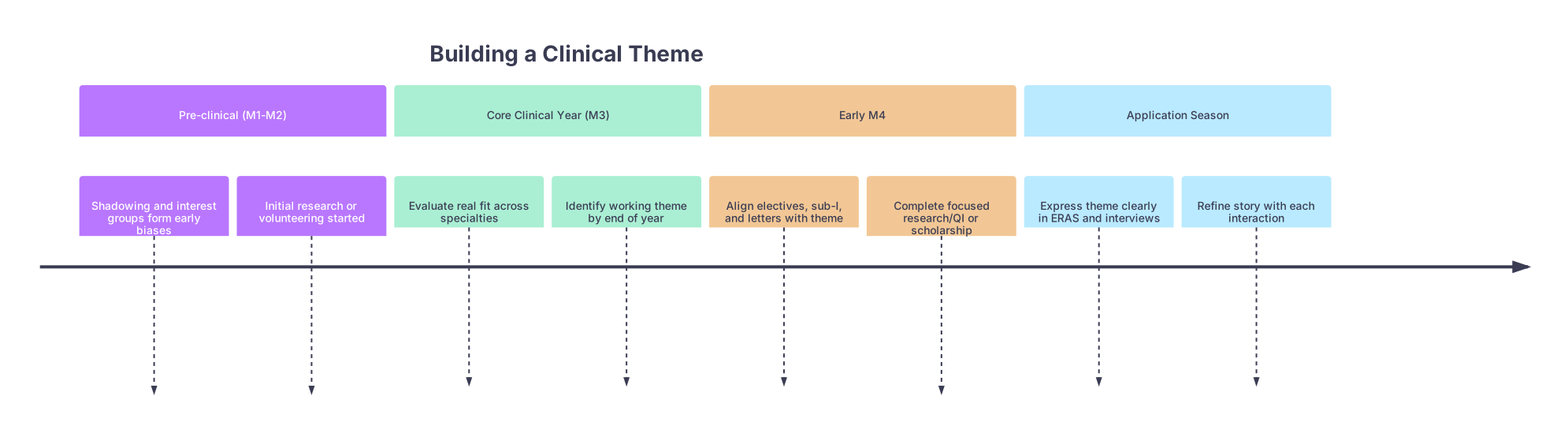
The key inflection point is late M3. If you are still “keeping all options open” in August of M4, you are behind.
Step 8: Avoiding the Common, Theme-Destroying Mistakes
Let me be blunt about the patterns that hurt applicants.
1. The “collector” mentality
Some students treat rotations like stamps in a passport. They want one of everything.
The result: nothing is deep. Everything is surface-level. Under-read, under-involved, forgettable comments.
Better to be very strong in your primary track and reasonably competent elsewhere than uniformly average everywhere.
2. Hoping charisma will patch incoherence
“I am great in person, I will explain it in the interview.”
No. You may never get the interview. The screeners make decisions off 10–15 minutes per file, sometimes less. If your written application does not show a pattern, you will not reach the point where your charm matters.
3. Overloading on research that does not match your clinical self
Research is not inherently good. Incoherent research is actively bad.
Examples that raise questions:
- Four derm papers then an application to General Surgery with zero surgical exposure.
- Two years of wet lab oncology work then a last-minute EM application with no acute care projects.
You can fix this by:
- Adding at least one scholarly piece that clearly matches your specialty.
- Being ready with a clean explanation: “I learned X, realized Y, and here is how those skills carry over.”
4. Listing everything you ever touched
The experiences section is not an honesty contest. It is a curation exercise.
If something does not support your theme or your character as a future resident, it can be cut or minimized. You are not obligated to mention the three-week summer camp from M1 that you barely remember.
How Program Directors Actually Read Your File
Let me pull back the curtain a bit.
Most PDs and selection committee members do a pattern pass:
- Step scores / COMLEX / MSPE comments – are you safe to interview?
- Clerkship narrative comments – do you function on the wards?
- Activities – do these look coherent with the specialty?
- Letters – do they confirm the picture?
- Personal statement – does the story make sense or does it feel fabricated?
They are not trying to catch you lying. They are assessing fit and trajectory.
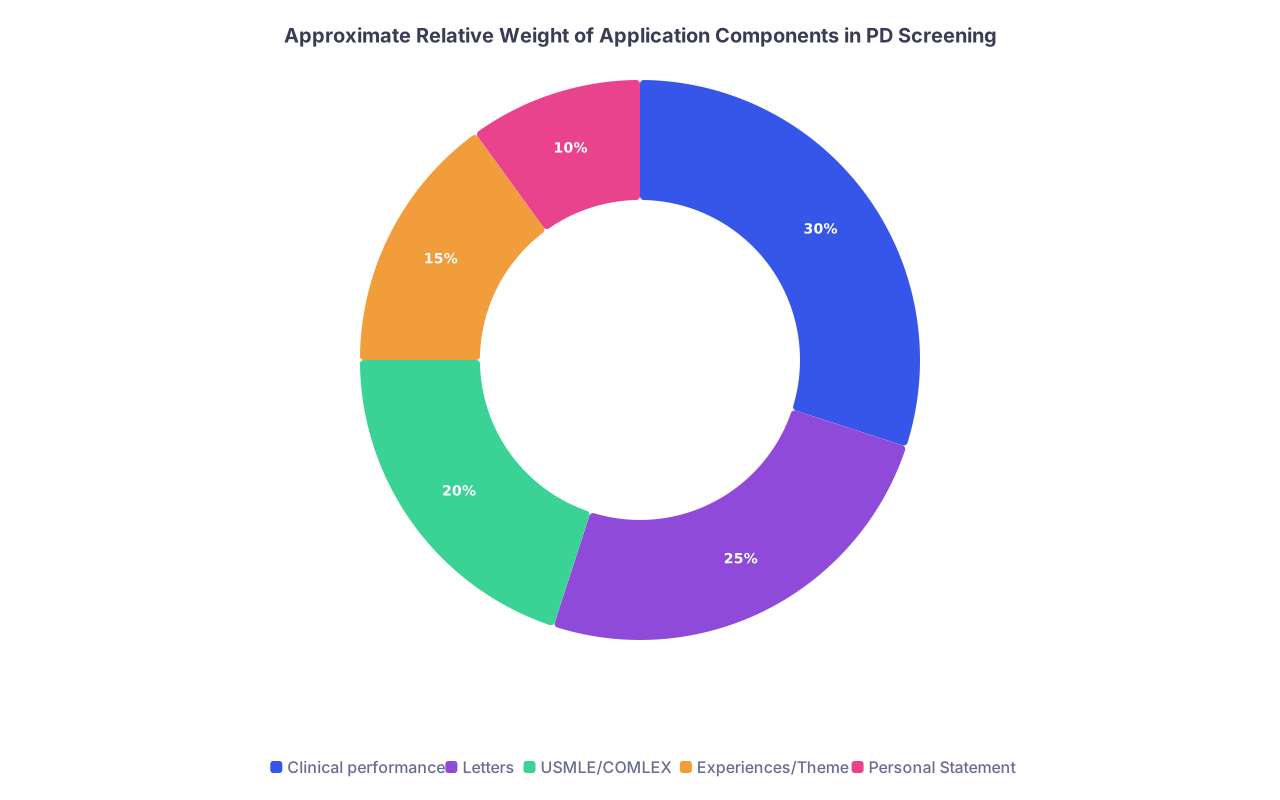
| Category | Value |
|---|---|
| Clinical performance | 30 |
| Letters | 25 |
| USMLE/COMLEX | 20 |
| Experiences/Theme | 15 |
| Personal Statement | 10 |
Those percentages are not official, but they are roughly how many PDs actually behave.
Your “theme” lives in:
- Which rotations you chose
- What your evaluations say you did on them
- What your activities and letters highlight
- How you frame all of it
That bundle is roughly a quarter to one-third of how people think about you.
Ignoring it is reckless.
Concrete Example: Two Applicants, Same Scores
To make this painfully clear, here is a side-by-side.
| Feature | Applicant A (Coherent) | Applicant B (Scattered) |
|---|---|---|
| Specialty | Internal Medicine | Internal Medicine |
| Step 2 | 247 | 249 |
| Sub-I | IM at home program | IM at home program |
| Electives | Nephrology, Cardiology, Palliative | Derm, Radiology, Ortho |
| Research | Hospital readmissions QI | 1 Derm case report |
| Volunteering | Free clinic, longitudinal | One-time health fair, M1 |
| Letters | 2 IM, 1 Palliative | 1 IM, 1 Derm, 1 Surgery |
Who looks more like a future internist? Applicant A. Easily.
Applicant B is not a bad student. They simply look undecided and reactive. A recruiter has 60 seconds—Applicant A will get the interview invite first every time.
Integrating Theme Into Your Day-to-Day on Rotations
We have talked big picture. Let me end with ground-level tactics.
On any given rotation, you can:
- Ask the attending or resident for patients that match your interest (“I am heading toward IM and really want to work with complex, multi-morbidity patients if you have any you suggest I follow closely”).
- Offer to do a brief teaching session on a topic within your theme for the team.
- Identify a small QI or workflow issue and at least present a mini-project or idea (even if it never becomes formal).
- Follow up on “your” patients across settings—clinic, rehab, SNF, readmission. Document that continuity.
- Collect specific stories and feedback that later feed your MSPE, letters, and personal statement.
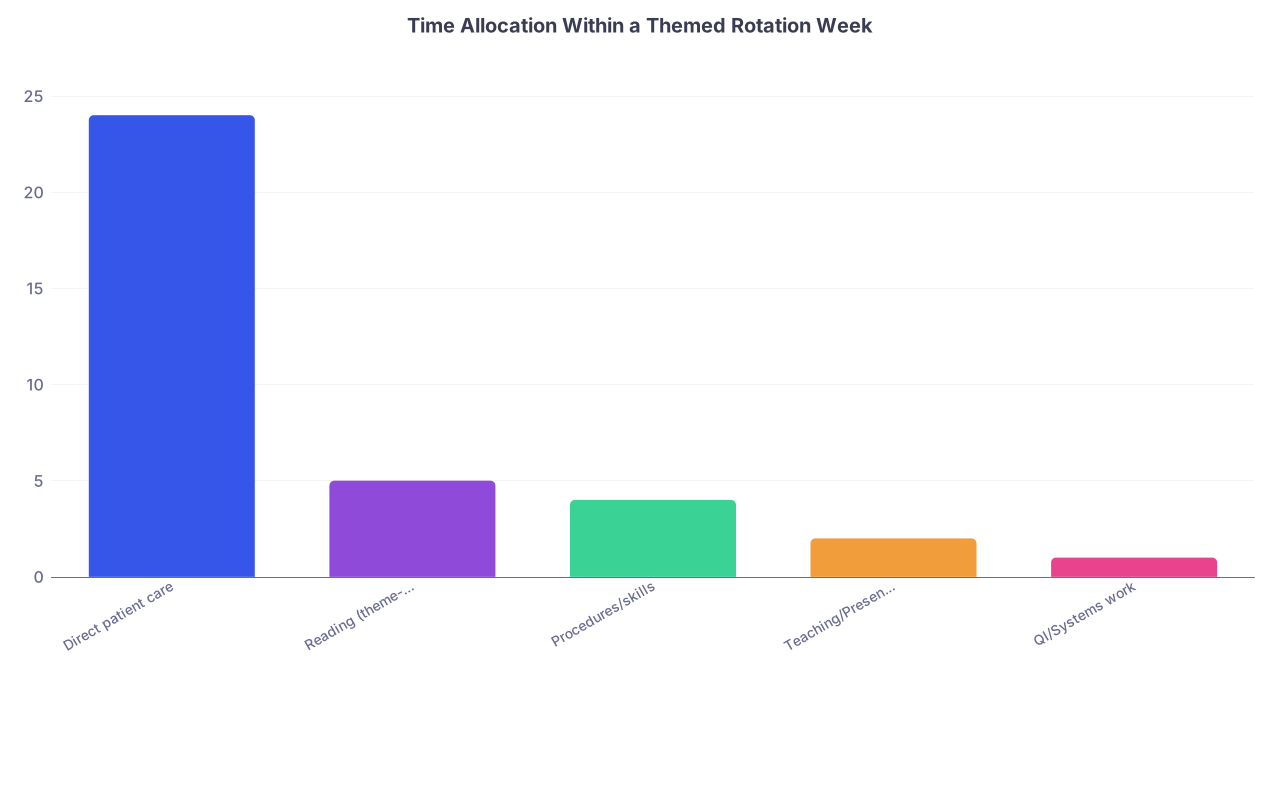
| Category | Value |
|---|---|
| Direct patient care | 24 |
| Reading (theme-focused) | 5 |
| Procedures/skills | 4 |
| Teaching/Presentations | 2 |
| QI/Systems work | 1 |
You will still be doing the same core tasks as your peers. You are just consistently biasing your marginal decisions toward your theme.
Do this for six months, and your application almost writes itself.
FAQ (Exactly 6 Questions)
1. Is it “fake” to build a theme if I am not 100 percent sure about my future niche?
No. What is fake is pretending you have no preferences. A theme is not a lifetime contract; it is a coherent explanation of why your current choices make sense. If your interests change later in residency, nobody will care that your M4 narrative was slightly different. What matters for the Match is that your present story hangs together.
2. How many electives should directly match my primary specialty versus adjacent fields?
For most applicants: two to three in your home specialty (including at least one sub-I) and one to three in clearly adjacent areas is ideal. The rest can be either true exploration or schedule pragmatics. If more than half your electives are in fields unrelated to your specialty, you need a very good explanation or some reframing.
3. Can I still match if my early research and activities do not match my current specialty choice?
Yes, if your later choices and framing are strong. You cannot erase your past, but you can: add at least one aligned scholarly project, lean on clinical performance and letters in your target field, and explicitly connect transferable skills from old work to your new direction. Reviewers forgive evolution; they dislike chaos.
4. How do I handle a “backup” specialty without diluting my theme?
You maintain one primary theme that is adaptable. For example: “I care about complex adult inpatients and systems of care.” That can be framed for IM or EM with minimal reframing. What you do not want is two completely unrelated narratives (e.g., derm researcher and aspiring trauma surgeon) in the same season. If you are applying to two specialties, your activities should plausibly support both, and you must be disciplined in crafting two tailored, internally consistent applications.
5. Do community programs care about “theme” as much as academic programs?
They do, but they use different language. Community PDs might call it “fit” or “knowing what they signed up for.” They want residents who are not going to be miserable because the job they wanted was actually something else. A clear theme tells them you understand the day-to-day work of their specialty, whether or not you plan to be heavily academic.
6. What if my school’s scheduling limitations made it hard to get ideal electives or sub-Is?
Then you explain constraints briefly and point to what you did control. Maybe you could not get an away rotation, but you secured a strong home sub-I and a clinic elective. Maybe you compensated with research or a longitudinal clinic. You do not whine about the system in your application; you highlight the pattern in what you were able to shape and let your letters and MSPE document any structural issues.
With a coherent clinical theme, you stop looking like a random assortment of rotations and bullet points and start looking like a future colleague. Build that through-line now, and by the time you hit interview season, you will not be scrambling to explain your path; you will be refining it. The next step is learning how to articulate that story across 10–15 different interviews without sounding rehearsed—but that, as always, is another conversation.