
Most students completely misread what program directors care about in the MSPE. They obsess over the wrong lines and ignore the parts that quietly kill—or save—their application.
Let me break this down specifically. The MSPE is not a love letter. It is a coded document written for program directors, by people who know how PDs read it. You are not the intended audience. Which is exactly why you and your classmates tend to fixate on narrative fluff while PDs are scanning for patterns, red flags, and code words.
We are going to walk through what actually gets noticed, what is skimmed, and what quietly screams “problem” even when everything sounds polite and professional.
How PDs Actually Read the MSPE

| Step | Description |
|---|---|
| Step 1 | Open MSPE |
| Step 2 | Scroll to Summary / Overall Assessment |
| Step 3 | Check Class Rank / Quartile if available |
| Step 4 | Scan Clinical Rotation Performance Grid |
| Step 5 | Look for Failures / LOA / Remediation |
| Step 6 | Skim Narrative Comments for Patterns & Red Flags |
| Step 7 | Check Professionalism / Deans Comments |
| Step 8 | Decide: Comfortable to Interview or Pass |
The fantasy is that PDs read your MSPE line by line. The reality: most are speed-reading with a mental checklist.
Here is the usual sequence:
- Overall summary / comparative statement
- Any visible class ranking / quartile / decile
- The “grid” of clinical grades and any code legend
- Flags: failures, leaves of absence, professionalism issues
- Rotation narratives for clinical years (especially core clerkships)
- Dean’s/summary comments at the end
Some PDs barely look at your preclinical comments unless there is an obvious concern. Many will not read every narrative. They look for patterns: “solid across the board,” “big discrepancy between shelf and clinical,” “one bad rotation vs many,” “consistent professionalism mentions—or conspicuous silence.”
Your job is to understand which signals matter in each of those sections.
The Comment Types PDs Actually Pay Attention To
There are three broad flavors of comments in the MSPE:
- Boilerplate filler
- Soft-coded concerns
- True standouts or red flags
Let me be blunt: PDs barely register boilerplate. They zone in hard on the other two.
1. Boilerplate: What PDs Skim Past
Every school has its generic praise phrases. You know them:
- “Pleasure to work with”
- “Will be an asset to any residency program”
- “Demonstrated solid fund of knowledge”
- “Works well with team members”
I have watched PDs do this: they literally skim past these phrases without their eyes even fully focusing. Why? Because they see them on 90% of MSPEs.
What typically lands in the “background noise” bucket:
- Generic adjectives: “nice,” “hardworking,” “motivated,” “pleasant.”
- Non-specific “team” comments: “a team player,” “good team member.”
- Vague cognitive praise: “good knowledge,” “performs at expected level.”
- Anything obviously copied-and-pasted, especially if repeated across rotations.
If your comment would fit on almost anyone’s MSPE, it does not distinguish you. That is not bad. It is just not what moves the needle.
2. Soft-coded Concerns: The Stuff PDs Are Trained to Catch
Here is where things get interesting. Faculty and deans do not usually write: “This student is below average and we were worried.” Instead, they use coded language that PDs have seen a thousand times.
Common soft-coded concerns:
- “Improved over the course of the rotation.”
- “Required more supervision early in the rotation.”
- “Will benefit from continued refinement of time management/organization.”
- “With additional experience, will develop more efficient patient care skills.”
- “Needed guidance to prioritize tasks and patient care responsibilities.”
- “More comfortable in one-on-one settings than in busy clinical environments.”
These are not compliments. They are warnings, written in nice clothes.
When PDs see:
- “Improved steadily” = started below where we wanted.
- “With additional experience…” = not there yet, lagging peers.
- “Needed significant direction” = independent function was a concern.
- “Had some difficulty integrating feedback at times” = defensive, rigid, or uncoachable.
You will not see the word “problem.” But PDs read this as: “Do not rank highly unless desperate” or “Could be risky in a small program with thin supervision.”
This also applies to comments about communication or professionalism. For example:
- “May occasionally appear quiet or reserved” → sometimes code for disengaged or hard to assess.
- “At times, needed reminders about timely completion of documentation” → borderline reliability.
- “Was reminded to maintain professional boundaries” → major yellow flag.
If a phrase feels oddly specific or a little off, assume PDs have seen that exact wording as a euphemism before.
3. Standout Phrases That Actually Impress
Now the good side. There are phrases that immediately catch a PD’s attention and push someone from “generic solid” to “very comfortable” or “definitely interview.”
Strong signals:
Comparison at the peer level:
- “Among the top students I have worked with in the last several years.”
- “In the top 10% of students I have supervised.”
- “One of the strongest [specialty] students in this graduating class.”
Autonomy and trust:
- “Functioned at the level of an intern by the end of the rotation.”
- “Required minimal supervision for day-to-day patient care tasks.”
- “I would be comfortable having this student as an intern on my service.”
Initiative and ownership:
- “Took ownership of her patients; families sought her out for updates.”
- “Consistently volunteered for new tasks and handled increased responsibility well.”
Reliability and professionalism—when described concretely:
- “Never missed a deadline; notes and orders were consistently timely and accurate.”
- “Calm and composed during high-acuity situations; stabilized anxious families and nursing staff.”
PDs notice specific, comparative, and concrete comments. If a faculty member sticks their neck out with “top 10%,” that matters more than three paragraphs of vague enthusiasm.
The Code Systems, Grids, and Rankings PDs Rely On
Beyond narrative comments, the less glamorous parts of the MSPE—the tables, codes, and legends—are often what PDs use to quickly stratify applicants.
Clinical Grade Grids: Where You Actually Get Sorted
Most schools now include some kind of clinical performance grid: clerkships down the left, final grades across the top (Honors / High Pass / Pass / etc.), with counts and/or shading.
PDs scan these grids fast:
- Number and distribution of Honors / High Pass in core clerkships
- Outliers (one bad clerkship vs pattern)
- Where your target specialty sits in that pattern
A typical internal medicine PD reviewing a grid:
- Strong applicant: Honors in IM, Surgery, Peds, with maybe a High Pass in OB/Gyn, Pass in Psych.
- Borderline: Pass in IM and Surgery, with one or two Honors in less relevant fields.
- Concerning: Multiple Passes in core “heavy” clerkships (IM, Surgery), especially if pattern persists into sub-I.
The details of the code legend matter. Some schools only give Honors to 10–20% of students; others to 40–50%. PDs know this and often have cheat sheets for major feeder schools.
| Pattern | PD Interpretation |
|---|---|
| Honors in most cores | Likely top third; strong clinical base |
| Mixed Honors/High Pass, no Pass | Solid, reliable, probably safe intern |
| Mostly Pass, 1–2 Honors | Middle/lower tier; need context |
| Multiple low passes or fails | Significant concern, needs explanation |
If your school provides class-wide distributions for each clerkship (e.g., 30% Honors, 50% High Pass, 20% Pass), PDs actually look at that—especially highly competitive specialties. They want to know if your “High Pass” is actually top third or dead middle.
Class Rank, Quartiles, and Comparative Language
Some schools still state explicit quartiles or deciles. Others ban explicit rank but sneak in language like:
- “Outstanding” / “Excellent” / “Very Good” / “Good” categories
- “Student is at the top / upper / middle / lower portion of the class”
- “This ranking is based on…” statements with brackets or coded descriptors
PDs read this section carefully. If there is any hint of ranking, they mentally tag you as:
- Top tier (top 10–25%)
- Solid (middle 50%)
- Lower third
Even phrases like “performed at or above the level of their peers” vs “performed at the expected level for their training” are doing work here. The first is roughly “above average.” The second is “average.” If you consistently see “at expected level,” PDs do not read that as excellence.
Red Flags: What Really Worries PDs in the MSPE
Not everything labeled a “red flag” is fatal. But there are certain patterns that make PDs much more cautious.
1. Failures, Remediations, and Leaves of Absence
These sections get read. Every time.
Common issues:
- Failed courses or clerkships
- Step/COMLEX exam failures
- Leaves of absence (medical, personal, academic)
- Remediation for professionalism or academic performance
PDs look for:
- How many times did this happen?
- Was it early (M1–M2) or late (M3–M4)?
- How transparent is the explanation?
- Is there a clear “since then, no further issues”?
One failed preclinical course, remediated, with subsequent strong performance? Many PDs will move past it, especially in less competitive specialties. Multiple failed clerkships or repeated licensing exam failures? Very different story.
Tone matters. Compare:
- “Student was required to remediate the internal medicine clerkship due to below-passing clinical performance; on remediation, performance was satisfactory.”
vs - “Student initially struggled with test-taking in the preclinical curriculum, failing two courses; after targeted support and remediation, they passed all subsequent coursework and performed at or above the class average in clinical clerkships.”
Both admit problems. One suggests a persistent baseline weakness. The other suggests growth and resolution.
2. Professionalism Concerns
This is the one category that will torpedo an otherwise good application.
How these often appear:
- “Was counseled regarding punctuality and timely completion of clinical documentation.”
- “Was reminded about appropriate use of personal devices during clinical duties.”
- “Experienced a professionalism concern related to communication with staff, which was addressed with the student; there have been no further incidents.”
PDs are unforgiving about repeated professionalism language. One isolated event, clearly resolved, sometimes survives. A pattern does not.
A quiet red flag is when the MSPE seems unnaturally sparse on character or teamwork comments. If everyone else in your class has, “Beloved by staff and patients,” “Excellent colleague,” etc., and your comments are limited to neutral performance statements, PDs notice the absence.
3. Inconsistency Across Rotations
PDs pay attention to internal contradictions.
Examples:
- One rotation: “Among the best students I have worked with this year.”
Another: “Required frequent prompting to complete assigned tasks.” - One: “Excellent communicator; families loved working with him.”
Another: “Needs to work on tailoring communication to various audiences.”
If the “bad” rotation is surgery and you are applying pediatrics, they may discount it – a bit. But if inconsistency shows up across IM, Peds, and OB, the narrative becomes: “Unpredictable performance.” Nobody wants that in an intern.
Specialty-Specific Reading of MSPE Comments and Codes
Different specialties lean on different parts of the MSPE. The same comment can land very differently depending on where you are applying.
Competitive Procedural (Derm, Ortho, Plastics, ENT)
These programs care heavily about:
- Class rank / quartile
- Number of Honors in core clerkships
- Honors in surgery + relevant subspecialty rotations
- Any explicit “top 10–20%” language
For them, near-universal Honors in core rotations is almost expected. A single Pass in IM may not kill you. But a pattern of “High Pass” across the board with no standouts makes you very middle-of-the-road, even if your dean told you you were “excellent.”
Narrative comments they especially like:
- “Operative skills advanced rapidly; hand skills above expected level.”
- “Quickly understood and anticipated intraoperative needs.”
- “Handled high volume and long hours without complaint.”
They notice any mention of limited stamina, difficulty with busy services, or time management problems. Those are almost automatic downgrades.
Cognitive Specialties (IM, Neuro, Psych)
Internal medicine PDs in particular stare hard at:
- IM clerkship and sub-I grades
- Shelf exam performance if included
- Comments about reasoning, synthesis, and follow-through
Comments like:
- “Thoughtful, analytical presentations; always had a prioritized problem list.”
- “Excellent follow-through; test results and consults never fell through the cracks.”
These land extremely well. On the flip side, anything related to “organization,” “prioritization,” or “documentation delays” will hurt you.
Psychiatry PDs care about:
- Communication style
- Interpersonal sensitivity
- Reliability and boundaries
They will pause at any hint of boundary issues, poor interprofessional communication, or difficulty with empathetic engagement.
Primary Care (FM, Peds)
They pay more attention than some students think to:
- Breadth of solid performance across multiple clerkships
- Comments about teamwork, communication with families, and continuity
- Reliability and independent functioning
They like to see:
- “Families sought her out with questions; she became a trusted presence.”
- “Excellent rapport with patients from diverse backgrounds.”
- “Handled a large outpatient schedule with maturity and efficiency.”
In family medicine and pediatrics, a couple of Passes will not end you if the narrative consistently says “reliable, kind, good judgment.” But professionalism and documentation issues are still fatal.
How Schools Quietly Encode Strength and Weakness
One of the most misunderstood aspects of the MSPE is “code words” at the institutional level. Every school has its own style.
Some examples I have actually seen:
School A:
- “Outstanding” = roughly top 10%
- “Excellent” = top third
- “Very good” = middle third
- “Good” = bottom third
School B:
- “Truly outstanding” = rarely used, top 5–10 students
- “Among the top students I have worked with” = top 10–15%
- “Performed at the expected level” = code for forgettable
PDs who routinely recruit from certain schools know this. They have pattern recognition by now.
Your mistake is thinking the MSPE “sounds good” because there are no negatives. PDs are often reading between the adjectives.
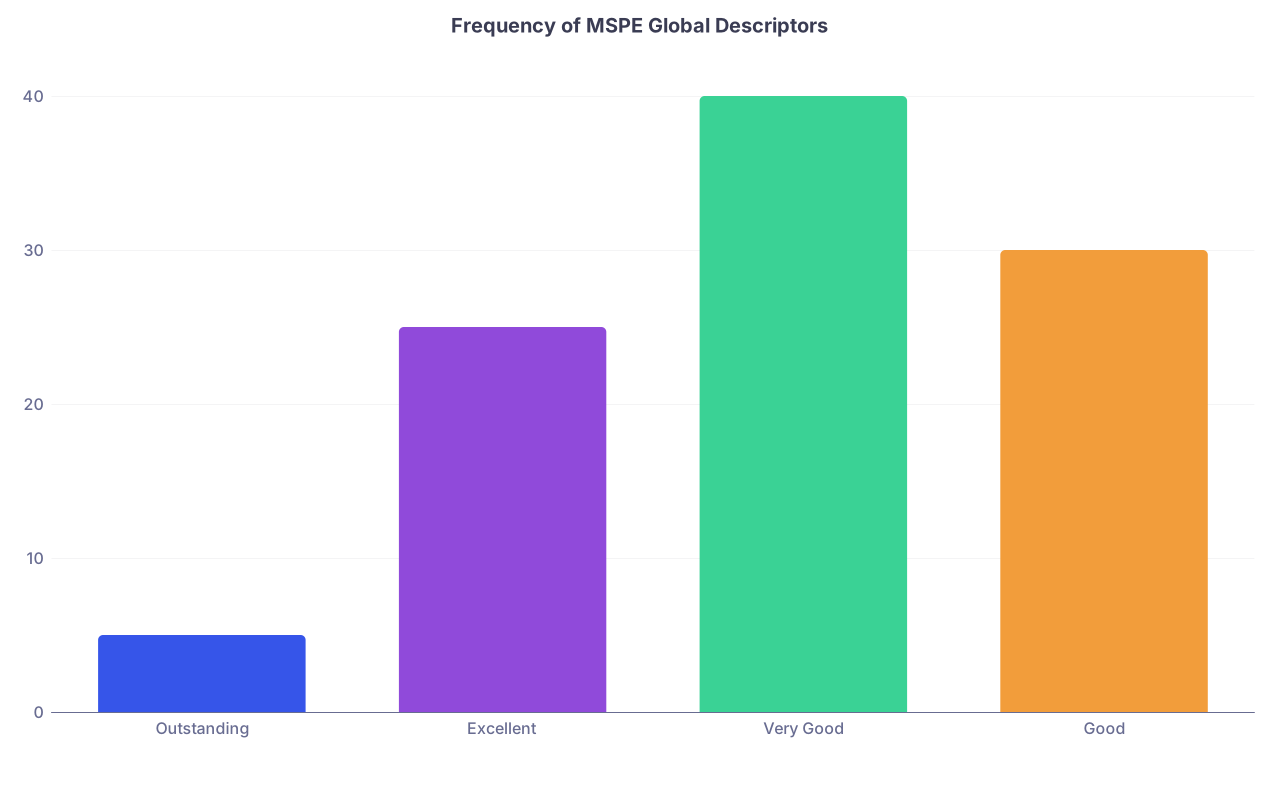
| Category | Value |
|---|---|
| Outstanding | 5 |
| Excellent | 25 |
| Very Good | 40 |
| Good | 30 |
Imagine a school where “Outstanding” is used for 5% of students, “Excellent” for 25%, “Very Good” for 40%, “Good” for 30%. If your MSPE describes you as “a very good student,” PDs who know this school read that as “middle.”
What You Should Actually Worry About vs Ignore
Let me draw a line between real issues and background noise, because students often stress over the wrong things.
Things You Are Overvaluing (Low PD Impact)
- Generic positive adjectives (“hardworking,” “pleasant,” “team player”).
- Whether a single attending called you “outstanding” vs “excellent.”
- Paragraph length of narrative comments (some attendings just write more).
- Slight differences in phrasing of “solid fund of knowledge.”
Most PDs are not counting adjectives. They are looking at the global pattern.
Things You Are Undervaluing (High PD Impact)
- Any hint of professionalism concern, even if “resolved.”
- Repeated references to time management, documentation delays, or needing reminders.
- Comparative language in the Dean’s summary (top vs middle vs bottom).
- Number and distribution of Honors in key clerkships for your specialty.
- Inconsistency across rotations (one glowing, one clearly negative).
If you have one weaker clerkship, the damage can be limited if the story is: “bad fit, one-off, everything else solid.” If your Dean’s summary quietly labels you “good” in a scale where “excellent” and “outstanding” exist, that anchors the whole document.
How to Use This Knowledge (Without Losing Your Mind)
You cannot rewrite your MSPE. But you can:
- Ask early (M3) how your school encodes performance in MSPE language.
- Look at anonymized prior MSPEs from your school to decode phrases.
- Prioritize rotations where grades and comments matter most for your specialty (IM + sub-I for IM; surgery + subspecialty for ortho, etc.).
- Address real red flags head-on in your personal statement or ERAS experiences, rather than hoping PDs miss them. They will not.
For example, repeated preclinical failures followed by strong clinical performance? You can openly say something like:
“I struggled initially with volume and test-taking in the preclinical curriculum, failed two courses, and required remediation. Since then, with structured changes to my study approach, I have passed all subsequent coursework, honored X and Y clerkships, and received strong feedback on my reliability and clinical reasoning.”
That gives PDs a narrative: early weakness, later strength. Without that, the MSPE just looks like “unstable student.”
FAQs
1. How much do program directors actually rely on the MSPE compared to letters of recommendation?
They use them differently. Letters are for depth; MSPEs are for breadth and verification. PDs use MSPEs to confirm that your glowing letter from one attending is not contradicted by multiple mediocre clerkships or professionalism flags. A stellar letter plus a very average MSPE usually lands you in “interview but not top of rank list” territory. A stellar letter plus a very strong MSPE (top quartile language, many Honors) moves you into genuine contender range.
2. If I have one bad clerkship evaluation, will it ruin my chances?
One bad rotation rarely kills an application if the rest of your MSPE is consistent and strong. PDs do discount an outlier, especially if the specialty is not directly relevant and your target field looks better. Two or three problematic rotations, especially in core areas (IM, Surgery), is where concerns start stacking and some PDs simply filter you out early.
3. Do PDs care about preclinical comments or just clinical years?
Most skim preclinical sections unless something stands out (serious professionalism issues, numerous failures, or a clearly documented upward trend). Clinical performance drives the majority of their attention. If your preclinical performance was mediocre but you have excellent clinical grades and comments, PDs generally weight the latter more heavily, especially in fields that value bedside skills over raw test performance.
4. Can I ask my Dean to change or remove certain phrases from the MSPE?
You can request clarification or correction of factual errors (wrong grades, incorrect dates, misreported leaves), and most schools will fix those. You have much less leverage on phrasing, tone, or global assessments; deans protect their credibility with PDs and will not “upgrade” you just because you ask. If something in the MSPE is technically accurate but context is missing, your better move is to address that context in your personal statement or in advisor-supported communication, not to fight the Dean’s office over adjectives.
Key points:
- PDs read the MSPE for patterns, codes, and red flags, not for generic praise.
- Soft-coded concerns about professionalism, reliability, and independence matter far more than flowery language.
- Your clerkship grid, comparative language, and any documented issues shape your risk profile in a PD’s mind far more than you think.