
The biggest mistake applicants make is obsessing over “getting more interviews” and almost never measuring how well they convert those interviews into actual, rankable options. The data shows: once you clear a certain invite threshold, yield matters more than volume.
The Real Metric: Interview Yield, Not Interview Count
You are not trying to “collect interviews.” You are trying to turn interviews into programs you can honestly rank, and that can honestly rank you.
Define interview yield in plain numbers:
At the program level:
Interview Yield (program) = Number of interviewed applicants who rank the program / Number of applicants interviewedAt the applicant level (what you care about):
Interview Yield (applicant) = Number of programs you rank / Number of interviews attended
That second number is brutally clarifying. I have seen people with 18 interviews end up with 8 real rankable choices. And people with 10 interviews end up ranking 9 or 10. The second person is statistically safer, despite having “worse” interview volume.
Programs track this too. Many PDs quietly calculate:
- “How many of our interviewees actually ranked us last year?”
- “What proportion ranked us in their top 5?”
They notice patterns. Geographically close applicants rank higher. Couples have different yield characteristics. IMG-heavy pools have different yield behaviors from MD-only pools. And they adjust invite strategy to protect their own fill rate.
You need to do the same analysis from your side.
How Many Interviews Do You Actually Need?
There is a stubborn mythology here. People throw out “12 interviews is safe for IM” or “You need 15+ for competitive specialties” without evidence. Let’s put numbers on it.
NRMP publishes data on probability of matching by number of contiguous ranks. That is your best proxy for “interview yield converted into rank list depth.”
Here is a simplified picture using representative NRMP-style numbers for categorical positions (US MDs, illustrative but directionally accurate):
| Contiguous Ranks | Primary Care (IM/FM/Peds) | Moderately Competitive (EM/Anes) | Highly Competitive (Derm, Ortho, etc.) |
|---|---|---|---|
| 3 | 65% | 40% | 20% |
| 5 | 80% | 55% | 30% |
| 8 | 90%+ | 70% | 45% |
| 10 | 95%+ | 80% | 55% |
| 12 | 97%+ | 85% | 60%+ |
Notice the curve. Diminishing returns after about 10–12 rankable programs for most non-ultra-competitive specialties. The critical word: rankable. Not “places you showed up and hated.” Not prelim programs you would only use as insurance. Actual options you could live with.
So if you assume:
- You will rank about 80–90% of programs you interview at in fields like IM/FM/Peds
- You will rank 60–80% in more competitive surgical or lifestyle specialties (because the gap between dream and backup is wider)
Then your interview yield target looks roughly like this:
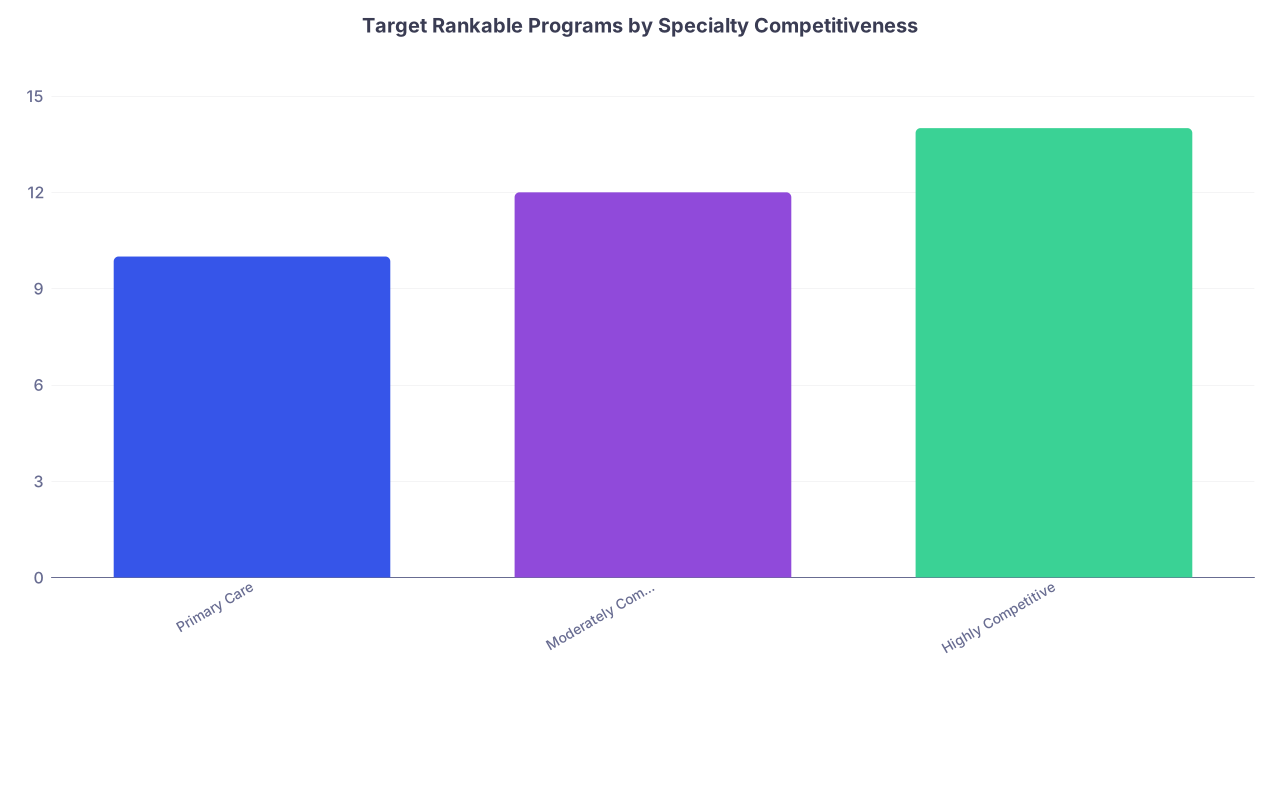
| Category | Value |
|---|---|
| Primary Care | 10 |
| Moderately Competitive | 12 |
| Highly Competitive | 14 |
Translate:
- Primary care-ish fields: Aim for ~10 rankable programs → usually requires ~11–13 interviews.
- Moderately competitive: Aim for ~12 rankable → often ~14–16 interviews.
- Highly competitive: Aim for ~14+ rankable → may require 18–20+ interviews.
If your yield is poor—say you only end up ranking half your interviews—you must either:
- Increase total interviews, or
- Improve conversion rate (how you perform, and which programs you select/accept).
Both are levers. Most applicants only pull the first.
Measuring Your Own Interview Yield (In Real Time)
You cannot improve what you do not track. This part is not glamorous, but it is where the advantage comes from.
Set up a very simple tracking sheet. Columns:
- Program name
- Specialty / track (categorical, prelim, advanced)
- Interview date
- Pre-interview interest (1–5)
- Post-interview interest (1–5)
- “Would rank?” (Y/N, decided within 48 hours)
- “Rank position band” (Top 3 / 4–8 / 9+)
- Notes: red flags, culture read, location constraints
Now compute:
- Raw Interview Yield = (# programs marked “Would rank? = Y”) / (total interviews completed)
- High-Yield Programs = those ending up in Top 5–8 band
- High-Yield Rate = (# high-yield programs) / (total interviews)
You start seeing patterns:
- Programs in certain cities convert much better to “would rank.”
- Academic vs community yield differences.
- Places with malignant vibes drop your yield fast.
I watched one applicant track this across two regions. In-region interviews had a 90% “would rank” rate. Out-of-region was under 50%. That applicant cancelled three far-away interviews late season and focused on preparing deeply for remaining in-region ones. Ended up with a 14-program rank list off 16 interviews.
That was not luck. That was yield management.
Why Some Interviews Convert Poorly (And Others Convert Almost Automatically)
If your yield is low, it is usually not an accident. It is structural. The data almost always reflects one of four issues:
Bad pre-screening of programs.
You accepted interviews at places you would never realistically move to, or whose practice style does not match your priorities.Late discovery of deal-breakers.
You only realize during the interview that call is Q3 with minimal day-off protection. Or that the location is far more isolating than the website implied.Weak interviewing and poor signaling.
Programs cannot “see” you as a real fit, so you fall low on their list—even if you liked them. Your personal yield (from “interview” to “mutual rank”) tanks.Mismatched expectations.
You showed up treating a safety program like a backup. They sensed that energy. They ranked you accordingly. Your probability of matching there, even if you rank them, is much lower than the naive “one more rank increases safety” assumption.
Interview yield is not just “did I like them.” It is “did they like me, enough, and did my application align with what they historically rank highly?”
Programs have patterns. They deny it in public, but they track this privately. For example, I have seen PDs look at 3-year match patterns on a slide:
- “Did we rank our own rotators higher than non-rotators?”
- “What Step 2 range actually ended up matching here?”
- “How many unmatched positions came from over-ranking applicants who never ranked us?”
They adjust. Invite more rotators if yield is high. Pull back on reaching for ultra-competitive candidates who rarely rank them top 5. You can do your own version from the applicant side.
Converting Invites into Rankable Options: Where the Data Points
Once you start viewing interviews as conversion events rather than trophies, strategy changes.
1. Front-load research to screen out low-yield programs
Time is finite. So is energy. If you attend 18 interviews but show up underprepared to all, your “mutual yield” drops. Programs strongly favor candidates who sound aligned, specific, and informed.
Before accepting or attending an interview, ask:
- What is the historical board pass rate and fellowship match profile?
- What is the call structure and schedule? Are there known burn-out signals (excessive 28-hour calls, minimal backup)?
- Does this location fit my actual life constraints (partner job, kids, visas, family)?
If a program fails on obvious hard constraints, your probability of ever ranking it is near zero. Attending “just for practice” late in the season is usually a waste. Early season, maybe. Late season, your marginal gain is tiny.
2. Treat each interview as a probability multiplier, not a lottery ticket
NRMP data shows a non-linear effect: the jump from 3 to 5 rankable programs is enormous. The jump from 11 to 13 is small. So you should:
- Apply maximal preparation intensity to the first 8–10 interviews.
- Use structured debriefing to iterate (what questions stumped you, what stories resonated).
- Focus on programs that are realistic but not bottom-of-barrel for you.
Programs also rank on vibes. They often say explicitly in ranking meetings: “Would I want to be stuck post-call with this person?” That is not quantifiable on a spreadsheet, but it is brutally real in discussion rooms.
So your “yield-improvement levers” include:
- Polished, concise answers that actually show how you think.
- Clean, consistent narrative that explains your trajectory, red flags, or transitions.
- Targeted, specific questions that signal genuine interest in their program, not generic curiosity.
Low-energy, generic interviews depress your conversion rate more than one extra interview slot could compensate for.
3. Track your evolving rank list like a dataset, not a diary
I tell people to force-rank after every interview. No ties. No “groupings.” You must decide: would I place this above Program X or below it?
Create three bands:
- Band A: Top 3–5, “would be thrilled”
- Band B: 6–10, “genuinely content”
- Band C: 11+, “acceptable but not ideal”
Now track how often new interviews enter each band. You may see this pattern:
- Early interviews: Many land in Band A (because you are excited and inexperienced).
- Middle season: You start demoting earlier options as you see better fits.
- Late season: Programs mostly land in Band B/C because your bar is higher.
Plotting that mentally matters. If by mid-season you already have 10+ programs in Band A/B, additional interviews are primarily marginal insurance, not life-savers.
Conversely, if your Band A remains thin (1–2 programs) after 10 interviews, you have a yield problem. You either misjudged your competitiveness (aiming too high) or you are underperforming in interviews—or both.
The Math of “How Many More Do I Need?”
Let’s make this more quantitative. Assume:
- Field: moderately competitive (EM/Anes/OB)
- Target: ≥80% chance of matching
- Based on NRMP-style curves, you want ≈12 rankable programs
If your personal interview yield is:
- 90% → you need ~14 interviews
- 75% → you need ~16 interviews
- 60% → you need ~20 interviews
Now consider their probability of ranking you high enough. Suppose:
- For programs where you are solidly competitive and interview well, probability they rank you “matchable” is about 40–50%.
- For reaches, maybe 10–20%.
If your interview mix is:
- 30% reach, 50% realistic, 20% safety
Your effective “mutual match probability” per program is not equal. In practice, your safest bets are realistic and safety programs. They are your yield backbone.
I have seen people overweight reaches, end with a “pretty” rank list full of big names, and then act shocked when they slide way down to 1–2 low-safety options—or worse, do not match at all.
The underlying math was obvious from day one: too many low-yield invites from the start.
Calendars, Fatigue, and Diminishing Returns
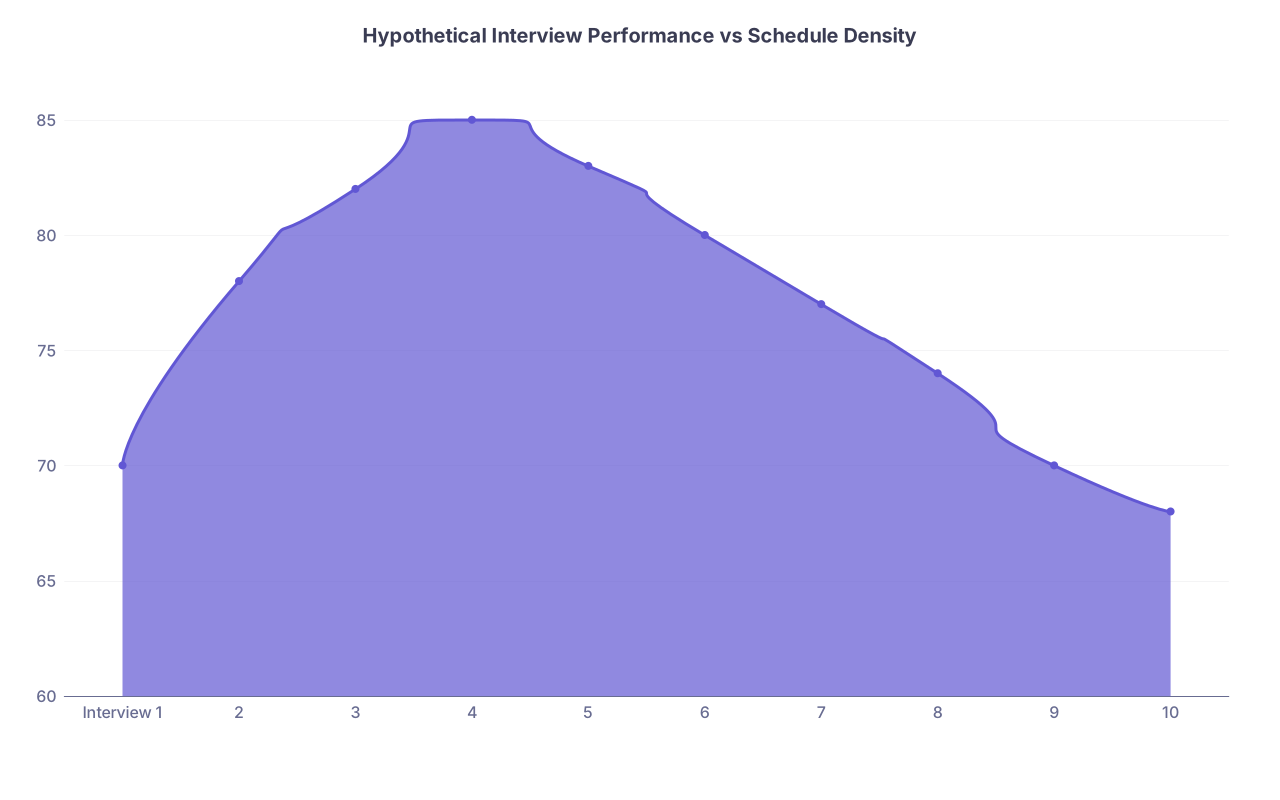
One under-discussed variable: performance decay over time.
If you pack 4–5 interviews per week for several weeks, your marginal performance on each additional interview slides. You repeat yourself. You sound flat. You stop tailoring your answers.
The effect is measurable in outcomes. Talk to residents. You will hear the same story: “By January I was so burned out my answers felt canned.”
This translates directly to lower interview yield. Programs later in the sequence get a weaker version of you.
So spacing interviews strategically can actually increase your effective yield. Instead of jamming 18 in six weeks, 14 well-prepared, well-spaced interviews might produce more rankable outcomes.
A simple, illustrative trend:
| Category | Value |
|---|---|
| Interview 1 | 70 |
| 2 | 78 |
| 3 | 82 |
| 4 | 85 |
| 5 | 83 |
| 6 | 80 |
| 7 | 77 |
| 8 | 74 |
| 9 | 70 |
| 10 | 68 |
Where “performance” is just a proxy (energy, clarity, rapport). You improve rapidly over the first few, then gradually degrade as fatigue accumulates. Smart scheduling aims to flatten that decline.
Reading the Room: Qualitative Signals That Predict Yield
Not everything can be reduced to a number, but some qualitative markers have very strong correlation with final rank behavior:
- Residents linger to talk with you off-schedule. Good sign.
- PD or APD mentions specific ways you match their needs (“we really value your chief year experience”). Good sign.
- Rushed, disorganized interview day, residents complain indirectly about workload, no one articulates a vision for the program. Low-yield.
Write these down immediately after each interview. Then look back a week later and see which feelings persisted and which faded. Programs that keep “pulling your attention” even after the excitement settles usually end up higher on the rank list.
That matters because your emotional ranking affects how you talk about them with mentors, partners, family. And that talk, in turn, affects whether you unconsciously downplay or upplay them if you end up in a tie-break situation. Yield is part numbers, part psychology.
Strategy Near the End of Interview Season
Late season is where people make panicked, data-blind decisions. You should not.
Here is a rational approach as you enter the final 3–4 weeks of invites:
Compute your current yield.
How many interviews completed? How many would you definitely rank? That percentage is your working yield.Project rank list depth.
If your current yield holds, and you accept all remaining invites, how many rankable programs will you end with?Compare to your target.
Using the earlier table, decide whether you are already in the “high probability” zone or still in a risky band.Decide on cancellations.
If projected depth is solid and remaining invites are far, expensive, or poor fit, cancellation is rational. Not cowardly. Rational.Reinvest reclaimed time.
Use that time to sharpen prep for high-yield programs still ahead, or to rest so your performance curve does not crash.
I have watched applicants go from projected 9 rankable to 11 not by adding interviews, but by improving yield on the last few. That can move you from ~70% match probability to >80%. That is not trivial.
A Quick Word on Couples Match and Yield
Couples match wrecks naive yield assumptions. The match algorithm is brutal for couples with shallow and poorly aligned lists.
Interview yield for couples is not:
- “How many programs do I like?”
It is:
- “How many city/program combinations allow both of us to be placed in acceptable positions?”
So your effective yield is the intersection of two people’s rankable sets. If you each have 10 rankable programs but only 5 overlapping cities, your “couples yield” is closer to 5 than 10.
You must treat overlap as the critical statistic, not individual counts. I have seen couples where one partner stacked 18 interviews, the other had 9, but only 4 cities overlapped strongly. They did match—but deep in their list, with much less safety margin than the raw numbers suggested.
Track this formally. Count overlapping, acceptable combinations, not just individual interviews.
The Bottom Line: Manage Yield Like a Statistician, Not Like a Tourist
Let me end this without sugar-coating:
Interview count is a vanity metric beyond a certain threshold. Interview yield—how many rankable, realistic options you create—is what drives match probability.
You can actively improve yield. Through ruthless pre-screening of programs, better preparation, smarter scheduling, and disciplined post-interview ranking, you convert more invites into real options instead of wasted trips.
The match algorithm rewards depth and realism, not wishful thinking. A rank list with 10–12 solid, mutually realistic programs beats a “prestige-heavy” list of reaches every time.
If you treat each interview as a data point to be optimized—not a souvenir—your odds improve dramatically.