The way most students talk about a mediocre clinical year to program directors is completely wrong—and it is killing otherwise salvageable applications.
You do not hide it. You do not over-explain it. You weaponize it.
This is repairable. But only if you stop pretending “average” is invisible and start turning it into a controlled, coherent story that makes sense to a busy PD reading your file for 90 seconds.
Below is exactly how to do that.
Step 1: Diagnose Why Your Clinical Year Looked Mediocre
You cannot fix what you have not named. “Mediocre” is too vague. PDs look for patterns, not vibes. You need to know exactly what they might see.
Pull your evaluations, grades, and comments. Print them if you have to. Then go line by line.
You are looking for four things:
- Global pattern of performance
- Timing of weaker blocks
- Content of narrative comments
- Objective vs subjective mismatch
1. Global Pattern
Ask yourself bluntly:
- Were your clerkship grades mostly:
- All High Pass with 1–2 Pass
- Mostly Pass, a couple High Pass
- Pass with one actual fail or remediation
- Any downward or upward trend?
| Pattern | PD Risk Level |
|---|---|
| Mostly Honors/HP, one Pass | Low |
| Mix of HP/Pass, no fails | Moderate |
| Mostly Pass, 1 HP, no narrative red flags | Moderate–High |
| Multiple Pass + 1 Fail or remediation | High |
| Clear downward trend across the year | High |
If your pattern is in the “moderate” zone, this is absolutely salvageable with strong Step 2, strong letters, and a tight narrative. Even “high” risk can be partially neutralized if you control the story.
2. Timing
When did you underperform?
- Early year: typical adjustment phase. Easier to explain.
- Middle year: often reflects personal / health / family disruptions.
- Late year: can signal burnout, disengagement, or personal issues.
A very common real scenario I have seen:
- Surgery (first clerkship): Pass
- Internal Medicine: Pass
- OB/GYN: High Pass
- Pediatrics: High Pass
- Psych: High Pass
- FM: High Pass
That is not a “bad” file. But the early string of Passes sets a tone unless you explicitly show the learning curve and upward trajectory.
3. Narrative Comments
Ignore the grade labels for a second and read verbatim comments. Highlight phrases into three buckets:
- Green (good): “hardworking,” “empathetic,” “team player,” “prepared,” “strong with patients”
- Yellow (neutral/needs growth): “would benefit from more confidence,” “quiet,” “needs to speak up more,” “slow to present”
- Red (concerning): “unreliable,” “unprofessional,” “poor communication,” “difficulty accepting feedback,” “boundary concerns”
Most “mediocre” years are actually:
- Grade: Pass/High Pass mix
- Comments: Mostly green and yellow, very few true red flags
PDs care more about red flags than a stack of Passes. Your job is to understand if you actually have any.
4. Objective vs Subjective
Compare:
- Shelf scores vs clinical evaluations
- Early shelves vs later shelves
- Pre-clinical performance vs clinical
Patterns that help your narrative:
- Lowish early shelves → improving shelves across the year.
- Better shelves than clinical grade → you can frame this as initial difficulty with “performing” on the team that you recognized and improved.
- Conversely, strong clinical comments with mediocre shelves? You emphasize being a strong clinician whose test performance improved by Step 2.
Step 2: Decide What Story You Are Actually Telling
Your clinical year needs a thesis. One clear story, not three half-baked ones.
Mediocre years usually fall into one of these buckets:
- Slow Adaptor, Then Improved
- Personal / Health Disruption, Then Stabilized
- System Mismatch (very strict grading, bad luck with teams)
- Quiet, Under-the-Radar Student Who Later Found Their Voice
- Overextended (research, leadership) and Underfocused Clinically
Pick the one that matches your reality. Not the one that sounds best.
Then you structure it like this:
- What was the problem? (concrete, not vague)
- What did you do about it? (evidence of insight and action)
- What is different now? (proof in your record)
If you cannot answer those three in one or two sentences, your story is not ready.
Example Story Frames
1. Slow Adaptor → Strong Finish
- Problem: Needed more time to figure out how to function on wards and translate knowledge into clinical performance.
- Action: Asked for explicit expectations, started pre-rounding earlier, practiced oral presentations daily, sought mid-rotation feedback.
- Now: Later clerkships: stronger evaluations, more leadership comments; Step 2 CK: competitive.
2. Personal Disruption (without oversharing)
- Problem: Family illness / personal health issue during months X–Y that affected focus and availability.
- Action: Communicated with administration, arranged coverage or make-up work, got support, kept patient care safe.
- Now: Issue resolved / medically managed; performance stabilized; recent rotations and letters strong.
3. Quiet Student Finding Their Voice
- Problem: Initially very reserved, hesitant to speak up on rounds, which was read as disengagement.
- Action: Practiced structured presentations, set goals with residents, deliberately volunteered for tasks and patient presentations.
- Now: Later rotations mention “more confident,” “effective communicator,” “reliable member of the team.”
You are not writing a confession. You are writing a professional performance review narrative with receipts.
Step 3: Build Objective Counterweights
You cannot talk your way out of a pattern of Passes. You need evidence that who you are now is different from the student on those early evals.
The three biggest counterweights:
- Strong Step 2 CK
- Deliberately chosen sub-I / audition rotations with strong letters
- Recent performance trend
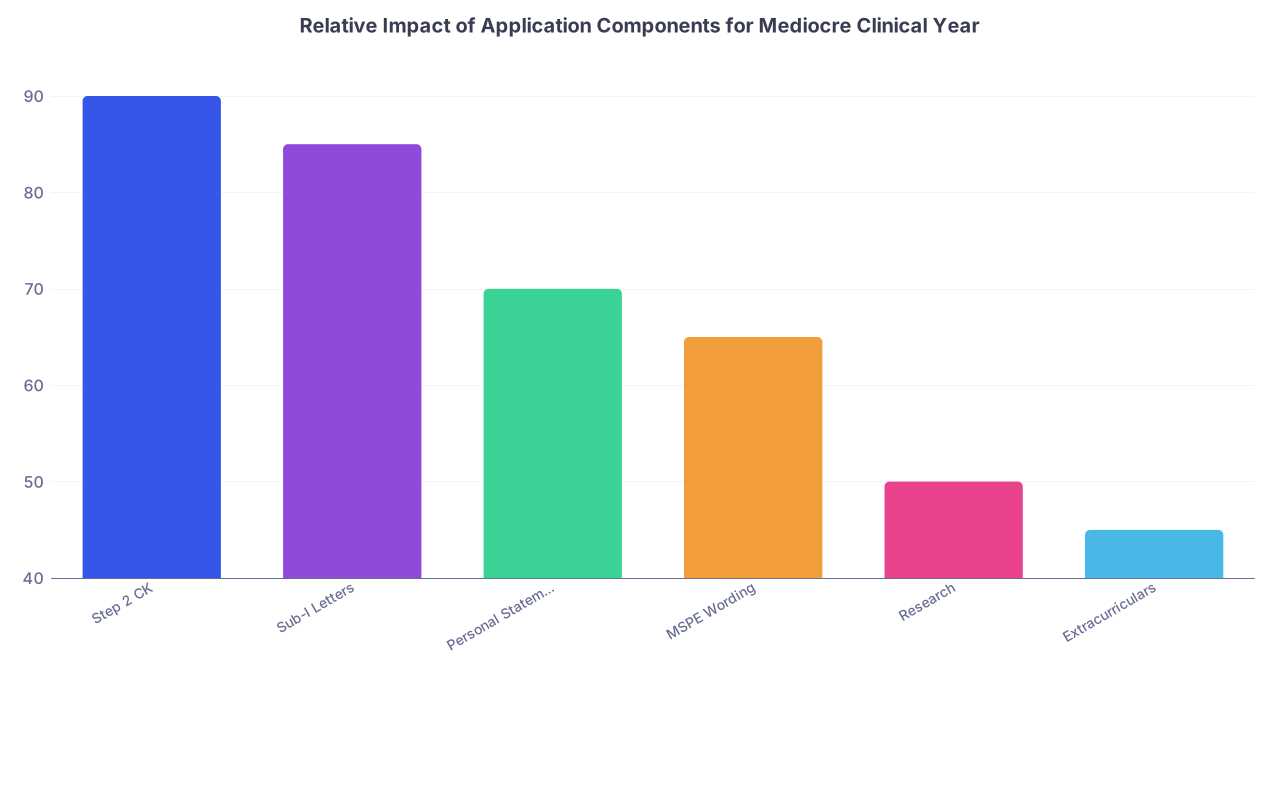
| Category | Value |
|---|---|
| Step 2 CK | 90 |
| Sub-I Letters | 85 |
| Personal Statement Narrative | 70 |
| MSPE Wording | 65 |
| Research | 50 |
| Extracurriculars | 45 |
1. Step 2 CK as a Rescue Tool
You want Step 2 CK to say: “This person has the knowledge base and test discipline of a solid resident.”
Action plan:
- Target: At or above the mean for your desired specialty, ideally above your Step 1 percentile.
- If Step 1 was mid-range or pass: Step 2 must be clearly stronger.
- Study with structure—NBME practice exams scheduled, at least 2–3 self-assessments documented.
You will later reference this concisely:
“My early clerkship performance did not fully reflect my knowledge base. The structured preparation I used for Step 2 CK (XX score) reflects the way I now approach clinical learning and performance.”
Short. Controlled. Purposeful.
2. Sub-I / Acting Internships
Pick at least one sub-I in your chosen specialty where you can:
- Work with attendings who are known to write strong letters.
- Get real-time feedback and adjust quickly.
- Demonstrate exactly the traits PDs worry about when they see Passes:
- Reliability
- Ownership of patient care
- Ability to function at intern level
- Communication with nurses and team
On day 3–4 of that sub-I, do this:
- Ask your senior or attending: “I am aiming to show that I can function at an intern level and that I have addressed earlier feedback about [X]. Could you let me know by midpoint if there are specific areas I should push on?”
That line alone changes how they see you. You go from “average student” to “self-aware, coachable candidate.”
3. Recent Performance Trend
You want your last 4–6 months of medical school to be:
- Clean record: no professionalism issues, no near-fails.
- Good narrative words: “reliable,” “self-directed,” “calm under pressure.”
- Aligning with your chosen specialty: at least one rotation in that field with a strong comment.
If necessary, stack the deck:
- Schedule a second rotation in your chosen specialty at your home or away site.
- Choose clinical electives where you can get visible responsibility (not just shadowing subspecialty clinics).
Step 4: Rewrite Your Story in the Personal Statement
Most personal statements are useless. Yours cannot be.
Your job is to:
- Acknowledge the reality once
- Show insight and specific behavior change
- Spend most of the space on who you are now, not apologizing for who you were
Structure That Works
- Opening: A specific clinical moment that reflects the type of resident you are trying to be.
- Pivot: Briefly reference that you did not start out this way.
- Insight + Action: Describe what you learned from your weaker performance and how you changed your behavior.
- Now: Point to concrete recent experiences (sub-I, leadership moments, specific patient care episodes) that show the new version in action.
- Future: What type of resident you aim to be in their program.
Example Middle Paragraph (Adaptable Template)
“My early clerkships reflected a student who was quieter on rounds and slower to translate knowledge into action. Midway through third year, after a series of Pass evaluations, a senior resident told me, ‘You know the answer when I ask later. I need you to speak up when it counts.’ I took that seriously. I started setting explicit daily goals with my team, practiced concise presentations each night, and asked for midpoint feedback on whether I was meeting expectations. Over the next rotations, my evaluations shifted. Attendings described me as ‘more confident,’ ‘reliable,’ and ‘a steady presence on busy services,’ which is the trajectory I have continued on my medicine sub-internship.”
Notice what it does:
- Names the problem without drama.
- Has a real quote. Sounds like actual ward life.
- Describes concrete behavioral changes.
- Ties to documented improvements.
You do not list grades. You tell the story behind them.
Step 5: Coordinate with Your Letter Writers and Dean’s Office
If your clinical year was average, your letters and MSPE language matter even more. You cannot afford a tepid, generic letter from someone who barely remembers you.
1. Choosing Letter Writers Strategically
Prioritize:
- Attendings on rotations where:
- You performed later in the year.
- You demonstrated growth compared to earlier comments.
- Sub-I or senior electives in your chosen field.
- Someone who has literally said versions of:
- “You’re functioning at intern level.”
- “I would be happy to work with you as a resident.”
- “You really improved over the rotation.”
Avoid:
- Early rotations with mediocre performance unless:
- You had very strong narrative comments.
- They explicitly saw your growth and will state it.
When you ask for a letter, say something like:
“I am working on presenting a clear upward trajectory from my early Passes to my more recent performance. You’ve seen me [describe something specific: manage a complex patient, lead sign-out]. Would you feel comfortable commenting on how I functioned relative to an intern and the progress you saw?”
You are not putting words in their mouth. You are telling them what story you are trying to support.
2. The MSPE (“Dean’s Letter”) Reality
The MSPE will list:
- Clerkship grades
- Some narrative excerpts
- Possibly a summary phrase about your overall performance
You probably cannot rewrite it. But you can align your story with it.
Steps:
- Meet with the dean or advisor responsible for your MSPE.
- Bring a one-page summary:
- Early pattern: X
- Specific steps you took: Y
- Recent performance evidence: Z
- Say plainly:
“I want to make sure my file reflects the improvement and the kind of resident I am now. I accept that my early grades are what they are. I would appreciate if the narrative can point out the upward trend and my responsiveness to feedback.”
You are not begging. You are being a professional advocating for accuracy.

| Step | Description |
|---|---|
| Step 1 | Clinical Year Record |
| Step 2 | Pattern Analysis |
| Step 3 | Choose Core Narrative |
| Step 4 | Strengthen Objective Counterweights |
| Step 5 | Craft Personal Statement |
| Step 6 | Coordinate Letters & MSPE |
| Step 7 | Align Interview Talking Points |
Step 6: Control the Conversation on Interviews
If your clinical year is truly mediocre, some PDs or faculty will ask.
Common versions:
- “Can you walk me through your clerkship performance?”
- “I see mostly Pass grades. Tell me about that.”
- “Is there anything in your clinical record you wish were different?”
You need one rehearsed, honest, concise answer. No rambling. No defensiveness.
Blueprint for an Interview Answer
Own it in one sentence.
“My early clerkship performance was solid but not exceptional. I had several Passes before I really hit my stride.”Name the cause without melodrama.
“I struggled initially with speaking up on rounds and translating my studying into visible participation.”Describe concrete changes.
“After feedback from a senior resident, I started setting daily goals, arriving earlier to pre-round, and practicing concise presentations every evening.”Point to evidence.
“You can see that in my later rotations—stronger narrative evaluations, especially on my sub-I, and in my Step 2 score.”End with who you are now.
“I am glad I went through that process while still a student, because I now have a clear system for self-assessment and improvement that I already apply on the wards.”
Then stop talking. Let them ask follow-ups if they want more.
Step 7: Be Realistic and Strategic About Specialty and Program List
Some specialties are unforgiving with mediocre clerkship years. Some are more flexible if other pieces are strong.
You cannot change your third-year transcript now. You can change where you apply and how widely.
| Specialty Type | Competitiveness with Mediocre Year |
|---|---|
| Derm, Plastics, Ortho, ENT | Very difficult without exceptional Step 2 + research |
| EM, Anesthesia, Rads | Possible if Step 2 and letters are strong |
| IM, Peds, FM | Often forgiving with clear upward trend |
| Psych, PM&R | Often very open to growth narratives |
Be honest:
- If you have:
- Mostly Passes
- No true standout letters
- Only average Step scores
Then applying ENT or Ortho as your main plan is not a strategy. It is wishful thinking.
Better moves:
- Reframe to a slightly less competitive, but still satisfying field.
- If you insist on a highly competitive specialty:
- Consider doing a fifth research year with heavy clinical exposure and outstanding letters.
- Understand the risk profile. Do not pretend it is low.
Step 8: Clean Up Any True Red Flags
“Mediocre” is not the same as “toxic.”
If you had:
- A professionalism write-up
- A failed clerkship
- A remediation semester
You cannot bury it. But you can show:
- You understand what happened.
- You changed behavior.
- There have been no repeats.
Say it plainly in your application (often in the “adversity” or “anything else” section):
“During my [X] rotation, I received a professionalism concern related to [brief, factual description]. I met with [advisors, dean], completed [remediation or reflective work], and have had no similar issues since. This experience changed how I communicate and document tasks. My subsequent evaluations, particularly in [later rotations], reflect this sustained improvement.”
If your file is “mediocre + one concerning professionalism event,” the professionalism piece is the bigger problem. Fix the narrative around that first.
Putting It All Together: A Sample Before/After
Before (what most students do):
- Personal statement: Generic story about “always wanting to help people,” zero mention of grades or growth.
- Letters: Random mix of early and late rotations, one from an attending who barely remembers them.
- No conversation with dean about MSPE.
- On interview: Stumbles when asked about grades, blames “grading policies” or “subjectivity.”
After (what you are going to do):
- Clear narrative: “I had a slow start clinically, recognized it, made specific changes, and now function like an intern.”
- Step 2: Stronger than Step 1, clearly above specialty mean.
- Sub-I: One or two deliberate experiences with attendings who can comment on intern-level performance.
- Personal statement: Includes a concise, controlled paragraph telling the growth story.
- Letters: From people who explicitly saw that growth and will say so.
- MSPE: Dean has been briefed on your trajectory and has language reflecting improvement.
- Interview: You carry a rehearsed, calm answer that matches everything else in your file.
That applicant does not look “mediocre.” That applicant looks like someone who developed late, learned fast, and is now ready.
Two Quick Case Examples
Case 1: The Quiet Medicine Applicant
- Grades:
- Early: Surgery P, IM P
- Middle: Peds HP, Psych HP
- Late: Medicine Sub-I HP (strong comments)
- Scores:
- Step 1: Pass
- Step 2: 247
Fix:
- Narrative: “Quiet student who learned to communicate assertively.”
- Counterweights: Strong medicine sub-I letter; another from Peds.
- PS: One paragraph explaining the early Passes and later improvement.
- Programs: IM mid-tier academic + strong community; 40–50 applications.
Outcome I have seen multiple times: Matches solid IM program, sometimes better than expected, because the trajectory + Step 2 + letters line up.
Case 2: The Overextended Researcher Going into EM
- Grades: Mostly Pass with one HP, no fails.
- Massive research + leadership, multiple posters.
- Step 2: 250.
Fix:
- Narrative: “Initially stretched too thin between clinical work and research; learned to prioritize patient care and team needs.”
- Counterweights: Outstanding EM sub-I letter: “Functions at intern level, highly reliable on busy shifts.”
- PS: Explicitly ties research discipline to current clinical focus.
- Programs: Broad EM list; includes plenty of community and mid-tier academic.
Again, I have watched this profile match comfortably when the story is coherent and application materials are aligned.
What You Should Do Today
Open a blank document and do three things:
List, in order, every core clerkship with:
- Grade
- Shelf percentile (if you know it)
- 1–2 key phrases from your narrative evals
Under that, write one paragraph answering:
- What was the main problem?
- What did I actually do about it?
- How is that visible in my later record?
Draft a 4–5 sentence answer you would give out loud if asked: “Tell me about your clinical performance.”
Do not try to make it perfect. Get the raw truth down. That becomes the backbone of your personal statement, your dean meeting, and your interview answers.