
The residents PDs remember usually did something small and subtle, not flashy. And almost none of it shows up on ERAS.
Let me tell you what actually happens behind the closed doors of the rank meeting: once you clear the “can this person do the work?” bar, the discussion turns almost entirely to professionalism. Not the HR definition. The lived definition. Can I trust this person at 2 a.m. with a crashing patient, a frustrated nurse, and a family ready to complain to the CEO?
You’re told to “be professional.” Nobody tells you the unwritten rules that actually move your name up or down a rank list. I will.
What PDs Really Mean by “Professional”
On paper, professionalism is some bland combination of honesty, respect, responsibility. In PD language, it’s more brutal and much simpler:
Will you make my life easier or harder?
That’s it. Once your Step scores, grades, and letters hit a certain level, you move into a different category. You’re no longer competing on raw brainpower; you’re competing on whether attendings enjoyed working with you enough to go to bat for you in a closed-door meeting.
I’ve sat in those meetings. I’ve watched a mid-tier, average-score applicant jump 20 spots on the rank list because three attendings said variations of:
“I’d be fine being on call with them.”
“Zero drama. Just got the work done.”
“Nurses loved this one.”
None of that came from their ERAS bullet points. It came from daily, often invisible behaviors that screamed, “this person is safe, solid, and won’t embarrass us.”
Let’s go through the actual unwritten rules that make PDs remember you — by name, in a good way.
Rule #1: You’re Being Watched Long Before You Think You Are
Here’s the part students never believe until it’s too late: by the time you’re on an actual residency interview, most programs already have an impression of you from MS3 and MS4 behavior.
PDs talk to each other. Attendings gossip. Chiefs remember.
I heard a PD at a big-name IM program say this flat-out in an education meeting:
“I don’t care what their personal statement says. If my residents tell me they were lazy and disappeared on rounds, they’re not coming here.”
You think a single rotation doesn’t matter? It does if it’s with someone with influence. Example:
- Student A: 250s, AOA, research, one lukewarm comment from a high-power subspecialty attending: “Smart but often late, hard to find in the afternoons.”
That line alone essentially killed their shot at that institution. Not because the PD “hates lateness,” but because lateness plus “hard to find” translates as: might disappear when things get busy. That’s a professional liability.
Contrast that with Student B: Step barely above average, but the same attending says: “Not the flashiest, but always there when you needed them. Residents trusted them. Great attitude.”
Same PD fought to rank that student high.
The unwritten rule: every person you work with is already voting on your professional reputation. Long before you open ERAS.
Rule #2: Show Up Early, But Not Just for Optics
Yes, professionalism starts with the unsexy stuff: being on time, looking put-together, not being the one person everyone waits for every morning. But PDs can spot when you’re “early for show” and useless the rest of the day.
The residents and attendings remember the student who quietly:
- Was physically present before sign-out started
- Had already checked vitals and overnight events on “their” patients
- Knew where the team actually was throughout the day (not constantly paging, “Where are you guys now?”)
I watched a surgery PD rewrite their impression of a student based on one thing: she showed up to a 5:30 a.m. vascular case at 4:50 a.m., prepped the room, checked consents, verified labs, pulled imaging. No one told her to. The scrub nurse literally said in the OR lounge later, “Get that one into our program.”
Nobody wrote “prepped the room at 4:50 a.m.” on an eval form. But the vibe carried. That student’s name came up later:
“Oh, that’s the early vascular girl. She was good.”
You’re not just banking minutes on a clock. You’re banking an identity: early, ready, reliable. Or late, scattered, and invisible.
Rule #3: Your Worst Day Counts More Than Your Best Day
Everybody can be professional when they’re rested, praised, and on an easy service. PDs care what you look like on post-call day 5 when everything’s behind and the attending is in a mood.
That’s when your real behavior leaks.
The unwritten rule: your worst moments are what actually get reported up the chain, not your best.
I’ve listened to evaluation discussions where 90% of the praise was vague — “nice, smart, works hard” — and then one very specific negative story sank the whole ship:
“They were fine most of the month, but one night when things were crazy, they snapped at a nurse and argued in front of a family. It just rubbed me the wrong way.”
That’s all it takes. You might feel like, “I was just exhausted,” or “that nurse was being unreasonable.” The PD hears: under pressure, they lose control and damage relationships.
So how do you survive your worst days?
You build two reflexes:
The reset reflex: when you feel irritation boiling up, you pause. Even one beat. “Give me a second to look that up,” instead of, “I already did that.” That one beat protects you.
The repair reflex: if you do snap — and some of you will — you consciously go back and fix it. I’ve seen attendings upgrade their impression of a student because they pulled a nurse aside and said, “Hey, I was short with you earlier. I’m tired, but that’s not an excuse. Sorry about that.”
You’d be stunned how often that story gets relayed like gold: “They’re mature. They own their stuff.”
Rule #4: How You Treat People With No Power Is a Loud Signal
PDs absolutely ask nurses, coordinators, and techs what they think of you. Not in a formal way. More like:
“Hey, how were the students this month? Anyone stand out — good or bad?”
If a unit secretary rolls their eyes when your name comes up, you’re cooked.
The unwritten rule here is simple: staff will forgive you for being green, slow, or even a little awkward. They won’t forgive you for being dismissive or condescending.
I watched a candidate’s fate get sealed over a single, short story:
“He was fine with the attendings, but he constantly interrupted the interpreter and talked over the family. We had to tell him multiple times.”
The PD summarized it in one sentence: “He doesn’t respect the team. Hard no.”
On the flip side, here’s the kind of thing that gets you remembered for the right reasons:
- You learn the charge nurse’s name on day 1 and actually use it.
- You thank the unit clerk when they page your attending twice.
- You help transport an unstable patient when the team is drowning instead of vanishing with your coffee.
It’s not about being fake-nice. It’s about acting like everyone matters. Because they do — and the PD knows exactly who keeps their residency afloat.
Rule #5: The Way You Ask for Help Is a Professional Skill
One of the quietest, most powerful professionalism tests: how you handle not knowing what to do.
Residents talk. They know which students:
- Hide in the chart rather than admit they’re lost
- Make decisions just a little beyond their competency hoping no one notices
- Call for help late, when things are already going bad
Those get flagged. Hard.
The students who rise on rank lists are the ones who learn the art of the clean, non-dramatic ask. It sounds like:
“I’m in room 12. The patient’s pressure just dropped from 120s to 80s after standing up. I don’t know what’s causing it yet. I’ve put them back in bed, checked the IV, and I’m rechecking vitals, but I’d like you to come take a look with me.”
That’s professional. You showed judgment, initiated basic stabilization, and then escalated without ego.
The unprofessional version?
“Uh, room 12 doesn’t look good, can you come?”
No context, no actions taken, no sense that you’ve thought for even five seconds. Those are the details that residents remember when the PD sends out the “How were this year’s applicants?” email.
Rule #6: Email and Messaging Are Your Permanent Record
You think I’m exaggerating? I’ve sat with PDs scrolling through email threads while discussing borderline applicants.
They’re looking for patterns:
- Do you answer emails from the coordinator promptly and clearly?
- Are your messages to faculty complete sentences, or are you texting like you’re in group chat?
- When you’re late to something, do you communicate like an adult or disappear and then apologize hours later?
I know of a case where a PD quietly downgraded an otherwise strong applicant because of a single careless email to the coordinator:
“Hey, can’t make the site visit tmrw, something came up, can I just come a diff day?”
No greeting. No apology. No acknowledgment this was a scheduled, prepared event. The coordinator flagged it: “Not sure this one understands boundaries.”
That email got screenshotted, forwarded, and yes — referenced when the rank list was made.
The unwritten rules for professional communication are basic but rarely followed:
- Default to formality with PDs, APDs, and coordinators. Short, clear, respectful.
- If you must cancel or reschedule, give a specific reason, apologize briefly once (not theatrically), and offer alternatives.
- Never leave a PD or coordinator “on read” for anything time-sensitive. Even, “Got it, thank you,” is better than silence.
You’re not just sending emails. You’re showing the PD how you’ll behave when patients email you, when admin asks you for documentation, when the hospital sends you something with a deadline.
Rule #7: Own Your Mistakes the Way Residents Do
One of the most telling behaviors: what you do when you screw up. And you will.
I watched an applicant get an enthusiastic letter — after missing a critical lab.
The story: they were on wards, accidentally overlooked a 6 a.m. potassium of 2.8. The resident discovered it during rounds. Could’ve been ugly. Instead of making excuses, the student said:
“I missed that. That’s on me. I’ve flagged the patient, I’ll call the nurse now and we’ll get replacement started and recheck a level. I’ll also add a check for morning lytes to my pre-rounding checklist so I don’t miss this again.”
Attending wrote later: “Shows maturity beyond level, accepts feedback, immediately implements systems to improve.”
At rank time, that same attending: “They made a mistake, but I trust them more because of how they handled it.”
The death sentence version of that same event?
- Blaming Epic.
- Blaming sign-out.
- Acting like it wasn’t a big deal.
- Or worse, getting defensive: “Well, no one told me to check that.”
PDs know residents will make mistakes. They’re allergic to residents who won’t admit them or won’t learn from them.
Rule #8: Calm Is a Flex — Especially When Things Go Sideways
PDs are like seismographs for emotional instability. They don’t care if you’re high-energy or quiet. They care if your emotional state swings wildly with stress and feedback.
They notice:
- The student who bursts into tears every time they’re corrected.
- The one who slams computers or curses under their breath when things are busy.
- The one who radiates frantic energy and makes the whole team more anxious.
And they remember the opposite:
- The student who says, “Okay, let’s prioritize,” when five new admissions hit at once.
- The one who takes the hit from an annoyed consultant and responds with, “Understood, what would you recommend we do next?” instead of snapping back.
- The one who absorbs blunt feedback and says, “Thank you for pointing that out,” and then actually, visibly improves.
I’ve watched PDs move someone up the rank list because nursing staff said, “They were really calm that day the unit was crazy. Helped keep everyone on track.”
You don’t have to be emotionally bulletproof. But if you routinely externalize your stress onto other people — or onto the environment — that’s going to tank you.
Rule #9: Professional Curiosity Beats Performative Enthusiasm
Everyone says “I’m really interested in your program” on interview day. PDs barely register it. They’re not moved by your line about “collaborative culture” or “commitment to underserved communities.” They’ve heard it 400 times.
They remember the applicant who demonstrated professional-level curiosity.
That looks like:
- Asking about systems instead of fluff: “How does your program handle a resident who’s struggling clinically? What does support look like beyond just ‘do better’?”
- Showing you understand the job: “On nights, what’s the expected cap and who’s physically in-house as backup?”
- Digging into real issues: “How does feedback flow here — is it primarily end-of-rotation or do you get point-of-care teaching? How receptive are faculty when residents give feedback upward?”
Those questions tell a PD: this person is thinking like a colleague, not a tourist.
The unspoken rule: professionalism at the interview stage looks like clarity about what you’re signing up for, not passive cheerleading.
Rule #10: You Are Building a Reputation, Not Just a CV
The biggest misunderstanding applicants have is thinking their “application” is a static document. It isn’t. It’s a living narrative made up of:
- Every offhand comment from attendings
- Every Slack or email the chiefs send about you
- Every time a nurse mentions you to a resident
- Every rotation director who quietly tells a PD, “If you can get this one, you want them”
By the time the PD opens your ERAS file, they may already have:
- An email forwarded from a subspecialty attending: “This student is one of the most reliable I’ve worked with. Would absolutely vouch for them.”
- A quiet warning from another PD at your home institution: “I’d be cautious with this one — great scores, but we’ve had some professionalism flags this year.”
You will never see those messages. You’ll only see the final rank decision and wonder why things didn’t line up with your stats.
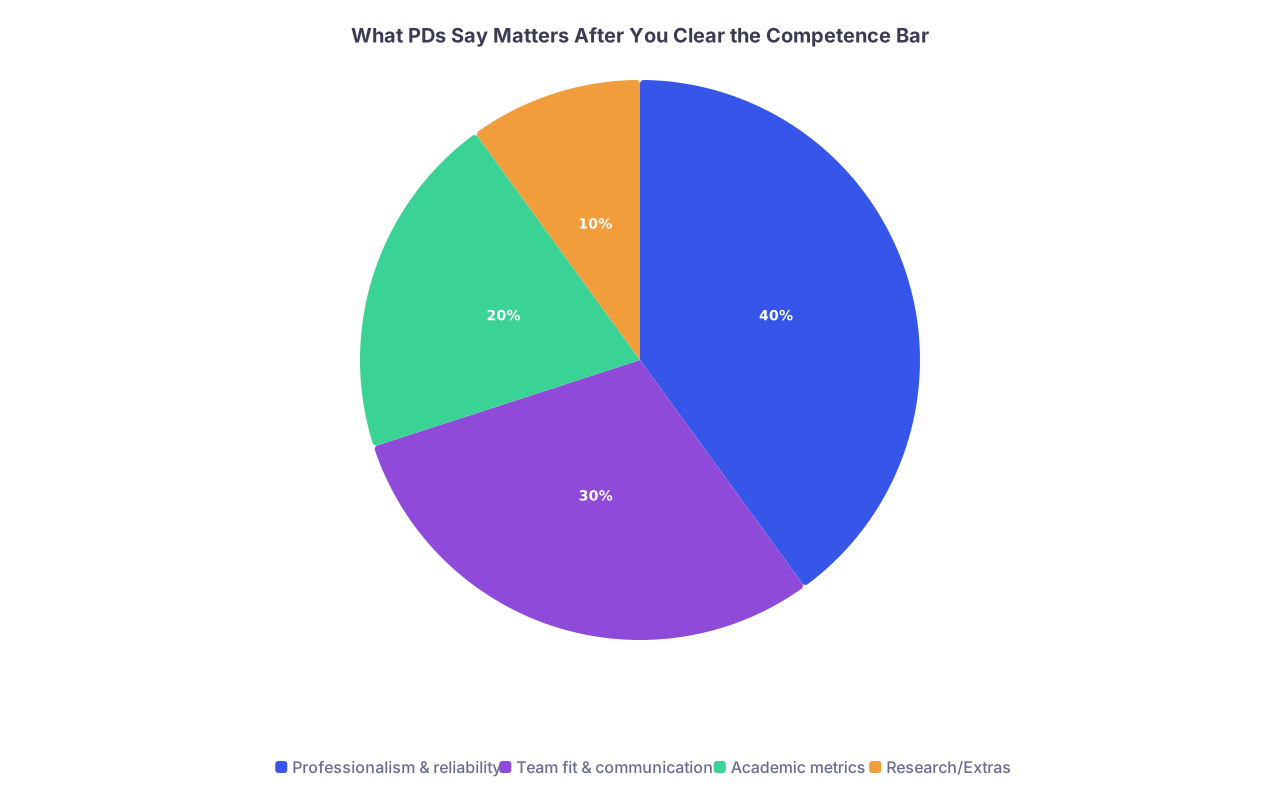
| Category | Value |
|---|---|
| Professionalism & reliability | 40 |
| Team fit & communication | 30 |
| Academic metrics | 20 |
| Research/Extras | 10 |
How to Make PDs Remember You for the Right Reasons
Let’s make this practical. Here’s what consistently gets candidates marked as “I’d fight to have them” in PD discussions:
You become the person everyone trusts to:
- Show up where you said you’d be, when you said you’d be there
- Do what you said you’d do, or tell someone early if you can’t
- Handle stress without making it everyone else’s problem
- Treat every member of the team — from EVS to Chair — with the same baseline respect
- Admit when you’re over your head and pull help in promptly
None of this is glamorous. Most of it never goes on a CV. But I’ve watched over and over as these behaviors outweighed an extra publication or a slightly higher Step 2.
If you take nothing else from this, remember:
- PDs rank trust over talent once you’re above the competence floor.
- Your reputation is built in corridors, call rooms, inboxes, and worst days — not just in Dean’s letters.
- The unwritten professionalism rules are simple: be reliable, be decent to everyone, handle stress like a grown-up, and own your mistakes.
Do that relentlessly, and you won’t just match. You’ll have attendings quietly making calls on your behalf, saying the eight words that really move applications:
“If you can get them, you want them.”