
It’s late. You’re clicking through ERAS, staring at your Step score section.
Your cursor hovers over “Certify and Submit.”
You’re thinking:
“Do I list that first failed attempt?”
“Do I need to explain that 209?”
“Will they notice my Step 2 is missing?”
Here’s the uncomfortable truth: program directors are skimming hundreds of applications in brutal, time‑limited batches. They are not digging deep at first. They’re scanning for red flags and risk. And Step scores—how you earned them, reported them, and explained them—can quietly put you in the “too risky” pile.
Not always because of the number.
Often because of the mistakes around the number.
You’re reading this because you suspect your Step story isn’t perfect. Good. Let’s keep it from looking worse than it is.
1. Hiding, Minimizing, or “Forgetting” Bad Step Scores
The fastest way to look risky?
Act like you’re trying to hide something.
I’ve seen this over and over on selection committees:
- Application looks solid on first pass
- Someone pulls up state licensing or NRMP data
- Surprise: an unmentioned fail, attempt, or delay
- The room’s energy changes from “maybe” to “nope”
Mistake: Trying to “bury” a bad score
Common versions of this:
- You “forget” to mention a failed attempt in your personal statement or experiences.
- You never address a massive score jump (e.g., 192 → 244) and hope no one asks.
- You act like a Step 1 fail doesn’t exist because it’s pass/fail now.
Program directors aren’t stupid. Many of them trained before pass/fail. They’ve sat in enough CCC and promotions meetings to know what fails and repeats look like behind the scenes.
Why this makes you look risky:
- Dishonesty > low score. Every time.
- If you omit or spin the story, PDs worry:
“What else is this person hiding? Will this be a problem with future exams? With duty hours? With documentation?” - You look like more work. More risk. Less trust.
What you should do instead:
Own the history clearly in your application:
- If there was a fail or low score, don’t pretend it never happened.
- Do not dramatize it. Do not write a novel. One short, clean explanation is enough.
Use the right place to explain:
- ERAS “Additional Information” or “Education interruptions” section
- A short note in your MSPE/Dean’s letter (often they already did this)
- Only mention it in your personal statement if it connects directly to growth, discipline, or a clear turning point—not just as damage control.
Keep the tone:
- Factual
- Brief
- Accountability-focused
Example language:
“I failed Step 1 on my first attempt during a period of poorly structured study. After reevaluating my approach and increasing question-based learning, I passed on the second attempt and later scored 242 on Step 2 CK. This experience changed how I prepare for high-stakes exams and led to more consistent performance in my clerkships.”
Do not make it a sob story. Do not blame everyone else. That’s another red flag.
2. Not Having Step 2 CK In on Time (When You Clearly Need It)
You know who can “get away with” submitting without Step 2 CK early?
The student with a strong transcript, solid Step 1 pass, and letters from big names.
You with a marginal Step 1, an attempt, or weaker pre-clinical record?
You cannot.
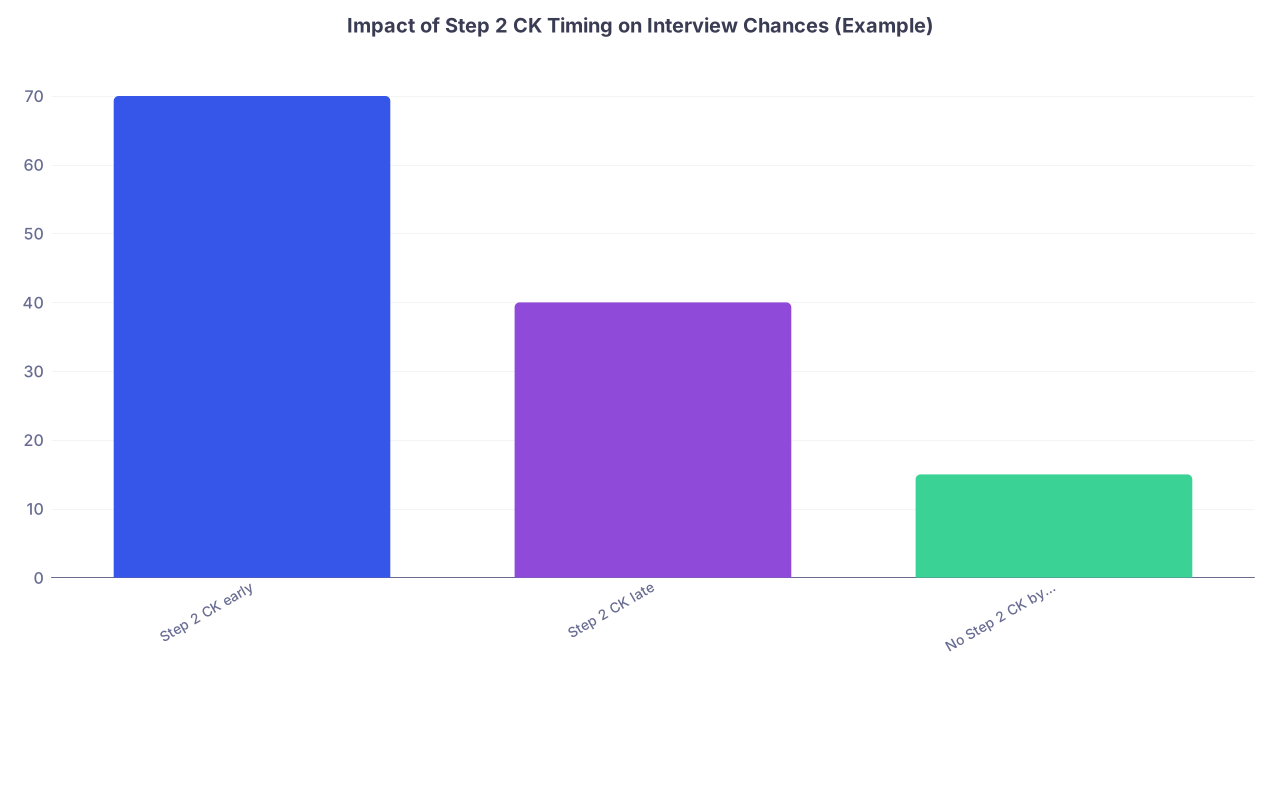
| Category | Value |
|---|---|
| Step 2 CK early | 70 |
| Step 2 CK late | 40 |
| No Step 2 CK by November | 15 |
(This is example data, but the pattern is real: earlier strong Step 2 = more comfortable PDs.)
Mistake: Submitting without Step 2 when your Step 1 story is shaky
This looks bad in three ways:
Signals avoidance:
PD thought: “So you had a marginal/failed Step 1 and still didn’t have Step 2 in by September? Why? Are you going to fail it? Are you already failing it?”Blocks you from auto-filters:
Many programs use filters like:- “Must have Step 2 score reported”
- “No Step failures”
If you’re missing Step 2, you never even hit the PD’s screen.
Kills your chance to show improvement:
A big Step 2 jump can redeem a lot. But not if it shows up in December when interview slots are gone.
What you should do instead:
If Step 1 is marginal/bad, Step 2 needs to be taken early enough to be reported by:
- Early September for competitive specialties
- September–October for less competitive fields
If your school calendar is tight:
- Talk to your dean’s office early about adjusting your schedule.
- Consider a shorter dedicated period but earlier exam, instead of chasing a “perfect” timeline that pushes your score report into late fall.
If you have to apply without Step 2:
- Explicitly state your planned test date in ERAS.
- Mention in your personal statement that you’ve adjusted your study approach from Step 1 and are prioritizing Step 2 performance.
- Understand: this is a handicap. Not fatal always, but dangerous.
3. Ignoring Score Context: Applying Like Your Numbers Don’t Matter
This one feels harsh, but I’ll say it plainly:
Applying like you have 250s when you do not is a way to waste money and quietly humiliate yourself.
Overconfident advising ruins good applicants every year.

Mistake: Building a list that does not respect your score reality
What I see too often:
- Student with 214 on Step 2 CK applying heavy to university anesthesiology and EM programs with historically high averages.
- IMG with a Step 1 pass and 220 Step 2 applying only to big-name university internal medicine and zero community programs.
- Applicant with a failure on Step 1 still chasing ultra-competitive specialties with almost no safety net.
You’re not just “aiming high.” You’re ignoring data.
Why this makes you look risky:
PDs know their historical ranges. If your score is way below the usual incoming class, you’re not just “borderline”—you look like someone who:
- Doesn’t understand their own competitiveness
- Might have poor insight
- Might struggle with in-training exams and boards
You’re more likely to end up unmatched, reapplying with even more stigma the next year.
What you should do instead:
Know your lane. Get real with score ranges.
Example Step 2 CK Ranges by Program Type (Illustrative) Program Type Typical Step 2 CK Range Top academic derm/ortho 255+ Competitive university IM 245–255 Mid-tier university IM 235–245 Community IM with academics 225–240 Many community IM/FM 215–230 These are example ranges, not gospel, but the pattern holds.
Balance your list:
- Reach: 10–20%
- Realistic core: 50–60%
- Safety/community: 20–30%
Use your score strategically:
- If your score is modest, offset with:
- Strong home program connection
- Early aways where you impressed people
- Excellent, specific letters
But don’t pretend the score is invisible.
- If your score is modest, offset with:
4. Over-Explaining, Excusing, or Blaming Around Scores
On the other end of the spectrum: people who turn a simple low score into a character problem with their own words.
The classic pattern:
- Paragraphs and paragraphs in the personal statement about:
- Family issues
- Illness
- Breakup
- Bad question bank
- Unfair test center conditions
Instead of making PDs sympathetic, it makes them tired. And suspicious.
Mistake: Turning a score issue into a drama
Why this backfires:
- You over-focus the application on your worst feature.
- You seem fragile, easily derailed, or externalizing.
- PDs think, “Residency is harder than Step. If this broke you, what will nights in the MICU do?”
What you should do instead:
One short, clean paragraph if explanation is needed. Max 3–5 sentences.
Use “I” and responsibility language:
- “I underestimated…”
- “I failed to structure…”
- “I learned to…”
No blame list. No detailed play-by-play of every life crisis.
Example of too much:
“Right before Step 2, my relationship ended, my landlord raised my rent, and my car broke down, leaving me stranded. On top of that, my grandmother was in the hospital, and the stress completely overwhelmed me…”
Example of reasonable:
“During my initial Step 1 preparation, I relied too heavily on passive study and underestimated the importance of timed questions. After that experience, I shifted to daily question-based learning and structured review, which led to a 238 on Step 2 CK and much stronger clinical evaluations.”
See the difference? One is excuses. The other is growth.
5. Not Showing a Clear Upward Trajectory
Program directors don’t just look at a number. They look at the pattern.
The pattern that scares them: flat or declining performance as stakes increase.
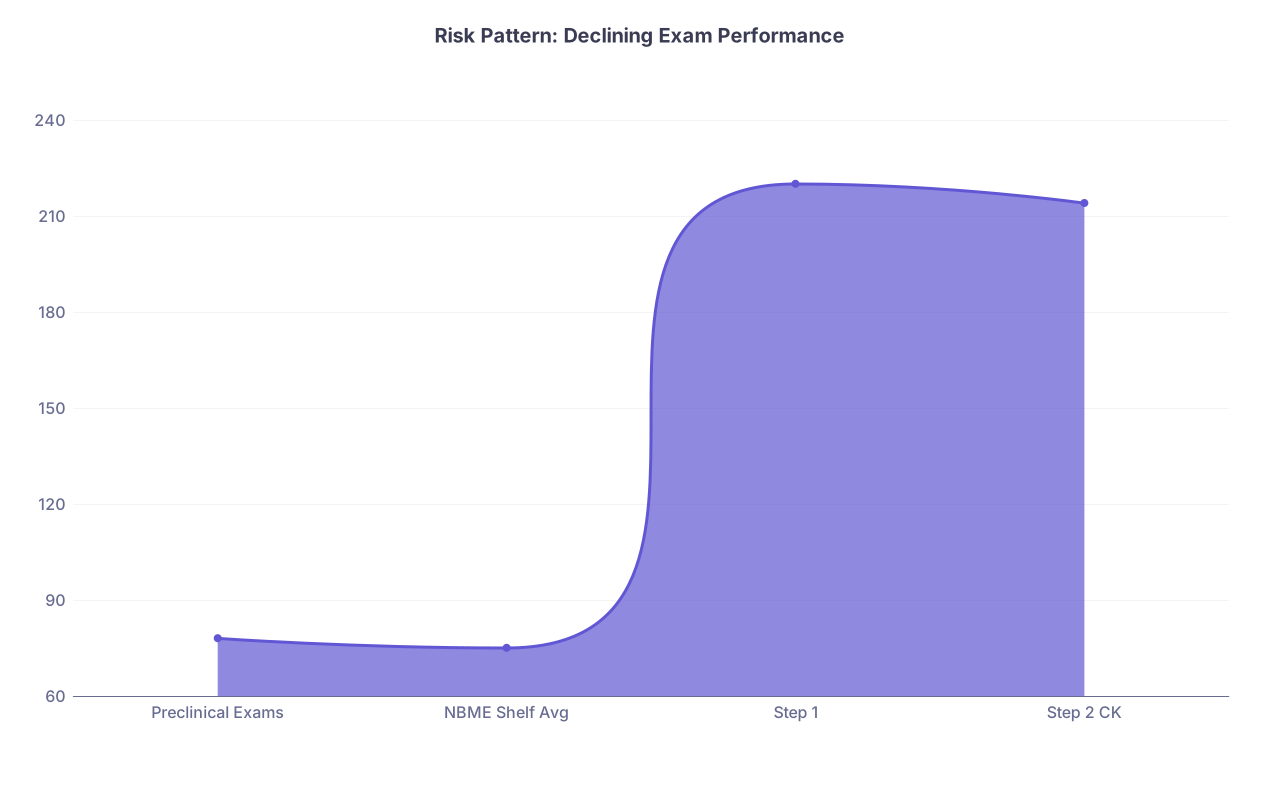
| Category | Value |
|---|---|
| Preclinical Exams | 78 |
| NBME Shelf Avg | 75 |
| Step 1 | 220 |
| Step 2 CK | 214 |
That kind of downward line screams “future in‑training exam and board risk.”
Mistake: Failing to demonstrate any rebound or growth
Risk patterns that look bad:
- Step 1 barely passed + Step 2 slightly higher but still weak + mediocre shelves.
- Solid preclinical grades, but Step 1/Step 2 both underperform and you never address study changes.
- Fail → pass but with no significant jump to show you truly fixed the problem.
Why this scares PDs:
Programs get burned when residents fail boards. It costs:
- Money for remediation
- Time for faculty
- Headaches with ACGME and the board pass rate metrics
If your record suggests you’ll be part of that problem, you fall fast on the rank list.
What you should do instead:
If your numbers are not impressive, your trajectory must be:
- Step 1: marginal
- Step 2: clearly higher
- Shelves: improving through the year
- Comments: “Hard-working, prepared, improving”
Explicitly connect the dots:
- In your MSPE (if they reference it)
- In a short explanation box
- Possibly in a LOR where a faculty member describes your improvement
Show evidence of systematic change:
- Switched to question-based learning
- Started regular spaced repetition
- Used disability testing services if you have a documented issue (without oversharing protected info)
Programs want to hear: “Yes, I stumbled. Then I built a new system and it works.”
6. Acting Like Scores Don’t Matter… in a Specialty Where They Clearly Do
Another self-sabotage move: pretending your 220 Step 2 is a minor detail while you apply to dermatology, plastic surgery, or neurosurgery “because I really love the field.”
I’ve been in those rank meetings. This is how it sounds:
“Nice kid, but with a 220? We’d never even get him through the GME board approval. Pass.”
Mistake: Score–specialty mismatch without a back-up plan
Red flags PDs see:
- Your personal statement is full of “lifelong passion” for a specialty that routinely matches residents with scores 30 points above yours.
- You have almost no parallel plan (like a medicine or prelim backup) in your application materials.
- You ignore advice about risk and then expect PDs to take that risk for you.
What you should do instead:
Study actual match data for your specialty. Not rumors. Real numbers. Look at NRMP Charting Outcomes, not just Reddit.
If you’re significantly below average for that field:
- Double down on:
- Home department support
- Research with local big names
- Stellar aways where someone will go to bat for you
- And still: build a realistic backup plan (categorical or prelim).
- Double down on:
Don’t make PDs guess if you have a plan B. Make it obvious:
- Apply to appropriate mix of programs
- Be honest in interviews (tactfully) that you’ve thought about realistic paths.
7. Sloppy Reporting: Inconsistencies, Missing Data, and Typos
This one sounds small, but it’s not. PDs hate chaos. Chaos in your application screams “charting problems later.”
I’ve seen applications where:
- Step dates don’t match what’s in the MSPE
- Attempts are mis-entered
- A Step 2 score is missing even though the MSPE mentions it
- The applicant writes a different score in the personal statement than what’s on the official report
- ERAS fields left blank when a score exists
Mistake: Making your Step record look messy or unreliable
Why this looks risky:
- Program staff worry about future documentation issues.
- It raises the question: “If they’re this careless with their own most important exam, what will ICU notes and chemo orders look like?”
What you should do instead:
Before certifying ERAS:
- Cross-check all USMLE/COMLEX dates and scores against official reports.
- Make sure every attempt is entered correctly (pass, fail, incomplete).
- Confirm your school’s MSPE reflects the same exam history you do.
Do not:
- Round your score in the personal statement.
- “Estimate” if it’s not back yet. Just give the date.
Attention to detail here is non-negotiable. It’s an easy place to look competent. Or not.
8. Letting Step Scores Be the Whole Story (Good or Bad)
Last mistake: defining yourself entirely by your Step numbers—on either end.
- High scorers who act arrogant or disinterested because “my 260 will carry me”
- Lower scorers who shrink, apologize repeatedly, and never highlight what they do bring

Mistake: Making your Step score your full identity as an applicant
Here’s the internal PD calculus:
- Strong score, bad attitude = risk
- Moderate score, strong work ethic + great team feedback = safer bet
- Low score, huge improvement + reliable reputation = sometimes a yes
If you spend half of your interview time apologizing for a 220, you’re telling them: “I don’t believe I belong here.” Programs listen to that.
If you flex your 260 but can’t answer basic questions, you look like a liability with an expiration date.
What you should do instead:
- Accept your score reality. Then move on.
- Build your narrative around:
- Work ethic
- Clinical performance
- Team behavior
- Communication skills
- Ownership of mistakes
Let the Step explanation be one controlled part of your story. Not the headline.
Quick Step-Score Sanity Checklist
Before you hit “Submit” on ERAS, check yourself against this list:
- Every exam attempt (pass/fail) is accurately entered and consistent with official reports
- Any failure or big discrepancy has a brief, responsible, non-dramatic explanation
- Step 2 CK is taken early enough or you’ve clearly stated its scheduled date
- Your specialty choice is plausible given your score, with a backup plan that’s visible
- Your program list reflects your actual competitiveness, not fantasy data
- You have no score typos anywhere (CV, PS, ERAS)
- You are not downplaying or hiding issues that a PD will obviously see anyway
- You can explain how you study now in a way that reassures them about future boards
If you can’t check several of these boxes, you’re about to look riskier than you need to.
FAQ (Exactly 3 Questions)
1. I failed Step 1 but passed Step 2 with a solid score. Should I still bring up the fail?
Yes, briefly. If you ignore it completely, PDs assume either denial or poor insight. One short explanation showing what you changed and how that led to a stronger Step 2 performance is usually the safest move. Don’t center your whole application on it, but don’t pretend it didn’t happen.
2. My Step 2 CK is borderline for my chosen specialty. Should I delay applying a year to re-take or boost my profile?
Usually, no. Re-taking a passing Step 2 just to chase a few extra points is almost always a bad idea and can raise more red flags than it removes. A more reasonable approach is adjusting your target programs and having a realistic backup specialty or more community-heavy list, while using letters, rotations, and meaningful experiences to strengthen your file.
3. Will a single low shelf exam or one bad preclinical block matter if my Step scores are okay?
Usually not by themselves. PDs care more about patterns than isolated data points. One weak clerkship or block with otherwise consistent or improving performance is rarely a deal-breaker. It only becomes concerning if it fits a broader story of inconsistent effort, declining scores, or poor reliability. If there’s a clear outlier, your goal is to make everything around it look stable and mature.
Open your ERAS right now and scroll to your USMLE/COMLEX section. Line by line, compare every score and date to your official score reports. Fix any mismatch today—before a program director sees it and quietly moves on to the next file.