
What do program directors really think when they see “I learned a lot from this failure” in your ERAS – right after you explain failing Step 1?
They roll their eyes. Then they move on to the next application.
Let me be very clear: a red flag in your residency application does not kill your chances by itself. The way you explain it absolutely can.
Most applicants either under-explain (vague, defensive, evasive) or over-explain (long, emotional, excuse-filled essays). Both are deadly in their own way.
You’re here to avoid that. Good.
The Biggest Mistake: Treating Red Flags Like Personal Essays
Red flag explanations are not personal statements. They’re not confessionals. They’re not therapy notes. They are risk-management documents for program directors.
Their mental question is simple:
“If I take this person, is this problem going to bite me – on call, in clinic, with the accreditation people, or with my chiefs?”
You answer that wrong, you’re done.
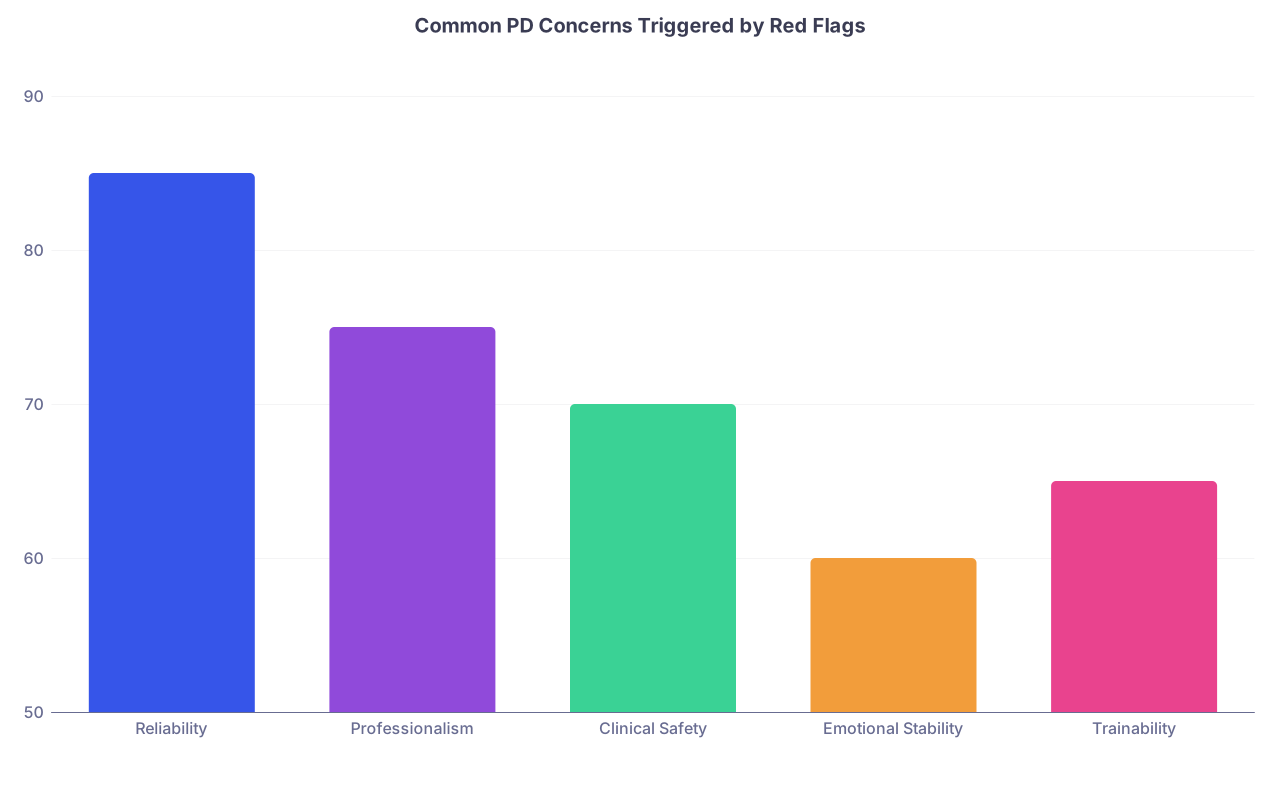
| Category | Value |
|---|---|
| Reliability | 85 |
| Professionalism | 75 |
| Clinical Safety | 70 |
| Emotional Stability | 60 |
| Trainability | 65 |
The worst mistake I see? Applicants writing like they’re trying to gain sympathy or “tell their truth,” instead of reducing perceived risk.
Let me walk you through the exact phrases and patterns that quietly destroy you – and what to do instead.
Category 1: Excuse-Heavy Language That Screams “Not My Fault”
Program directors hate one thing more than low scores: people who do not own their own mess.
Here are phrases that instantly raise red flags on top of your red flag.
1. “Due to circumstances beyond my control…”
Translation in PD’s head: “I don’t take responsibility. I don’t think I could have done anything differently.”
Variations to avoid:
- “Things happened that were out of my hands…”
- “Multiple external factors contributed…”
- “I was a victim of circumstances…”
Why it’s bad: Even when life genuinely kicked you in the teeth – illness, family crisis, whatever – you still had choices. They want to see if you understand that.
Better approach:
- State the context briefly.
- Own the outcome.
- Show what you changed.
Example rewrite:
- Bad: “Due to circumstances beyond my control, I failed Step 1.”
- Better: “During my initial Step 1 attempt, a family crisis significantly disrupted my preparation. I made poor decisions about boundaries and timing, and I failed. Since then, I’ve changed how I manage obligations and demonstrated improvement with a [Step 2 score of X].”
Short. Ownership. Concrete improvement.
2. “I do not believe this reflects my true potential…”
They do not care what you believe. They care what you did.
Variations:
- “This is not representative of my abilities.”
- “This does not reflect who I am as a student/clinician.”
Why it’s bad: It’s subjective, self-serving, and empty. Everyone with a bad score says this. It sounds like begging them to ignore objective data.
What to do instead: Show them contrasting data and changed behavior. Numbers, patterns, actions.
- Bad: “I do not believe this failure reflects my true potential as a physician.”
- Better: “After failing [exam], I adjusted my study approach by [specific change]. My subsequent performance on [later exam/rotation] (score X, Honors in Y) better reflects my current level of preparation.”
You’re not asking them to accept your feelings. You’re handing them evidence.
3. Overuse of passive voice: “Mistakes were made…”
Program directors read dozens of these. Passive voice is a red flag on honesty and accountability.
Watch for:
- “A miscommunication occurred…”
- “Boundaries were not clearly defined…”
- “Expectations were not communicated…”
Ask this: can I add “by whom?” If you can and you didn’t, you’re dodging.
- Bad: “A miscommunication occurred regarding my exam scheduling, which led to a delay.”
- Better: “I misread the exam scheduling requirements and registered late, which delayed my exam.”
Owning the action doesn’t hurt you. Dodging does.
Category 2: Over-Emotional, “Trauma Dump” Explanations
You’re not writing a therapy note. You’re writing to a time-strapped PD who is worried about on-call performance and stability.

Be very careful with how you discuss personal hardship, mental health, and family crises.
4. Hyper-dramatic life event descriptions
You do not get extra interview points for emotional detail. You do get extra worry points.
Avoid language like:
- “My world completely fell apart when…”
- “This was the darkest time in my life…”
- “I was utterly broken and unable to function…”
They read that and think:
“Is this person emotionally stable enough for residency-level stress?”
You can and should acknowledge real hardship. But compress it.
- Bad: “My world completely fell apart when my relationship ended and I fell into a deep depression that consumed me for months.”
- Better: “During M2, I experienced a major personal loss and developed depression, which I initially didn’t manage appropriately. My academic performance suffered, leading to [specific consequence]. After starting treatment and counseling, my performance stabilized and returned to my prior level, as reflected in [X, Y].”
Stable. Contained. Shows recovery.
5. Vague, ominous mental health language
Be extremely careful with phrases that sound uncontrolled or ongoing:
- “I still struggle daily with…”
- “I constantly battle overwhelming anxiety…”
- “I’m always on the verge of burnout…”
They don’t want to hear “chronic, unstable, uncontrolled” anything without a clear stabilization arc.
Better alternative: Frame it as:
- Identified
- Treated
- Stabilized
- Functioning well
Not:
- Ongoing battle with unpredictable results
Example:
- Risky: “I still struggle daily with anxiety, which sometimes affects my performance.”
- Safer: “I was diagnosed with generalized anxiety during M3. Since starting treatment and maintaining regular follow-up, I’ve been stable for over 18 months and have successfully completed full clinical workloads, including [ICU, surgery, night float].”
You’re showing: this has been field-tested under stress.
Category 3: Oversharing and Unnecessary Detail
This is where otherwise smart people tank themselves: they tell the whole story.
Program directors want the relevant story, not the complete story.

| Step | Description |
|---|---|
| Step 1 | Red Flag Exists |
| Step 2 | Focused, factual, safe |
| Step 3 | Over-explain |
| Step 4 | Extra concerning details |
| Step 5 | Higher perceived risk |
| Step 6 | Explain briefly? |
6. Giving more misconduct details than needed
If you had a professionalism concern, remediation, or disciplinary action, do not write a Netflix script.
Common oversharing mistakes:
Describing every conversation with deans
Quoting angry emails
Naming every person involved
Recounting “he said / she said” disputes
Bad:
“During my third-year surgery rotation, I had multiple clashes with a chief resident. He often raised his voice and publicly humiliated me. After one incident where he accused me of ‘having no business being in medicine’ in front of the team, I responded defensively…”
All the PD sees is: “clashes,” “defensively,” conflict drama.
- Better:
“During my third-year surgery rotation, I received feedback about unprofessional responses to critical feedback from a chief resident. I met with the clerkship director, completed a professionalism remediation plan, and subsequently received positive evaluations on later services, including [X, Y].”
You provided:
- Nature of the issue
- Corrective action
- Evidence of improvement
No blow-by-blow.
7. Volunteering extra red flags that aren’t required
A common self-sabotage: “While I’m explaining my LOA, I might as well mention those borderline fails and that conflict with Dr. X…”
No.
Unless:
- The application explicitly asks
- There is a formal record / institutional action they will see anyway
…you don’t dump every mistake you’ve ever made into this box.
You are not being “more honest” by volunteering problems that have no record, no consequence, and no relevance to current risk.
PD mindset: “If I see this, I have to worry about it.”
Category 4: The Over-Redemption Arc (Trying Too Hard to Be Inspiring)
This is the classic. Someone fails Step 1 or repeats a year, and suddenly the application turns into a TED Talk.
8. “This failure made me a better person/physician…”
They’ve read this line a thousand times. At best, it’s white noise. At worst, it sounds like you’re trying to spin a serious problem into something… positive.
Phrases to avoid:
- “This failure was actually a blessing in disguise…”
- “In retrospect, I’m glad this happened…”
- “This made me a stronger person and future physician…”
You’re allowed to show growth. Just don’t advertise your failure as your origin story.
- Bad: “Failing Step 1 was the best thing that ever happened to me because it forced me to reevaluate my priorities and become the resilient future physician I am today.”
- Better: “Failing Step 1 forced me to reassess my study approach and time management. I developed a structured plan, sought faculty support, and adjusted my resources. My Step 2 CK score of [X] reflects these changes and my current level of preparation.”
Growth is shown by:
- Different behavior
- Better outcomes
Not by inspirational adjectives.
9. Overuse of cliché “reflection” language
Watch for:
- “I have deeply reflected on…”
- “I took a long, hard look at myself…”
- “This experience taught me the value of resilience/grit/perseverance…”
Everyone writes this. It’s fluff.
Program directors don’t want your reflection story. They want your behavioral change story.
Swap this pattern:
- Feeling → Insight → Vague aspiration
For this:
- Problem → Specific change → Measurable result
Example:
- Fluffy: “This experience taught me the value of resilience and the importance of self-care.”
- Better: “After [event], I started scheduling regular follow-ups with my physician and counselor and reduced my non-academic commitments. Since then, I’ve maintained full-time clinical rotations without further leaves or failures.”
Category 5: Minimizing or Arguing With the Red Flag
Some applicants try to lawyer their way out. Bad move.
10. Arguing the decision was unfair
I see this a lot with professionalism concerns, failed OSCEs, or course failures.
Red phrases:
- “I disagreed with this decision…”
- “I feel I was unfairly targeted…”
- “The evaluation was not an accurate representation…”
The PD reads:
“If this person has an issue here, am I going to be dragged into endless debates every time they get constructive criticism?”
Even if the situation was unfair, your explanation should not sound like an appeal letter.
Better framing:
Acknowledge the decision.
Acknowledge your portion.
Show that you adapted and moved on.
Bad: “I disagreed with the remediation and felt I was held to a different standard than my peers.”
Better: “Although I initially disagreed with the remediation, I completed it and focused on improving my documentation and communication. Since then, I have not had further professionalism concerns and have received strong feedback from [X, Y].”
You’re not here to win the past. You’re here to look safe for the future.
11. Minimizing the seriousness
On the flip side, don’t act like a failed board exam or professionalism issue is “no big deal.”
Red flags:
- “It was just one bad day/exam…”
- “This was a minor misunderstanding…”
- “Everyone was under a lot of stress…”
Programs know:
- Board failures are not “just one bad exam.”
- Professionalism actions involve multiple steps and documentation.
Don’t insult their intelligence.
Balanced approach:
Name it plainly.
Don’t dramatize.
Don’t trivialize.
Bad: “This was simply one off exam and shouldn’t overshadow my entire application.”
Better: “While my failure on [exam] is a significant concern, I have addressed the underlying issues by [specifics], and my subsequent performance on [later exam/clerkships] reflects my current reliability.”
Category 6: Length, Tone, and Structural Mistakes
Even if your content is fine, the format can sink you.

12. Writing a full narrative instead of a tight explanation
Your red flag explanation should look like:
- 1–2 short paragraphs
Not: - A full-page essay with a dramatic opening and emotional conclusion.
If it takes more than:
- 6–8 sentences total
you’re probably overdoing it.
A simple safe structure:
- What happened (1–2 sentences)
- Brief context, not excuses (1–2 sentences)
- What you changed (2–3 sentences)
- How you’ve demonstrated improvement (1–2 sentences)
13. Tone mismatch: overly casual, overly formal, or performative
Avoid:
- Jokes
- Sarcasm
- Very informal language (“I totally crashed and burned on Step 1”)
- Overly bureaucratic legalese (“I hereby acknowledge full responsibility for the aforementioned incident”)
Sound like a calm, mature colleague who’s comfortable owning reality.
Good tone feels:
- Straightforward
- Neutral
- Factual with a hint of humility
Quick Comparison: Good vs Bad Phrases
| Situation | Risky Phrase | Safer Alternative |
|---|---|---|
| Exam failure | “Due to circumstances beyond my control…” | “I did not manage [X] well, which led to failing [exam]…” |
| Low score meaning | “This does not reflect my true potential…” | “Since then, I scored [X] on [later exam], reflecting progress.” |
| Professionalism issue | “I was unfairly targeted…” | “I initially disagreed, but I completed remediation and…” |
| Mental health leave | “My world fell apart and I couldn’t function…” | “I developed depression, received treatment, and have since…” |
| Redemption arc | “This failure was a blessing in disguise…” | “This prompted specific changes in how I [study/work]…” |
How Program Directors Actually Read Your Explanation
Let’s be honest about their process.
They’re not sitting with coffee, thoughtfully savoring each sentence. They’re skimming.
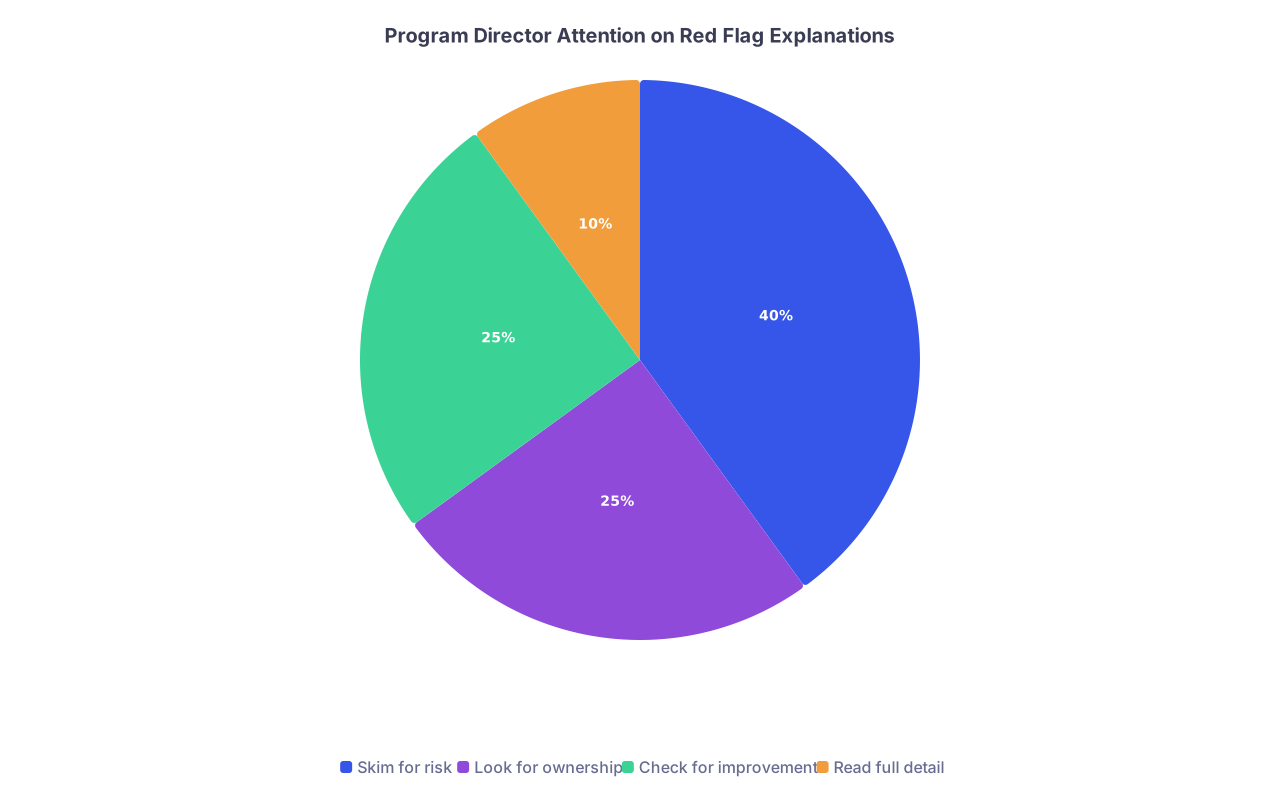
| Category | Value |
|---|---|
| Skim for risk | 40 |
| Look for ownership | 25 |
| Check for improvement | 25 |
| Read full detail | 10 |
What they scan for:
- Clear labeling of the issue
- Evidence of personal accountability
- Evidence that the problem has been solved or controlled
- No extra drama, excuses, or surprises
If they finish reading and think:
“Okay, problem happened, seems addressed, recent track record looks solid.”
…you’ve done your job.
If they finish and think:
“This feels unstable / defensive / still ongoing.”
…your explanation hurt you more than the red flag itself.
Practical Checklist: Before You Submit Any Red Flag Explanation
Use this ruthlessly. Don’t skip it.
Ask yourself:
Am I explaining or arguing?
- If you’re trying to convince them the red flag “shouldn’t count,” you’re arguing. Fix it.
Did I use any of these words?
- “Blessing in disguise”
- “Not reflective of my true potential”
- “Circumstances beyond my control”
- “Unfairly targeted”
If yes, rewrite.
Can every sentence be defended with facts?
- Not feelings. Not beliefs. Facts and observable behaviors.
Do I show what I changed and how it’s worked under real stress?
- If you don’t have evidence of improvement, you’re not ready to write a convincing explanation.
Could this be cut in half and still say the same thing?
- If yes, cut it.

| Step | Description |
|---|---|
| Step 1 | Identify Red Flag |
| Step 2 | State Issue Clearly |
| Step 3 | Brief Context |
| Step 4 | Own Responsibility |
| Step 5 | Describe Specific Changes |
| Step 6 | Show Evidence of Improvement |
| Step 7 | Cut & Rewrite |
| Step 8 | Submit |
| Step 9 | Any Excuses or Drama? |
FAQ (Exactly 4 Questions)
1. Should I always explain a red flag, or only if the program asks?
If it’s something that will clearly show up or be obvious (board failure, LOA, repeat year, disciplinary action), you’re safer addressing it briefly and proactively. Hiding it or hoping they “won’t notice” is naïve. But do not invent explanations for minor bumps that aren’t actually red flags.
2. Can I mention mental health as the reason for a leave or poor performance?
Yes, but be extremely careful with tone and framing. Keep it brief, avoid graphic or unstable language, and focus heavily on treatment, stabilization, and duration of good functioning since then. Programs are less scared of “treated and stable” than “vague, emotional, and currently struggling.”
3. Is it better to sound very apologetic and self-blaming to show insight?
No. Excessive self-flagellation looks unstable and sometimes manipulative. You want calm, factual ownership: “I did X, it led to Y, I’ve changed A, B, C, and since then Z has improved.” You are not writing a confession; you’re demonstrating reliability.
4. Can I ask a mentor to read my red flag explanation?
You should. But choose someone who’s actually sat on an admissions or residency committee if you can. Friends and family will push you toward oversharing and emotional detail. You want someone who’ll say, “Cut this. This makes you look unstable/defensive. Condense this to three sentences.”
Key points to remember:
- The red flag usually isn’t what kills you. The way you explain it is.
- Avoid excuses, drama, over-redemption arcs, and arguments about fairness.
- Aim for this: brief, factual, accountable, and backed by recent, solid performance.