
The myth that program directors carefully read every line of your CV is fiction.
Most of the time, they’re skimming your entire professional life in under a minute, often closer to 20–30 seconds, and deciding “auto-interview,” “maybe,” or “no” before they’ve even hit the bottom of the page. I’ve sat in those rooms. I’ve heard the comments. Let me walk you through how it actually works.
The Reality: How Your CV Is Really Seen
First thing to understand: your CV is not read in a vacuum. It’s read in context.
The PD isn’t sitting at home with a glass of wine, reflecting on your journey. They’re in between meetings. Or between cases. Or during yet another Zoom committee session with 1,200 applications in the queue and a GME office breathing down their neck about timelines.
So what do they do? They develop a mental “pattern recognition” system. They stop reading documents and start reading signals.
Those signals live in very specific parts of your CV. If you do not hit those quickly and clearly, you lose them. Not because you’re a bad applicant. Because you’re hard to read fast.
Let me show you how the 60 seconds actually break down in their head.
The First 10 Seconds: The Instant Triage
Here is the ugly truth: for a large chunk of programs, the real screening happens before a human ever looks at your CV. Filters on Step scores, visa status, graduation year. But let’s assume you’ve cleared that and you’re on a real person’s screen.
The first 10 seconds are ruthless.
1. The “Gut Feel” from the ERAS Snapshot
They start on the ERAS overview screen, not even your full CV yet. Name. Medical school. Grad year. Step 1/2 if visible in their layout. Home institution. Maybe your photo depending on what screen they use.
Three questions hit them immediately:
- “Is this person likely to survive our program academically?”
- “Will this person be a headache from a professionalism standpoint?”
- “Does anything about this application scream ‘top 5%’ or ‘no way’ right off the bat?”
They are not thinking these as full sentences. It’s more subconscious than that.
If Step 2 CK is visible, that number is the first hard anchor. Yes, even with Step 1 pass/fail, CK is often the true gatekeeper.
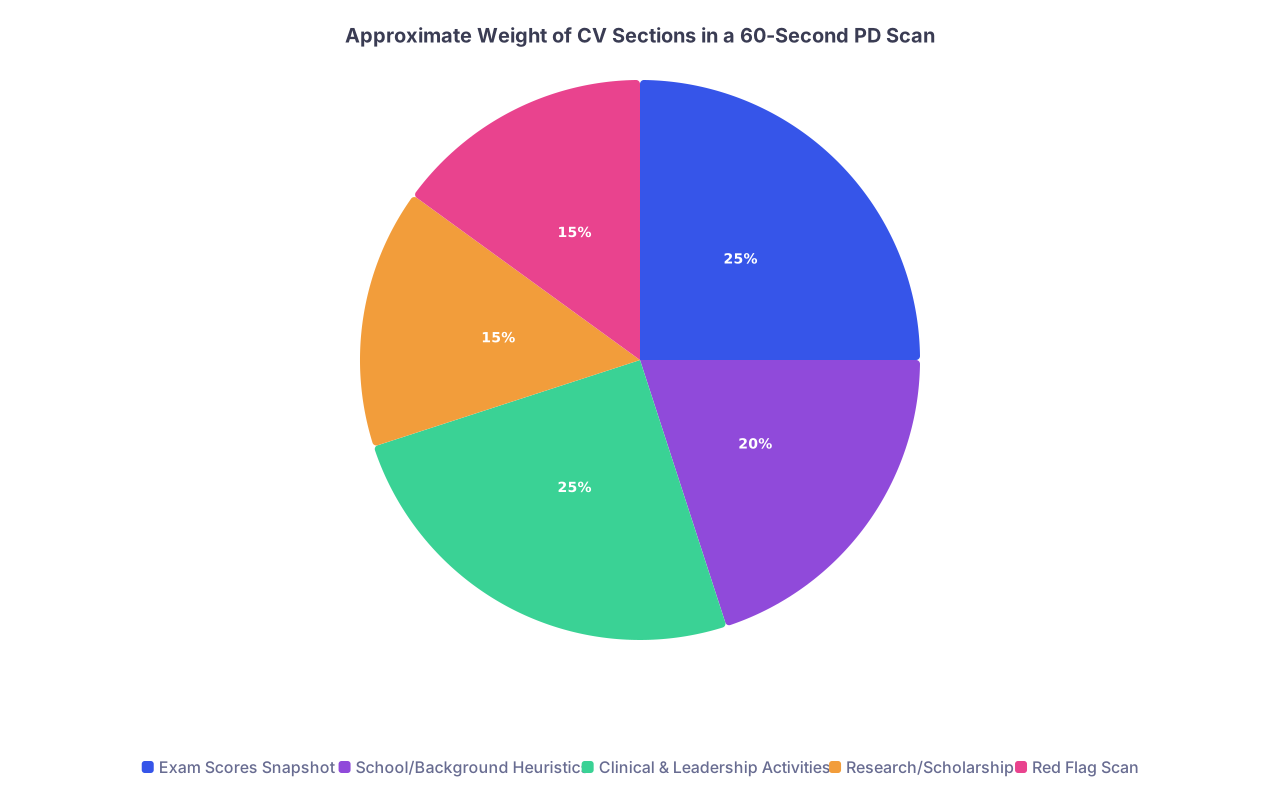
| Category | Value |
|---|---|
| Exam Scores Snapshot | 25 |
| School/Background Heuristics | 20 |
| Clinical & Leadership Activities | 25 |
| Research/Scholarship | 15 |
| Red Flag Scan | 15 |
No, these aren’t “official” numbers. But they’re not far from how real PDs mentally apportion attention.
2. The Fast School Heuristic
If you trained at their own medical school or an affiliated institution, you suddenly get more benefit of the doubt. Why? Because they know your curriculum and how to interpret your performance. They’ve seen your type before.
If you’re from a well-known US MD school, there’s an automatic “probably fine” assumption unless something else contradicts it.
If you’re from a newer DO school, a lesser-known offshore school, or an international school that isn’t on their mental shortlist, the question becomes: “Does anything offset this?” That offset has to come later: scores, research, strong US letters. But you start with a slight trust deficit.
Nobody will say this on a webinar. But I’ve heard it in selection meetings word-for-word:
“Where’s this school? Anyone know it? Ok, what are the scores?”
Seconds 10–25: The CV Layout Test
Once they click into your actual CV/ERAS experiences, here’s what happens.
They do not start at the top and read down slowly. They glance at:
- How crowded is this?
- Is it clearly structured, or is it a wall of text?
- Do the headings and bolded text pull their eye to the right places?
A chaotic CV telegraphs a chaotic resident. A dense but clean CV—or a concise one with clear highlights—telegraphs someone who understands how busy people read. That matters far more than you think.
This is the “can I read this quickly without cursing?” test. If your experiences section looks like a novel, they’re not going to reward your literary ambition. They will just stop reading sooner.
Here’s the hierarchy of what their eyes jump to first on the CV itself:
| Order | Section / Element |
|---|---|
| 1 | Exam scores / transcript snapshot (if open) |
| 2 | Medical school + grad year |
| 3 | Most recent clinical / leadership roles |
| 4 | Research summary line (if any) |
| 5 | Awards / honors (only if prominent) |
If your most meaningful experience is buried under three “shadowing” entries and six meaningless campus clubs, you’ve already sabotaged yourself.
Seconds 25–45: The “Is This Person Real or Inflated?” Scan
This is where the PD or faculty reviewer actually engages with content for about 20 seconds. That’s it. Those 20 seconds can make or break your interview invite.
1. They Look for Anchor Activities, Not Laundry Lists
Most applicants think quantity matters. “Let me show them I did 19 activities.” That’s how you get skipped.
What PDs and faculty are actually looking for is 1–3 anchor experiences that tell a coherent story:
- A leadership role you clearly owned, not just “member”
- A sustained commitment (2+ years) vs fifteen 3-month hobbies
- A research or QI project that looks real, not cosmetic
I’ve watched a PD scroll right past five tiny entries and stop at one line:
“Chief student coordinator, student-run free clinic, 2 years”
She clicked that, skimmed, and said: “Ok, that’s real. They can commit. Mark as interview.”
The five other activities? Totally irrelevant. Decorative fluff.
2. They Scan Descriptions for Substance
Your bullet points—or in ERAS, your sentences—betray you quickly.
“Participated in rounds and observed patient care”
“Shadowed physician and learned about [specialty]”
“Attended meetings and helped with planning”
That kind of filler tells them: nothing here. Just hours.
What catches attention is concrete, ownership-based language:
- “Created standardized sign-out template used by the team”
- “Led a 6-student team that increased vaccination outreach by 40%”
- “Designed data collection form and performed preliminary analysis on 120 patients”
No, they’re not double-checking your numbers. They’re checking if you’ve ever driven a process, owned tasks, and gotten actual outcomes.
One PD’s exact line during a review:
“If I see ‘shadowing’ more than twice, I’m out. Show me something you did, not where you stood.”
3. Leadership Is Interpreted Differently Than You Think
“President of ____ Club” means nothing if every med student has a president title for something.
What they look for is scope and friction. Did you oversee actual people doing work that could go wrong? Did you interact with administration, faculty, or external stakeholders? Did your decisions matter?
“Organized monthly talks” is fine.
“Negotiated CME support and funding for interdepartmental workshop series” is better.
“Created a new rotation orientation process now used by 40+ students per year” is the sort of line that gets mentioned in meetings.
The word “president” doesn’t impress them. The evidence that someone trusted you with headaches does.

The Red Flag Scan: The Silent Killer
While they’re scanning your CV, their mind is running a quiet background process:
“Is there anything here that will blow up in my face later?”
They are not just hunting for brilliance. They’re hunting for risk.
Common red flags they watch for, often in under 10 seconds:
- Unexplained gaps in training
- Multiple short, non-sequential jobs or research stints without a story
- A string of “resigned,” “left early,” “not continued” roles
- Long list of activities with very small time commitments, suggesting box-checking
- Any hint of professionalism issues in the MSPE that your CV doesn’t reconcile
The worst thing you can do is let your CV raise questions you don’t answer anywhere else. If you took a year off, your CV and personal statement should both make that year look purposeful, structured, and valuable.
What unnerves PDs isn’t time off. It’s time that looks like drift.
How PDs Really Rank the Pieces of Your CV
Let’s be blunt. PDs are not identical, but across internal medicine, surgery, peds, psych, EM, you see the same pattern.
| Item | Typical Reaction in 60 Seconds | |
|---|---|---|
| Strong Step 2 CK (for your field) | “Safe academically. Green light unless other issues.” | |
| US MD/DO vs unknown school | “Known quantity” vs “need evidence to trust performance.” | |
| 1–2 substantial leadership roles | “This person might function as a senior early.” | |
| Meaningful, ongoing clinical work | “Ok, this is not just shadowing; they have real patient contact.” | |
| Real research with output | “They can complete projects—not just start them.” | |
| Scattered, tiny activities | “Trying to look busy. Not much depth here.” | |
| Clear, clean formatting | “I can read this—probably organized in real life too.” | |
| B --> | Pass | C[PD/Coordinator Quick Scan] |
| B --> | Fail | Z[Screened Out] |
| D --> | Strong | E[Auto-Interview Pool] |
| D --> | Borderline | F[Resident/Faculty Review] |
| D --> | Weak | Z |
| G --> | Positive | E |
| G --> | Negative | Z |
If your CV only speaks to one group—say, pure research for the faculty—while ignoring the others, you’ll feel that in your invite rate.
Formatting Tricks That PDs Won’t Tell You They Care About
I’ve heard more than one PD mutter, “If you can’t format a simple CV, how are you going to write notes or discharge summaries?” Nobody puts that on the website. It comes out in closed-door sessions.
Some specific patterns I’ve watched PDs react to:
- Dense text paragraphs for activity descriptions ⇒ “This looks painful.”
- Inconsistent date formats ⇒ “Messy.”
- Overuse of buzzwords (“passionate,” “lifelong dream,” “dedicated to excellence”) ⇒ “Generic, trying too hard.”
- Overstacking minor awards ⇒ “High school trophy shelf.”
They like:
- Clean chronological ordering, most recent first
- Clear roles and time frames
- Outcome-focused descriptions in 2–3 lines max
- Obvious separation between major and minor experiences
If your “Research” section runs a full page and your “Clinical” experiences are thin and vague, it immediately raises the suspicion that you’re more comfortable behind a spreadsheet than at the bedside. That’s fine for some programs. For many, it’s a strike.
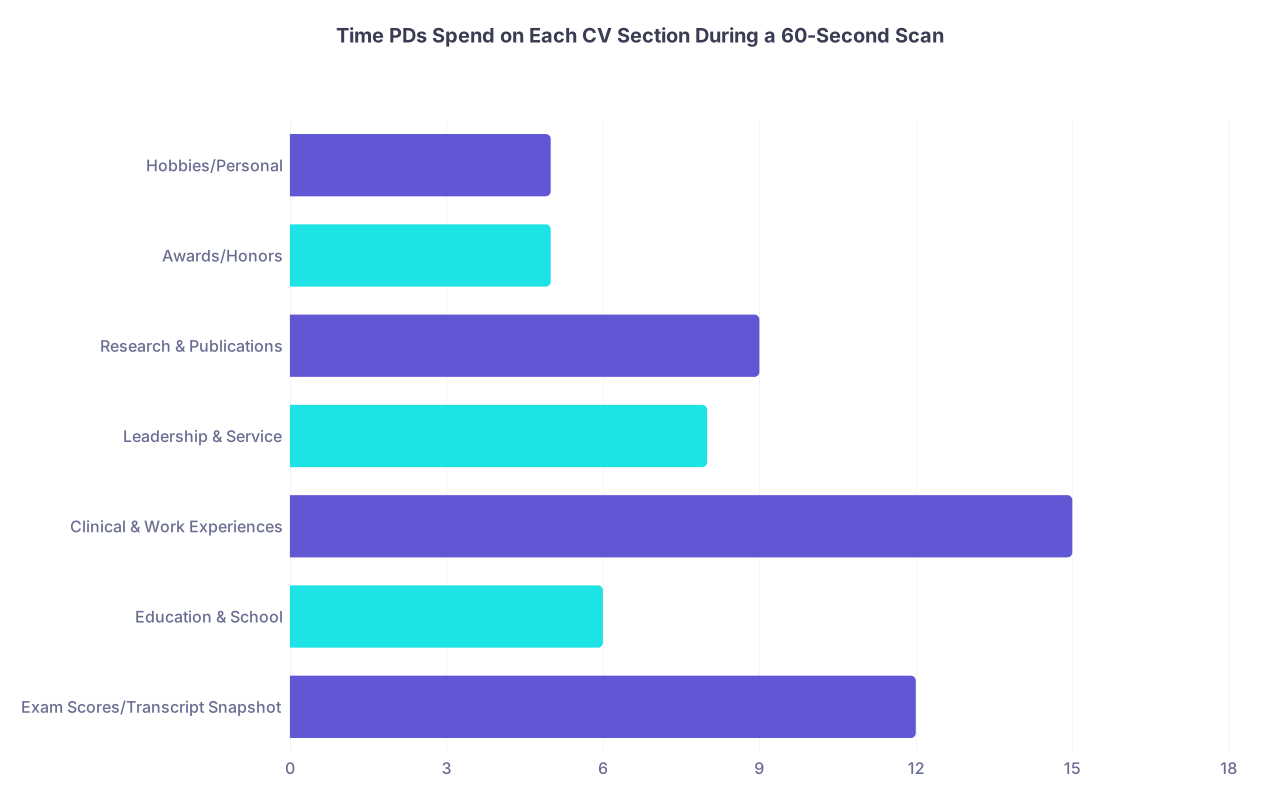
| Category | Value |
|---|---|
| Exam Scores/Transcript Snapshot | 12 |
| Education & School | 6 |
| Clinical & Work Experiences | 15 |
| Leadership & Service | 8 |
| Research & Publications | 9 |
| Awards/Honors | 5 |
| Hobbies/Personal | 5 |
Again, not exact seconds, but the proportional attention is honest.
What Actually Makes a CV “Pop” in 60 Seconds
Let me give you a composite example of how a PD’s 60 seconds might go on a strong but not superstar applicant.
Sees US MD, mid-tier school, grad year current. No issues.
Glances at CK: 244. “Fine, safe.”
Scrolls to experiences. Sees:
“Lead student coordinator, mobile clinic program, 3 years”
Skims description: “Supervised logistics for monthly clinics serving 120+ patients per year, created new triage workflow reducing wait times by 30%, trained 10+ junior volunteers annually.”Thoughts: “Ok, this person actually runs things. System thinker.”
Next:
“Clinical research assistant, heart failure clinic, 2 years”
With one line: “Managed prospective patient registry, co-authored 1 abstract, 1 manuscript under review.”Thoughts: “Not a research star, but they complete work. Solid.”
A teaching role:
“Small-group tutor, MS1 physiology, 1 year”Thoughts: “Teaches, likely good team member, can help juniors.”
Quick scroll: no weird gaps, no “shadowed Dr. X” junk, hobbies show one or two real interests (e.g., long-distance running, amateur photography). Human.
Total time? Maybe 35 seconds. Outcome? “Interview. This looks like a functional adult.”
Now compare that with the 260+ applicant who has:
- Twenty “activities,” each 2–3 months long.
- Ten “memberships,” all passive.
- Three summer research positions, no outputs mentioned.
- Descriptions full of “participated” and “observed.”
- No sustained leadership, no continuity.
They’ll say: “Smart test-taker, but I don’t know if they do any actual work.” If your academic power is undercut by a flimsy CV, you’ve left points on the table.

How to Build a CV That Survives the Real Screen
You can’t change your scores or your school at this point. But you can change how your CV lands in those 60 seconds.
Here’s the blunt playbook:
Focus your narrative. When a PD looks at your experiences, they should see 1–2 clear themes: service and leadership, research and teaching, QI and systems work. Not twelve random clubs. Coherence reads as maturity.
Trim dead weight. If an activity doesn’t prove responsibility, skill, or commitment, compress it or drop it. Eight strong entries beat twenty weak ones. Your ego wants the big list. The PD wants the short, convincing one.
Write like someone who actually did the work. Replace “exposed to,” “participated in,” “observed” with “created,” “led,” “implemented,” “analyzed,” “organized.” You either owned tasks or you didn’t. If you did, say so clearly.
Elevate a few anchor experiences. If you have one clinic, project, or leadership role that really defines you, make sure the title is clear, the timeline is long, and the description includes at least one tangible outcome. That’s what they’ll remember.
Make the layout idiot-proof. Clean sections. Consistent dates. No mini-essays in the descriptions. PDs are scanning, not studying.
And do not underestimate this: your CV, personal statement, and letters should all tell the same person story. If your CV advertises you as a hardcore researcher but your PS is all about community psych, and your letters focus on “pleasant and kind,” nobody knows who you actually are. In doubt, they move on.

The Three Things You Need to Remember
You’re not being read like a book; you’re being scanned like a chart.
In those 60 seconds, three things decide your fate more than anything else:
- Whether your CV makes you look reliable, not just impressive.
- Whether you have 1–3 anchor experiences that show real ownership and outcomes.
- Whether your formatting and content make it easy for an overworked PD to see those anchors instantly.
If your CV does that, you survive the real screening process. If it does not, no amount of “but I also…” arguments in your head will matter, because they’ll never see them.