Community residency programs are not your “backup safety schools.” Treat them that way, and you will get burned.
There’s a lazy belief that university programs are competitive and community programs are where you go if you cannot “match up.” That belief is outdated, misleading, and for many specialties—flat‑out wrong. I’ve watched plenty of applicants aim “too low” at community-heavy lists and end up unmatched, stunned that “these places rejected me too.”
Let’s dismantle the myth properly.
The Core Myth: “Community = Less Competitive”
Here’s the typical narrative you hear from MS2s on Reddit or in some hallway advice session:
- “Academic programs are for the superstars.”
- “Community programs are less picky; they just need warm bodies.”
- “If I apply to a lot of community programs, I’ll be safe.”
That was maybe half-true 20–30 years ago, when some community hospitals were chronically short of applicants. The landscape in 2024 is different.
Several factors have massively tightened the market:
- Step 1 went pass/fail → more emphasis on Step 2, clerkship grades, and overall application.
- DO and international (IMG/FMG) applicants are applying much more broadly.
- “Hidden gem” community programs have built strong reputations and now pull national-level applications.
- Geography and lifestyle (big city, high COL regions) have made some “community” spots just as desired as mid‑tier university programs.
You are not competing in your imagination. You are competing in a national marketplace where programs—community and academic—can be quite ruthless when they have 1500–4000 applications for 8–12 spots.
What the Data Actually Shows
Let’s get concrete. The NRMP’s Program Director Survey and Charting Outcomes data make one thing painfully obvious: the average credentials for matched applicants at many community-heavy specialties are not “low.”
Example (internal medicine, categorical, recent cycles, approximated from NRMP patterns):
| Program Type | Avg Step 2 CK (US MD) | AOA/Top Quartile (US MD) | % With Research (Any) |
|---|---|---|---|
| University IM | 246–250 | High | Very High |
| Community/Hybrid IM | 240–245 | Moderate | High |
| Community-Only IM | 236–242 | Lower–Moderate | Moderate–High |
Those “community-only” programs aren’t taking 220s with failed rotations and no letters. They’re matching:
- US MDs with mid‑230s–240s Step 2
- US DOs with solid COMLEX/Step 2 equivalents
- IMGs with 240+ plus strong US clinical experience
And in competitive specialties (EM, anesthesia, radiology, ortho, derm, etc.), the difference between “university” and “community” stats is often a handful of points, not 30.
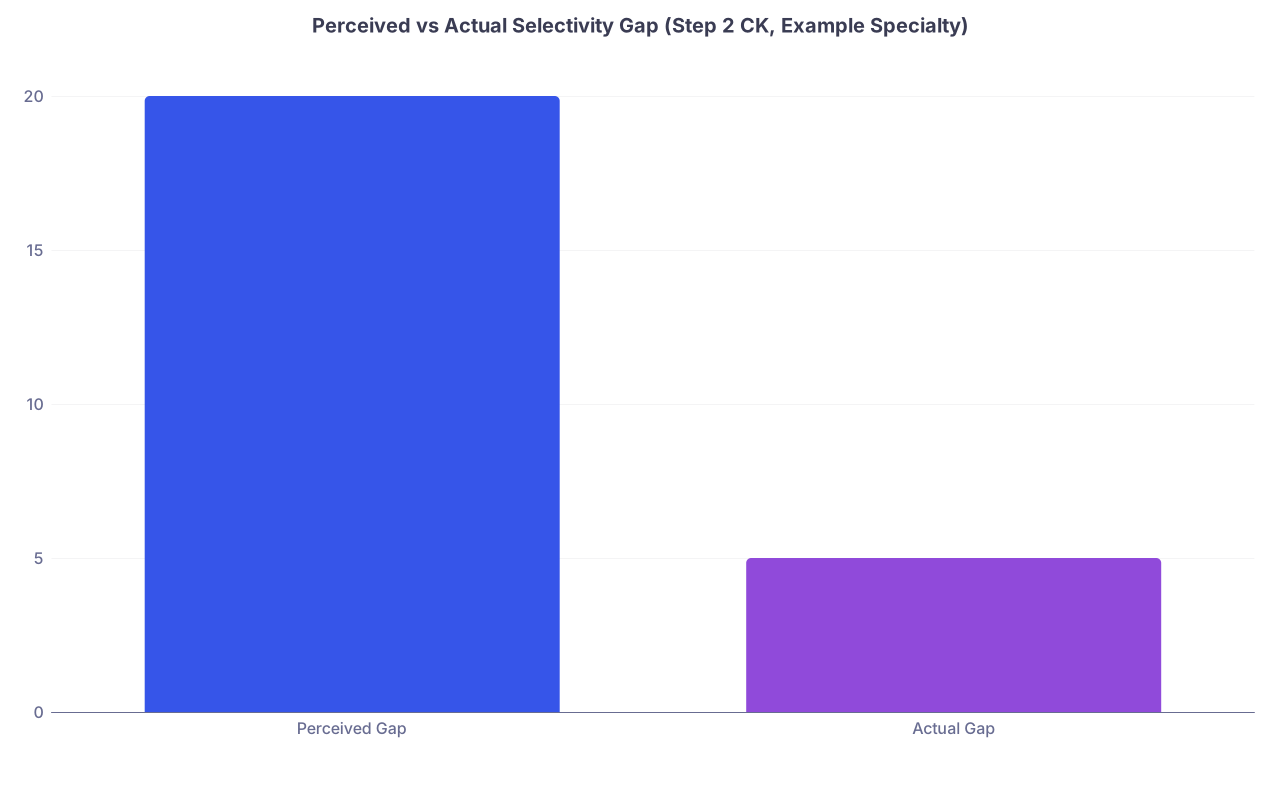
To visualize the gap people think exists vs the gap that actually exists:
| Category | Value |
|---|---|
| Perceived Gap | 20 |
| Actual Gap | 5 |
Applicants behave like the gap is 20–30 points. Data suggest maybe 5–10 on average and often less in high‑demand areas.
Why Some Community Programs Are Brutally Selective
You want a simple rule like “university > community in competitiveness.” Reality is messier.
There are community programs that are harder to match than some low‑tier university programs. Why?
1. Geography and Lifestyle Trump “Academic Brand”
I’ve seen this exact sentence from applicants: “I’ll apply to community programs in NYC/LA/Chicago as back-ups.”
You and everyone else.
A “no-name” community IM program in Manhattan can get 4000+ applications for 10 spots. A cushy suburban EM program near a major city with a strong reputation and nice schedule will be flooded.
Programs in:
- Major metros (NYC, LA, SF Bay, Boston, Chicago, Seattle, DC)
- Desirable lifestyle regions (California broadly, Colorado, Pacific Northwest, Florida coasts)
- States with big cities and lots of partner job opportunities
…often have far more applicants than midwestern or rural university programs. That lets them be picky. Very picky.
2. Word‑of‑Mouth Reputation Inside Medicine
Applicants see “community hospital” and assume generic training. Attendings and residents know better.
There are community programs that:
- Place graduates into top fellowships (cards, GI, heme/onc, critical care).
- Have attendings with strong academic CVs who just prefer non-university practice.
- Run high-volume services with robust pathology.
Word spreads. So do match lists. Once students realize “Residents from X Community IM are getting GI at major universities,” that program stops being a backup and becomes a target.
3. Applicant Psychology: “I Need Safeties” → Over-application
The safety-school mentality backfires. When 2000+ “average-strong” applicants all decide the same community programs are “safe,” there are no safeties. Just angry unmatched seniors.
Programs see this oversupply, then:
- Raise screening thresholds.
- Auto-filter lower Step 2 scores or multiple attempts.
- De-prioritize IMGs/DOs if they have enough US MDs.
- Expect better letters and stronger narratives even for community positions.
“Community” does not mean “desperate.”
The Silent Killer: Misalignment, Not Just Stats
Here’s the twist no one tells you: at many community programs, fit and alignment are even more important than at big academic centers.
Why? Smaller faculty, smaller classes, tighter culture. One bad fit poisons the well quickly.
So PDs at community places often care intensely about:
- Your geographic ties (Do you actually have a reason to be in this city/state?)
- Your long-term goals (Do you want to be a community clinician, or are you clearly using them as a fellowship stepping stone and flight risk?)
- Your work style (Are you comfortable with high service, less hand-holding, lots of autonomy?)
I have watched average‑stat applicants match into excellent community programs over numerically stronger peers because:
- They grew up in that region.
- Their personal statement explicitly addressed why that type of training suited their goals.
- Their letters painted them as gritty, hands-on, team players—ideal for a service-heavy environment.
On the flip side, I’ve seen 250+ scorers with generic “I love teaching and research” essays get quietly screened out by community programs who read that as: “She’s leaving after PGY-1 if she can.”
What Actually Makes a Residency Application “Strong” at Community Programs
Let’s pivot from myth-busting to reality-building. A “strong” community-residency application is not just lower-bar academic.
It’s differently optimized.
1. Numbers Still Matter (Stop Pretending They Don’t)
Step 2 CK / COMLEX-II, clerkship grades, and fails/remediations are very real filters.
For US MDs in moderately competitive community programs (IM, FM, peds, psych):
- Step 2 in the mid‑230s–240s is often “safe enough to be read,” not “guaranteed to match.”
- Below ~220–225, many community programs will auto-screen unless you have a strong hook (home institution, strong letter, unique path).
For DOs and IMGs, those numbers usually need to be higher for non-FM/psych.
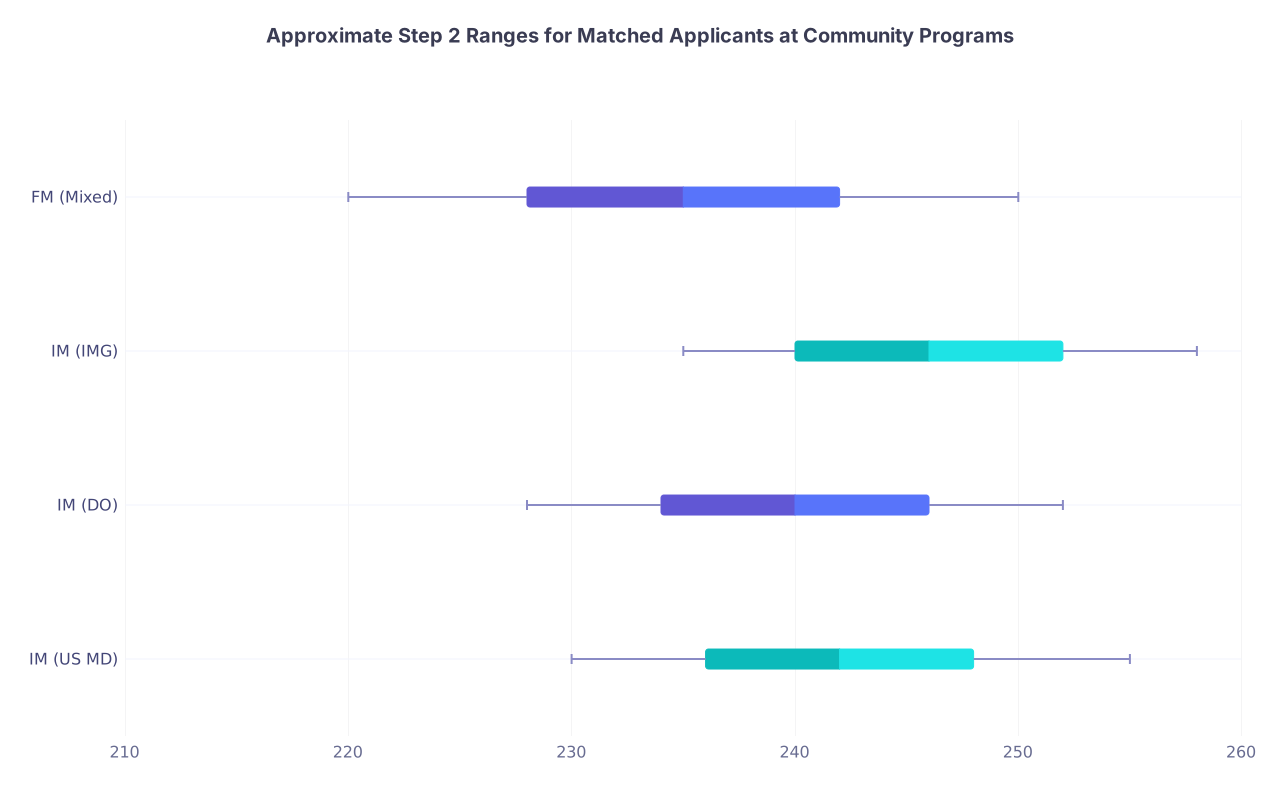
| Category | Min | Q1 | Median | Q3 | Max |
|---|---|---|---|---|---|
| IM (US MD) | 230 | 236 | 242 | 248 | 255 |
| IM (DO) | 228 | 234 | 240 | 246 | 252 |
| IM (IMG) | 235 | 240 | 246 | 252 | 258 |
| FM (Mixed) | 220 | 228 | 235 | 242 | 250 |
These are ballpark, but they’re nowhere near “open door” territory.
2. Letters and Narrative Are Magnified
Community PDs often know the local attendings personally. Names matter. Signals matter.
Compared with big university programs, community PDs may:
- Place more weight on rotation-specific letters from places that look like their hospital.
- Care less about first-author publications and more about “this person shows up, handles volume, is coachable.”
A generic glowing letter from a famous academic can get beaten by a very specific, concrete letter from a community physician who describes you managing a sick census without falling apart.
Your personal statement and experiences should also match what they actually do:
- Heavy outpatient? Show you like continuity and real-world medicine.
- Heavy inpatient and ED admits? Show you can grind, prioritize, and learn by doing.
3. Local Ties Are Not Optional at Many Places
This is the single most underestimated factor for community programs.
If you have:
- Grew up in the region / high school there.
- Undergrad or med school in same state.
- Spouse/family job that locks you into the area.
- Prior extended work (EMT, scribe, MA) at local hospitals.
You need to scream that from the rooftops—in your ERAS entries, your personal statement, and ideally in your letters.
Some PDs flat-out say this in surveys: they would rather take a slightly weaker but clearly locally-committed applicant than a superstar who will bounce after a year or two.
Where Community Programs Are Less Selective
I’m not going to pretend all community programs are secretly hyper‑competitive. There are real differences, but they’re nuanced.
Patterns where community programs are often more accessible:
- Less desirable geography (rural, very cold, very hot, economically depressed).
- Specialties with chronic workforce shortages (family medicine, some psych, prelim surgery in certain areas).
- Newer programs still building a reputation and not yet on every dean’s radar.
Even there, the bar has risen. In some lower-demand Family Medicine community programs, yes, you can match with:
- Step 2 in the low‑220s (or COMLEX equivalent).
- Modest research.
- Solid but not superstar letters.
But that’s not the same as “they will take anyone who can fog a mirror,” which is how some students talk casually about community FM or IM. That’s disrespectful and wrong.
And in EM, anesthesia, radiology, ortho, derm, uro, neurosurgery, etc.? The existence of a community label does not magically make them accessible for a weak file. Many of those programs swim in applicants and can pick and choose.
Strategic Mistakes Applicants Make About Community Programs
Let me be blunt about a few recurring errors:
Using community programs as a dumping ground on the rank list.
“I’ll just throw these 10 community IM programs in big cities at the bottom; I won’t need them.”
Result: you either never get interviews, or you burn a program that sees you don’t really want them.Zero tailoring in personal statements or communications.
Sending the same “I’m passionate about research and teaching” essay to a community hospital with 0 NIH funding and no residents going into fellowship is a red flag. They know you’re not staying.Ignoring program type differences.
Some “community” programs are actually community-based universities or hybrids with strong academic linkage. Others are fully independent. Lumping them together tells on you.Underestimating how many apps everyone else sends.
You’re not uniquely clever for “broadly applying to lots of community programs.” It’s the norm now. Volume without strategy is noise.
How to Actually Leverage Community Programs Intelligently
If you want to use community programs well in your Match strategy, do this like an adult, not like a panicked MS4.
- Identify truly less competitive regions and programs using actual data: interview invites per position, historical match outcomes at your school, word-of-mouth from recent grads.
- Figure out where you have authentic ties or compelling reasons to be—and lean into those programs.
- Calibrate your expectations: a 215 Step 2 with multiple Cs in core rotations is not getting saved by “adding more community programs” in EM or anesthesia. You may need strategy shifts: different specialty, prelim→categorical plan, gap year, etc.
- For mid-range applicants, anchor your list with a mix: some academic, some hybrid, some community, across varied geographies, with targeted signaling (emails, PS tweaks, away rotations).

| Step | Description |
|---|---|
| Step 1 | Assess Stats & Specialty |
| Step 2 | Include top academic + strong community |
| Step 3 | Balanced list: academic, hybrid, community |
| Step 4 | Consider less competitive specialties + broad community focus |
| Step 5 | Target by geography and program culture |
| Step 6 | Customize PS and highlight local ties |
| Step 7 | Competitive? |
The Bottom Line: Community ≠ Easy
Strip away the myths, and the picture is simple:
Community programs are not automatically less selective; many are intensely competitive because of geography, lifestyle, and reputation.
A strong residency application to a community program is not a “worse” version of an academic app—it’s a different optimization: solid numbers, strong hands-on letters, obvious alignment with their training model and region.
Using community programs as generic safeties is how smart applicants end up unmatched. Targeted, data-informed, and locally grounded applications are how you actually leverage them.
Stop treating “community” like code for “easy.” Programs certainly don’t. And they’re the ones with the rank list.