It is mid-September. ERAS is open. Your classmates are bragging about “casting a wide net” and “just to be safe I sent 120 applications.” You are staring at your dashboard, finger hovering over the “Apply to All” button for three regions you do not even want to live in.
You feel one thing: fear. Fear of not matching, fear of being the only one who “underapplied,” fear that if you do not click now, you are sabotaging your future.
This is exactly where people destroy an otherwise solid residency profile. Not with a bad Step score. Not with a weak letter. With panic overapplying.
Let me be blunt: overapplying is not just expensive and annoying. Done wrong, it quietly makes you look worse on paper and in person. I have watched strong applicants dilute their application, burn out before interview season, and end up with fewer interviews than classmates who applied to half as many programs.
You think more applications = more safety. In reality, beyond a certain point, more applications = more sloppiness, more red flags, and more ways to signal to programs that you do not really know what you are doing.
Let me walk through the big ways overapplying backfires, and the mistakes you need to avoid.
Mistake #1: Treating Residency Applications Like Lottery Tickets
The first mental error: thinking residency is like Powerball. “If I buy 100 tickets instead of 40, I double my chances.” That logic gets repeated verbatim every year in group chats.
Residency programs are not pulling names out of a hat. They are making pattern-based decisions:
- Who looks genuinely interested in us?
- Who fits our mission, location, clinical profile?
- Who put real thought into this application?
When you blast out 80–120 applications without a clear strategy, you:
Look generic
Your materials start reading like they could belong to anyone:- Same personal statement to every program (including community vs academic vs rural vs subspecialty-heavy)
- No mention of why that program, that region, or that training environment
- No alignment between your experiences and what the program actually values
Program directors see this all day. They can tell when you wrote one “Dear Sir or Madam” statement and hit send 100 times.
Signal desperation instead of intent
Programs know approximately how many applications make sense for your specialty and profile. If you are a US MD with solid scores applying to Internal Medicine and you send 120 applications, that does not scream “thoughtful.” It screams “I do not know my numbers or I do not believe in myself.”Waste time where you have no realistic shot
And you pay real money for it. Then you are shocked when your interview list looks thin despite the massive spend.
Overapplying without a targeted list is not risk management. It is panic.
Mistake #2: Spreading Yourself So Thin Your Application Quality Drops
Here is the part no one factors in when they say “just apply to more”: your time and cognitive bandwidth are limited. You are trying to:
- Finish sub‑I’s or AI’s
- Show up well clinically so letter writers will still recommend you
- Take care of Step 2/COMLEX 2 (or the fallout from your score)
- Draft, revise, and tailor personal statements
- Fill out ERAS accurately
- Prepare for interviews
Now add 40–80 extra applications and the secondaries / supplemental questions that come with them. Something breaks. Usually, quality.
Common ways I see overapplying degrade the actual content:
Recycling the same vague personal statement for every program, including wildly different institutions
Copy‑pasting program names and forgetting to change them (yes, programs notice when your PS praises “what I admire about XYZ” and it is clearly some other institution)
Rushing through ERAS entries with:
- Typos in major experiences
- Poorly written descriptions
- Duplicated or inconsistent dates
Forgetting to tailor program signals (for specialties using signaling) to places you actually fit

The result:
Your average application quality drops. And programs are not seeing your “best version” 90 times. They see something slightly sloppy, slightly generic, slightly off. Enough to move you to the “no” pile.
Mistake #3: Underestimating Interview Fatigue and Schedule Chaos
People focus on the front end: “Will I get interviews?” They ignore the back end: “Can I handle interviews well if I do get them?”
Overapplying, paradoxically, often leads to:
- Too many low-yield interviews at programs you never seriously considered
- Not enough energy for the ones that actually matter to you
- Poor performance because you are repeating your story 4–5 times per week across time zones
I have watched applicants:
- Accept 25–30 interviews “because you never know”
- Show up to the 10 they actually cared about exhausted, under-researched, and flat
- Perform their best at programs lower on their list and their worst at true target or dream programs
Virtual interviews made this worse. It feels “easy” to say yes to everything because there is no flight or hotel. The hidden cost is attention and preparation.
You need time to:
- Read about each program
- Review your application so your stories match what they see
- Study your interviewers’ backgrounds
- Reflect on why you genuinely want that program
If you have 18 interviews scattered across programs you applied to out of fear, you will cut corners. Interviewers notice when you have not even looked at their website.
Mistake #4: Ignoring How Overapplying Looks from the Program Side
Program leadership is not oblivious. They see the national trends on applications per applicant climbing each year.
Overapplication has created:
Massive applicant pools with:
- Many people who have never set foot in the region
- Zero evidence of interest in that kind of program
- No connection to their mission or patient population
Signal fatigue where everyone claims:
- “I would be honored to train at your prestigious institution”
- “I am deeply committed to [insert generic value here]”
When you apply to dozens of programs you would not actually rank highly, a few things can happen:
You get screened out as “noise”
Your profile might be fine, but your lack of tailored interest + the sheer volume means you never make it to the human eyes stage at some places.You look inconsistent
Programs compare signals:- You say you want heavy research, yet you applied to a ton of research-light community programs
- You say you need to be near family in the Midwest, yet your map shows 40 coastal applications
That inconsistency damages your credibility.
You dilute your chance where you actually fit
Because those programs are now buried among a sea of mismatched choices. When everything is “I want you,” nothing is.
Mistake #5: Misusing “Safety” Programs and Hurting Both Sides
The myth: “I will apply to a bunch of safety programs just in case. I can always rank them low.”
The real problems:
- Many of these “safeties” know exactly when they are being used as a backup.
- If you match there, you might resent it and they might feel like you were never really committed.
- They have limited interview spots and may pass on truly interested applicants in favor of you, someone who will just complain in the resident workroom three months in.
You weaken your profile when you fill it with:
- Rotations that do not align with your true goals because you felt you “had to show interest” in backup cities
- Statements that read forced or insincere about loving rural medicine, or underserved care, or academic research, when your whole record points elsewhere
It is not just about ethics, although that matters. It is about coherence. A strong residency application tells a consistent story. Overapplying “to safeties” often forces you into stories that look all over the map.
Mistake #6: Destroying Your Budget on Low-Yield Applications
Money is not just money in this process. It is opportunity cost. The more you waste on pointless applications, the less you can:
- Travel (if needed) for key in-person visits or second looks
- Invest in a structured interview prep resource or mock interviews
- Take time off work or rotations to rest and perform well in interviews
Let me quantify this a bit.
| # of Programs | Typical Use Case | Interview Yield Pattern* |
|---|---|---|
| 20–30 | Highly competitive, targeted | High quality, few wasted |
| 40–60 | Average applicant in most fields | Reasonable balance |
| 80+ | Fear‑based overapplying | Minimal extra yield, more noise |
*Pattern = what I have repeatedly seen, not a guarantee.
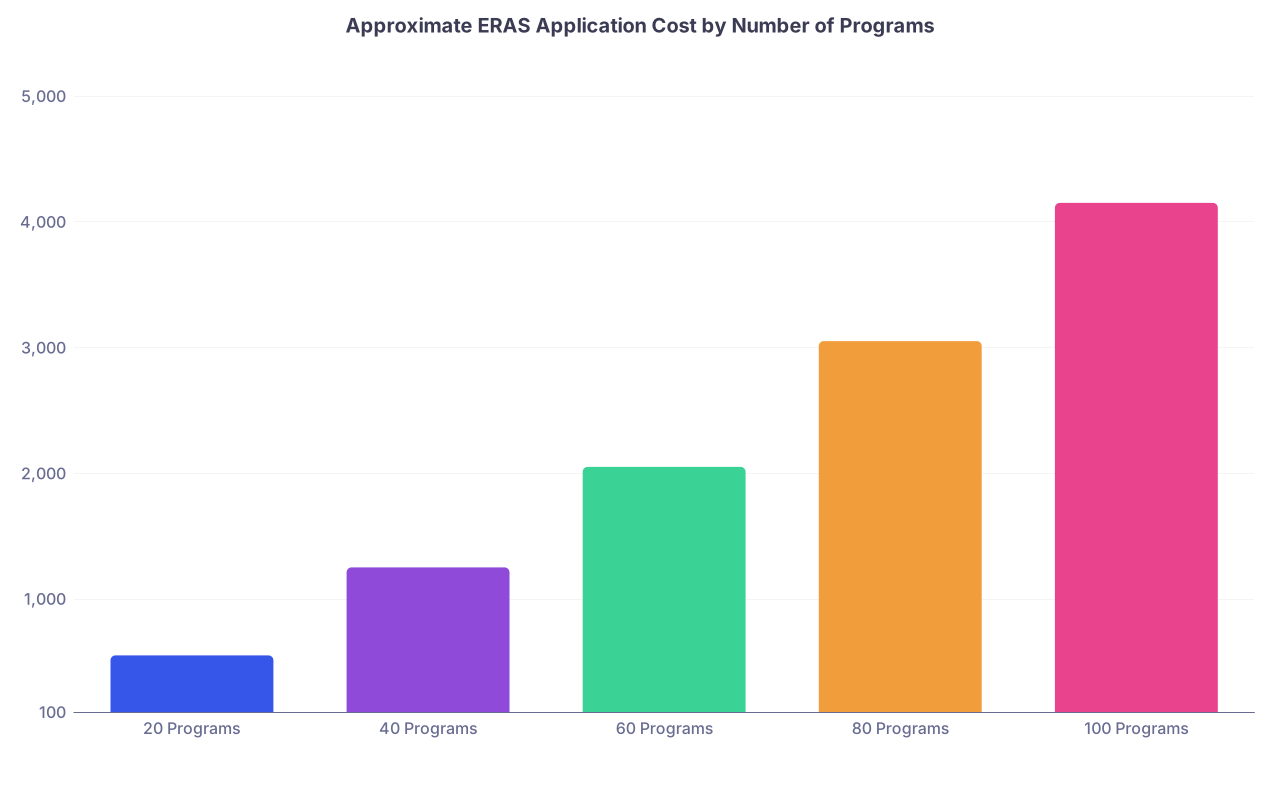
And the financial side:
| Category | Value |
|---|---|
| 20 Programs | 550 |
| 40 Programs | 1250 |
| 60 Programs | 2050 |
| 80 Programs | 3050 |
| 100 Programs | 4150 |
Numbers vary by year and specialty, but the pattern holds. The cost curve is steep, and the return curve flattens. That is a bad trade.
Instead of dumping money into sending the same generic application to an extra 30 programs, you would be smarter to:
- Pay for dedicated interview coaching (if you know you interview poorly)
- Take time off during heavy interview weeks to avoid crashing
- Buy a plane ticket to do an away or visit in a region that is truly important to you (for fields / programs where this still matters)
Mistake #7: Confusing “Breadth” with “Lack of Direction”
One of the more subtle ways overapplying weakens you: it makes your application read like you have no real direction or priorities.
For example, I see:
Applicants saying they are deeply passionate about academic medicine, then applying to:
- Dozens of small community programs with no real research infrastructure
Applicants claiming strong ties to a specific city or region, then:
- Applying heavily to three other corners of the country with no explanation
Applicants emphasizing a specific patient population (rural, underserved urban, VA-heavy), then:
- Applying everywhere without regard to whether that population is present
Programs want residents who are intentional. Not rigid, but intentional. Overapplying in a scattered way screams the opposite: “I just need any spot, anywhere, doing anything.”
Your “brand” as an applicant becomes fuzzy. Instead of “this is the person who clearly wants X and has built their profile around it,” you are “this is the person who hit submit on 90 programs without a plan.”
Mistake #8: Not Understanding Diminishing Returns by Specialty and Profile
Another trap: ignoring data. Every specialty has reasonably predictable application behavior by:
- US MD vs US DO vs IMG
- Step/COMLEX scores
- Research, AOA, class rank
- Geographic preferences
Instead of using that information to craft a focused list, applicants often just round up. “Derm friends said to apply to 80, so I will apply to 100, just to be safe.”
That “just to be safe” mentality is how good profiles get swallowed in noise.
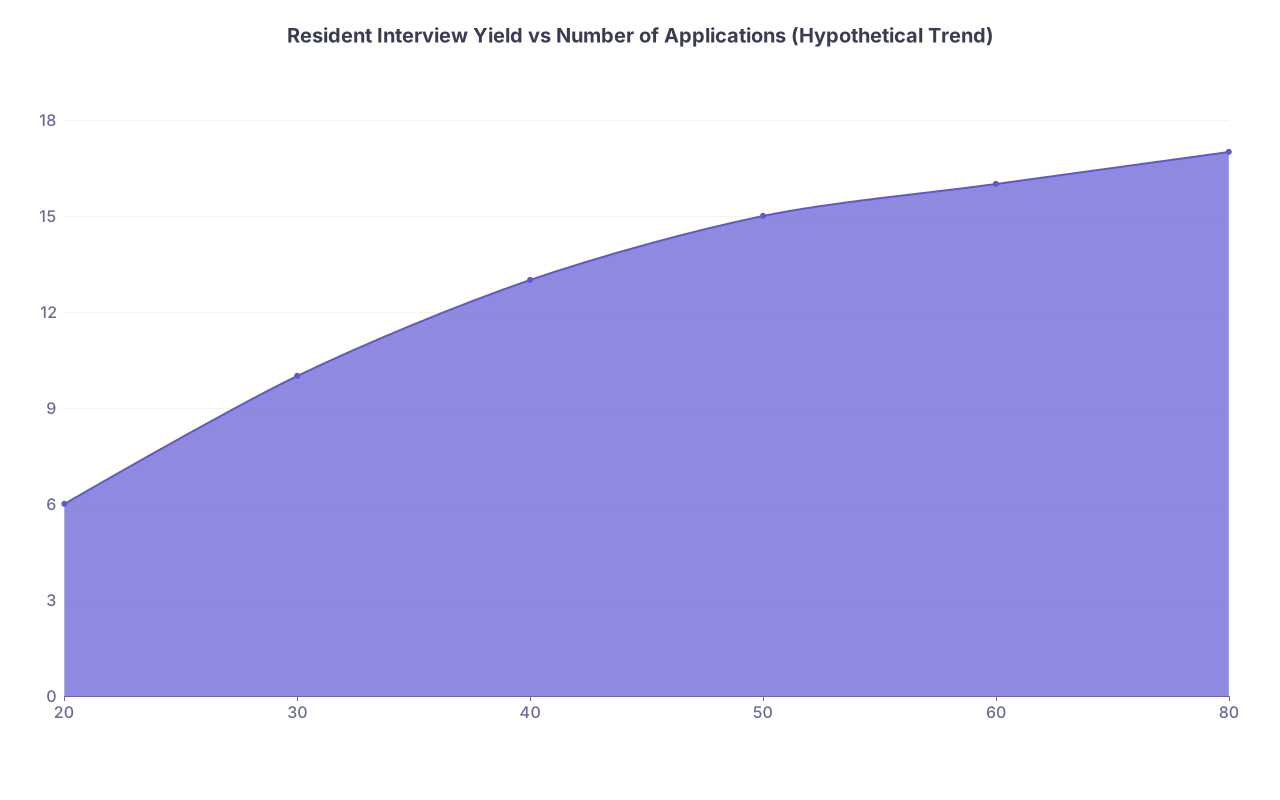
You need to know where the returns flatten for you, not for Twitter as a whole.
| Category | Value |
|---|---|
| 20 | 6 |
| 30 | 10 |
| 40 | 13 |
| 50 | 15 |
| 60 | 16 |
| 80 | 17 |
Look at that shape. Again, hypothetical but very close to real patterns I have seen. You gain a lot going from 20 → 40. You gain almost nothing going from 60 → 80. But you definitely pay for those last 20—in money and in chaos.
Mistake #9: Burning Bridges with Programs You Never Cared About
Overapplying leads to a behavior pattern that quietly harms your reputation:
- You apply to a program “just in case”
- They offer you an interview
- You:
- Cancel late
- No‑show
- Show up clearly uninterested
- Ask rude or disinterested questions
Program directors talk. Coordinators talk even more. Your name can easily come up when people ask, “Anyone have experience with this applicant?” If the coordinator chimes in, “Yeah, they no‑showed our interview without any notice,” that is not neutral.
You weaken your overall professional image when you treat programs as throwaways. Especially in smaller specialties where people see each other at meetings, review the same applicants, and share impressions freely.
Mistake #10: Letting Fear, Not Strategy, Drive Your List
Underneath all of this is one simple truth: overapplying is usually a symptom of unmanaged anxiety, not a rational plan.
Signs your list is fear-based:
- You cannot clearly explain why you applied to half the programs on it.
- Your primary justification is some version of “everyone else is applying to a lot.”
- You picked numbers (60, 80, 100) without tying them to your actual competitiveness metrics.
- You feel slightly sick when you look at your ERAS cart, but you hit submit anyway.
Let me be clear. Some applicants absolutely need broad lists:
- Lower scores in ultra‑competitive fields
- IMGs without US rotations
- DO students with weak Step/COMLEX in certain specialties
But even then, the answer is targeted broadness, not blind overapplying.

There is a difference between:
- “I intentionally applied to 80 community programs in X region because my metrics are below mean and I really want this specialty,” and
- “I applied to 80 random programs across 4 regions because my friend said 80 was safe.”
The first is strategic. The second is fear.
How to Apply Broadly Without Sabotaging Yourself
So how do you avoid these traps but still protect yourself? Here is a more disciplined approach.
1. Build a tiered, reasoned list
Group programs into:
- High reach (low chance but meaningful to you)
- Realistic (where your metrics and profile align)
- Safety (but only if you would genuinely train there without resentment)
Then:
- Cap each category with actual numbers, not vibes.
- Trim programs where:
- You have no plausible reason to live there
- The program type (research-heavy, rural, etc.) blatantly mismatches your record
2. Decide your true upper limit before panic sets in
Set a hard ceiling based on your specialty + profile. Something like:
- “If I had unlimited money and zero anxiety, how many could I thoughtfully apply to?”
- Then subtract 10–20% to leave room for quality. Yes, subtract.
Write this number down. Put it near your laptop when you open ERAS. If your finger hovers over “add 20 more,” force yourself to justify each one out loud.
3. Protect quality over quantity
Non‑negotiables:
Personal statement that is at least slightly tailored for:
- Academic vs community
- Region (if it matters to you)
- Focus area (underserved, research, etc.)
Clean, accurate ERAS with:
- No glaring typos
- Well written experience descriptions
- Coherent story
If you start to notice you are sending out applications where you have not even skimmed the program website, that is your warning sign: you have crossed into overapplying territory.
4. Plan for interview bandwidth now
Use a realistic cap on interviews you can handle while still performing well. For many people that number is in the 12–18 range for most core specialties, higher for the very competitive ones.
Then:
- Accept interviews strategically
- Decline early (and respectfully) at programs you would not rank above others already on your list
This is how you avoid becoming the person who tanks at their top choice because they are doing their fourth interview of the week on four hours of sleep.

| Step | Description |
|---|---|
| Step 1 | Self-assess profile |
| Step 2 | Set application ceiling |
| Step 3 | Create tiered program list |
| Step 4 | Research and prune list |
| Step 5 | Submit targeted applications |
| Step 6 | Screen interview invites |
| Step 7 | Cap total interviews |
| Step 8 | Focus prep on top-priority programs |
The Hidden Strength of Applying Less (and Better)
Here is what people underestimate: a slightly smaller, intentionally chosen list makes you look stronger, not weaker.
Programs see an applicant who:
- Makes decisions based on data and fit, not just fear
- Has a coherent story backed by tailored materials
- Shows real interest in the places they chose to apply
- Does not crumble into sloppiness when things get busy
That is a resident they want. Someone who can handle complexity without panicking and blasting out sloppy work.
You are not trying to “win” at some unofficial contest of who can click “apply” the most times. You are trying to build a believable, stable, and compelling case that you fit well in certain types of programs and will thrive there.
Overapplying undermines that case more often than it helps.
Your Next Step Today
Do one concrete thing right now:
Open your current or draft program list and delete 5 programs you know in your gut you would never rank above others. The places you added “just in case” or because someone on Reddit mentioned them.
Then ask yourself for each remaining program:
“Can I give a specific, honest reason I might actually want to train here?”
If you cannot, that program is a candidate for the chopping block. Better to cut it now than pay for it later in money, time, and a weaker version of you showing up where it counts.