
Why Your Dean’s Letter Matters More (or Less) Than You Think
It’s late October. You just got the email: your MSPE — the Dean’s Letter — is released to programs. You open ERAS, click “View,” and your stomach drops.
There it is. Paragraphs about your “professionalism,” “work ethic,” “team player,” all those vague phrases you’ve heard a hundred times. You’re trying to decode every adjective like it’s a secret CIA file.
Now the real question in your head:
Are program directors actually reading this thing, and how much is it going to help — or hurt — my chances?
Let me tell you what really happens.
Behind closed doors, the MSPE is both overrated and underestimated. It’s not the magic key applicants worry it is, but it’s also not the useless fluff some residents claim after the fact. The trick is knowing which parts programs actually care about, when it changes your fate, and when it’s just background noise.
We’ll walk through it the way PDs and selection committees actually use it — not the sanitized version your school tells you during “Dean’s Letter Town Hall.”
What the Dean’s Letter Actually Is (And What It Isn’t)
First, strip away the mythology.
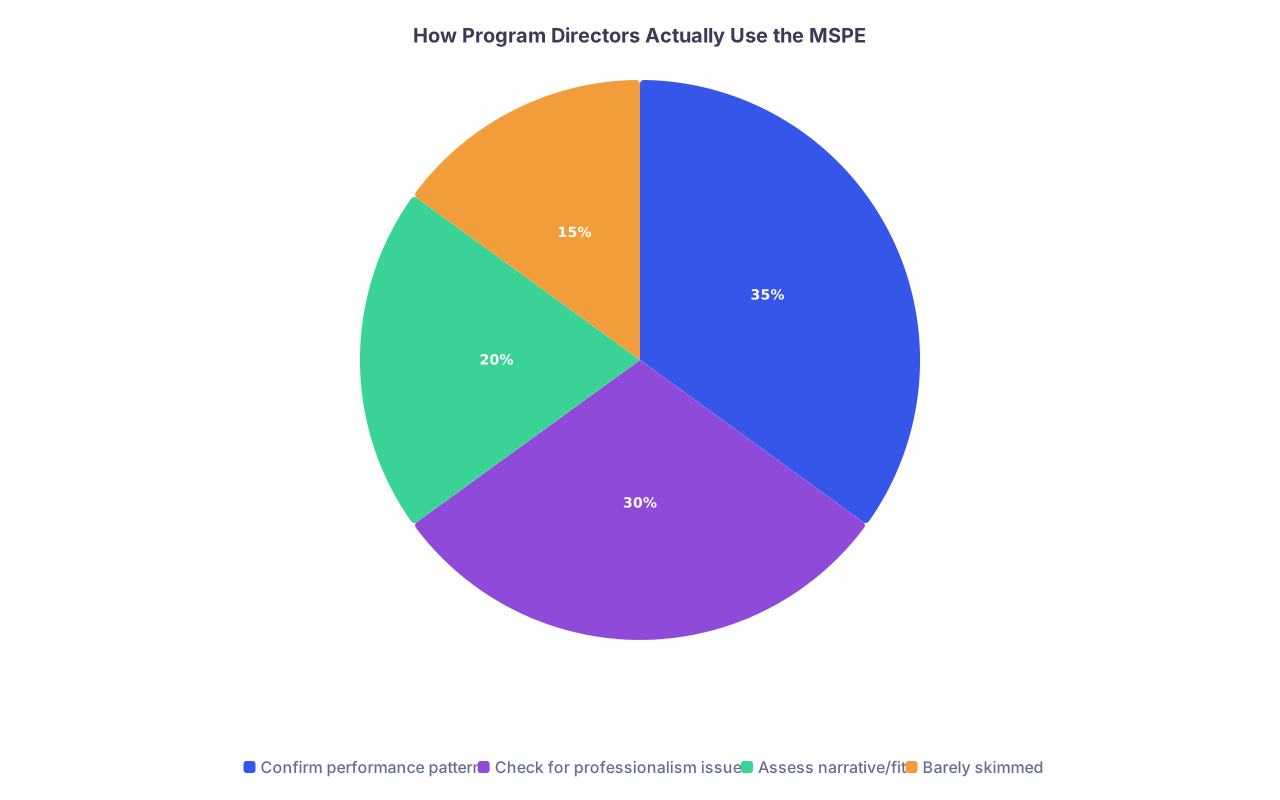
The MSPE is not a “letter of recommendation.” It’s a standardized performance narrative. Designed by committee. Written to be politically safe. But it does three things programs quietly depend on:
- Confirms your performance pattern over time
- Flags red or yellow issues
- Ranks you relative to your classmates—whether they admit it or not
| Category | Value |
|---|---|
| Confirm performance pattern | 35 |
| Check for professionalism issues | 30 |
| Assess narrative/fit | 20 |
| Barely skimmed | 15 |
What it is not:
- It’s not written primarily for you. It’s written for them (programs).
- It’s not purely objective — schools spin, omit, and soften constantly.
- It’s not the main reason you get ranked high or low. But it can be the reason you get dropped or quietly moved way down.
Here’s the part your school never says out loud:
Your MSPE matters most if something is “off”: failed shelf, professionalism concern, abruptly changed clerkship schedule, or that mysterious “leave of absence.” That’s when PDs go hunting through every word.
If you’re clean, normal, above-average, it becomes confirmatory. Not decisive.
How PDs Actually Read the Dean’s Letter
I’ve watched PDs, associate PDs, and crusty faculty doing file review for years. The pattern is almost always the same.
They open ERAS. Step scores (if they care), transcript, personal statement maybe. Then MSPE.
And here’s their sequence.
1. They scroll straight to the “Notable Concerns” and “Adverse Actions” sections
They’re not reading your flowery intro paragraph about “John is a delightful student whose curiosity…”
They go right to the danger zones.
They’re looking for:
- Words like “remediated,” “repeated,” “concern,” “investigation,” “probation,” “formal feedback”
- Leaves of absence — how long, what reason, how explained
- Any reference to “professionalism,” “professional conduct,” or “communication” framed as an “area for growth”
If there’s a professionalism blip, it will be discussed in the applicant review meeting. That includes:
- Mistreatment complaints
- Attendance issues
- EMR/documentation problems
- Unprofessional email or behavior that escalated to the Dean’s office
If your MSPE is totally clean in this section — no concerns, no adverse actions, bland language — you’ve already passed the first and most important MSPE test: you are not a risk.
The truth: Programs are far more worried about a professionalism headache than about a mediocre Step 2 score.
2. They scan your clerkship grades and comments — fast, but with a trained eye
This is where the MSPE earns its keep.
Most PDs know the grading games:
- Some schools hand out “Honors” like Halloween candy.
- Others give 10% Honors to gods and everyone else gets High Pass.
- Some have no grades, just “Pass.”
So they don’t just look at the letter grade. They scan patterns and read between the lines of the comments.
They’re asking:
- Did this student consistently perform at the top, middle, or bottom of their class?
- Any clerkship that stands out as unusually poor (or unusually great)?
- Any repeated themes in the comments?
If three different services say a version of “needs to improve efficiency” or “quiet and reserved with the team,” that sticks. Not necessarily as a rejection, but as a trait.
If you get something like “best student I’ve worked with in the last 5 years” in Medicine or Surgery, that sticks too. And PDs mentally weight that comment way more than a faculty LOR with generic praise.
3. They check for “translation” — your school’s quiet ranking language
This is where the game gets subtle.
Many schools pretend they don’t rank students. Most of them lie.
They just bury it in coded language or “quartile” data. PDs know this, and they know how to read it.
Common versions:
- “Top 10–20% of class” or “upper quartile”
- “Performed at the level expected of a [School] student” (translation: middle-ish)
- “Among the strongest students on the team” (depending on frequency, could be high quartile)
- “Solid performance” / “met expectations” (this is not a compliment)
Some MSPEs even have a quiet table: where your clerkship Honors / HP / Pass rate is compared to your class median. PDs love that table because it gives them relative performance, not the inflated raw numbers.
| Phrase in MSPE | What PDs Usually Hear |
|---|---|
| "Top 10% of the class" | Strong, likely to interview |
| "Upper quartile" | Above average, competitive |
| "Performed as expected" | Middle of the pack |
| "Steady progress over the year" | Started weak, improved |
| "Solid performance" | Nothing special |
No one tells you this as a student, but I’ve heard PDs say:
“We don’t need an official rank list. The MSPE gives it to us in code.”
When Your Dean’s Letter Matters A Lot
Let’s talk about when the MSPE can swing your outcome.
1. You’re borderline on paper
If your Step scores, class rank, or grades are “okay but not great” for your target specialty, the MSPE can push you into or out of the interview pile.
Scenario I’ve seen more than once:
- Applicant: borderline scores for EM at a mid-tier academic program
- PD opens MSPE, sees: consistently strong Medicine, EM, Surgery comments, phrases like “top 10–20%,” “outstanding team member,” “natural clinical reasoning”
- Result: “Invite them. The numbers aren’t stellar but this looks like someone who will function well.”
The reverse also happens.
You have decent scores, but your MSPE is full of “quiet,” “needs to develop confidence,” “benefited from feedback regarding time management.” No disasters. Just soft red flags.
Those applicants often land in the “maybe if we have spots later” pile.
2. You have a professionalism or academic issue
This is where the Dean’s Letter goes from background music to full volume.
If you failed a clerkship, had a remediation, a leave, or a documented professionalism issue, how the MSPE frames it matters more than you think.
PDs look for:
- Responsibility: Does the narrative show you owned it and improved?
- Pattern vs one-off: One bad semester during a family crisis ≠ 3 years of scattered issues
- The Dean’s tone: Defending you vs distancing from you
If your MSPE narrative sounds like:
“During the third-year internal medicine clerkship, [Student] experienced difficulty managing the demands of clinical responsibilities and examination preparation, resulting in a failing score on the NBME. They remediated the shelf exam successfully and have passed all subsequent clinical requirements.”
That’s a very different signal from:
“[Student] struggled to meet the expectations of the internal medicine clerkship. Concerns were raised about reliability and follow-through, and the clerkship director required a remediation experience to address these areas.”
Same event. Completely different temperature.
And yes, PDs absolutely discuss these in ranking meetings. I’ve heard conversations like:
- “I’m okay with a remediated shelf if they clearly improved afterward.”
- “I don’t want to deal with professionalism drama again this year. Hard pass.”
3. You’re from a lesser-known or new school
If you’re not coming from a big-name or well-known institution, your MSPE is how programs calibrate you.
They use it to answer:
“Is this student actually strong, or just the best of a weak pool?”
So they read:
- Class performance comparisons
- Any national benchmarks (AOA, GHHS, etc.)
- Comment strength — anyone calling you “one of the best I’ve worked with”
This is why students from newer DO or MD schools sometimes “overperform”: a strong MSPE with clear relative language lets PDs feel more confident taking a chance.
When Your Dean’s Letter Matters Less Than You Think
Now the part students have trouble believing.
There are situations where the MSPE doesn’t change much at all.
1. You’re clearly in the top tier for that specialty
If you’re applying Derm, Ortho, ENT, Rad Onc, etc., with 260+ Step 2, strong research, glowing letters — your MSPE is mainly there to confirm you didn’t burn the hospital down.
If it shows:
- Honors-heavy transcript
- No professionalism flags
- Typical “top 10–20%” language
You’re already in. The MSPE just doesn’t get in the way.
Faculty at highly competitive programs are not weeping over whether you were described as “outstanding” vs “excellent.” They’re looking at your entire application arc and your letters from people they know personally.
If you’re high-octane and clean, the Dean’s Letter is background.
2. You’re already known to the program
If you rotated there, the chair knows you, and the PD has seen you present at morning report — your MSPE is largely irrelevant for that specific program.
I’ve heard PDs say flat out in meetings:
“I don’t care what the MSPE says, they were fantastic on our rotation. Rank them high.”
Or the reverse:
“Their MSPE is fine, but they were a nightmare here. Absolutely not.”
Your direct behavior on their turf always outweighs whatever the Dean writes.
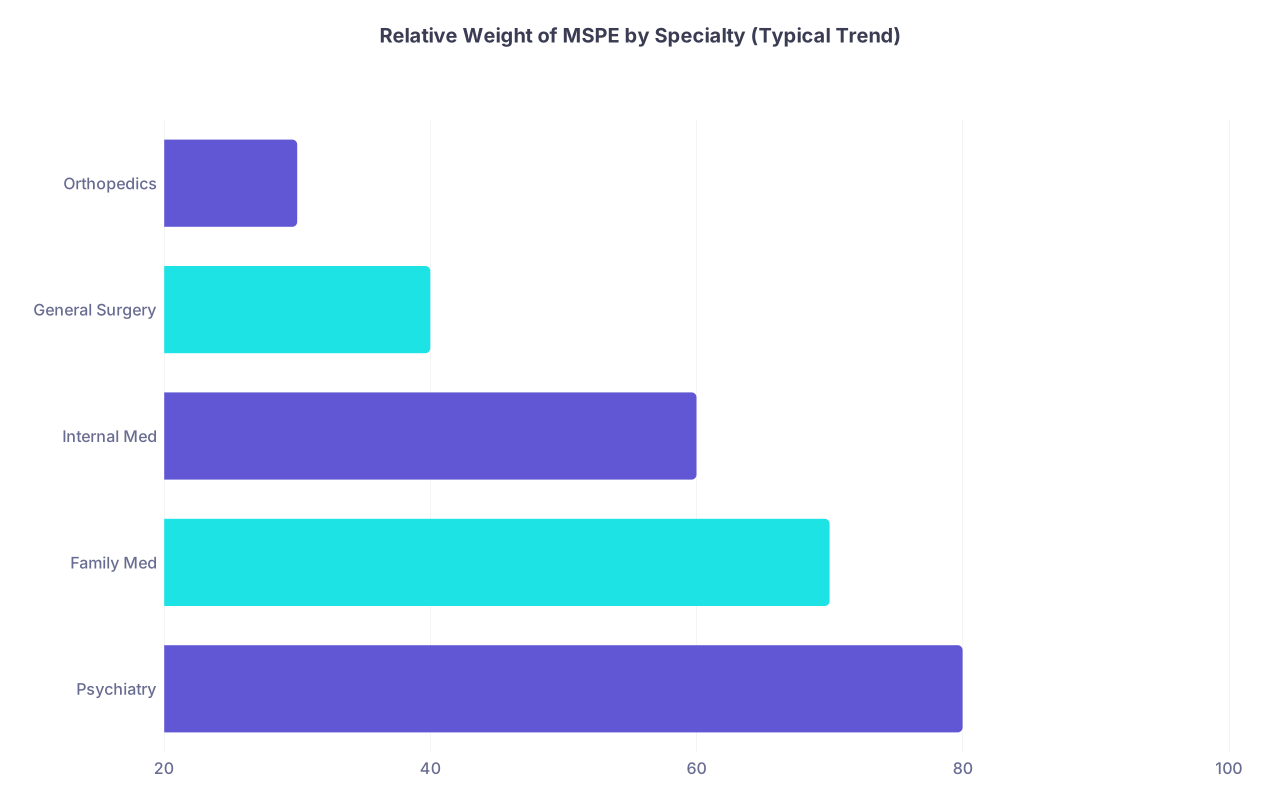
3. Specialty norms devalue it a bit
Some specialties lean more heavily on objective metrics, others on narrative.
For example:
| Category | Value |
|---|---|
| Psychiatry | 80 |
| Family Med | 70 |
| Internal Med | 60 |
| General Surgery | 40 |
| Orthopedics | 30 |
Rough pattern I’ve seen:
- Psych, FM, IM – MSPE narrative and professionalism sections carry decent weight
- Surgery, Ortho – they glance at it, but letters, rotations, and technical potential matter more
- EM – historically, SLOEs >> MSPE for decision-making
So if you’re surgery-bound and your MSPE is bland but clean, as long as your surgery letters and performance are strong, you’re fine. They’re not dissecting every word of your OB/GYN comments.
The Parts of the Dean’s Letter PDs Actually Care About
Here’s what consistently gets attention.
1. The Clerkship Comment Pattern
Not one clerkship. The pattern.
Do your comments keep circling:
- “Works hard, well-liked, team player, dependable” → They see a reliable, solid resident
- “Excellent fund of knowledge, strong clinical reasoning, independent learner” → High-ceiling resident
- “Quiet, reserved, somewhat hesitant” → May function fine but not a star
- “Needed frequent reminders,” “benefited from additional guidance,” “improved with feedback” → Risk for low-efficiency, higher-maintenance intern
One outstanding comment from Medicine or the target specialty can punch above its weight. PDs remember that better than they remember your exact Step score.
2. The Grade Distribution vs Class
If your MSPE includes a breakdown like:
- You: 6 Honors / 3 HP / 1 Pass
- Class median: 3 Honors / 5 HP / 2 Pass
You just got a quiet bump. That makes you look legitimately top tier, not just “lucky with a few Honors.”
If instead it shows:
- You: 2 Honors / 6 HP / 2 Pass
- Class median: 5 Honors / 3 HP / 2 Pass
Now even your “okay” looking grades feel below par.
This is where a lot of mid-pack students get surprised. On their own campus, they felt solid. On paper relative to the class, they look weaker.
3. Any “coded” warning language
PDs are fluent in euphemism.
They know when a school is trying to warn them without saying the words “do not take this person.”
Common code phrases that raise eyebrows:
- “Requires closer supervision than typical at their level”
- “Will benefit from continued development of time management skills”
- “Became more receptive to feedback over time”
- “Can be sensitive to feedback”
- “Will need to continue working on communication with team members”
None of those are automatic death sentences. But they will knock you down relative to a similarly qualified applicant without them.
How to Interpret Your Own Dean’s Letter (Without Losing Your Mind)
You’ve read your MSPE. Now what?
First, stop obsessing over whether they used “outstanding” or “excellent” on page one. That’s fluff.
Instead, ask:
- Do I have any explicit red flags?
- Is there any repeated soft warning language?
- Does my grade pattern and relative comparison match my target specialty?
- Is there any event (leave, remediation, delay) that needs explaining?
If the answer to that last one is “yes,” you deal with it head-on:
- In your personal statement (briefly, factually)
- If asked in interviews (own it, show growth, no excuses)
Programs hate surprises more than they hate imperfection. A known issue, well accounted for, is more acceptable than a buried one.

| Step | Description |
|---|---|
| Step 1 | Open MSPE |
| Step 2 | Discuss in meeting |
| Step 3 | Scan clerkship grades/comments |
| Step 4 | Lower rank or screen out |
| Step 5 | Consider context |
| Step 6 | Supports higher ranking |
| Step 7 | Neutral impact |
| Step 8 | Any red flags? |
| Step 9 | Pattern or one-off? |
| Step 10 | Strong or average pattern? |
If your MSPE is boring, clean, and roughly matches your performance, you’re fine. Boring is underrated.
What You Can Influence (If You’re Not Done Yet)
If you’re M3 or early M4, you actually still have leverage, even though you can’t “edit” the MSPE.
You influence it upstream:
- Clinical behavior – the single biggest input is how interns, residents, and attendings talk about you on evaluations
- Reliability – just not being the person who’s late, unprepared, or argumentative protects you from the worst language
- One truly standout clerkship – gives your Dean’s Office something powerful to quote
And here’s the quiet trick students don’t use enough:
If you know you absolutely crushed a Medicine or specialty clerkship, you can politely ask the attending if they’d support you with a strong narrative. Many of them will go out of their way in their evals — which then get lifted into the MSPE.
Will your Dean’s Office cherry-pick the best comments? Often yes. They want their grads to match. They aren’t neutral arbiters; they’re advocates with limits.
Play into that.
FAQ: Dean’s Letters and the Residency Match
1. My MSPE mentions a remediated shelf exam. Am I screwed?
No. A single remediated shelf, clearly passed on the second attempt with otherwise solid performance, is usually not fatal. Programs look at the context and the pattern. If all your other shelves and clinical comments are fine, most PDs will shrug and move on. It becomes a bigger problem if you also have weak clinical comments or other academic issues.
2. My school doesn’t “rank” students, but my MSPE says “performed as expected.” Is that bad?
“Performed as expected” is Dean-speak for “middle of the pack.” It isn’t bad, it’s just not a plus. For competitive specialties, that phrase without strong clerkship comments or standout letters will hurt. For community IM, FM, peds, and similar, it’s usually perfectly acceptable as long as you’re clean on professionalism.
3. There’s a professionalism issue mentioned. Should I bring it up or hope no one asks?
If it’s in the MSPE, they’ll see it. Do not pretend it doesn’t exist. You don’t have to open every interview with a confession, but if asked — or if it’s significant — address it calmly and directly. One short, honest explanation plus clear evidence of improvement plays much better than evasiveness or blame-shifting.
4. Programs in my specialty barely mentioned my MSPE at interviews. Does that mean they don’t care about it?
Not necessarily. Most of the MSPE’s work is done silently at the application review and ranking meeting stages, not in conversation with you. If no one brought it up, that usually means: no red flags, no surprises, nothing they’re worried about. That’s a win. They’ll still use it to confirm patterns, even if they never mention it.
5. My MSPE feels underwhelming compared to how I actually performed. Can I fix that?
You usually can’t change the MSPE text after release. What you can do is make sure your other letters are strong, specific, and reflect the version of you that you recognize. Strong specialty letters and great on-site performance (aways, sub-Is) can absolutely outweigh a lukewarm but clean MSPE. Programs trust what they see directly and what trusted colleagues write more than a bland institutional summary.
Core takeaways:
Your Dean’s Letter is a risk filter and a pattern confirmer, not the main event. It matters most when there’s a problem, a discrepancy, or a borderline case. If it’s clean, consistent with your record, and free of coded warnings, stop obsessing and focus your energy where it still moves the needle: interviews, letters, and how you show up in front of the people actually ranking you.