
“Top‑tier” vs “low‑tier” medical schools are wildly overrated in residency selection.
Not irrelevant. But nowhere near the kingmaker most students think they are.
I’ve heard versions of the same line a hundred times from students:
“I’m at a bottom‑tier MD school; I’ll never match derm.”
“I’m DO, so I have to overapply and pray.”
“They only take Harvard and Hopkins kids.”
This is mostly mythology built on half‑truths, survivor bias, and a lot of anxiety.
Let’s pull this apart using what actual data and behavior from program directors show—NRMP Program Director Surveys, Charting Outcomes, and what people actually do on selection committees when the spreadsheets open and the rank lists start forming.
The Big Myth: “School Tier Is a Top‑3 Factor”
The common story:
Residency programs screen by school prestige, then Step score, then everything else. If you’re not from a “top 20” school, you’re already behind.
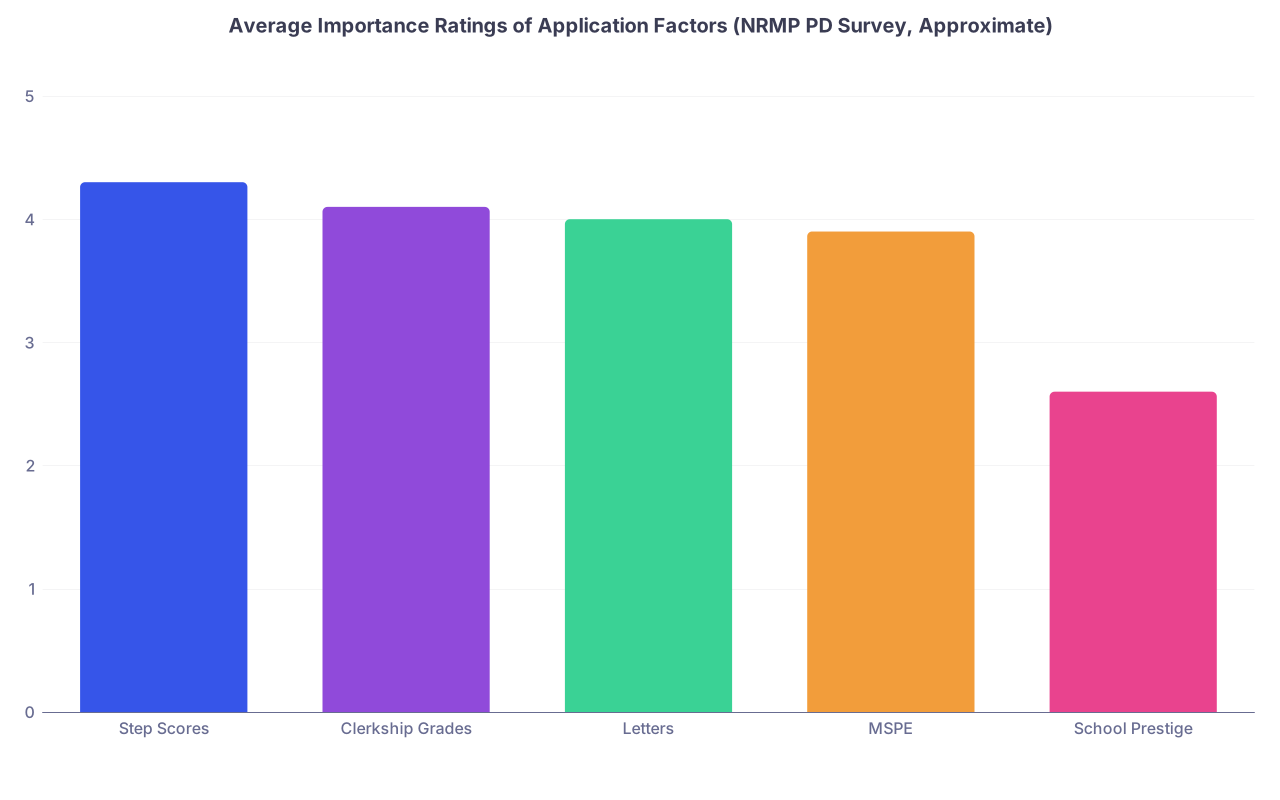
The data say something else.
| Category | Value |
|---|---|
| Step Scores | 4.3 |
| Clerkship Grades | 4.1 |
| Letters | 4 |
| MSPE | 3.9 |
| School Prestige | 2.6 |
NRMP Program Director Surveys (2018, 2020, 2022) consistently show:
- USMLE/COMLEX scores (or now, Step 2 CK scores)
- Clinical grades / class rank
- Letters of recommendation
- MSPE (Dean’s letter)
…all sit near the top of the “importance” scale.
Medical school reputation? It shows up. But it’s mid‑pack. Not irrelevant. Not decisive.
Program directors are blunt in free‑text comments: they mainly care whether your school prepares you well, whether they know how to interpret your transcript, and whether prior residents from your school did well. That’s not the same as US News “Top 20.”
The idea that every PD is sitting there saying “We only want Ivy kids” is the kind of story that spreads well on Reddit because it feeds anxiety. It’s not how most rank meetings actually run.
Where Tier Does Show Up (And Where It Doesn’t)
There are three different levels you need to separate:
- Getting your application screened in
- How your file is evaluated once read
- How you’re ranked after interview
People mash all three into “prestige bias” and then draw exaggerated conclusions.
1. Screening: The Only Place Tier Can Quietly Hurt You
Initial screening is the most algorithmic part of this process. Someone—often not the PD—is culling 3,000+ applications down to a manageable pile. That’s where simple shortcuts get used.
Here’s how “tier” actually creeps in:
- Some programs keep an informal “known schools” list from which they’ve historically had strong residents. This includes plenty of unglamorous state schools.
- A small subset of elite academic programs (think top 5–10 in certain specialties) do like top‑branded schools. Not as an absolute rule, but as a signal.
- DO schools sometimes get grouped together, particularly for historically more competitive university programs.
But here’s the part students underestimate: most of the time, Step scores and red flags matter more than school name even at the screening level. A 262 from “no‑name Midwest MD” gets through more often than a 223 from “top‑10 research powerhouse.”
In other words: tier can nudge your probability of being read at some hyper‑competitive places. It does not erase a strong file. And it does not rescue a weak one.
2. File Review: Tier Gets Demoted Hard
Once a real human is looking at the full application, school name drops in importance fast.
I’ve heard actual PDs say things like:
- “I can’t remember where half of our best residents went to med school, but I remember who crushed wards and who couldn’t manage a cross‑cover call.”
- “We had a superstar from [unranked Caribbean‑sounding but actually US MD] and two total disasters from top‑10 schools. School name is a soft signal at best.”
Inside the room, conversations sound like:
“She’s from [mid‑tier state MD], but 260+ Step 2, honors in all core rotations, great letter from our own faculty who said she was one of the best students they’ve ever worked with.”
No one says, “Yeah, but she’s not from a top school, so pass.” That’s not how this works.
3. Rank List: Performance, Fit, and Letters Win
By the time you’re on a rank list, school tier is almost an afterthought. It might still float in the background in a vague “this person’s training environment is familiar” way, but:
- How you interviewed
- How your away rotation went
- What your letter writers said
- Whether you seem coachable, safe, and hardworking
These dominate.
I’ve watched programs rank a DO from a school no one can spell above multiple applicants from “brand name” MDs because their rotation feedback was stellar and they felt normal and reliable at 2 a.m. That’s the reality.
MD vs DO vs “Top‑Tier MD”: The Real Gaps
Let’s be blunt: some structural biases exist.
But they’re not clean “ranked top‑20 or doomed” lines. They look more like this:
| Background | Signal to PDs (Typical) |
|---|---|
| Top-tier academic MD | Strong research, good letters, known evals |
| Mid/low-tier US MD | Solid baseline training, variable research |
| DO (US) | Good clinicians, variable Step/letters |
| Caribbean/intl (non-US) | Highly variable, lots of noise |
This is a signal‑to‑noise issue, not a prestige worship issue.
Program directors have lots of historical data on certain schools: they know what “Honors in Medicine” means, what the MSPE language really translates to, how those students have done as residents. That familiarity does more work than the logo.
So yes:
- Being MD from a highly academic, well‑known school may help a bit at research‑intense, ultra‑elite programs.
- Being DO or international can be a handicap at a subset of university programs in traditionally competitive specialties.
But you know what moves the needle more? Your objective and semi‑objective signals:
- Step 2 CK / COMLEX scores
- Clinical grades
- Strong specialty‑specific letters
- Evidence you can function on a team without imploding
I’ve seen DOs match ortho, derm, radiology at solid university programs. Not by apologizing for their degree. By hammering every other part of the application until reviewers didn’t care.
Where Tier Actually Helps: The Hidden Advantages
Let’s be fair. There are real advantages to being at a “higher tier” school. But they’re indirect, and that’s exactly why students misinterpret them.
Better Access ≠ Automatic Outcome
Stronger‑reputation schools often have:
- More research infrastructure and funding
- Full‑time faculty connected to big national societies
- In‑house “name” departments in competitive specialties
- Alumni already in top residencies who can vouch for you
That buys you opportunity, not outcomes.
If you show up at a “tier 3” state MD or DO school and you grind properly—find a mentor, show up early, do meaningful research, perform clinically—you can build nearly the same application signal. It’s harder logistically, but not structurally impossible.
What I do see repeatedly: students at top‑tier schools coasting because they think the brand will carry them. Then they wind up shocked when someone from a no‑name program with better letters and higher Step 2 takes “their” spot.
Specialty Differences: Where Tier Matters More (And Less)
“Does tier matter?” is the wrong question. You should be asking, “For which specialties and which programs does tier have more weight?”
Highly Competitive Academic Specialties
Think: Dermatology, Plastic Surgery, Neurosurgery, ENT, Ortho at top academic centers.
Here, school tier can have a noticeable effect—but as a tie‑breaker or early filter more than a primary driver.
Patterns you actually see:
- At UCSF derm, if 80% of their past residents came from top‑20 research schools, it’s not that they only select those students. It’s that these schools more often produce applicants with high Step 2, strong research, glowing letters, and home‑program mentors with influence.
- If you’re from a mid‑tier or DO program trying to break into this kind of environment, you often need:
– Higher scores than the median
– Stronger research output than average
– Away rotations that prove you belong
That’s not fair in a philosophical sense. But it is how they mitigate risk: less known school = more evidence required.
Bread‑and‑Butter Specialties
Internal Medicine, Pediatrics, Family Medicine, Psychiatry, Neurology at most places.
Here, school tier is close to irrelevant unless:
- The program has had repeated issues with grads from a specific school, or
- They’re flooded with more applicants than they can reasonably read and use shortcut heuristics.
But for these specialties, what gets you filtered in is much simpler: no red flags, decent scores, evidence you’ll show up and work.
That’s why you often see a wild mix of schools on the resident roster: Ivy MD next to state MD next to DO from a place you’ve never heard of. Because once they’re on the wards, none of that matters. They either handle cross‑cover or they don’t.
Community vs University Programs
Another misunderstood axis.
Community programs, especially solid, busy ones, often care less about tier and more about whether you’re going to function clinically without drama. They may have less bandwidth to “decode” exotic grading systems, but they’re very comfortable taking strong applicants from a broad range of schools.
Top‑tier university programs may lean a bit more on brand familiarity—again, because of historical data and faculty relationships, not just snobbery.
What Program Directors Actually Complain About
You want to know what irritates PDs more than “low‑tier” med schools? I’ll list a few:
- Sloppy applications full of errors and generic personal statements
- Letters that damn with faint praise (“met expectations,” “adequate fund of knowledge”)
- Students who clearly did not read the program’s priorities or case mix
- Candidates who cannot describe a single meaningful patient experience without sounding rehearsed
Not once have I heard, in an actual rank meeting, “We liked them, but the school wasn’t prestigious enough.” I have heard, “School’s good, but their letters are weak and they were unimpressive on interview day.”
Concrete Reality Check: What Actually Moves You Up or Down
Let me make this brutally clear.
You do not control your school’s “tier” by the time you’re applying to residency. You do control:
- Your Step 2 CK / COMLEX Level 2 performance
- Your clerkship evaluations and shelf prep
- Whether attendings want to write you strong letters, not just letters
- Whether your personal statement sounds like a human, not ChatGPT or canned premed fluff
- How you show up on away rotations and interviews
Those are the dials you can actually turn.
If you’re at a “lower tier” school and want to punch above your weight in residency selection, your mindset should be:
“I don’t have the brand, so I’m going to remove any doubt through my numbers, my letters, and my actual behavior around patients and staff.”
That doesn’t guarantee derm at Harvard. But it absolutely can get you into competitive fields at excellent programs.
And if you’re at a “top‑tier” school and think that logo guarantees anything, you’re setting yourself up for a rude surprise.

| Step | Description |
|---|---|
| Step 1 | Medical School Tier |
| Step 2 | Opportunity for Mentors & Research |
| Step 3 | Strength of Application Signals |
| Step 4 | Interview & Rank Position |
| Step 5 | Clinical Performance |
| Step 6 | Step 2 / COMLEX Scores |
| Step 7 | Letters & MSPE |
School tier mostly acts upstream by shaping what opportunities and mentors you have. The downstream selection decisions are driven more by the signals you produce with those opportunities.
Bottom Line: What You Should Actually Believe
Strip away the mythology and here’s what the data and real‑world behavior say:
- Medical school tier is a secondary factor in residency selection. It matters a bit more for ultra‑competitive academic specialties and specific elite programs, but far less than students think overall.
- Your individual performance—Step 2/COMLEX scores, clinical grades, letters, and how you actually function on rotations—carries far more weight than the logo on your white coat.
- “Lower tier” does not mean “locked out.” It means you have less margin for mediocrity and need to be more deliberate about building a strong, coherent application signal.
You cannot change your school’s perceived tier. You can absolutely build an application that makes programs stop caring about it.