
The biggest myth about sub-internships is that you “turn it on” on Day 1. You do not. By the time you show up for your first pre-round, your evaluation is already 50% decided—by your prep, your systems, and your reputation.
Here is a brutal but accurate truth: strong sub-I evaluations are built six weeks before the rotation starts and protected day by day once you are there.
You want a clear, chronological plan. So let’s walk it out.
6–8 Weeks Before Your Sub-I: Foundation Phase
At this point you should stop coasting and start acting like the sub-I already started. This is where most students lose ground—by assuming “I’ll review a bit the weekend before.” Wrong rotation, wrong specialty, and wrong era to try that.
1. Clarify Your Targets (Week 8–7)
You cannot hit an evaluation you have never read.
By 6–8 weeks out you should:
- Pull the official evaluation form for the rotation (from your school’s website or clerkship office).
- Get the ACGME Milestones for that specialty at the intern level.
- Look at prior written comments in your dean’s letter/MSPE from third-year.
Make two short lists in a document you will actually read:
Skills they will grade you on
Examples:- Intern-level H&P and daily notes
- Managing 4–6 patients independently
- Calling consults appropriately
- Presenting concisely on rounds
- Professionalism and reliability
Your known weaknesses from prior evals
Real examples I have seen:- “Presentations are thorough but somewhat disorganized”
- “Needs to work on time management and prioritizing tasks”
- “Often quiet on rounds; could show more initiative”
At this point you should be designing your sub-I around fixing your known weaknesses while showing off your strengths. Not just “I hope they like me.”
2. Build Your Clinical Knowledge Plan (Week 7–6)
You will not learn internal medicine during an IM sub-I. You are there to prove you can function like an intern with the knowledge you already have plus a targeted tune-up.
Pick one primary resource and one question bank or case source. Then stop shopping.
For example:
- Internal Medicine Sub-I:
- Text: “Step-Up to Medicine” or “Pocket Medicine” + one core text chapter list
- Questions: MKSAP for Students, UWorld IM blocks tied to your patient problems
- Surgery Sub-I:
- Text: “Surgical Recall” or “ABSITE Killer”
- Questions: TrueLearn/ABSITE style sets; case-based reading in “Greenfield’s Essentials”
Your 4–6 week pre-rotation plan should look like:
- 3–4 days per week:
- 60–90 minutes: Core reading on:
- Common admitting diagnoses
- Post-op care (if surgery)
- Common ward problems: fever, hypotension, AKI, chest pain, shortness of breath
- 20–40 minutes: 10–15 questions with fast review
- 60–90 minutes: Core reading on:
Focus on patterns:
- How do they admit?
- What labs do they order?
- What is the standard first-line treatment?
- What does “sick vs not sick” look like in this specialty?
You want to arrive competent enough that the team’s first impression is: “Ok, this person can hang.”
4 Weeks Before: Systems and Logistics
At this point you should be switching from “studying” to “building systems so you look organized and reliable on day one.”
3. Build Your Personal Workflow (Week 4)
You cannot develop a rounding workflow on the fly. You will be too overwhelmed.
By 4 weeks out:
Create a pre-rounding template (index card or small notepad):
- Vitals overnight (HR, BP, RR, T, O2)
- I/Os
- Labs (key ones circled for the specialty)
- Imaging results
- Brief overnight events
- To-do boxes (labs to order, consults, imaging, discharge tasks)
Standard SOAP note skeleton stored on your device or in your head:
- S: Overnight events + current complaints
- O: Vitals, exam by system (prioritize organ systems relevant to that specialty)
- A: 3–7 problem list items, each with:
- One-line summary
- Assessment sentence
- P: Bullet each step (meds, labs, imaging, consults, monitoring)
Practice writing 2–3 fake notes per week based on:
- Old patient cases from clerkships
- Online clinical cases
- Board-style questions with clinical vignettes
You want speed and structure. Not perfection.
4. Lock Down Logistics (Week 4–3)
Stupid, preventable logistical mistakes are why strong students get average evaluations.
By 3–4 weeks before the start date:
- Confirm:
- Start date, time, and exact location of orientation
- Dress code (scrubs vs clinic clothes)
- EMR training status and login access
- Call schedule system (how and when you receive it)
- Email the course director or coordinator:
- Ask if there is a rotation-specific handbook or expectations document
- Ask if they prefer you to have any pre-reading done
- If applying to that specialty:
- Clarify who the clerkship director and program leadership are. You will want to be on their radar by Week 2–3 of the rotation.
Set up your calendar:
- Block the entire rotation period (including weekends if applicable).
- Pre-block:
- Sleep windows
- Commute time
- 30–45 minutes most days for brief reading and reflection, not full studying
2 Weeks Before: Reputation and Relationships
At this point you should be managing your reputation inputs.
5. Quietly Gather Intel (Week 2)
Strong sub-I performance is not just about you. It is about understanding the culture of that service.
Two weeks before, do the following:
- Talk to 2–3 students who recently:
- Did that exact sub-I
- Or rotated on that service as MS3s
Ask specific questions:
- “What did highly rated sub-Is do differently from the average ones?”
- “What annoyed the residents or attendings?”
- “Who are the key people I need to impress?”
- “How early did people pre-round and how many patients did they carry?”
Use that to adjust:
- Your wake-up time estimate
- Number of patients you will try to carry by Week 2 (for many services: 3–4 is realistic at first, 5–6 by mid-rotation)
6. Clean Up Your Professional Footprint (Week 2–1)
People talk. Residents talk. The coordinator has opinions.
In the final 1–2 weeks:
- Fix:
- Your email signature (real name, medical school, expected graduation year)
- Any unprofessional public social media that is easily searchable
- Tell:
- Your letter-writer prospects that you are about to take a key sub-I and you plan to ask for a letter if it goes well. This mentally commits you.
3–5 Days Before: Final Prep and Checklists
At this point you should be tightening the last screws. Not starting from scratch.
7. Set Yourself Up for Day 1
- Re-read:
- The rotation expectations
- The evaluation form
- Your personal “weakness list”
- Assemble:
- Clipboard or slim folder
- Small notebook or index cards
- Two pens (one will die when you need it most)
- Pocket reference for that specialty (physical or app)
- Decide on a pre-rounding plan:
- What time you must wake up
- Target arrival time: 30 minutes earlier than you think you need for the first 2–3 days
Do one focused high-yield review session on:
- Cross-cover issues (fever, chest pain, confusion, hypotension)
- Order sets and common meds in that specialty’s EMR
You are not cramming facts. You are smoothing workflow.
Week 1 of the Sub-I: Establishing Your Identity
Now the clock starts. Your job in Week 1 is not to be impressive. It is to be reliable, safe, and coachable.

| Step | Description |
|---|---|
| Step 1 | Day 1-2 |
| Step 2 | Learn workflow |
| Step 3 | Day 3-4: Take ownership of 2-3 patients |
| Step 4 | Day 5: Ask for feedback |
Day 1–2: Learn Before You Lead
On Days 1 and 2, your mantra is: “What is the normal here?”
You should:
- Watch how interns:
- Pre-round
- Structure notes
- Present on rounds
- Communicate with nurses and consults
- Ask early:
- “How many patients is a good number for me to carry this week?”
- “What style of presentations do you prefer—full SOAP or focused quick hits?”
Make one-page cheat sheets for:
- How to admit a patient (order sets, default labs)
- Where to find key data in the EMR
- How to page consults and what information they want
You are building muscle memory.
Day 3–5: Start Owning Patients—Properly
By mid-Week 1, at this point you should be fully responsible for 2–3 patients:
- Pre-round independently
- Write daily notes (drafted early, signed when appropriate)
- Lead the presentation on those patients on rounds
- Know:
- Every med they are on and why
- What you are watching for today
- What will trigger you to call someone
Start your day with a simple priority list:
- Sickest patient
- Newest patient
- Everyone else
Ask your intern:
- “What can I take off your plate this afternoon that would be truly helpful but still appropriate for a sub-I?”
That question, asked once or twice a week, is gold.
End of Week 1: First Feedback Checkpoint
Before the weekend, you should deliberately ask for feedback.
Phrase it like this to your senior or attending:
“This sub-I is important for me, and I want to function as close to intern level as possible. After this first week, what are 1–2 things I should focus on to improve for next week?”
Write what they say in your notebook. Adjust the following week explicitly based on that.
Weeks 2–3: Building Toward “Intern-Level”
This is where strong evaluations are made. At this point you should be shifting from “good student” to “almost intern.”
Clinical Responsibility: Gradual Scale-Up
Typical progression (adjust for your service):
| Week | Target Patient Load | Primary Focus |
|---|---|---|
| 1 | 2–3 | Workflow & safety |
| 2 | 4–5 | Ownership & efficiency |
| 3 | 5–6+ | Anticipation & leadership |
By Week 2:
- Manage 4–5 patients with:
- Timely notes
- Prepared presentations
- Demonstrated understanding of pathophysiology and plan
- Start suggesting plans:
- “Given X, I was thinking we could adjust Y and follow Z; does that sound reasonable?”
Your goal: your intern feels noticeably lighter on days you are there.
Behavioral Signals of a Strong Sub-I (Week 2–3)
Strong sub-Is do very specific things consistently:
- They:
- Arrive early and are already in the chart when others show up
- Anticipate orders residents will put in and have them queued (but do not sign prematurely)
- Communicate updates to nurses and document key events
- Volunteer for scut strategically—transport, getting old records, calling family—while still protecting time for notes and learning
They do not:
- Disappear for hours “to study”
- Argue about feedback
- Try to correct the attending on arcane guideline changes mid-round
- Complain constantly about hours, notes, or consults
Your evaluation says “functions at intern level” when multiple residents can say, without hesitation, “I did not have to worry about their patients.”
Daily Micro-Checklist: Mid-Rotation
At this point you should have a daily rhythm. Use this as a quick mental checklist:
Morning (pre-round)
- Checked overnight vitals, labs, and events for all your patients
- Saw each patient with a focused exam
- Updated your to-do list per patient
- Identified 1–2 patients to read about later
Midday (post-round)
- Verified all orders were entered correctly
- Clarified any unclear parts of the plan with your intern
- Communicated key plan changes to nurses / case management
- Started or finished your notes early
Afternoon / Early Evening
- Followed up on:
- Pending tests/labs
- Consult recommendations
- Updated the team:
- “Neuro saw Ms. X; they recommend Y. I put in the orders and updated the note.”
- Quick 20–30 minute focused reading tied to an actual patient case
Week 3–4: Converting Performance into Evaluations
Strong clinical work does not automatically become a strong written evaluation. You have to help people see and remember what you did.
1. Mid- to Late-Rotation Feedback Tune-Up
At this point you should be slightly aggressive about feedback. You are on the clock for letters.
Around the start of Week 3:
- Ask your senior:
- “Are there any specific intern-level tasks you think I am ready to take on more of this week?”
- Ask your attending (after or between rounds):
- “As we get into the last 1–2 weeks, what would make you feel comfortable saying I am working at intern level? I would like to aim for that.”
Then—this is the key—link your behavior to what they said in the next few days. Let them see you doing exactly what they named.
2. Make Your Work Visible (Without Bragging)
Residents are busy. They forget who did what. You fix that by narrating your work just enough.
Examples:
- “I called cardiology about Mr. A; they think this is demand ischemia. I updated the note and put in the orders they suggested.”
- “I spoke with Ms. B’s daughter and went over the plan for discharge tomorrow; documented that in the chart.”
Short. Factual. It reminds people you are functioning like an intern.
Last 3–5 Days: Locking In Evaluations and Letters
At this point you should be intentionally transitioning from “performing” to “capturing.”
1. Directly Requesting Evaluations and Letters
Three to five days before the end:
Identify:
- 1–2 attendings
- 1–2 seniors / chiefs
Those who:
- Have seen you across at least 2 weeks
- Have watched you improve
Approach your top attending like this:
“Dr. X, I have really valued working with you this month. I am applying into [specialty], and this is a key sub-I for me. If you feel you can write a strong, supportive letter, I would be very grateful to ask you to do so.”
If they hesitate or say something vague, pivot to someone else.
For residents or fellows who will fill out evaluations, you can say:
“My sub-I evaluation will be a big part of my residency application. If there are any specific things I can do in these last few days to strengthen how you view my performance, I would really appreciate the chance to work on them.”
You show humility and seriousness. That matters.
2. End-of-Rotation Summary Emails
On the last or second-to-last day, send brief thank-you emails to key faculty:
- 3–4 sentences:
- Thank them for specific teaching moments
- Mention 1–2 concrete skills you feel you improved on the rotation
- Reiterate your interest in the specialty (if true) and that you would value keeping in touch
This does two things:
- It refreshes their memory right as they fill out evaluations.
- It gives them language they can echo in your letter or form.
Post-Rotation: Capture and Deploy
The rotation ends. The evaluations are not the end of the story.
1. Debrief Within 72 Hours
Within three days:
- Write a one-page reflection document:
- “What I did well”
- “What I need to fix before the next sub-I”
- “Positive comments I remember hearing”
- Log:
- Which attendings agreed to write letters
- Specific patient cases you managed that show responsibility
This becomes material for your ERAS personal statement and interviews.
2. Track Your Clinical Growth Across Sub-Is
If you are doing multiple sub-Is, compare them.
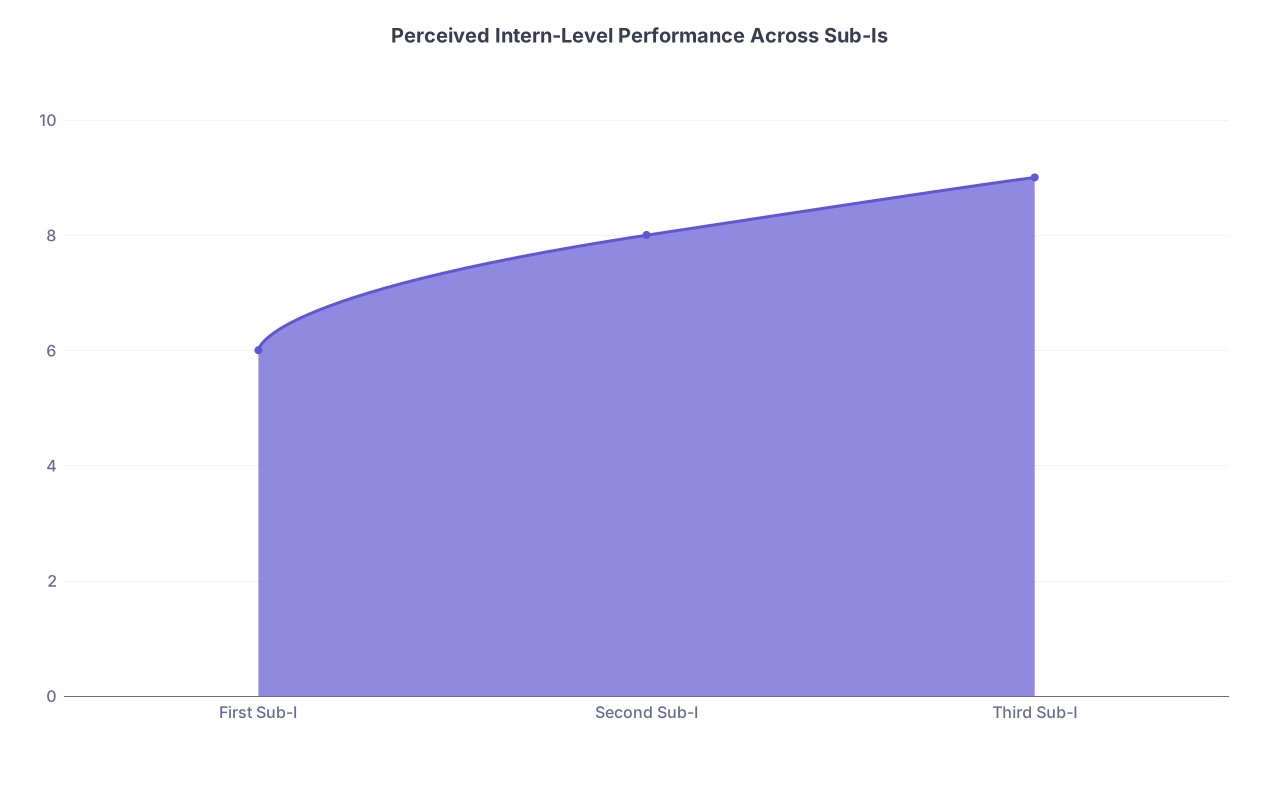
| Category | Value |
|---|---|
| First Sub-I | 6 |
| Second Sub-I | 8 |
| Third Sub-I | 9 |
(Scale 1–10 for how “intern-like” you actually felt.)
Use this to:
- Decide which attending’s letter to prioritize
- Identify skills that improved (time management, presentations, patient ownership)
- Show concrete growth when asked in interviews: “How did you grow across your sub-internships?”
Quick Snapshot: Timeline Overview
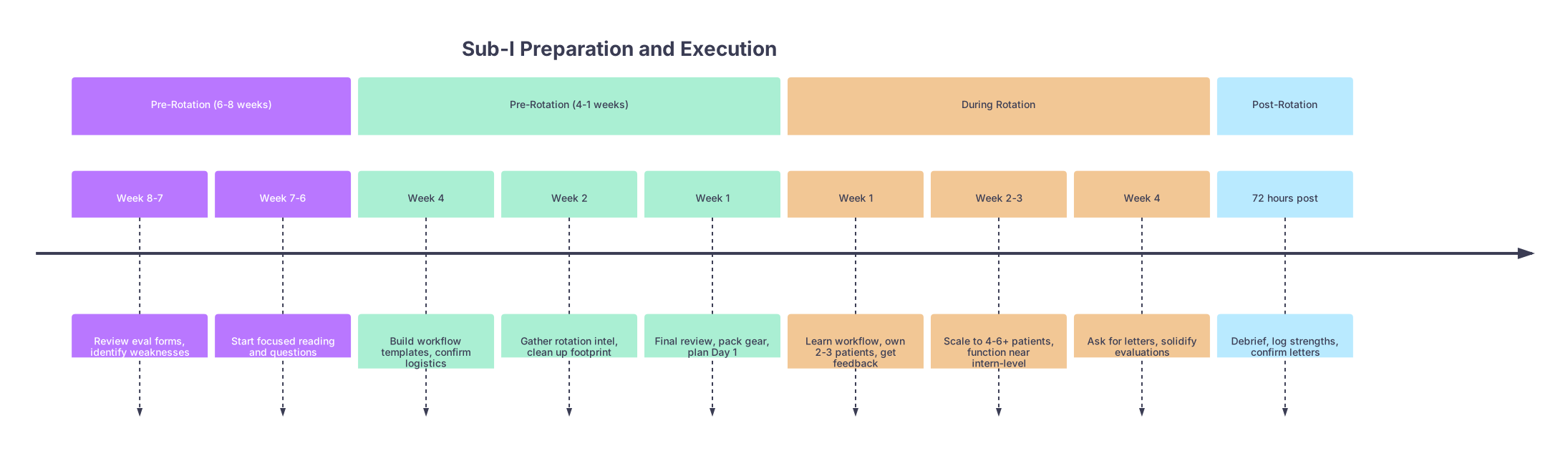
| Period | Event |
|---|---|
| Pre-Rotation (6-8 weeks) - Week 8-7 | Review eval forms, identify weaknesses |
| Pre-Rotation (6-8 weeks) - Week 7-6 | Start focused reading and questions |
| Pre-Rotation (4-1 weeks) - Week 4 | Build workflow templates, confirm logistics |
| Pre-Rotation (4-1 weeks) - Week 2 | Gather rotation intel, clean up footprint |
| Pre-Rotation (4-1 weeks) - Week 1 | Final review, pack gear, plan Day 1 |
| During Rotation - Week 1 | Learn workflow, own 2-3 patients, get feedback |
| During Rotation - Week 2-3 | Scale to 4-6+ patients, function near intern-level |
| During Rotation - Week 4 | Ask for letters, solidify evaluations |
| Post-Rotation - 72 hours post | Debrief, log strengths, confirm letters |
Final Thoughts: What Actually Turns Rotations into Strong Evaluations
You do not get honors on a sub-I by being smart and “working hard.” You get it by being predictably useful, safe, and easy to trust.
If you remember nothing else:
- Front-load the work. The students who win sub-Is start 4–6 weeks before, with clear targets and real systems, not last-minute cramming.
- Think and act like an intern. Own patients, anticipate needs, communicate clearly, and make your contributions visible without showing off.
- Engineer your evaluation. Ask for feedback early, adjust visibly, and be explicit and timely when asking for letters and strong written comments.
Do that, and your sub-I stops being “another rotation” and becomes one of the strongest pieces of your residency application.