
The biggest mistake students make in clerkships is chasing the wrong thing at the wrong time. Grades or experiences are not equal every month of third year.
You are on a clock. Programs read your application at a specific moment, and what matters in July is not what matters the following March. If you understand that timeline, you stop guessing and start playing the game correctly.
Below is how I would tell a strong, realistic student to prioritize clerkship grades versus experiences, month by month.
Big Picture: When Grades Matter Most vs Experiences
Let us start with a blunt hierarchy.
For most competitive-to-medium specialties, the priority across third year looks roughly like this:
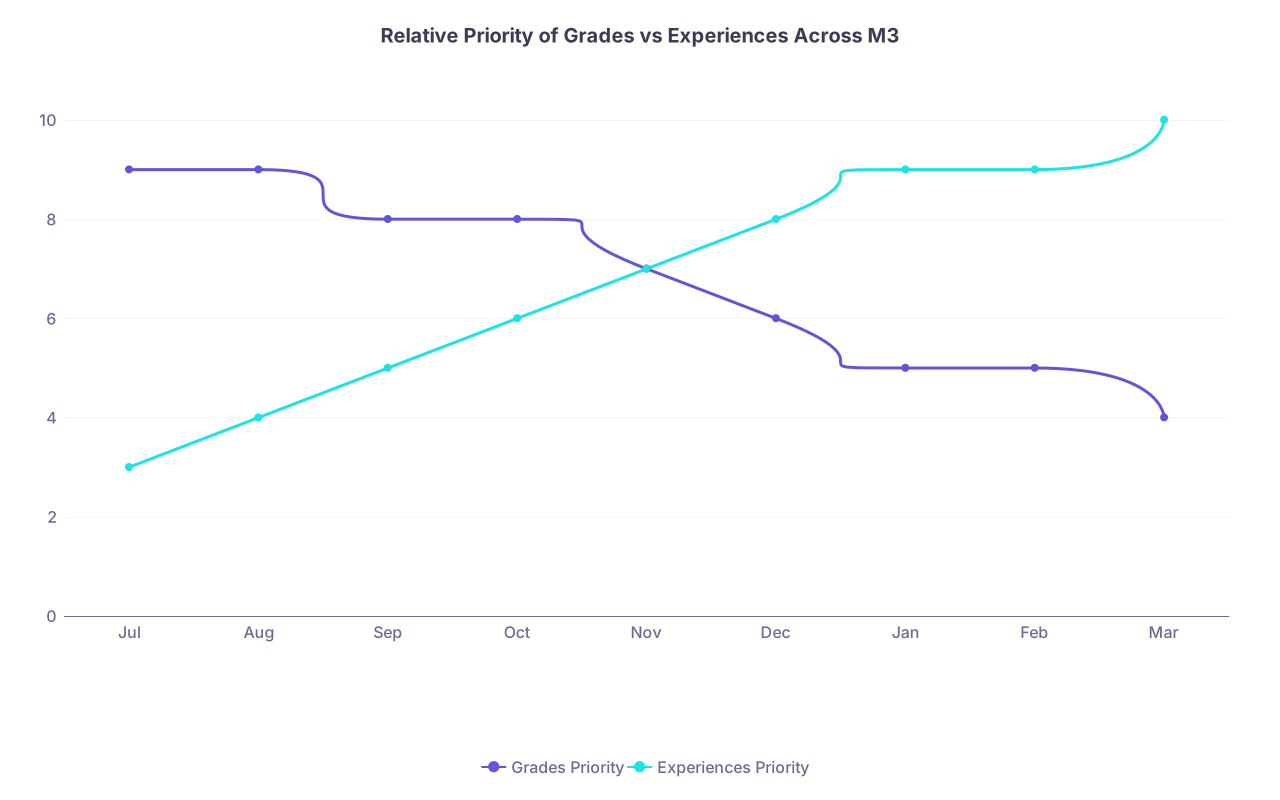
| Category | Grades Priority | Experiences Priority |
|---|---|---|
| Jul | 9 | 3 |
| Aug | 9 | 4 |
| Sep | 8 | 5 |
| Oct | 8 | 6 |
| Nov | 7 | 7 |
| Dec | 6 | 8 |
| Jan | 5 | 9 |
| Feb | 5 | 9 |
| Mar | 4 | 10 |
- Early M3 (July–October):
- Grades: Critical
- Experiences: Useful, but second priority
- Mid M3 (November–January):
- Grades: Still important, but marginal returns drop
- Experiences: Rising in importance
- Late M3 / Early M4 (February–July):
- Grades: Mostly “good enough vs red flag”
- Experiences: Core driver of your residency narrative
This shifts earlier if you are gunning for very competitive specialties (Derm, Ortho, ENT, Plastics, Neurosurgery). For those, your first 3–4 clerkships are disproportionately important.
Now let us walk it chronologically the way you will live it: month by month.
Pre–Clerkship Prep (2–4 Weeks Before M3 Starts)
At this point you should stop pretending you can “wing” third year. You cannot. Not if you care about strong letters and honors.
Your focus here:
Decide your initial tilt: grades-heavy or experience-heavy.
If you are:
- Borderline on class rank
- Interested in any competitive field
- Coming off a mediocre pre-clinical record
→ You are grades-heavy for at least the first 4–6 months.
If you:
- Already have stellar academic metrics
- Are targeting primary care, psych, or less competitive fields
- Learn much better by doing than by books
→ You have a bit more flexibility to lean into experiences earlier.
Set a default daily time budget.
This stops you from making the classic error of studying like a Step 1 hermit or, conversely, being everyone’s favorite student who honors nothing.- Weekdays:
- 8–10 hours clinical time
- 1 hour “professional development / reflection”
- 1–2 hours hard study (UWorld/Anki/questions)
- Weekends:
- One day light (questions + review)
- One day heavier (systematic studying, shelf prep)
- Weekdays:
Pick your first two clerkships to over-invest in grades.
Do not be cute here. If your schedule is fixed, fine. If not:- Aim to crush:
- Internal Medicine
- Surgery
- OB/GYN
Because these are the rotations that:
- Produce the most influential letters
- Are heavily weighted in MSPE comments
- Are read seriously by nearly every program
- Aim to crush:
Months 1–2 of Clerkship Year: Pure Grades Season
At this point you should behave like every evaluation and shelf score is permanent ink on your future. Because some of it is.
Focus split: 70–80% grades, 20–30% experiences
Weekly Structure (Months 1–2)
Monday–Friday
Primary priorities:
- Show up early, stay engaged, be visibly useful.
- Learn your attending’s and residents’ preferences by the end of Day 2.
Grades behaviors:
- Pre-chart 1–2 patients when possible.
- Volunteer for tasks that demonstrate reliability (notes, follow-up calls, discharge summaries).
- Ask for micro-feedback by the end of Week 2:
“Is there anything I can do differently to be more helpful on the team or improve for the evaluation?”
Experiences behaviors (kept tight):
- Keep a running list in your notes app titled “Potential stories / cases.”
- Jot quick reflections on:
- First time breaking bad news
- A patient you struggled to connect with
- A moment where the system clearly failed the patient
These become gold later for your personal statement and interview stories.
Weekends
- Shelf prep dominates.
- Aim for:
- 150–200 questions per week on medicine/surgery-heavy rotations.
- Reviewing NBME-style explanations, not just UWorld.
You are not “working on a side project,” “designing a QI initiative,” or “building deep mentorship” yet. Not heavily. You are proving you can be excellent at baseline clinical work.
Month 3–4: Still Grade-First, But Start Planting Experience Seeds
By now you either:
- Have at least one strong rotation evaluation and shelf under your belt
- Or you are staring at an early stumble
Either way, your priorities shift slightly.
Focus split: 60–70% grades, 30–40% experiences
At This Point You Should:
Lock in at least 2–3 strong clinical letter writers. On any rotation with a potentially supportive attending:
- By Week 2:
- Ask: “Would you be comfortable giving me feedback mid-rotation so I can make sure I am on track to do very well?”
- By Week 3–4:
- If feedback is positive and you are performing: “If things continue at this level, do you think you would be able to write me a strong letter for residency?”
This is still a grades move. But it opens the door to mentorship and serious experiences.
- By Week 2:
Start saying yes to select deeper experiences. Examples:
- A resident invites you to join a QI meeting about reducing readmissions. Attend.
- An attending mentions they are doing a small project on improving discharge summaries. Volunteer to help.
- A patient care scenario sticks with you. Ask if you can follow them through discharge and maybe outpatient.
You are not launching your own multi-site trial. You are attaching yourself to existing structures. Low friction, high yield.
Be strategic about which rotation to blow your energy on. You cannot give 120% to every block. If you are already leaning toward a specialty and you are on or near that rotation in Month 3–4, over-prioritize:
- Extra reading related to your patients
- Volunteering for call or cases
- Asking for more responsibility (present more patients, write more notes)
Mid-Year (Months 5–6): The Pivot Toward Experiences
By this point:
- You have a pattern in your evaluations
- Your shelves are mostly done or you understand what they will look like
- You likely have at least one or two plausible specialty options
Focus split: Grades ~50%, Experiences ~50–60% (yes, that sums to >100; you are busier now)

At This Point You Should:
Clarify your top 1–2 specialty choices. Serious, not hypothetical. You do not need 100% certainty, but by Month 6 you should be able to say:
- “Most likely IM vs EM.”
- Or “Leaning OB/GYN strongly.”
- Or “Very likely surgery subspecialty, still deciding which.”
Your next moves will depend on this.
Reassess grades vs experiences based on that choice.
Here is how different paths change the weighting:
| Specialty Type | Grades Priority (Mid M3) | Experiences Priority (Mid M3) |
|---|---|---|
| Very Competitive (Derm, Ortho, ENT) | Very High | High |
| Competitive (EM, Anes, OB/GYN) | High | High |
| Moderate (IM, Peds, Neuro) | Moderate | High |
| Less Competitive (FM, Psych) | Moderate | Very High |
Notice: there is no path where experiences are “low” at this stage. Programs want a story and evidence of fit, not just raw clerkship scores.
Actively seek deeper experiences in your likely specialty. You are now allowed—required, honestly—to lean into:
- Shadowing outside normal hours in your interest area.
- Starting or joining a small QI or education project with a faculty member in that field.
- Carving out mini-niches:
- In IM: maybe advanced heart failure or hospital medicine.
- In EM: ultrasound, toxicology.
- In surgery: colorectal vs trauma vs vascular exposure.
This does not mean you tank your grades. But a High Pass because you stayed late in the OR and worked on a real QI project beats a perfect shelf and zero meaningful experiences for many specialties.
Preserve at least one “clean” rotation for GPA/Ranking. If your clinical GPA is borderline for AOA or internal ranking:
- Choose one rotation in this mid-year window where you:
- Go back to grades-first mode.
- Do minimal extra “experience” work besides excellent patient care.
- Use it to repair or reinforce your academic profile.
- Choose one rotation in this mid-year window where you:
Late M3 (Months 7–9): Experiences Take the Lead
At this point you should be leaning aggressively into shaping your application narrative. Grades matter, but they are less plastic now. Experiences are not.
Focus split: Experiences 60–70%, Grades 30–40%
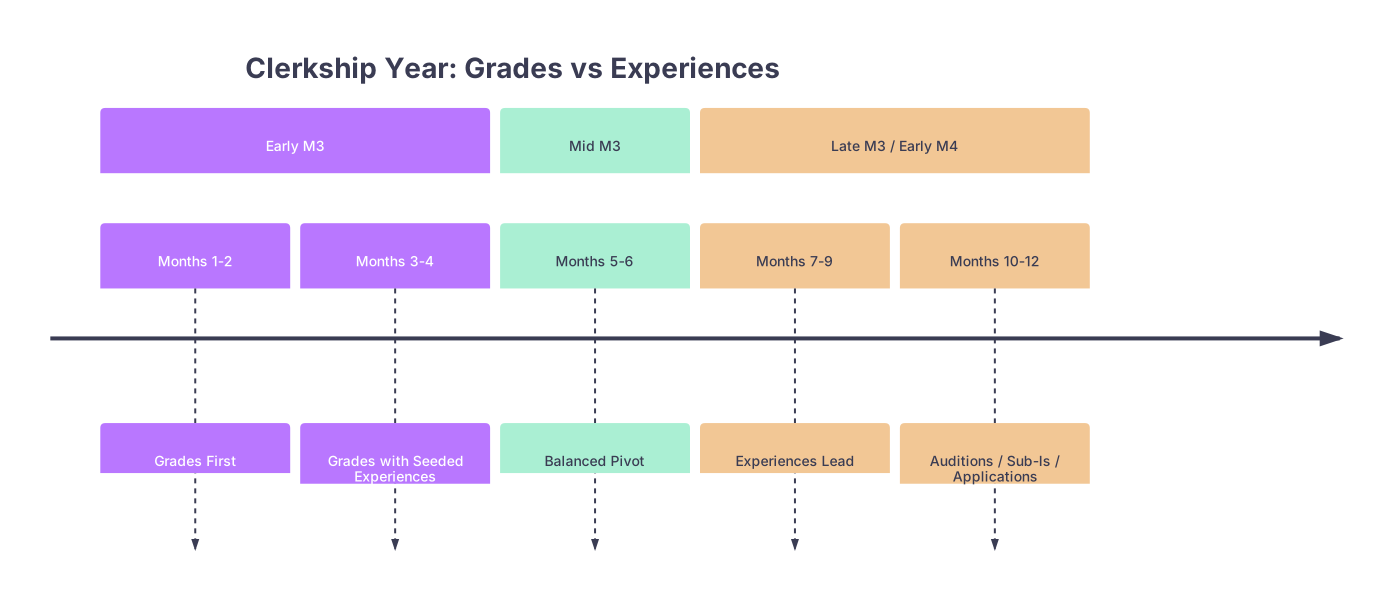
| Period | Event |
|---|---|
| title Clerkship Year | Grades vs Experiences |
| Early M3 - Months 1-2 | Grades First |
| Early M3 - Months 3-4 | Grades with Seeded Experiences |
| Mid M3 - Months 5-6 | Balanced Pivot |
| Late M3 / Early M4 - Months 7-9 | Experiences Lead |
| Late M3 / Early M4 - Months 10-12 | Auditions / Sub-Is / Applications |
At This Point You Should:
Secure concrete outputs from your experiences. Programs do not reward vague “I was interested in quality improvement” statements.
You want:
- A poster accepted (local or national—local is fine).
- A QI project with:
- A before/after metric
- A timeline
- Your role clearly defined
- A small education project:
- Creating a teaching module for junior students
- Running a case-based session with faculty support
Use your remaining clerkships to reinforce your chosen field. Example patterns:
- Future internist:
- Crush inpatient IM if still pending.
- Seek electives in cardiology, heme/onc, hospital medicine.
- Future EM doc:
- Extra EM shifts or electives.
- ICU rotation with clear EM relevance.
- Future surgeon:
- Another surgical subspecialty.
- SICU exposure.
Grades still matter—no fails, no professionalism flags—but the main question becomes: “Does your schedule and experience set make sense for someone applying to X?”
- Future internist:
Do targeted networking, not random “mentoring.” You are short on time. So:
Identify 2–3 faculty in your chosen field who:
- Know you personally
- Have seen you work clinically or on a project
- Could plausibly advocate for you during rank meetings
With each, you should:
- Meet at least once with an explicit purpose: “I’m planning to apply in EM. Here is what I have done, here is my current CV. What am I missing from the perspective of a PD or selection committee member?”
Start building the skeleton of your ERAS content. Yes, months 7–9 of M3. Not two weeks before ERAS opens.
- Keep a running document with:
- 5–7 meaningful experiences
- 3–5 impactful patient stories
- 2–3 conflict / failure / growth stories
These will feed your:
- Personal statement
- ERAS activity descriptions
- Interview answers
- Keep a running document with:
Early M4 (Months 10–12): Auditions, Sub-Is, and Application Lock-In
Now the switch has flipped. Grades are binary: do not mess up. Experiences and performance in your chosen specialty are everything.
Focus split: Experiences 80–90%, Grades as “do no harm”

At This Point You Should:
Treat every Sub-I / audition like a month-long interview. Priorities:
- Reliability > genius.
- Team fit > showing off esoteric knowledge.
- Work ethic and humility > calling consults solo at 2 am.
Programs will forgive a slightly lower Step 2 or a couple of High Passes. They will not forgive a reputation as:
- Lazy
- Difficult to work with
- Unreliable
Convert your experiences into application-ready stories. For each major experience, ask:
- What was the problem?
- What specifically did I do?
- What changed because of that action?
- What did I learn that will matter as a resident?
If you cannot answer those questions, the experience is not “ready” for ERAS or interviews yet.
Finalize letters and specialty alignment. By now you should:
- Have 2–3 letters from your chosen specialty.
- Have at least 1 strong general letter (IM, Surgery, etc.).
- Ensure your MSPE will show:
- No professionalism concerns
- A pattern of at least solid performance, ideally with clear strengths in relevant rotations
Use any remaining rotation bandwidth smartly:
- If you are strong academically and secure in your field:
- Consider something that builds breadth: palliative care, ethics consult, systems-based rotation.
- If your record is slightly shaky:
- Choose rotations where you can work closely with attendings who might advocate for you, even if not in your specialty.
- If you are strong academically and secure in your field:
How Programs Actually Weigh This Stuff
You need to think like a PD reading your file for 3–6 minutes.
They see:
- Transcript: pattern of Honors/HP/Pass; any glaring weak spots
- MSPE comments: professionalism, work ethic, “joy to work with” vs “quiet, reserved”
- Letters: concrete praise vs generic fluff
- Experiences: do they fit the specialty and show initiative or just checkbox items?
- Board scores: threshold issues more than tie-breakers (varies by field)
At that point your clerkship grades function mostly as:
- Gatekeepers early: keep you off “auto-screen-out” piles
- Pattern signals mid: confirm reliability and consistency
- Background context late: unless there is a red flag or a conspicuous upward trend
Experiences, on the other hand, function as:
- Differentiators: why you over another applicant with similar numbers
- Fit evidence: why you belong in this specialty and will not be miserable
- Character x-ray: whether you actually show up for things that matter beyond exams
So you time your investments accordingly.
Quick Month-By-Month Snapshot
Use this as your rough compass:
| Month of M3/M4 | Primary Focus | Grades vs Experiences |
|---|---|---|
| 1 | Core rotation performance | 80% Grades / 20% Experiences |
| 2 | Core rotation + shelf exams | 75% Grades / 25% Experiences |
| 3 | Strong evals + first mentors | 65% Grades / 35% Experiences |
| 4 | Letters + selective projects | 60% Grades / 40% Experiences |
| 5 | Clarify specialty lean | 50% Grades / 50% Experiences |
| 6 | Projects, posters, deeper work | 45% Grades / 55% Experiences |
| 7 | Solidify narrative in chosen field | 40% Grades / 60% Experiences |
| 8 | Advanced electives / networking | 35% Grades / 65% Experiences |
| 9–12 (early M4) | Sub-Is, auditions, ERAS prep | 20% Grades / 80% Experiences |
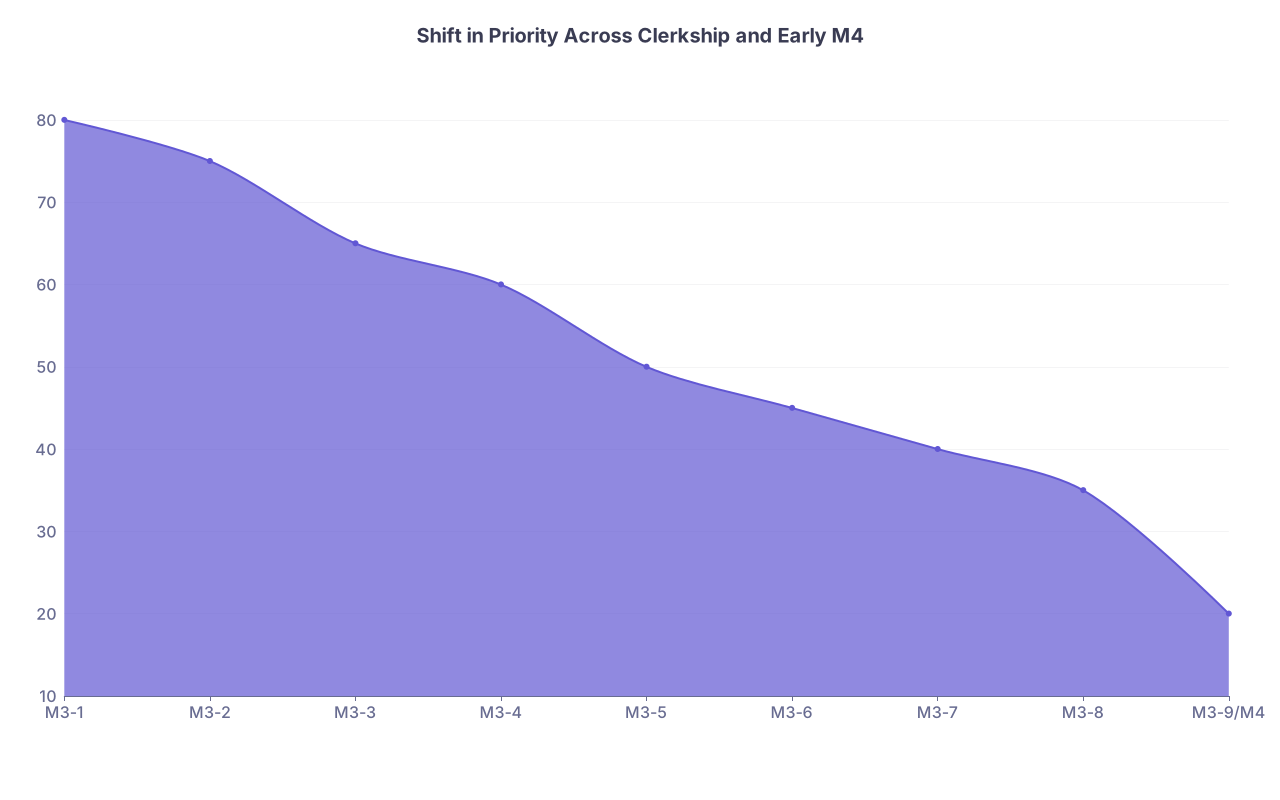
| Category | Value |
|---|---|
| M3-1 | 80 |
| M3-2 | 75 |
| M3-3 | 65 |
| M3-4 | 60 |
| M3-5 | 50 |
| M3-6 | 45 |
| M3-7 | 40 |
| M3-8 | 35 |
| M3-9/M4 | 20 |
(The remaining percentage each month is your experience focus.)
The Three Things To Remember
Front-load grades, back-load experiences.
Early M3 is for proving you can do the work. Late M3 and early M4 are for proving you belong in a specific field.Use each rotation deliberately.
Some are for GPA and evaluations. Some are for letters. Some are for projects and specialty depth. Do not treat them all the same.Aim for a coherent story, not perfection.
A few Honors, solid passes, a couple of meaningful projects, and clear specialty-aligned experiences beat a transcript of straight Honors with nothing interesting to talk about on interview day.