
The belief that you can “fix” a weak residency application in the last 2–3 months before ERAS opens is a fantasy. You transform a borderline application over 12 disciplined months, not 12 frantic weeks.
I am going to walk you month-by-month through that year.
This is for the student or grad who is:
- Average or below-average Step/COMLEX
- Light on research
- Weak or generic letters
- Few leadership or meaningful extracurriculars
- Maybe an attempt at a competitive specialty that is now clearly unrealistic
If that is you, this 12‑month roadmap is how you claw your way into a strong, realistic application.
Big Picture: Your 12-Month Turnaround At a Glance
You have three jobs over the coming year:
Fix the objective metrics you still can.
Step 2 / COMLEX 2, clinical performance, any remaining coursework.Manufacture real, recent strength.
Research, meaningful clinical work, targeted letters, and a clear narrative.Package and time everything for maximum impact.
Specialty choice, school list, ERAS, interview strategy.
Here is the high-level structure:
| Phase | Months | Primary Focus |
|---|---|---|
| Reset & Reality Check | 12–10 months out | Honest assessment, specialty decision, core plan |
| Build & Repair | 10–6 months out | Step 2, research, letters, targeted experiences |
| Convert to Application Strength | 6–3 months out | ERAS materials, networking, away rotations if applicable |
| Execute & Adapt | 3–0 months out | Final polishing, application submission, interviews |
Months 12–10 Out: Brutally Honest Assessment and Course Correction
At this point you should stop guessing and get an unsentimental evaluation of where you actually stand.
Week 1–2 (Month 12): Reality Check
You sit down with:
- A trusted faculty advisor (ideally PD or APD in your realistic specialty)
- Your dean’s office / career advisor
- If available, a recent grad who matched in your target specialty and tier
Bring:
- Step/COMLEX scores (and failures, if any)
- Clerkship grades and narrative comments
- Research and publications list
- CV and any prior personal statement
- List of specialties you are considering
Ask direct, uncomfortable questions:
- “Given this exact file, where would you expect me to match if I applied this year?”
- “What specialties are clearly out of reach, borderline, or reasonable?”
- “What must change in the next year for me to be competitive?”
You are looking for:
- Green lights
- Yellow lights with conditions
- Hard red lights
If you hear vague reassurance instead of specific strategy, find a different advisor.
Week 3–4 (Month 12): Decide on Specialty and Strategy
This is where many borderline applicants self-destruct. They cling to a fantasy specialty and spread themselves too thin.
By the end of Month 12 you should have:
- Primary specialty: realistic, aligned with your profile
(FM, IM, Peds, Psych, Neuro, Path, etc. depending on scores and grades) - Backup plan: within reason
(Ex: IM → prelim year + reapply, or broaden program list; not “Derm then maybe Ortho”) - Geographic strategy: home region, states with more programs, less competitive regions
If you are still dead set on a competitive field (Derm, Ortho, ENT, Plastics, etc.) with borderline metrics, you must:
- Accept a very high chance of not matching, and
- Build a fully viable backup pathway in parallel
Month 11: Build Your Core Turnaround Plan
At this point you should have a written 12‑month plan that covers:
-
- If Step 1/Level 1 is weak or fail → Step 2 must be early enough to appear on ERAS and be strong.
- Target: Test date between 6–3 months before ERAS opens, depending on how much remediation you need.
Research and scholarly work
- Identify 1–2 research mentors now.
- Choose projects that are feasible to complete or at least submit in 6–9 months.
- Case reports, retrospective chart reviews, QI projects are realistic.
Clinical relationships for letters
- Map which rotations and which attendings you want letters from.
- If you already burned bridges on core rotations, you need to create new clinical opportunities (electives, sub-Is, volunteer clinics).
Fix obvious red flags
- Professionalism issues, gaps in training, poor communication.
- Get documented improvement: committee work, consistent clinic volunteering, teaching roles.
Months 10–8 Out: Step 2 / COMLEX 2 and Credible Productivity
At this point you should be executing, not planning.
Month 10: Lock in Exam and Project Timelines
You choose:
- Exam date window (based on your baseline and schedule)
- Specific:
- Research projects
- QI initiatives
- Teaching roles
- Longitudinal clinic or volunteer commitments
Block your calendar:
- 8–10 weeks of serious Step 2/Level 2 prep
- Weekly protected time for research (minimum 4–6 hours)
- Consistent clinical or volunteering (e.g., one evening clinic per week)
Months 10–9: Step 2 / Level 2 Prep (Phase 1)
If your Step 1 was weak, Step 2 is your redemption arc. Programs watch this.
At this point you should:
- Take a diagnostic NBME or COMSAE very early.
- Build a weekly schedule:
- Weekdays: 40–60 practice questions/day (UWorld or equivalent)
- Weekends: 1 mini-block + targeted review
- Track:
- Percent correct by system
- Timing issues
- Repeated weak topics
Your goal:
- Move your predicted score out of the danger zone.
That might mean 220→240 for Step 2, or equivalent for Level 2.
I have seen that change the whole conversation about an otherwise borderline candidate.
Month 9–8: Research Productivity and Early Wins
You cannot make up for 4 years of zero research in 3 months. In 9–10 months? You can at least look serious.
At this point you should:
- Have at least one project where you:
- Know the exact role you play
- Have weekly or biweekly check-ins with the PI
- Have a realistic finishing path: abstract → submission → poster
Aim for:
- Case report(s) with specific patients you have actually seen
- Retrospective chart reviews where you help with data collection and basic analysis
- QI work with measurable outcomes (clinic no-show rates, discharge instruction compliance, etc.)
Deliverables you want by Month 6–7:
- Abstracts submitted or accepted
- Poster presentation(s) scheduled or completed
- A draft manuscript in progress, even if not accepted yet
Months 8–6 Out: Letters, Clinical Strength, and Narrative
This is where you start turning scattered work into a coherent story.
Month 8: Targeted Clinical Rotations
At this point you should be scheduling (or already on):
- Sub-internships / acting internships in your chosen specialty
- Electives where attendings actually see you work closely
- If you are an IMG or non-traditional: U.S. rotations that generate strong, recent letters
Your job on these rotations:
- Show up obnoxiously prepared
- Ask for mid-rotation feedback and fix issues quickly
- Make it obvious you care about the team, not just your eval
You are auditioning for letters, not just grades.
Month 7: Lock Down Your Letter Strategy
You need 3–4 letters that do real work. Not “hardworking, pleasant, will be a good resident” fluff.
Ideal mix:
- 2 letters from your chosen specialty (one from a sub-I if possible)
- 1 from a core rotation where you clearly improved or excelled
- 1 from research or a longitudinal mentor (optional but helpful for borderline applicants who need someone to vouch for their growth)
At this point you should:
- Identify exactly which attendings you will ask.
- Ask early, in person if possible:
- “Dr. X, would you feel comfortable writing a strong letter of recommendation for my application in [specialty]?”
- Provide:
- CV
- Draft personal statement (even an early one)
- Short bullet list: specific cases or moments that highlight your strengths
If they hesitate or hedge, thank them and do not rely on that letter.
Months 6–4 Out: Turning Work into Application Content
This is where a borderline application either becomes compelling or stays generic.
Month 6: Personal Statement and Story Drafting
At this point you should have:
- Enough clinical experience in your chosen field to know why you belong there.
- At least one research or QI project in progress.
- Clear understanding of your weaknesses and how you have addressed them.
Your personal statement for a borderline application is not a literary masterpiece. It is a surgical argument:
- Here is what I am like on teams.
- Here is how I responded when things went poorly (exams, rotations, life).
- Here is why [specialty] fits both my skills and my track record.
- Here is specific evidence (patients, projects, mentors) that supports that.
You do not:
- Rehash your CV in prose
- Over-explain every weakness
- Pretend your record is flawless
You do:
- Acknowledge major red flags in 1–2 sentences max if not explained elsewhere.
- Emphasize recent, sustained improvement.
Month 5: ERAS Activities and CV – Precision Work
Weak applications die in the ERAS activities section. Lazy, copy-paste bullets. No outcomes. No specifics.
At this point you should:
- List every activity in rough form
- For each entry, write:
- What you actually did
- What changed because you were there (numbers or specific outcomes whenever possible)
- 1 concrete example or result
Example transformation:
Bad:
- “Volunteered at student-run clinic. Provided care to underserved populations.”
Improved:
- “Led intake team at student-run clinic serving ~40 patients/month; implemented new triage checklist that reduced missed medication reconciliation errors by 30% over 3 months.”
You want:
- 2–4 “anchor” experiences that tell your story:
- Longitudinal clinic
- Major research/QI project
- Leadership or teaching role
- Sub-I where you took real responsibility
Month 4: Program List Strategy and Specialty Scope
At this point you should stop pretending every program is in play.
You build a program list that matches your profile:
- Community vs academic mix
- Geographic spread, weighted to where you have ties
- DO-friendly/IMG-friendly programs if applicable
- Backup specialty or prelim options if appropriate
You want volume and realism:
- Borderline applicants often need:
- IM/FM/Peds/Psych: 40–80 programs
- More competitive but still realistic fields: 60+ programs
- If you have failures or are an IMG: sometimes 80–100+
This is not about optimism. It is about probabilities.
Months 3–1 Out: Final Polishing and Early Networking
This is the period where disciplined applicants separate from last‑minute scramblers.
Month 3: Finalize Exam, Letters, and ERAS Skeleton
At this point you should have:
- Step 2 / Level 2 score back or pending with test taken
- Letter writers confirmed and given materials
- Personal statement at v2 or v3 with targeted edits
- Activities section close to final, with strong lead bullets
You also:
- Start tracking programs and contacts in a simple spreadsheet:
- Program name
- Location
- Notes on fit (ties, faculty, rotations)
- Any email or in-person contact made
Month 2: Quiet, Strategic Outreach
You are not spamming PDs. That does not work.
You are:
- Emailing specific faculty who actually know you:
- “I am applying in [specialty] this cycle and very interested in [Program] due to [specific reasons]. If you feel comfortable doing so, I would be grateful if you could mention my name to colleagues there.”
- Attending virtual open houses or webinars:
- Ask 1–2 thoughtful questions that show you did your homework.
- If you did an away or had visiting faculty:
- A brief, professional email updating them on your application and interest.
This is subtle context-building, not a marketing campaign.
Month 1: ERAS Finalization and Submission Strategy
At this point you should:
- Have no major changes left. This is polish, not overhaul.
- Do a final pass on:
- Spelling and grammar
- Consistency of dates and roles
- Clarity of explanations around any leaves, failures, or gaps
You submit:
- As early in the opening window as reasonably possible
- With Step 2 score included if it is your redeeming feature
- With program list already built; no last‑minute “I guess I will throw in Derm too”
Post-Submission (0–3 Months After): Interviews and Damage Control
You are not done when you click submit. Borderline applicants cannot coast.
Week 1–4 After Submission: Interview Readiness
At this point you should:
- Have mock interviews with:
- A faculty member or dean
- A peer who will be brutally honest
- Prepare for predictable questions:
- “Tell me about a time you failed.”
- “Why this specialty given [weak score, red flag, etc.]?”
- “What have you done to address [specific concern in your file]?”
Your answers:
- Own the problem
- Describe concrete actions you took
- Show a pattern of reliable, recent behavior
Months 1–3 After Submission: Uphold Your Story
As invites come in (and they will, if you did the work), your job is to match the written file:
You:
- Talk about your research with real detail (because you actually did it)
- Recall specific patients from your clinic or sub-I who shaped you
- Frame weaknesses as turning points, not excuses
If interviews are slow:
- A small number of targeted update letters can help:
- New publication
- Poster presentation
- Award
- Major Step 2 improvement
Not weekly “checking in” emails. Actual updates.
Visualizing the 12-Month Plan
Here is what your turnaround year roughly looks like:
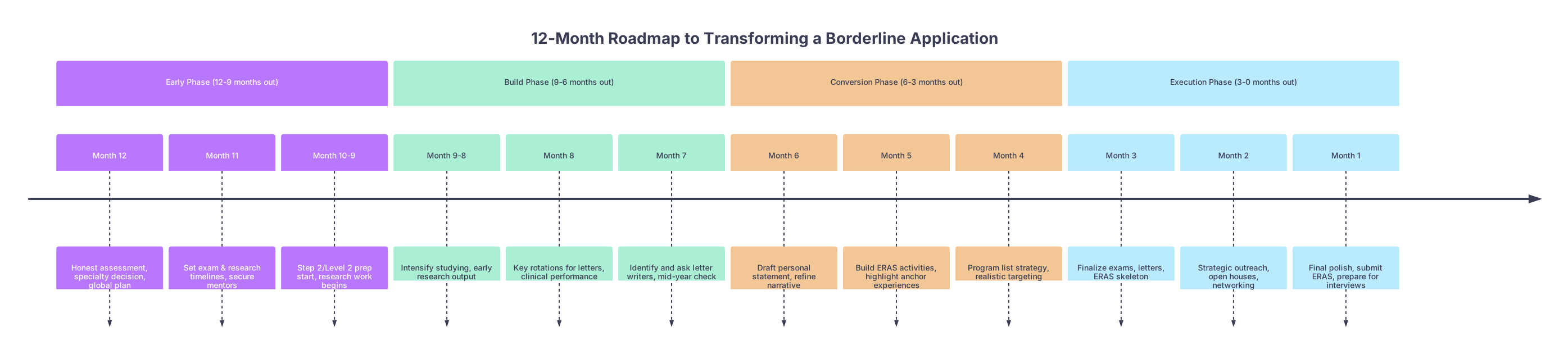
| Period | Event |
|---|---|
| Early Phase (12-9 months out) - Month 12 | Honest assessment, specialty decision, global plan |
| Early Phase (12-9 months out) - Month 11 | Set exam & research timelines, secure mentors |
| Early Phase (12-9 months out) - Month 10-9 | Step 2/Level 2 prep start, research work begins |
| Build Phase (9-6 months out) - Month 9-8 | Intensify studying, early research output |
| Build Phase (9-6 months out) - Month 8 | Key rotations for letters, clinical performance |
| Build Phase (9-6 months out) - Month 7 | Identify and ask letter writers, mid-year check |
| Conversion Phase (6-3 months out) - Month 6 | Draft personal statement, refine narrative |
| Conversion Phase (6-3 months out) - Month 5 | Build ERAS activities, highlight anchor experiences |
| Conversion Phase (6-3 months out) - Month 4 | Program list strategy, realistic targeting |
| Execution Phase (3-0 months out) - Month 3 | Finalize exams, letters, ERAS skeleton |
| Execution Phase (3-0 months out) - Month 2 | Strategic outreach, open houses, networking |
| Execution Phase (3-0 months out) - Month 1 | Final polish, submit ERAS, prepare for interviews |
And how your effort should roughly distribute across major domains:
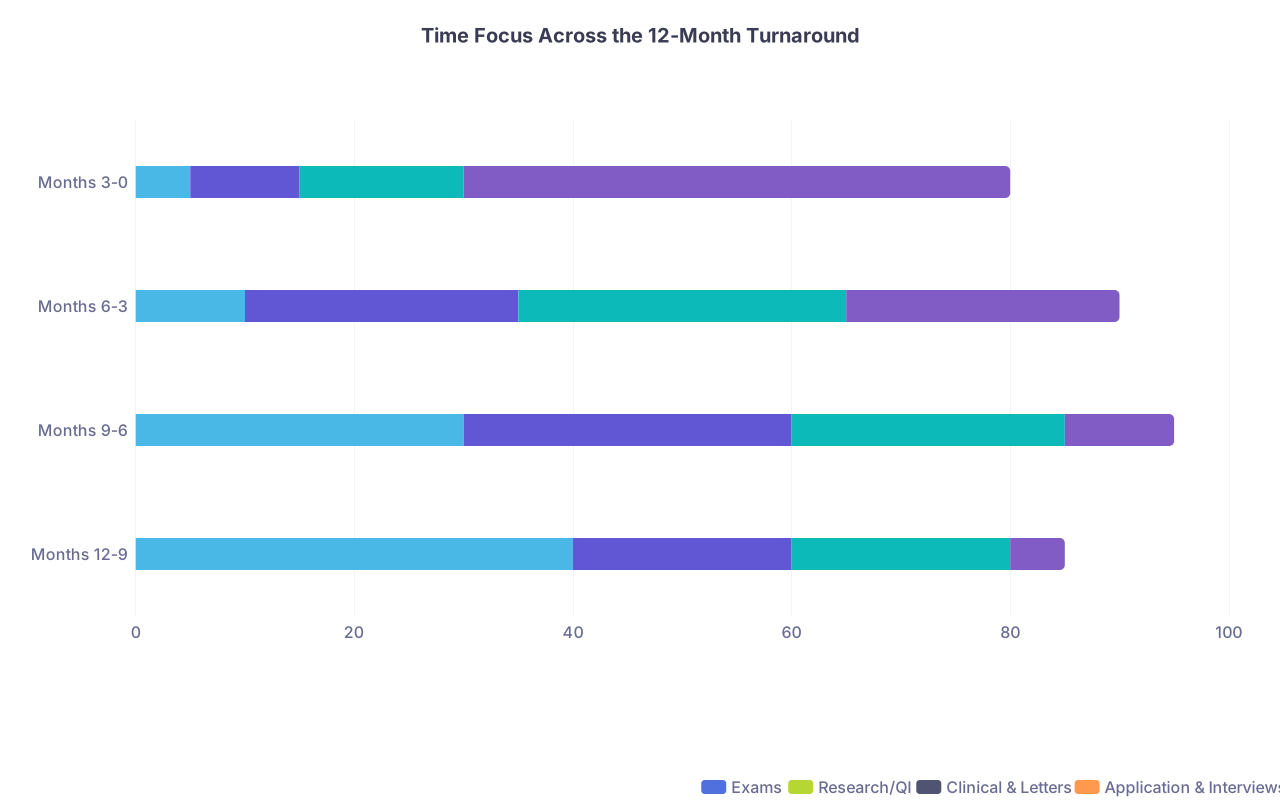
| Category | Exams | Research/QI | Clinical & Letters | Application & Interviews |
|---|---|---|---|---|
| Months 12-9 | 40 | 20 | 20 | 5 |
| Months 9-6 | 30 | 30 | 25 | 10 |
| Months 6-3 | 10 | 25 | 30 | 25 |
| Months 3-0 | 5 | 10 | 15 | 50 |
Three Things to Keep Straight
- You are not fixing your past year. You are building a new 12‑month track record that convinces programs you are now the person your early file failed to show.
- Step 2/Level 2, fresh letters, and concrete recent work (research, QI, clinic) are the three levers that move a borderline application most. Treat them like your full-time job.
- The calendar is not flexible. At each point you should be hitting specific milestones. If you are 6 months out and still “planning” your research or “thinking about” Step 2 timing, you are already behind. Adjust now, not when ERAS opens.